Specification for Freight Elevator Service
Understanding this form
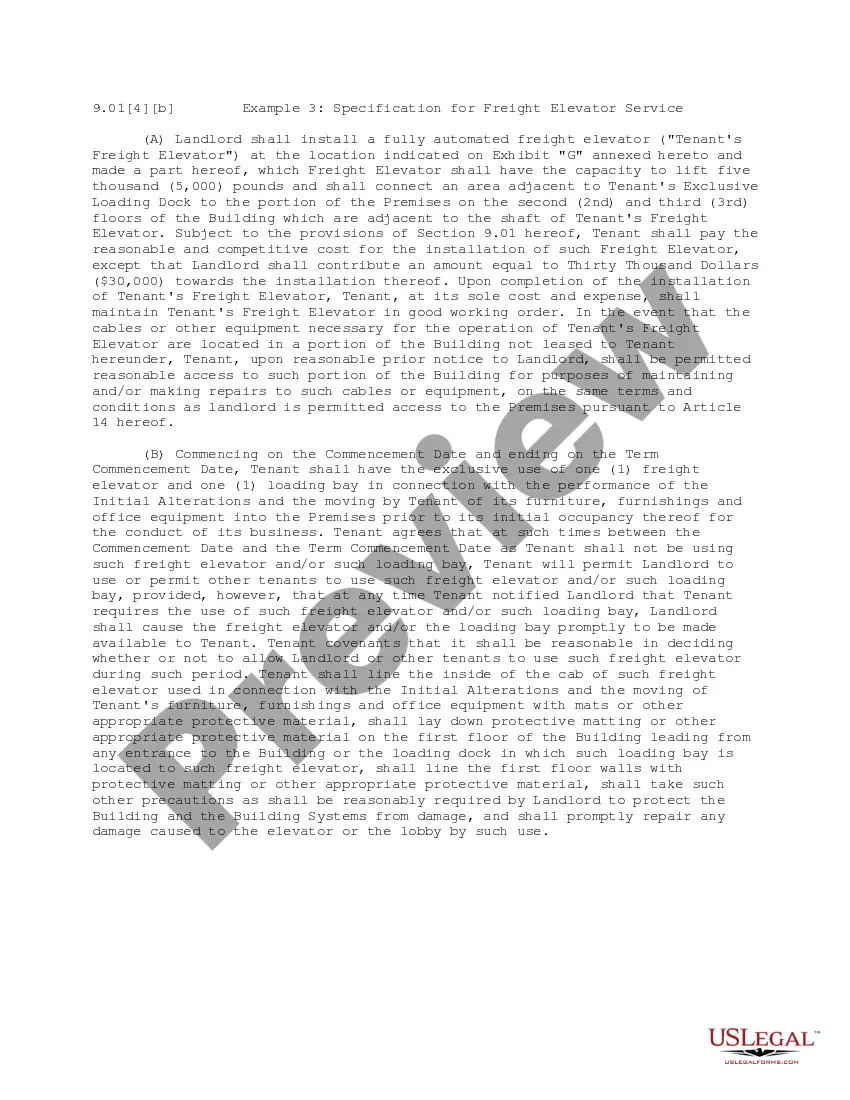
The Specification for Freight Elevator Service is a legal document used in office lease agreements. This form outlines the responsibilities of the landlord to install a freight elevator and the obligations of the tenant to maintain it. Unlike other lease forms, this document specifically addresses the installation and upkeep of a freight elevator, ensuring that the agreed-upon terms are clear to both parties.
Key components of this form
- Details regarding the installation of the freight elevator, including location and capacity.
- Financial responsibilities of both the landlord and tenant for the elevator's installation.
- Maintenance obligations of the tenant after installation.
- Conditions under which the tenant can access the elevator for maintenance.
- Exclusive use terms for the tenant regarding the freight elevator during the initial moving period.
- Requirements for protecting the building during the moving process.
When this form is needed
This form is essential when a business is leasing office space that requires a freight elevator for loading and unloading heavy equipment or supplies. It should be used during the lease negotiation phase to ensure all parties agree on the installation, maintenance responsibilities, and usage of the freight elevator, particularly in scenarios involving tenant alterations or initial moves into the premises.
Intended users of this form
- Landlords who are leasing office space with freight handling requirements.
- Tenants who need to ensure access to an efficient freight elevator for business operations.
- Commercial real estate professionals involved in drafting lease agreements.
How to prepare this document
- Identify the parties involved, including tenant and landlord details.
- Specify the location where the freight elevator will be installed as indicated in the lease.
- Detail the capacity of the freight elevator, ensuring it meets business needs.
- Clarify the financial contributions from both landlord and tenant for installation.
- Outline maintenance responsibilities and access rights related to the elevator.
- Review and sign the agreement to formalize the terms.
Is notarization required?
Notarization is not commonly needed for this form. However, certain documents or local rules may make it necessary. Our notarization service, powered by Notarize, allows you to finalize it securely online anytime, day or night.
Get your form ready online
Our built-in tools help you complete, sign, share, and store your documents in one place.
Make edits, fill in missing information, and update formatting in US Legal Forms—just like you would in MS Word.
Download a copy, print it, send it by email, or mail it via USPS—whatever works best for your next step.
Sign and collect signatures with our SignNow integration. Send to multiple recipients, set reminders, and more. Go Premium to unlock E-Sign.
If this form requires notarization, complete it online through a secure video call—no need to meet a notary in person or wait for an appointment.
We protect your documents and personal data by following strict security and privacy standards.

Make edits, fill in missing information, and update formatting in US Legal Forms—just like you would in MS Word.

Download a copy, print it, send it by email, or mail it via USPS—whatever works best for your next step.

Sign and collect signatures with our SignNow integration. Send to multiple recipients, set reminders, and more. Go Premium to unlock E-Sign.

If this form requires notarization, complete it online through a secure video call—no need to meet a notary in person or wait for an appointment.

We protect your documents and personal data by following strict security and privacy standards.
Common mistakes to avoid
- Failing to specify the location and capacity of the freight elevator.
- Not clearly stating maintenance responsibilities, leading to disputes later.
- Overlooking the need for protective measures during tenant moving activities.
Why use this form online
- Convenience of accessing the form from anywhere at any time.
- Editability allows users to customize the form to fit specific needs.
- Reliable templates drafted by licensed attorneys ensure legal compliance.
Legal use & context
- This form establishes clear terms for the installation and maintenance of a freight elevator.
- It helps prevent disputes between landlords and tenants by outlining specific responsibilities.
- Compliance with state laws regarding commercial leases is necessary for enforceability.
Summary of main points
- The Specification for Freight Elevator Service outlines the responsibilities of both landlord and tenant.
- It is crucial for commercial leases involving freight elevators and ensures clarity in usage and maintenance.
- Complete the form accurately and ensure signatures for legal validity.
Looking for another form?
Form popularity
FAQ
Freight elevators shall not be used for passenger service.
How Much Does a Freight Elevator Cost? Freight elevator units typically range from $65,000 to $75,000 depending on the elevator capacity and size and how many stories the elevator needs to travel.
What is the standard size of a home elevator? Generally, a residential elevator will be 36 inches wide by 48 inches deep; this is a nominal, clear platform size. An elevator of this size will require approximately a 48-inch wide by 60-inch deep hoistway.
The width of the elevator car is a minimum of 68 inches (1730 mm). The depth of the elevator car measured from the back wall to the elevator door is a minimum of 54 inches (1370 mm). The depth of the elevator car measured from the back wall to the control panel is a minimum of 51 inches (1291 mm).
Freight elevators are designed to move goods and materials throughout a building. Compared to passenger elevators, freight cars travel at slower speeds, can carry much heavier loads and are designed to withstand tougher working conditions.A freight elevator will usually include vertically opening doors.
How Much Does a Freight Elevator Cost? Freight elevator units typically range from $65,000 to $75,000 depending on the elevator capacity and size and how many stories the elevator needs to travel.
Commonly found throughout the country, hydraulic elevators operate with a pump moving liquid (oil based or vegetable based) under pressure into a cylinder. The cylinder contains a plunger that moves the elevator as liquid is pumped into or released from the cylinder through a valve.
Freight elevators are designed to move goods and materials throughout a building. Compared to passenger elevators, freight cars travel at slower speeds, can carry much heavier loads and are designed to withstand tougher working conditions.A freight elevator will usually include vertically opening doors.