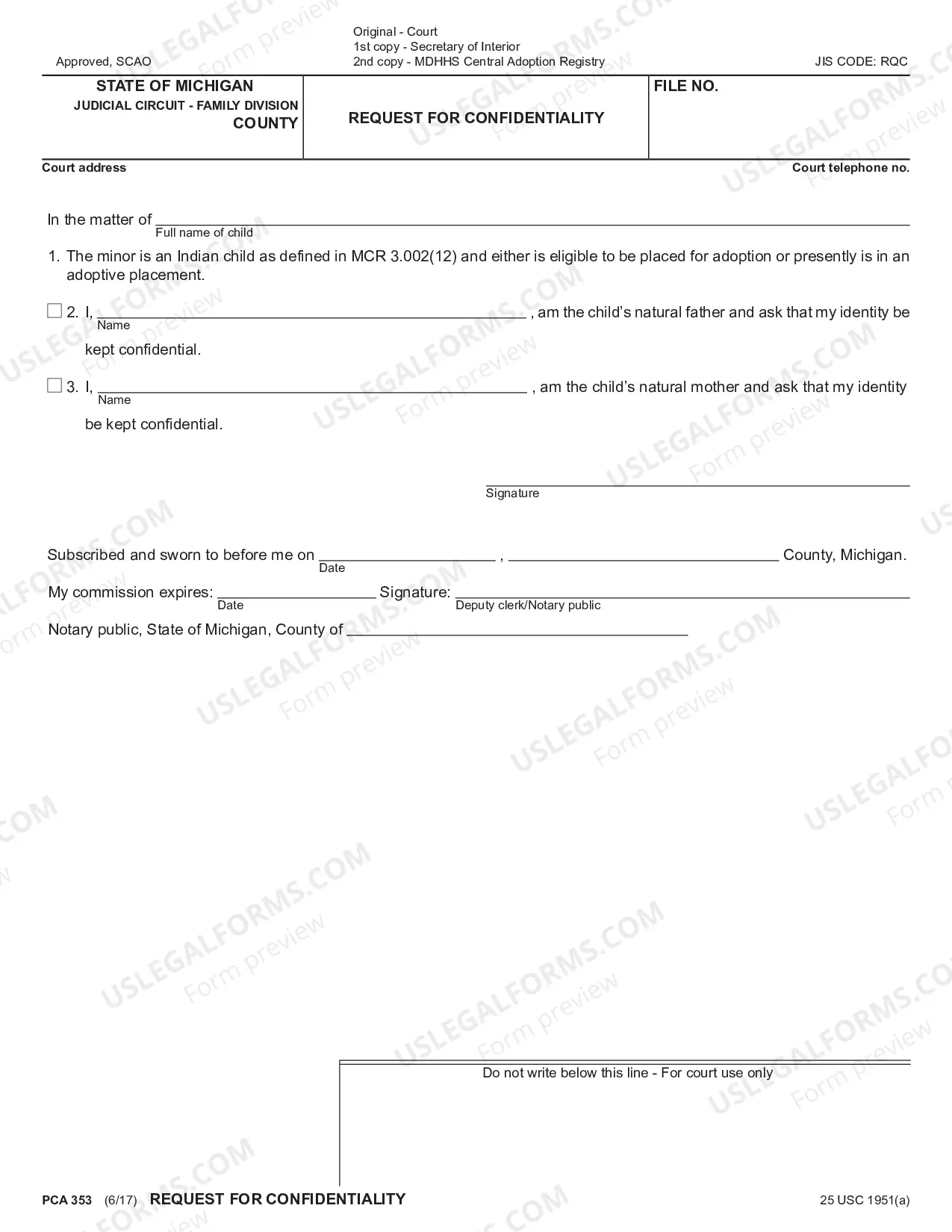
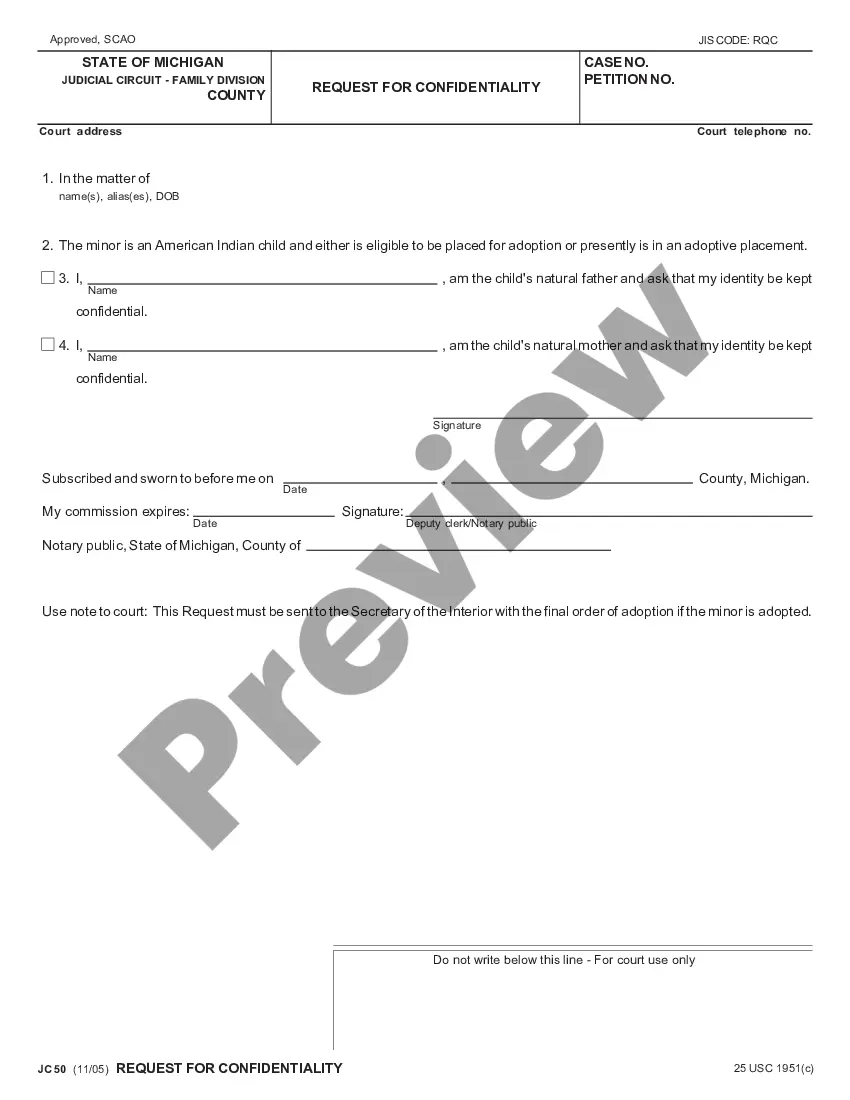
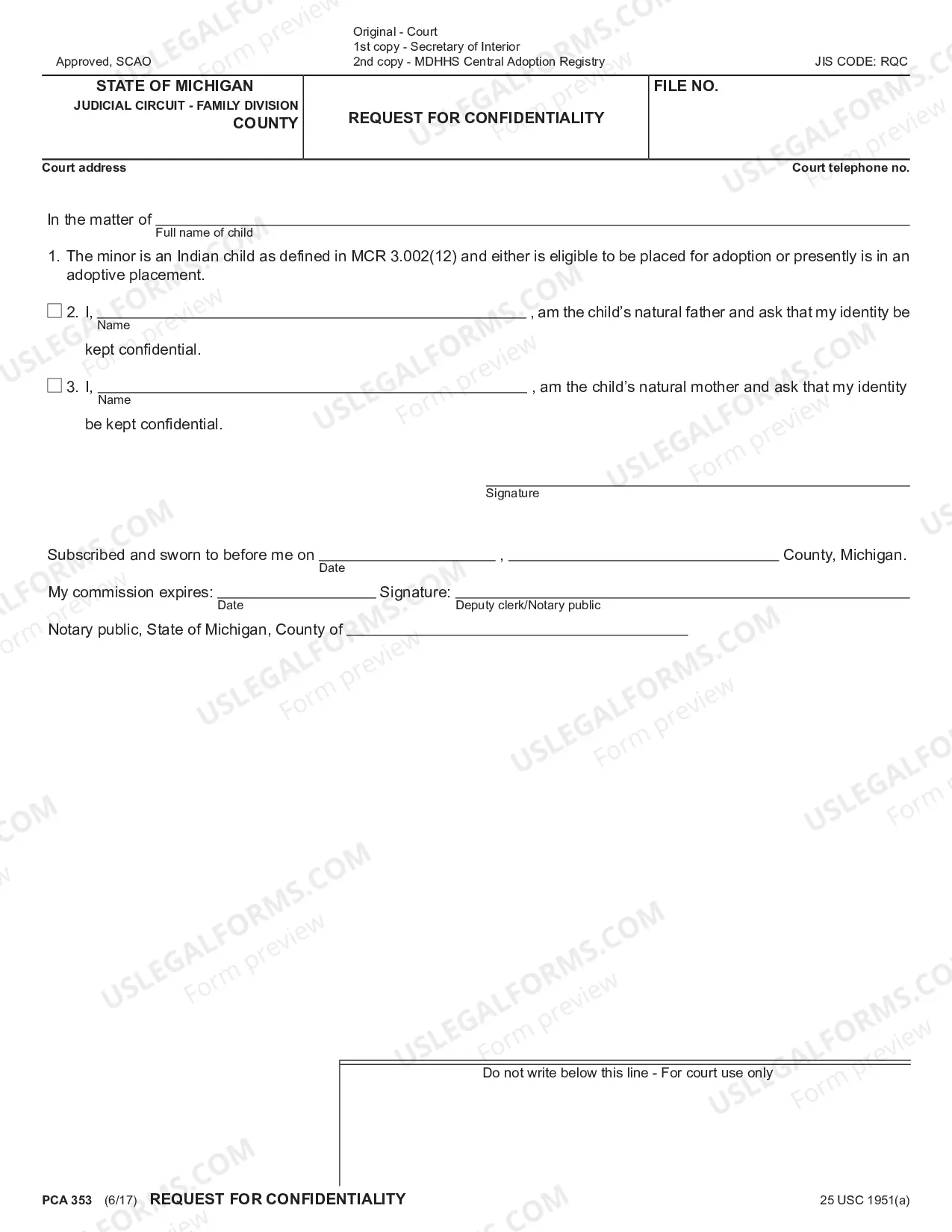
Michigan Request For Confidentiality is a legal document that allows an individual to request that their identity and personal information remain confidential when filing a legal case in Michigan. The document must be filed with the court at the same time as the legal action. This document is typically used when an individual does not want their name to be publicly associated with the action taken, or when the individual's safety or privacy is at risk. There are three types of Michigan Request For Confidentiality: Adult Request, Minor Request, and Public Body Request. The Adult Request is for individuals over the age of 18. The Minor Request is for individuals under the age of 18. The Public Body Request is for government entities, educational institutions, or other public bodies.
Michigan Request For Confidentiality
Description
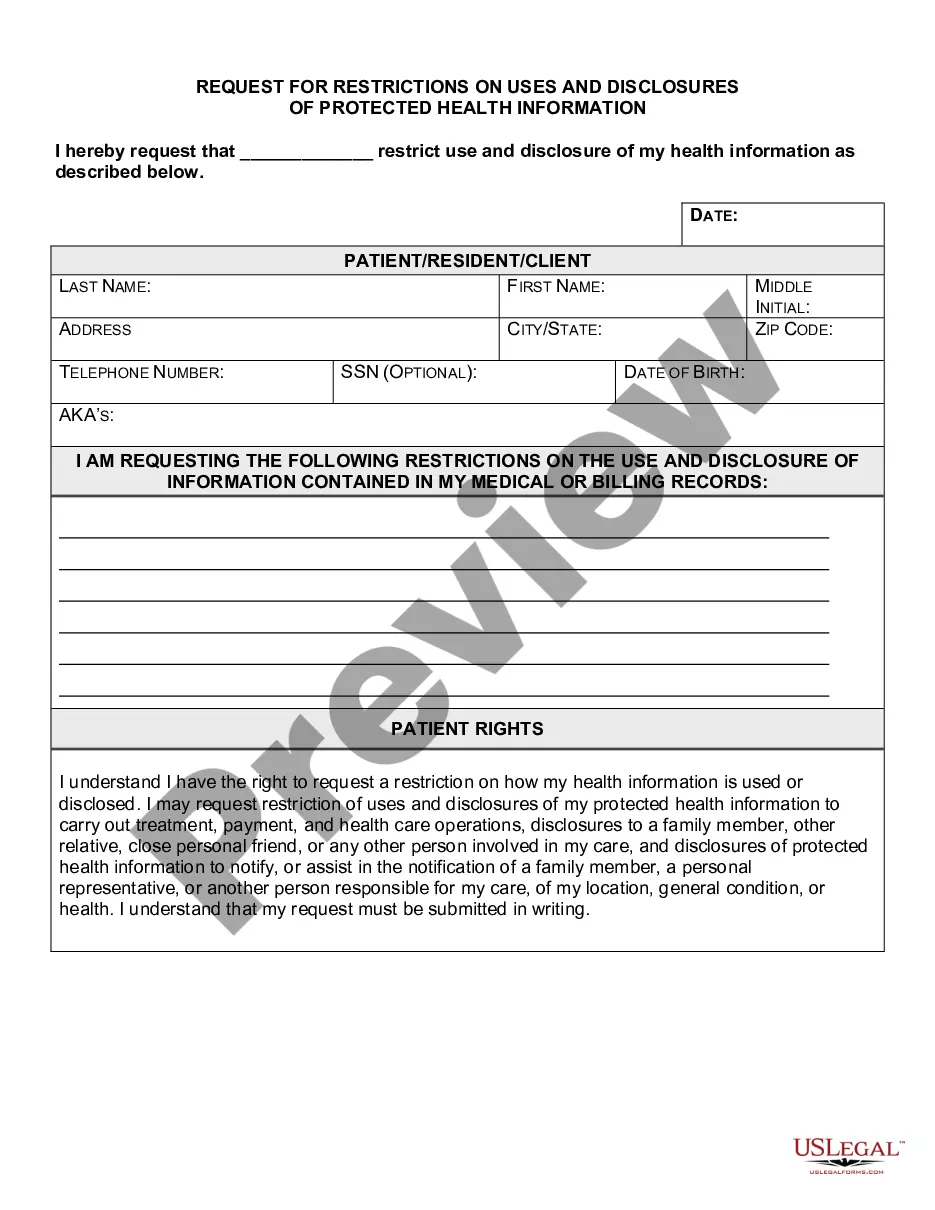
Get your form ready online
Our built-in tools help you complete, sign, share, and store your documents in one place.
Make edits, fill in missing information, and update formatting in US Legal Forms—just like you would in MS Word.
Download a copy, print it, send it by email, or mail it via USPS—whatever works best for your next step.
Sign and collect signatures with our SignNow integration. Send to multiple recipients, set reminders, and more. Go Premium to unlock E-Sign.
If this form requires notarization, complete it online through a secure video call—no need to meet a notary in person or wait for an appointment.
We protect your documents and personal data by following strict security and privacy standards.

Make edits, fill in missing information, and update formatting in US Legal Forms—just like you would in MS Word.

Download a copy, print it, send it by email, or mail it via USPS—whatever works best for your next step.

Sign and collect signatures with our SignNow integration. Send to multiple recipients, set reminders, and more. Go Premium to unlock E-Sign.

If this form requires notarization, complete it online through a secure video call—no need to meet a notary in person or wait for an appointment.

We protect your documents and personal data by following strict security and privacy standards.
Looking for another form?


How to fill out Michigan Request For Confidentiality?
Managing legal documentation necessitates focus, precision, and utilizing well-prepared templates. US Legal Forms has been assisting individuals nationwide with this for 25 years, ensuring that when you select your Michigan Request For Confidentiality form from our platform, it adheres to federal and state legislation.
Interacting with our service is simple and quick. To access the necessary documents, all you require is an account with an active subscription. Here’s a concise guide for you to acquire your Michigan Request For Confidentiality in just a few minutes.
All documents are designed for multiple uses, like the Michigan Request For Confidentiality you find on this page. If you need them again, you can fill them out without additional payment - simply access the My documents tab in your profile and complete your document whenever you need it. Experience US Legal Forms and complete your business and personal paperwork swiftly and in full legal compliance!
- Ensure to carefully review the form details and its alignment with general and legal standards by previewing it or examining its description.
- Look for an alternative official template if the one you initially opened does not correspond with your circumstances or state laws (the option for this is located at the top corner of the page).
- Log in to your account and save the Michigan Request For Confidentiality in your preferred format. If this is your first experience with our service, click Buy now to proceed.
- Create an account, select your subscription option, and settle your payment using your credit card or PayPal account.
- Select the format in which you wish to receive your document and click Download. Print the template or incorporate it into a professional PDF editor for a paper-free submission.
Form popularity
FAQ
When writing a statement of confidentiality, start by clearly stating the purpose of the confidentiality agreement. Include specific information about what data or documents need protection and identify the parties involved. Additionally, you can reference a Michigan Request For Confidentiality if the context requires legal backing for privacy concerns. To simplify this process, explore the resources provided by US Legal Forms, which can help you draft a comprehensive statement.
To request public records in Michigan, you must submit a Freedom of Information Act (FOIA) request to the appropriate government agency. Make sure to provide clear details about the records you seek, including dates and specific information. It’s important to note that if you require confidentiality, you can also include a Michigan Request For Confidentiality to protect sensitive information. For assistance, consider using the US Legal Forms platform, which offers templates and guidance for your request.
In Michigan, a therapist may break confidentiality under certain circumstances, such as when there is a risk of harm to the client or others, or if there is suspected abuse or neglect. It is essential for clients to understand these exceptions to confidentiality. Familiarizing yourself with the Michigan Request For Confidentiality can provide clarity on these important issues and help protect your rights.
In Michigan, you can request Child Protective Services (CPS) records by submitting a formal request to the Michigan Department of Health and Human Services. This request must include necessary details such as your information and the specific records you seek. Utilizing the Michigan Request For Confidentiality can help ensure that your request is handled properly and confidentially.
The Address Confidentiality Program in Michigan is designed to protect the addresses of individuals in certain situations, such as survivors of domestic violence. Participants receive a substitute address that can be used for legal documents and public records. To learn more about how to navigate this program, consider the Michigan Request For Confidentiality, which can guide you through the necessary steps.
In Michigan, the confidentiality code for mental health is governed by the Mental Health Code, which protects patient information. This code ensures that any details shared during therapy remain private unless the patient provides consent or specific legal exceptions apply. Understanding the Michigan Request For Confidentiality can help individuals safeguard their mental health records effectively.
An example of a confidentiality statement could be, 'This document contains confidential information and is intended solely for the use of individuals authorized by the sender.' Such statements are crucial in legal and business communications. When drafting your Michigan Request For Confidentiality, including a clear statement can help safeguard sensitive data.
A confidential statement can include phrases such as, 'This information is confidential and intended only for the recipient.' It should clearly define the information that is protected and the consequences of unauthorized disclosure. Utilizing a proper format can enhance your Michigan Request For Confidentiality.
To create a confidentiality statement, clearly state the purpose and scope of the confidentiality. Specify the information you wish to protect, and outline who is authorized to access it. Consider using a template or guidance from platforms like USLegalForms to ensure your Michigan Request For Confidentiality is properly formatted.
Under the Freedom of Information Act (FOIA), certain records are exempt from disclosure. This includes personal information that could invade someone's privacy, law enforcement records that could compromise investigations, and trade secrets, among others. It's important to understand these limitations when making a Michigan Request For Confidentiality.