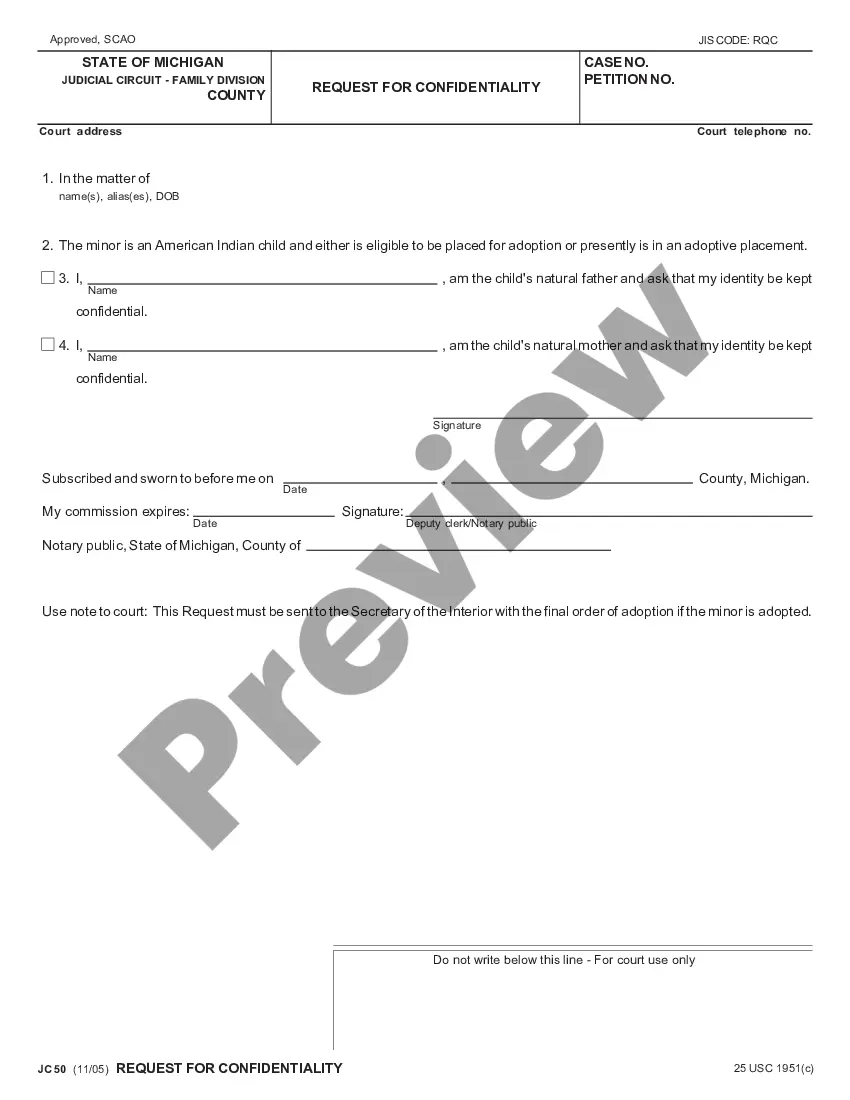
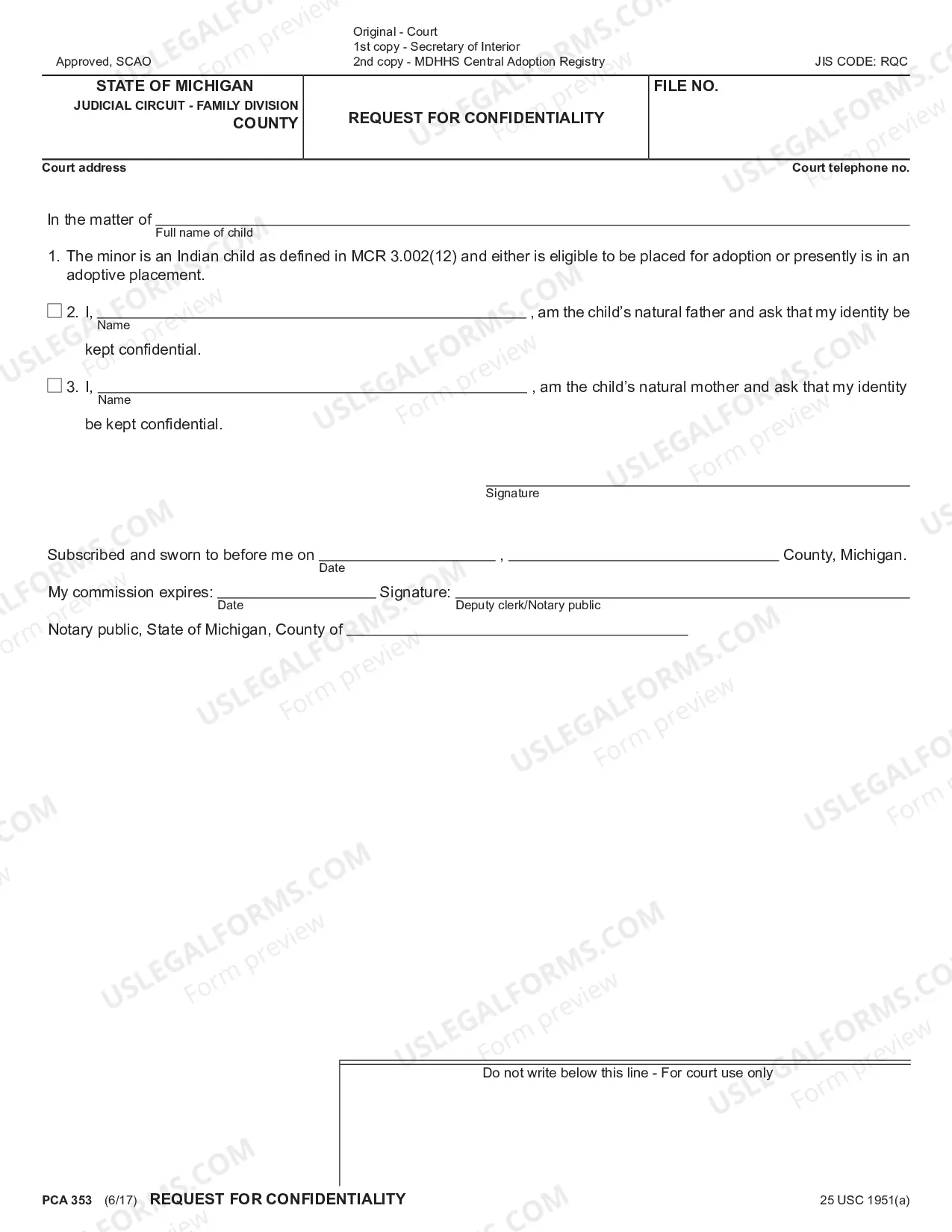
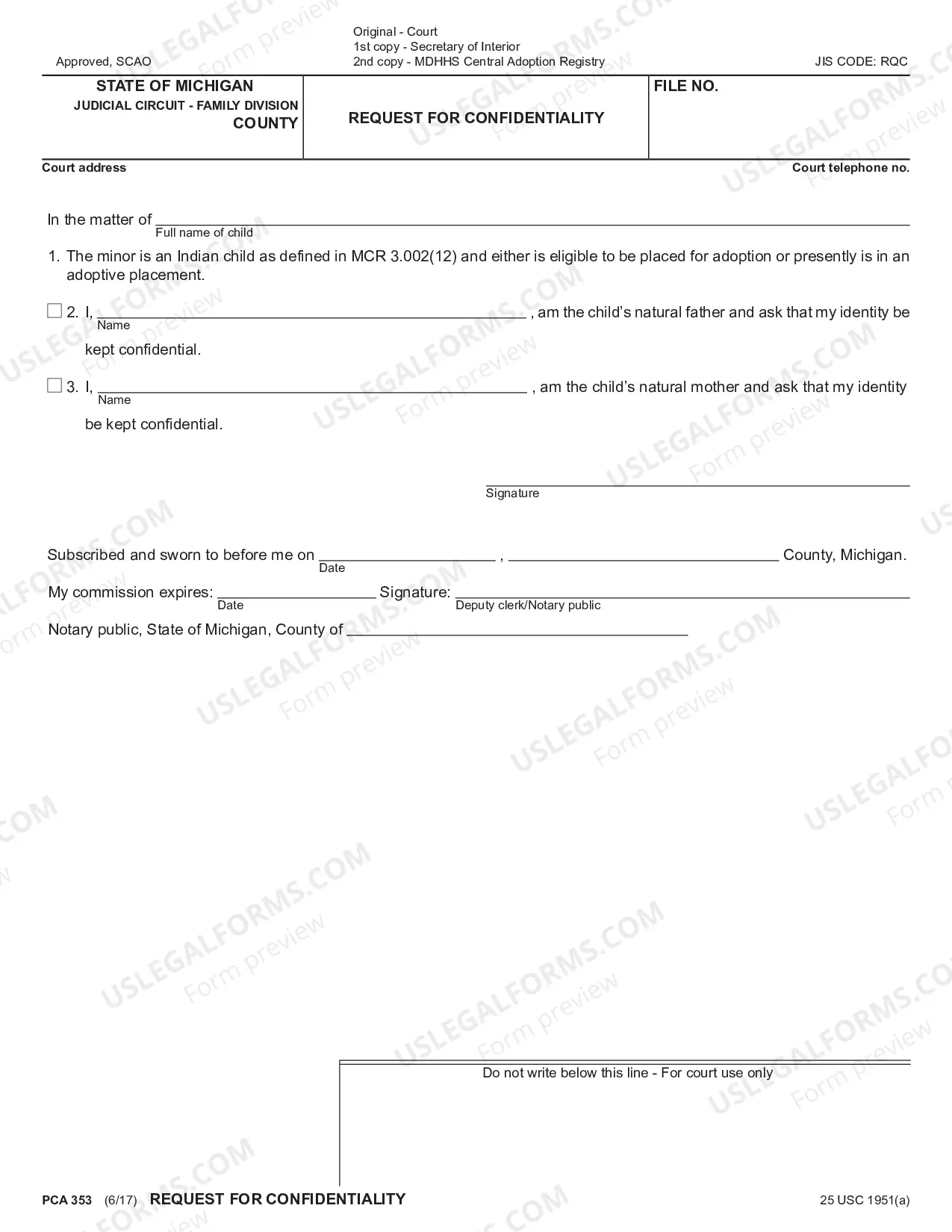
This Request for Confidentiality is an official document from the Michigan State Court Administration Office, and it complies with all applicable state and Federal codes and statutes. USLF updates all state and Federal forms as is required by state and Federal statutes and law.
Michigan Request for Confidentiality
Instant download
This website is not affiliated with any governmental entity
Public form
Description
Get your form ready online
Our built-in tools help you complete, sign, share, and store your documents in one place.
Built-in online Word editor
Make edits, fill in missing information, and update formatting in US Legal Forms—just like you would in MS Word.
Export easily
Download a copy, print it, send it by email, or mail it via USPS—whatever works best for your next step.
E-sign your document
Sign and collect signatures with our SignNow integration. Send to multiple recipients, set reminders, and more. Go Premium to unlock E-Sign.
Notarize online 24/7
If this form requires notarization, complete it online through a secure video call—no need to meet a notary in person or wait for an appointment.
Store your document securely
We protect your documents and personal data by following strict security and privacy standards.

Make edits, fill in missing information, and update formatting in US Legal Forms—just like you would in MS Word.

Download a copy, print it, send it by email, or mail it via USPS—whatever works best for your next step.

Sign and collect signatures with our SignNow integration. Send to multiple recipients, set reminders, and more. Go Premium to unlock E-Sign.

If this form requires notarization, complete it online through a secure video call—no need to meet a notary in person or wait for an appointment.

We protect your documents and personal data by following strict security and privacy standards.
Looking for another form?



How to fill out Michigan Request For Confidentiality?
Obtain any variation from 85,000 legal documents such as Michigan Request for Confidentiality online with US Legal Forms. Each template is composed and refreshed by state-certified legal experts.
If you possess a subscription, Log In. Once you are on the form’s page, click on the Download button and navigate to My documents to gain access to it.
If you haven’t subscribed yet, follow the instructions below: Check the state-specific prerequisites for the Michigan Request for Confidentiality you need to utilize. Review the description and preview the sample. When you’re certain the sample is what you require, click Buy Now. Choose a subscription plan that truly fits your budget. Create a personal account. Make a payment in one of two suitable methods: by credit card or through PayPal. Select a format to download the document in; two options are provided (PDF or Word). Download the document to the My documents section. When your reusable form is prepared, print it out or save it to your device.
- With US Legal Forms, you will consistently have immediate access to the appropriate downloadable template.
- The service grants you access to documents and categorizes them to streamline your search.
- Utilize US Legal Forms to acquire your Michigan Request for Confidentiality swiftly and effortlessly.
Form popularity
FAQ
Writing a statement of confidentiality involves clearly outlining the terms under which information will be kept confidential. Begin by stating the purpose of the confidentiality, then detail what information is considered confidential, and under which circumstances it can be shared. For those in legal or sensitive professional fields, ensuring that the statement adheres to the Michigan Request for Confidentiality guidelines is crucial. Resources like uslegalforms can help you draft a proper statement to protect your interests.
The Address Confidentiality Program (ACP) in Michigan aims to protect the addresses of individuals in certain situations, such as survivors of domestic violence. Participants in the program are provided with a substitute address that can be used for legal purposes. This helps maintain the safety and privacy of individuals while allowing them access to services. To enroll, you can visit the Michigan Department of State website for more details.
In Michigan, a therapist may break confidentiality under certain circumstances. If a client poses an imminent risk of harm to themselves or others, therapists are required to report this information. Additionally, if there is suspected child abuse or neglect, a therapist must report this as well. Understanding these exceptions helps individuals navigate the sensitive aspects of confidentiality in therapy.
To request public records in Michigan, you must submit a Freedom of Information Act (FOIA) request to the appropriate government agency. This request should clearly describe the records you seek to obtain. Remember, it's essential to provide your contact information to receive a response. Additionally, checking the agency's website for specific guidelines can enhance your chances of a successful request.
A confidentiality request, specifically in Michigan, allows individuals to keep certain personal information private in legal documents. This process protects sensitive data from public view, ensuring your address and other details remain confidential. By submitting a Michigan Request for Confidentiality, you can secure your privacy, especially if you have experienced domestic violence or similar situations. For assistance with this process, you can rely on USLegalForms to guide you through the necessary steps confidently.
To effectively request confidentiality, clearly communicate your need for discretion. You might start by stating that the information is sensitive and emphasize its importance to you. Additionally, reference the Michigan Request for Confidentiality process as a standard way to protect such information legally. Using formal or informal agreements can also help solidify the understanding that the details shared will remain private.
The Article 8 right reflects the common law duty of confidentiality in that patient information should only be disclosed with that patient's consent. If information is inappropriately disclosed the individual can take legal action for breach against the public body concerned.
200bYou may file a petition at the Probate Court of the county where the alleged mentally ill individual resides (or in some cases where the individual is found). You will be required to relate specific facts of the individual's actions. A hearing date will be set in approximately 28 days.
The terms 'privacy' and 'confidentiality' are commonly used interchangeably. Confidentiality relates to information only.The legal duty of confidentiality obliges health care practitioners to protect their patients against inappropriate disclosure of personal health information.
The Mental Health Code is the compilation of Michigan laws governing the delivery of mental health services.