Corporate Criminal Responsibility
Overview of this form
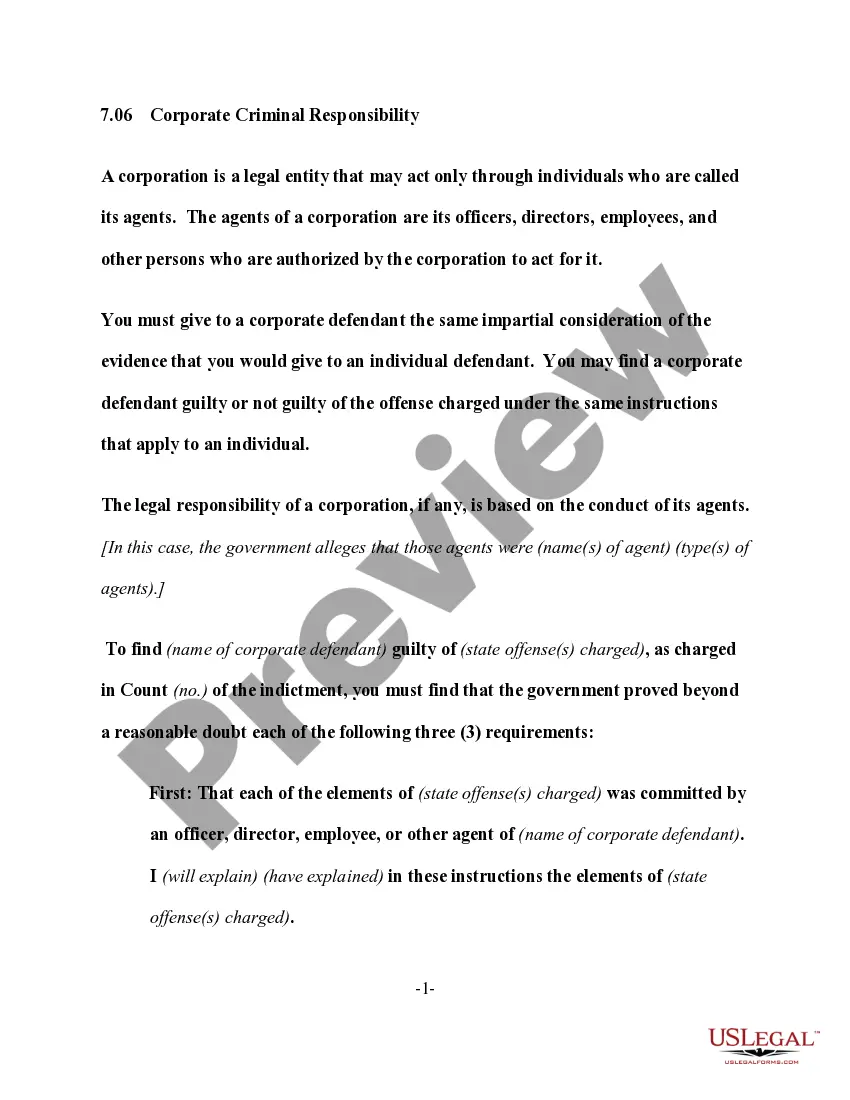
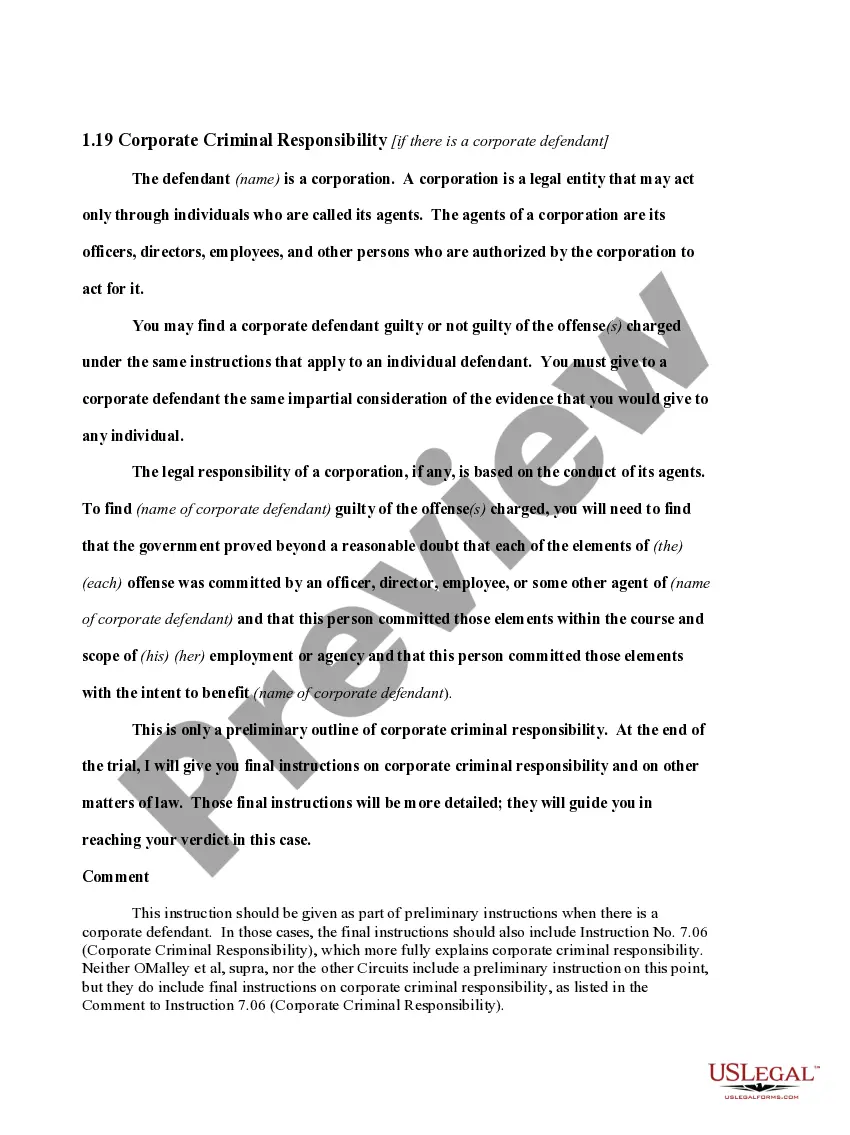
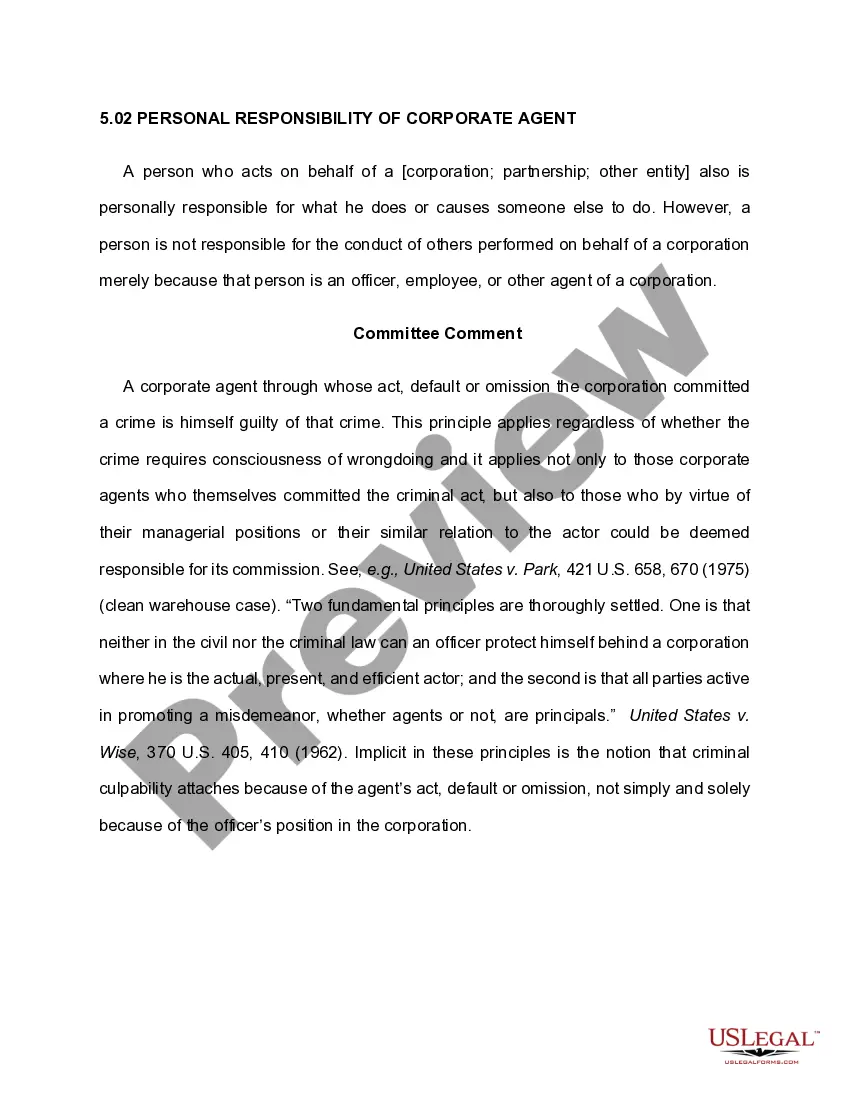
The Corporate Criminal Responsibility form outlines the legal standards for holding a corporation accountable for criminal actions taken by its agents, such as directors and employees. This form clarifies how corporate entities can be implicated in criminal behavior, distinguishing its application from individual criminal responsibility. It provides important insights into the principles governing corporate liability in criminal cases.
Key parts of this document
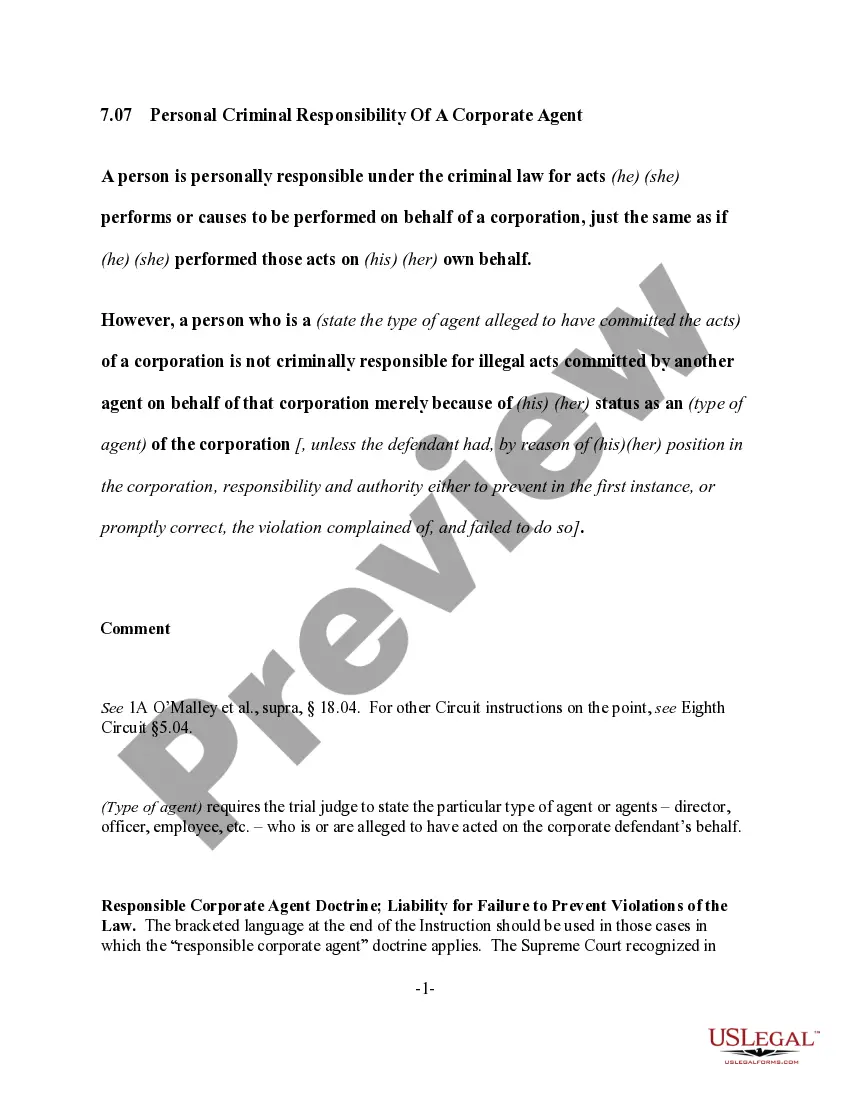
- Definition of corporate agents, including officers, directors, and employees.
- Impartial consideration of evidence for corporate defendants, similar to individual defendants.
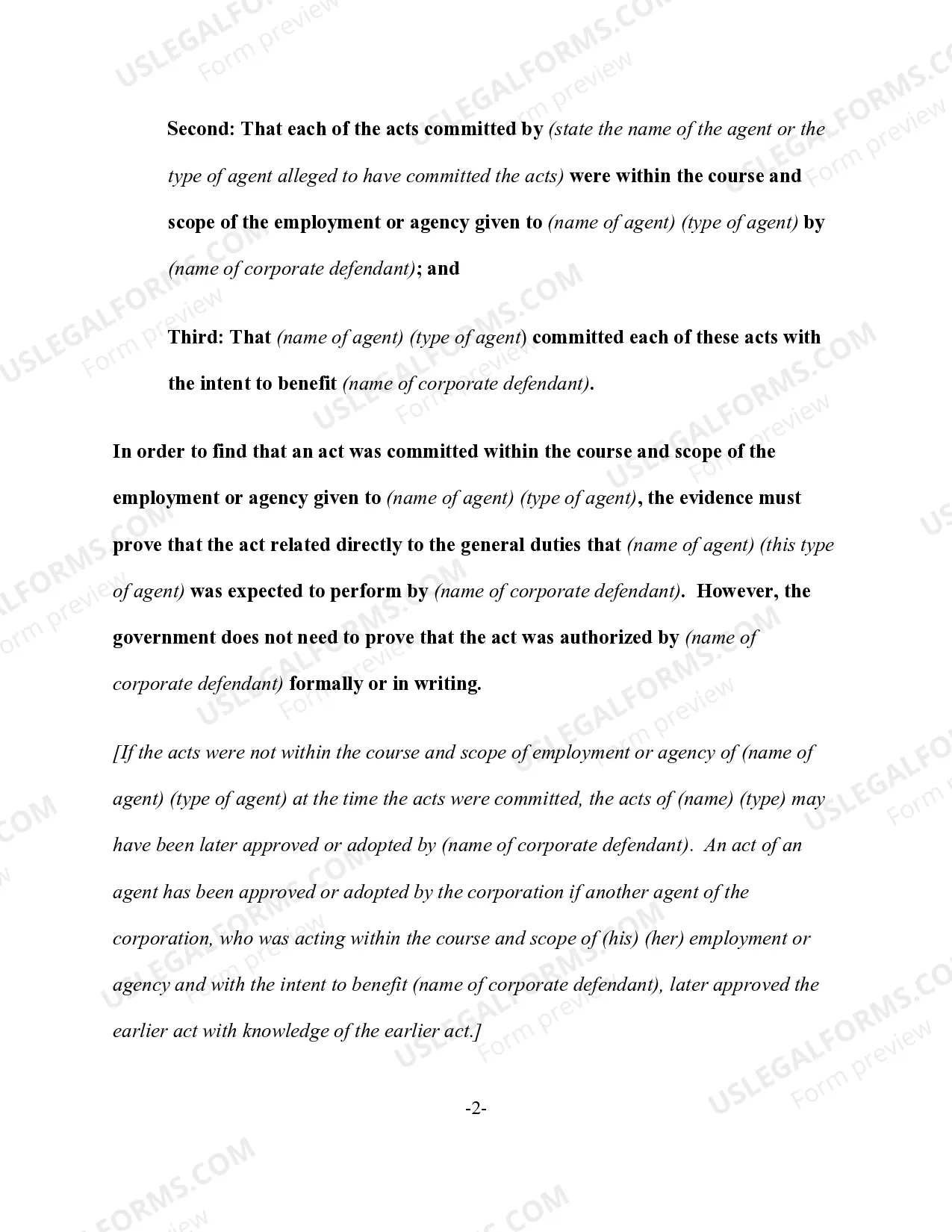
- Criteria for establishing a corporation's guilt based on agents' actions.
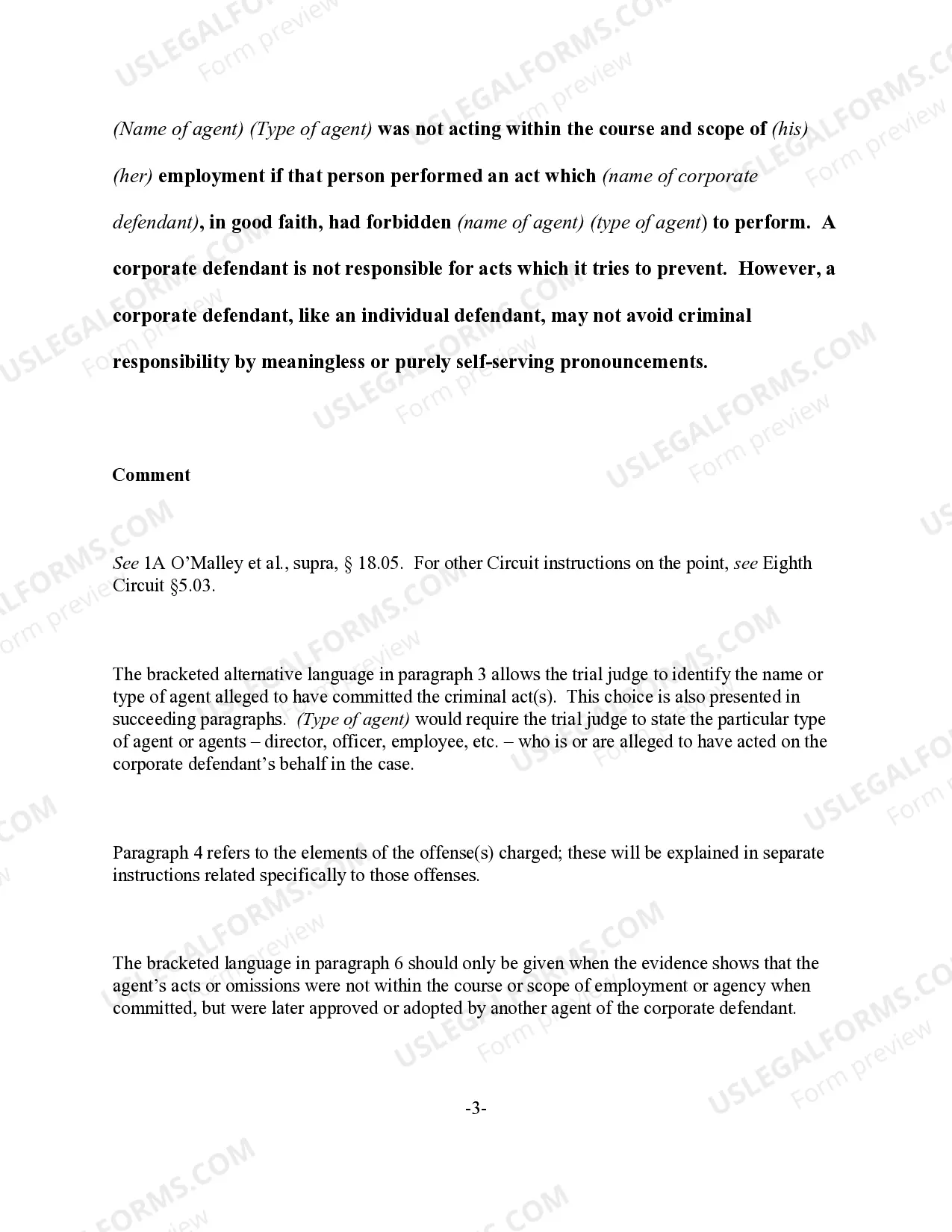
- Explanation of what constitutes acts within the course and scope of employment.
- Details on how corporate responsibility may be affected by acts that were later approved by the corporation.


When this form is needed
This form is essential in legal proceedings where a corporation is accused of a crime based on the actions of its agents. It should be used when determining the liability of a corporation in cases involving fraud, embezzlement, or any illegal activities performed by its employees or representatives that result in criminal charges against the corporation itself.
Who this form is for
- Corporate legal defense teams representing accused entities.
- Attorneys involved in criminal cases against corporations.
- Corporation executives needing clarity on potential legal liabilities.
- Business owners seeking to understand the implications of corporate actions in criminal law.
Completing this form step by step
- Identify the name of the corporate defendant involved in the case.
- List the names or types of agents alleged to have committed the criminal acts.
- Specify the criminal offense(s) charged against the corporation.
- Outline the evidence that demonstrates the acts were within the agents' scope of employment.
- Confirm the intent of the agents to benefit the corporation through their actions.
Notarization guidance
This form usually doesn’t need to be notarized. However, local laws or specific transactions may require it. Our online notarization service, powered by Notarize, lets you complete it remotely through a secure video session, available 24/7.
Get your form ready online
Our built-in tools help you complete, sign, share, and store your documents in one place.
Make edits, fill in missing information, and update formatting in US Legal Forms—just like you would in MS Word.
Download a copy, print it, send it by email, or mail it via USPS—whatever works best for your next step.
Sign and collect signatures with our SignNow integration. Send to multiple recipients, set reminders, and more. Go Premium to unlock E-Sign.
If this form requires notarization, complete it online through a secure video call—no need to meet a notary in person or wait for an appointment.
We protect your documents and personal data by following strict security and privacy standards.

Make edits, fill in missing information, and update formatting in US Legal Forms—just like you would in MS Word.

Download a copy, print it, send it by email, or mail it via USPS—whatever works best for your next step.

Sign and collect signatures with our SignNow integration. Send to multiple recipients, set reminders, and more. Go Premium to unlock E-Sign.

If this form requires notarization, complete it online through a secure video call—no need to meet a notary in person or wait for an appointment.

We protect your documents and personal data by following strict security and privacy standards.
Mistakes to watch out for
- Failing to adequately establish the connection between the agent's actions and the corporation's interests.
- Not properly identifying all agents involved in the alleged criminal behavior.
- Misunderstanding the criteria for an act being within the scope of employment.
- Neglecting to provide sufficient evidence to support claims of corporate intent.
Advantages of online completion
- Convenient access to reliable legal templates drafted by licensed attorneys.
- Easy to edit and customize to fit specific corporate situations.
- Time-efficient, allowing for quick downloads to meet legal deadlines.
- Secure and confidential, ensuring sensitive information is protected during usage.
Legal use & context
- This form serves as an essential reference in criminal cases involving corporate entities.
- It highlights the requirement for proving intent and scope of employment for agents.
- The application of this form can vary by jurisdiction, so local laws should be considered.
Key takeaways
- Corporate Criminal Responsibility involves the actions and intent of corporate agents.
- Key requirements must be met for corporate liability to be established.
- This form is useful for both prosecution and defense in corporate crime cases.
Looking for another form?
Form popularity
FAQ
Contents Overview. Report White-Collar Crime. Health Care Fraud. Corporate Fraud. Money Laundering. Securities and Commodities Fraud. Mortgage and Financial Instiution Fraud. Intellectual Property Theft/Piracy.
This can involve money laundering, tax evasion, fraud, bribery, insider trading, fraud, and regulatory offences, among many others.
Lesson Summary. Corporate crime is crime committed by individuals on behalf of a business. Corporate crimes can occur in a variety of ways: violations of environmental law, bribery, false claims, corporate fraud, and other methods.
The age of criminal responsibility is the age in which a child is considered by law to have understood that their actions were wrong and can face criminal charges.
What is Corporate Crime? Falsifying information on financial statements. Manipulating the stock market. Bribery. Bribery of public officials. False claims in advertising. Embezzlement. Damage caused to the environment due to negligence.
Section 25 of the Criminal Code 2002 (ACT) currently provides that a child under 10 years old is not criminally responsible for an offence, and section 26 states that a child aged 10 years or older, but under 14 years old, can only be criminally responsible for an offence if the child knows that his or her conduct is
A corporation has no defence of intervening conduct when the unexpected and uncontrollable conduct in question is that of an employee, agent or officer of the corporation.
Organizational goals, organizational structure, and organizational environment are the major organizational factors that influence the commission of corporate crimes.