Corporate Criminal Responsibility
Understanding this form
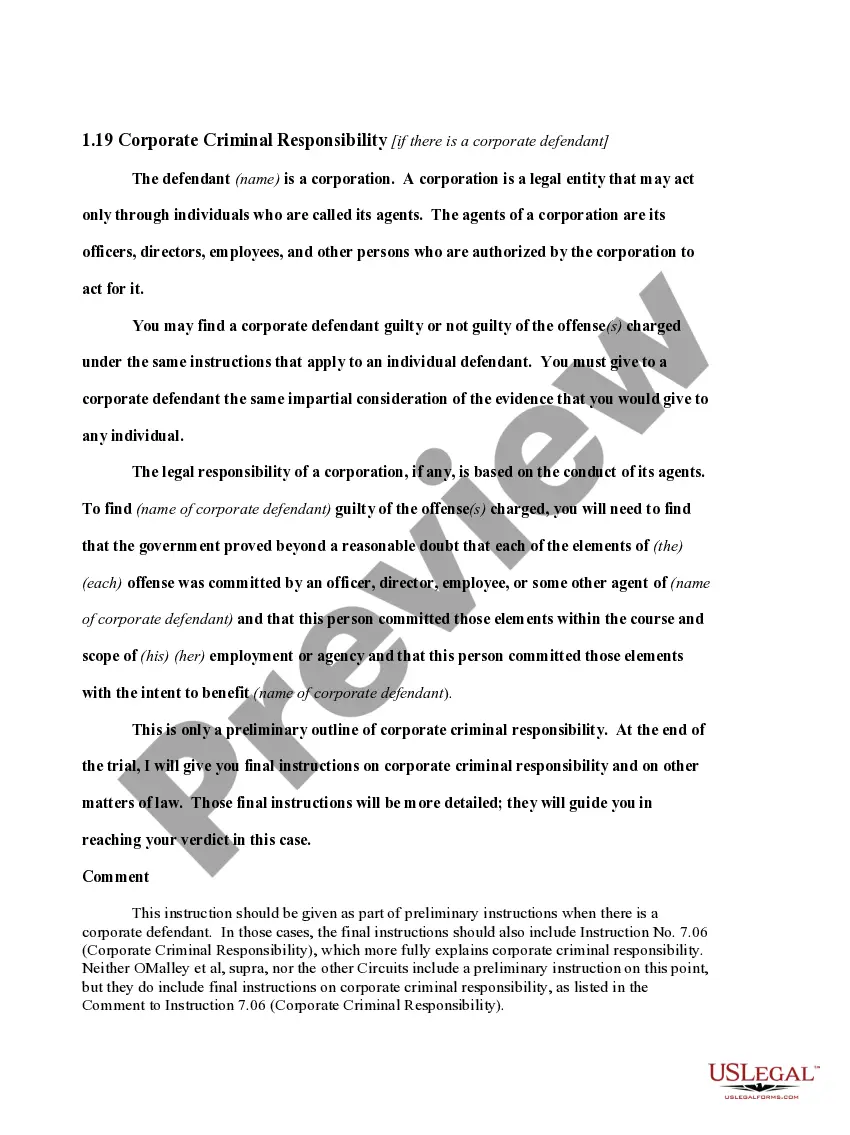
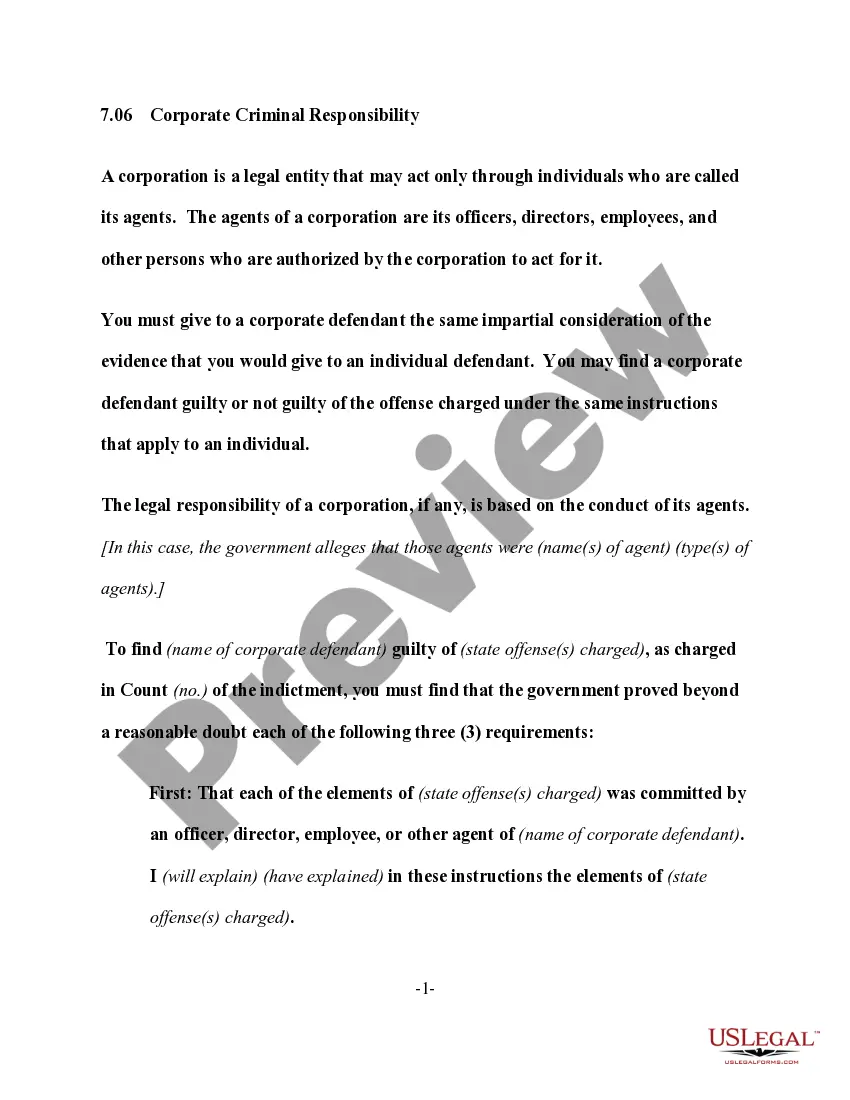
The Corporate Criminal Responsibility form sets guidelines for determining the criminal liability of a corporation. It outlines how to evaluate the actions of corporate agents, such as officers and employees, under the same legal standards applied to individual defendants. Used in trials where a corporation is accused of a crime, this form helps ensure that corporate accountability is assessed fairly and impartially.
Main sections of this form
- Definition of a corporation as a legal entity.
- Explanation of the role of corporate agents, including officers and employees.
- Standards for determining guilt based on agent conduct within their scope of employment.
- Instructions for ensuring impartial consideration of evidence for corporate defendants.
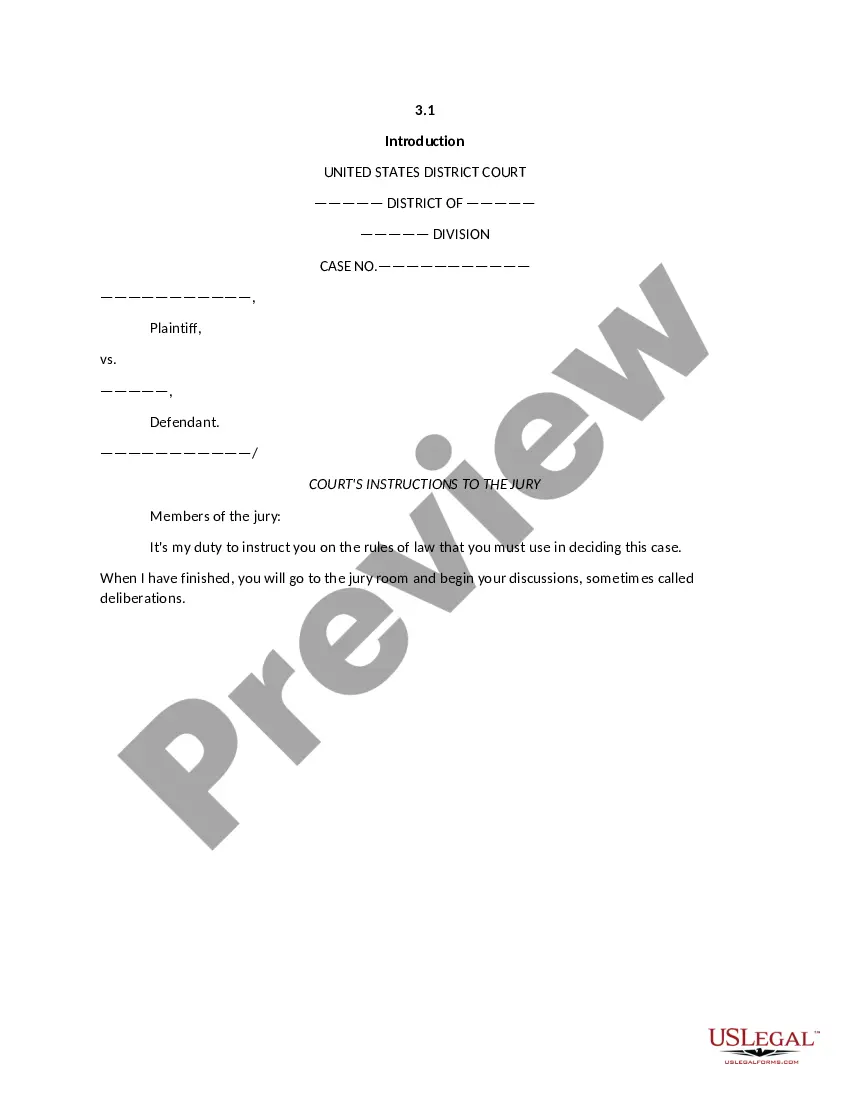
- Reference to more detailed final jury instructions regarding corporate criminal responsibility.
Common use cases
This form is essential in criminal cases where a corporation is the defendant. It is used during jury trials to guide jurors in evaluating the corporation's responsibility for criminal acts committed by its agents. Situations may include fraud, environmental violations, or any criminal activity attributed to corporate decisions or actions.
Who should use this form
- Jurors involved in a case with a corporate defendant.
- Legal professionals requiring clarity on corporate liability in criminal matters.
- Corporations facing allegations of criminal activity seeking to understand the legal framework.
Instructions for completing this form
- Identify the name of the corporate defendant involved in the case.
- Determine the specific offenses charged against the corporate entity.
- Assess the evidence related to the actions of the corporation's agents.
- Evaluate whether the actions were within the scope of employment or agency.
- Consider the intent behind the actions to determine if they were aimed at benefiting the corporation.
Does this form need to be notarized?
Notarization is generally not required for this form. However, certain states or situations might demand it. You can complete notarization online through US Legal Forms, powered by Notarize, using a verified video call available anytime.
Get your form ready online
Our built-in tools help you complete, sign, share, and store your documents in one place.
Make edits, fill in missing information, and update formatting in US Legal Forms—just like you would in MS Word.
Download a copy, print it, send it by email, or mail it via USPS—whatever works best for your next step.
Sign and collect signatures with our SignNow integration. Send to multiple recipients, set reminders, and more. Go Premium to unlock E-Sign.
If this form requires notarization, complete it online through a secure video call—no need to meet a notary in person or wait for an appointment.
We protect your documents and personal data by following strict security and privacy standards.

Make edits, fill in missing information, and update formatting in US Legal Forms—just like you would in MS Word.

Download a copy, print it, send it by email, or mail it via USPS—whatever works best for your next step.

Sign and collect signatures with our SignNow integration. Send to multiple recipients, set reminders, and more. Go Premium to unlock E-Sign.

If this form requires notarization, complete it online through a secure video call—no need to meet a notary in person or wait for an appointment.

We protect your documents and personal data by following strict security and privacy standards.
Common mistakes
- Failing to recognize that a corporation can only act through its agents.
- Neglecting to apply the same level of scrutiny to corporate defendants as individual defendants.
- Overlooking the necessity of demonstrating intent to benefit the corporation as part of the evaluation.
Benefits of completing this form online
- Easy download and access to essential legal documents at any time.
- Editable templates allow for customization according to case specifics.
- Preparation by licensed attorneys ensures accuracy and compliance with current laws.
Legal use & context
- Corporate criminal responsibility is a crucial aspect of business law.
- Courts hold corporations accountable to prevent illegal acts by individuals acting within corporate limits.
- This form is used alongside final jury instructions to guide jurors in their decision-making process.
Looking for another form?

Form popularity
FAQ
From 14 to either 17 or 18 years, young offenders may be held fully responsible for their criminal acts but are subject to a different range of criminal sanctions than adults committing the same offenses.
Lesson Summary. Corporate crime is crime committed by individuals on behalf of a business. Corporate crimes can occur in a variety of ways: violations of environmental law, bribery, false claims, corporate fraud, and other methods.
In its basic sense, the minimum age of criminal responsibility is a simple concept: the age at which a person can be charged with a criminal offence and processed within the criminal justice system.
Section 25 of the Criminal Code 2002 (ACT) currently provides that a child under 10 years old is not criminally responsible for an offence, and section 26 states that a child aged 10 years or older, but under 14 years old, can only be criminally responsible for an offence if the child knows that his or her conduct is
A corporation has no defence of intervening conduct when the unexpected and uncontrollable conduct in question is that of an employee, agent or officer of the corporation.
To the legal system, the answer is clear: children have the requisite moral sense--the ability to tell right from wrong--by age 7 to 15, depending on which state they live in, and so can be held responsible for their actions.
The age of criminal responsibility is the age in which a child is considered by law to have understood that their actions were wrong and can face criminal charges.