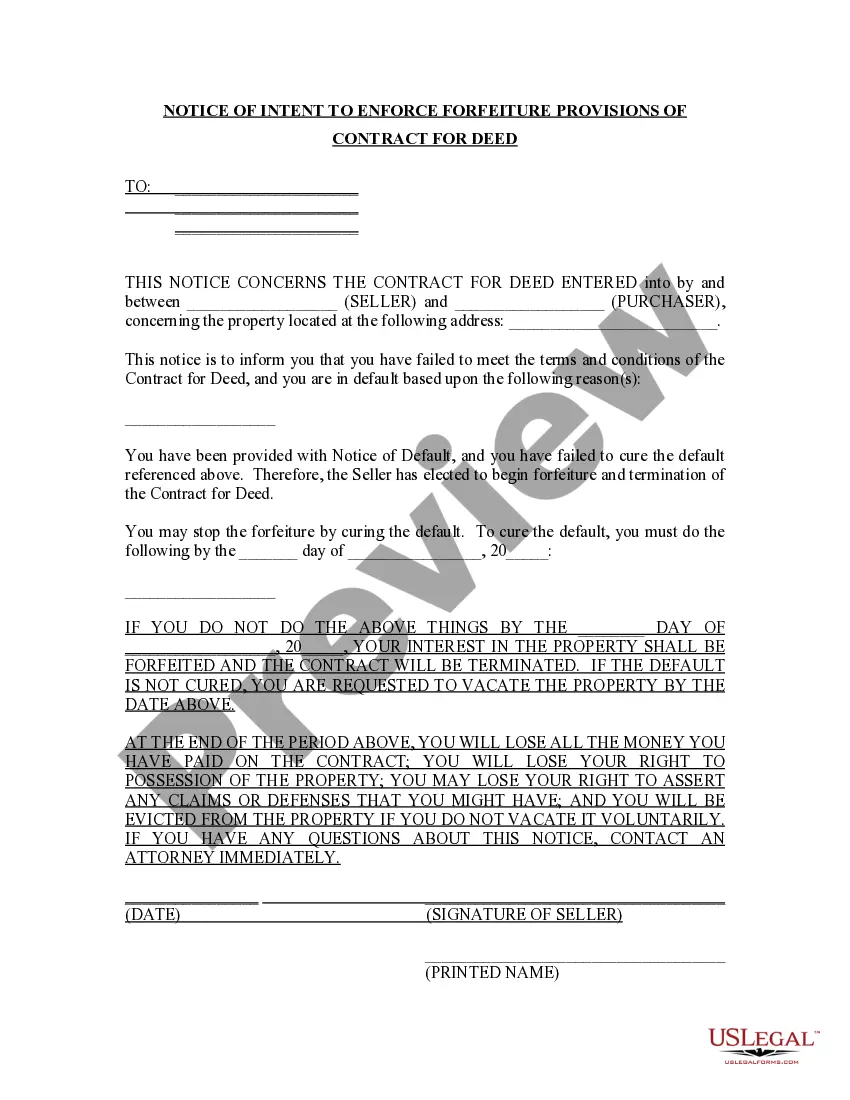
Maryland Notice of Intent to Enforce Forfeiture Provisions of Contact for Deed
Description

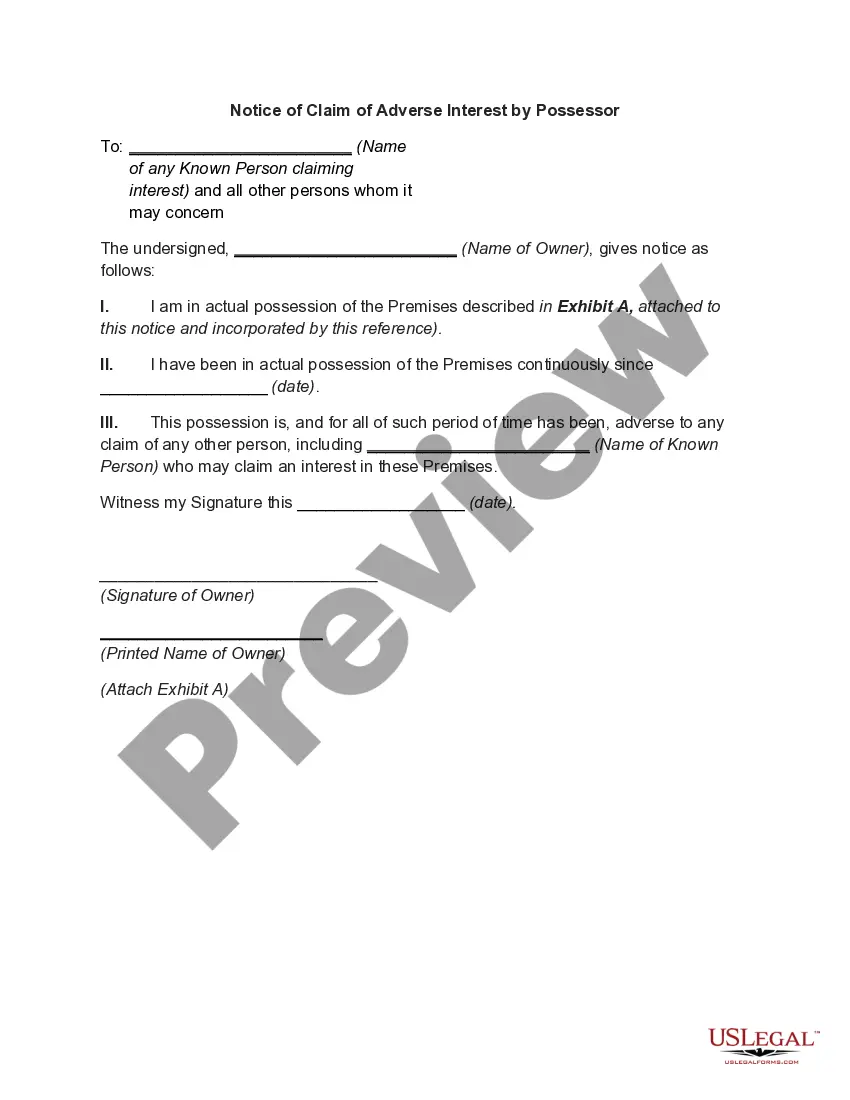

How to fill out Maryland Notice Of Intent To Enforce Forfeiture Provisions Of Contact For Deed?
Utilize US Legal Forms to secure a printable Maryland Notice of Intent to Enforce Forfeiture Provisions of Contract for Deed.
Our court-acceptable forms are crafted and frequently revised by experienced attorneys.
Ours is the most thorough Forms catalog online and offers reasonably priced and precise templates for consumers, legal professionals, and small to medium-sized businesses (SMBs).
Select Buy Now if it’s the template you require. Establish your account and complete payment via PayPal or by debit/credit card. Download the form to your device and feel free to reuse it multiple times. Employ the Search engine if you wish to locate another document template. US Legal Forms provides thousands of legal and tax templates and bundles for business and personal requirements, encompassing the Maryland Notice of Intent to Enforce Forfeiture Provisions of Contract for Deed. More than three million users have effectively utilized our platform. Choose your subscription plan and obtain high-quality documents within a few clicks.
- The documents are organized into state-specific categories and several of them can be previewed before downloading.
- To obtain templates, users are required to have a subscription and to sign in to their account.
- Click Download next to any template you choose and access it in My documents.
- For those who lack a subscription, adhere to the following steps to effortlessly locate and download the Maryland Notice of Intent to Enforce Forfeiture Provisions of Contract for Deed.
- Verify that you possess the correct form concerning the required state.
- Examine the document by reading the description and utilizing the Preview feature.
Form popularity
FAQ
It is an in personam (against the person) action and requires that the government indict (charge) the property used or derived from the crime along with the defendant. If the jury finds the property forfeitable, the court issues an order of forfeiture.
Whereas restitution is measured by the losses to victims and forfeiture is measured by the proceeds of a criminal offense, both amounts frequently turn out to be the same--especially in financial fraud cases.
The term money judgment is used to describe a particular kind of directly forfeitable property. It is a short-hand way of describing the defendant's continuing obligation to forfeit the money derived from or used to commit his criminal offense whether he has retained the actual dollars in his possession or not.
Criminal forfeiture is an action brought as a part of the criminal prosecution of a defendant.Civil judicial forfeiture is an in rem (against the property) action brought in court against the property. The property is the defendant and no criminal charge against the owner is necessary.
Letter of forfeiture means a notice in varied forms, sent to a bail bond agency/branch office, advising the agency/branch office that a defendant who has secured a bail bond with that agency has failed to appear on a given date in a given court in accordance with RCW 10.19. 090.
This means that if you default and can?t make your payments, you lose the property and all of the money you have already paid into it (often including repairs and improvements). Unlike a traditional mortgage, a defaulting buyer in a contact for deed may only have 30-60 days to cure the default or move out.
Forfeiture refers to a loss of any property, money, or assets without consideration or compensation in return. A forfeiture generally occurs due to default in complying with repayment obligations under a contract. It can also be used as a penalty for an illegal way of conducting business.
Forfeiture. A foreclosure action extinguishes any claim the mortgagor may have to the real property securing a defaulted loan, whereas a forfeiture refers generally to the loss of a right to something as a result of nonperformance of an obligation or condition.
Your Claim Opposing Forfeiture (MC-200) must be filed in the county where the property was seized. If you have received a notice, you can find the address of the court on that notice. Within 30 days after filing your claim, you must serve a copy on the District Attorney.