Michigan Insulation Contractor Package
About this form package
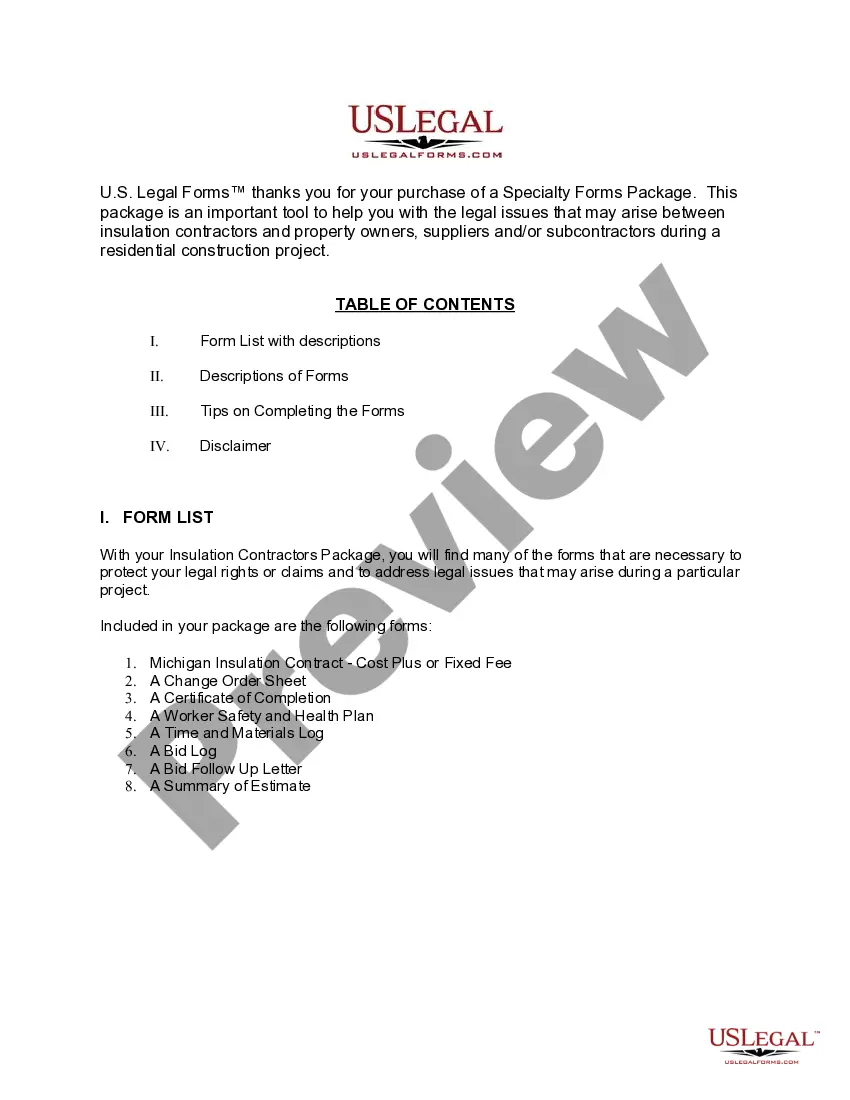
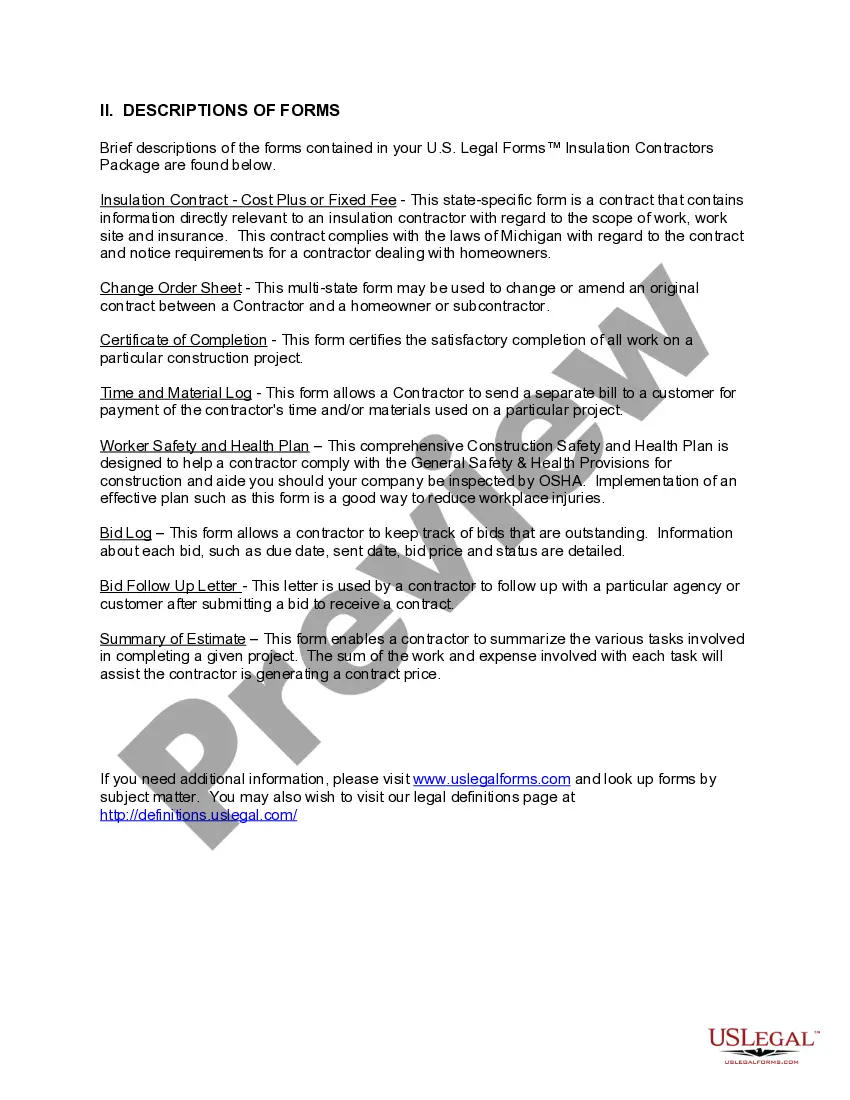
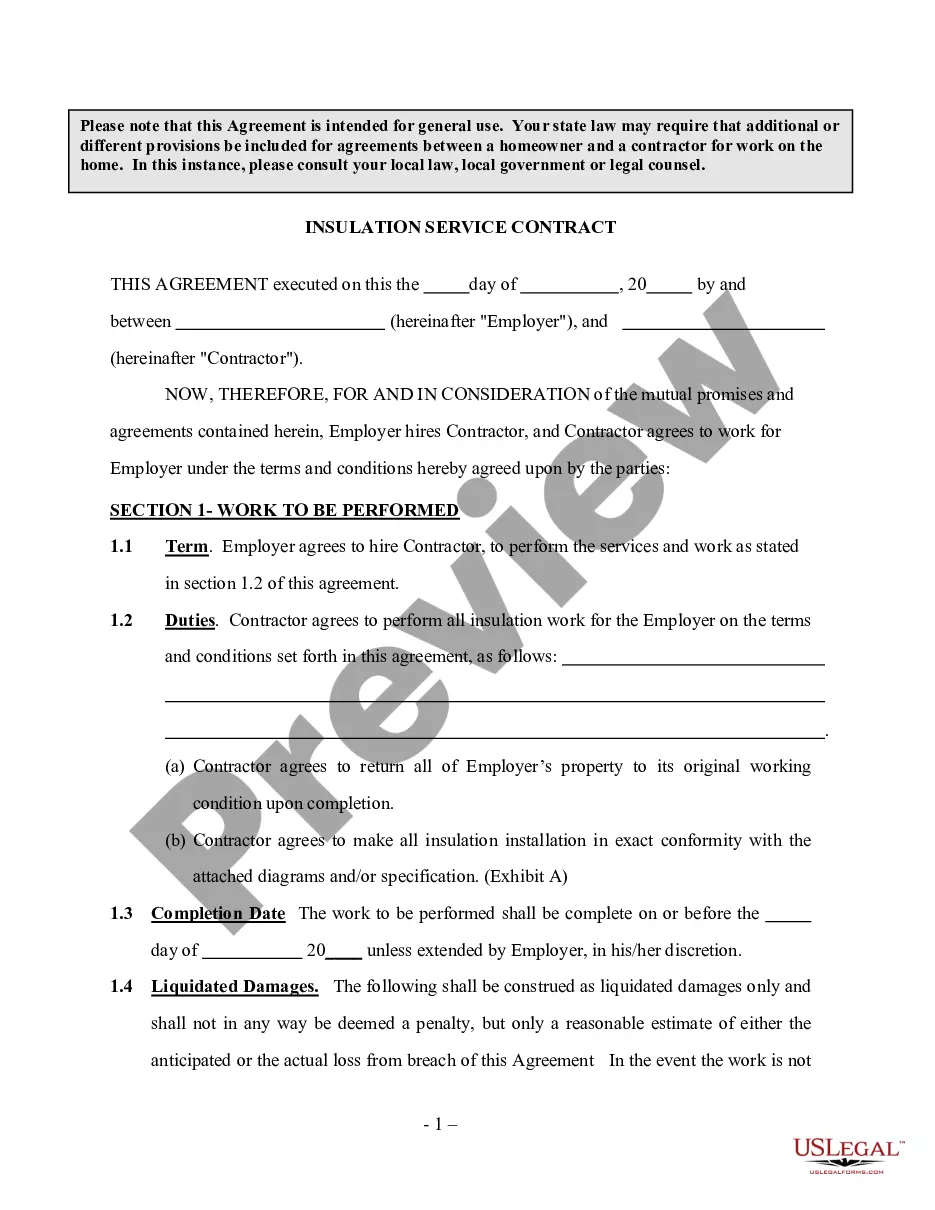
The Michigan Insulation Contractor Package is a comprehensive collection of legal documents specifically designed for insulation contractors, owners, suppliers, and subcontractors. This package includes essential forms to help assert legal rights, manage claims, and address various legal issues during insulation projects in residential properties. Its core component, the insulation contract, is drafted to comply with Michigan state law, ensuring it meets local legal requirements.
Forms included in this package

Common use cases
Utilize the Michigan Insulation Contractor Package in situations such as:
- When entering into a formal agreement for insulation installation services.
- If changes are necessary during the project requiring documentation through change orders.
- At project completion, to certify that all work has been satisfactorily finished.
- When tracking project bids and follow-ups with potential clients.
- To maintain detailed records of time and materials for billing purposes.
Who should use this form package
- Insulation contractors looking to formalize agreements with clients.
- Subcontractors needing documentation to assert claims or rights.
- Homeowners hiring insulation contractors for residential projects.
- Suppliers of insulating materials involved in contractual agreements.
Steps to complete these forms
- Review all included forms in the package to understand your requirements.
- Identify and clearly define the parties involved in the insulation project.
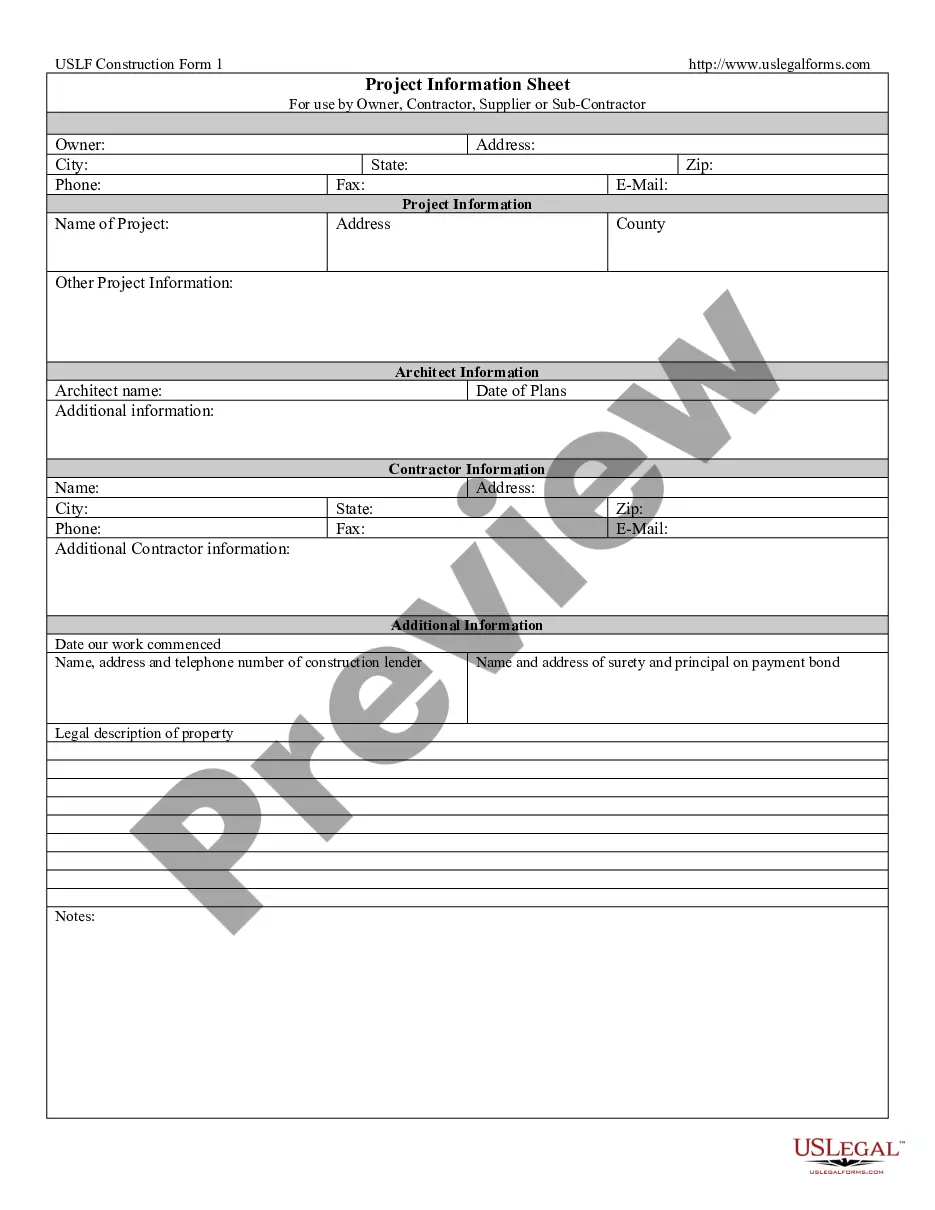
- Enter relevant details, including dates, project scope, and pricing in the insulation contract.
- Complete the change order sheet if amendments to the original contract are necessary.
- Ensure that the certificate of completion is signed at the end of the project to confirm satisfactory work.
Notarization guidance for this package
Forms in this package usually don’t need notarization, but certain jurisdictions or signing circumstances may require it. US Legal Forms provides a secure online notarization option powered by Notarize, accessible 24/7 from anywhere.
Get your form ready online
Our built-in tools help you complete, sign, share, and store your documents in one place.
Make edits, fill in missing information, and update formatting in US Legal Forms—just like you would in MS Word.
Download a copy, print it, send it by email, or mail it via USPS—whatever works best for your next step.
Sign and collect signatures with our SignNow integration. Send to multiple recipients, set reminders, and more. Go Premium to unlock E-Sign.
If this form requires notarization, complete it online through a secure video call—no need to meet a notary in person or wait for an appointment.
We protect your documents and personal data by following strict security and privacy standards.

Make edits, fill in missing information, and update formatting in US Legal Forms—just like you would in MS Word.

Download a copy, print it, send it by email, or mail it via USPS—whatever works best for your next step.

Sign and collect signatures with our SignNow integration. Send to multiple recipients, set reminders, and more. Go Premium to unlock E-Sign.

If this form requires notarization, complete it online through a secure video call—no need to meet a notary in person or wait for an appointment.

We protect your documents and personal data by following strict security and privacy standards.
Avoid these common issues
- Failing to include all necessary parties in the insulation contract.
- Not documenting changes on the change order sheet.
- Neglecting to complete the certificate of completion before moving to the next project.
- Inconsistencies in the time and material logging.
Benefits of using this package online
- Convenience of downloading forms directly to your computer.
- Editability allows customization to suit specific project needs.
- Reliability of documents drafted by licensed attorneys.
- Availability of numerous forms in one package, reducing costs compared to purchasing separately.
Looking for another form?
Form popularity
FAQ
Yes, in Michigan, property owners can act as their own general contractor (GC) for personal projects. However, they are responsible for obtaining the necessary permits and ensuring that all work complies with local building codes. By utilizing the Michigan Insulation Contractor Package, you can choose to manage your insulation project while having access to professional advice and resources to guide you through the process.
An insulation contractor specializes in installing and maintaining insulation in residential and commercial buildings. They assess the property to determine the best type of insulation for your needs, ensuring optimal energy efficiency and comfort. By choosing the right Michigan Insulation Contractor Package, you can benefit from their expertise, saving on energy costs while enhancing your property's performance.
To report a contractor in Michigan, you should first collect all relevant documentation, including contracts and any correspondence related to the issue. You can then submit a complaint to the Michigan Department of Licensing and Regulatory Affairs. If your situation requires legal assistance, consider using the Michigan Insulation Contractor Package available at US Legal Forms to navigate the reporting process and ensure your rights are protected.
In Michigan, the building code for insulation is governed by the Michigan Residential Code, which outlines specific requirements for thermal performance in homes. Generally, these codes specify minimum R-values for insulation materials used in different areas of a home. To ensure your project meets these regulations, consulting a Michigan Insulation Contractor Package can provide you with the necessary information and resources.
One of the most common complaints about contractors involves poor communication. Homeowners frequently express frustration over delays, lack of updates, and misunderstandings about project scope and timelines. To mitigate such issues, choosing a reputable contractor who offers a well-structured Michigan Insulation Contractor Package can help set clear expectations and improve transparency.
Filing a complaint against a contractor in Michigan involves several steps. First, you should gather evidence including contracts, photographs, and communication records. Then, you can file your complaint with the Michigan Department of Licensing and Regulatory Affairs, which oversees contractors. If necessary, consider utilizing the Michigan Insulation Contractor Package from US Legal Forms for additional support in navigating the complaint process.
In Michigan, homeowners can perform some work on their own homes without a contractor license, but there are limits. Generally, you can manage small repairs or renovations but larger projects, like insulation installation, typically require a licensed contractor. The Michigan Insulation Contractor Package guides you through what you can legally do and connects you with professionals for jobs that exceed your capabilities, ensuring compliance and quality workmanship.
For attic insulation in Michigan, the recommended R-value is typically between R-30 and R-60. This range helps to optimize energy conservation and maintain a comfortable living environment. Utilizing the Michigan Insulation Contractor Package can help you determine the best insulation solutions tailored to your specific attic needs, enhancing your home's overall energy performance.
The required R-value in Michigan depends on the area of your home and the climate zone. Typically, walls need an R-value of R-20 to R-25, while floors require R-19 or higher. The Michigan Insulation Contractor Package provides guidance on achieving the right R-value for your home, ensuring energy efficiency and comfort throughout the year.
In Michigan, insulation requirements vary based on your home’s location and structure. Generally, homes must meet specific energy code standards that dictate the type and amount of insulation necessary. Using the Michigan Insulation Contractor Package can help ensure compliance and optimize energy efficiency. Additionally, local building codes may have specific rules, so checking with your local authority is advisable.