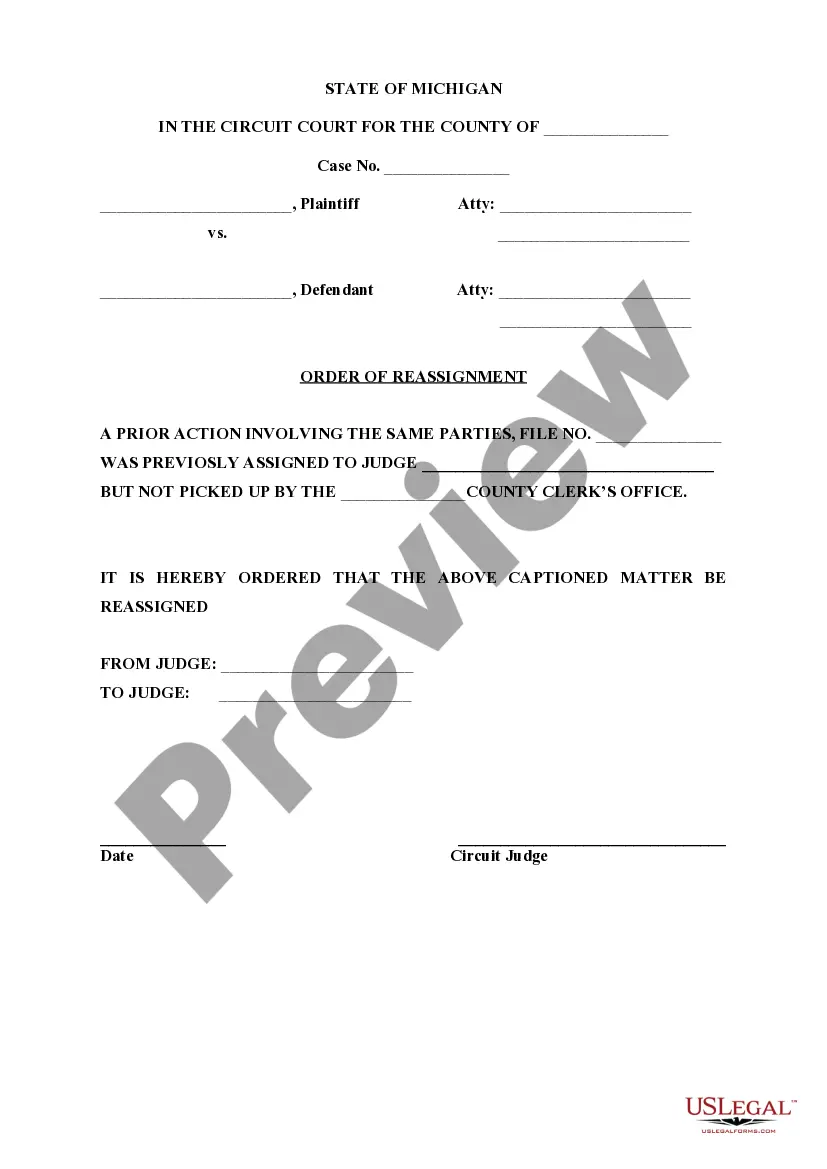
Michigan Order of Reassignment
What this document covers
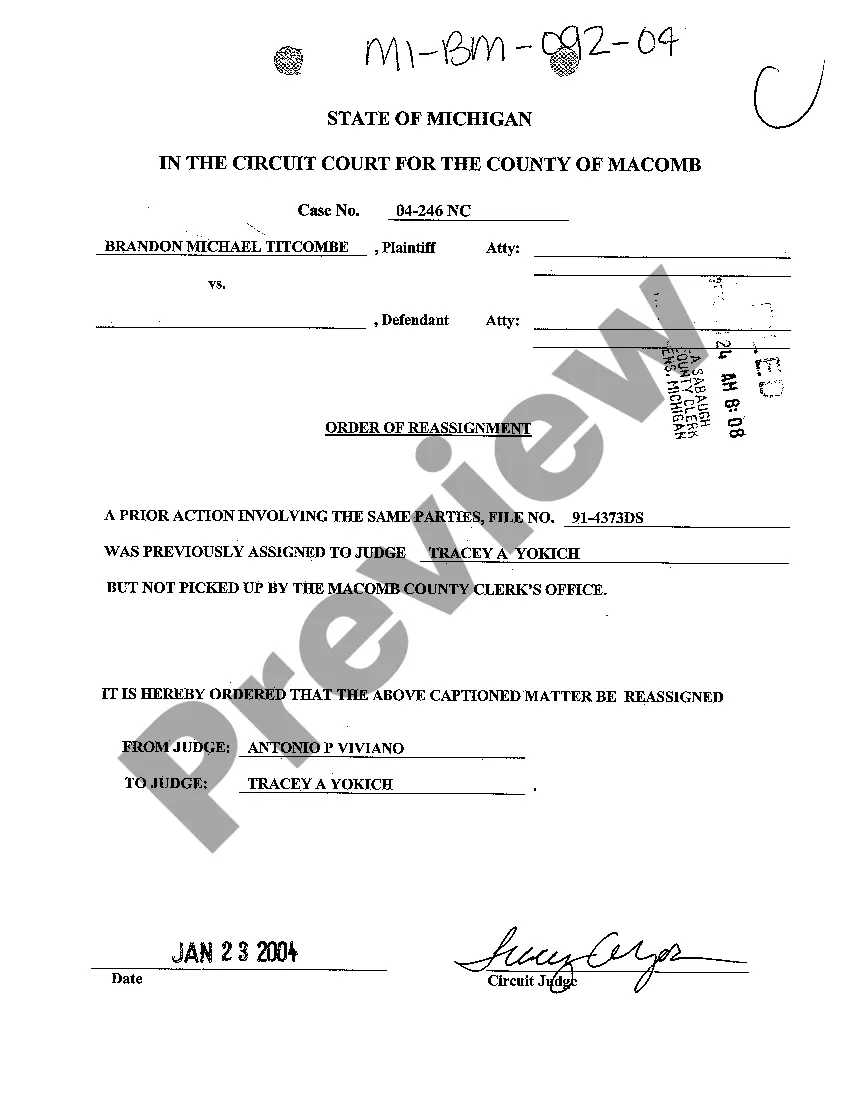
The Order of Reassignment is a legal document used in court to officially transfer a case from one judge to another. This form is typically utilized when the originally assigned judge is disqualified or unable to manage the case for valid reasons. By providing clear instructions and documenting the reassignment, this form helps ensure continuity and fairness in the judicial process.
Key parts of this document
- Case identification fields for the plaintiff, defendant, and attorneys.
- A statement confirming the previous assignment to a judge.
- Details regarding the reason for reassignment.
- The names of the judges involved in the transfer.
- Date and signature of the circuit judge issuing the order.

When to use this form
This form should be used when a judge is unable to preside over a case due to disqualification or other valid reasons. It is necessary for maintaining proper judicial procedure and ensuring that all parties receive equitable treatment in legal proceedings. Such situations can arise from conflicts of interest, health issues, or scheduling conflicts that prevent a judge from continuing with a case.
Who this form is for
- Judges responsible for managing court cases.
- Clerical staff within the court system handling case assignments.
- Legal representatives of involved parties who need to ensure proper handling of the case.
Instructions for completing this form
- Identify the case by filling out the case number and the names of the plaintiff and defendant.
- Provide initial details regarding the previous judge assigned to the case.
- State the reason for the reassignment.
- Clearly indicate the name of the new judge to whom the case is being reassigned.
- Sign and date the order as the circuit judge.
Is notarization required?
This form does not typically require notarization unless specified by local law. It is essential to check with local court rules to determine if notarization is necessary for compliance.
Get your form ready online
Our built-in tools help you complete, sign, share, and store your documents in one place.
Make edits, fill in missing information, and update formatting in US Legal Forms—just like you would in MS Word.
Download a copy, print it, send it by email, or mail it via USPS—whatever works best for your next step.
Sign and collect signatures with our SignNow integration. Send to multiple recipients, set reminders, and more. Go Premium to unlock E-Sign.
If this form requires notarization, complete it online through a secure video call—no need to meet a notary in person or wait for an appointment.
We protect your documents and personal data by following strict security and privacy standards.

Make edits, fill in missing information, and update formatting in US Legal Forms—just like you would in MS Word.

Download a copy, print it, send it by email, or mail it via USPS—whatever works best for your next step.

Sign and collect signatures with our SignNow integration. Send to multiple recipients, set reminders, and more. Go Premium to unlock E-Sign.

If this form requires notarization, complete it online through a secure video call—no need to meet a notary in person or wait for an appointment.

We protect your documents and personal data by following strict security and privacy standards.
Typical mistakes to avoid
- Failing to include the case number or names, which can lead to processing delays.
- Not providing a clear reason for the reassignment.
- Omitting signatures or dates, rendering the order invalid.
Advantages of online completion
- Convenience of completing the form from any location with internet access.
- Immediate availability of the form, ensuring timely processing of case reassignments.
- Editable format allows for easy input and corrections before finalizing.
Looking for another form?

Form popularity
FAQ
To obtain a court order for a name change in Michigan, you must file a petition with your local circuit court. This petition outlines your current name, the desired new name, and your reasoning for the change. The uslegalforms platform can assist you in preparing and filing the necessary documents for your case, ensuring that you understand each step related to the Michigan Order of Reassignment.
To change your name in Michigan, you usually need to show proof of your identity, such as a driver's license or passport. You may also need to provide a birth certificate and any other documents that support your name change request. Each of these documents helps solidify your case under the Michigan Order of Reassignment, making it easier to navigate the legal landscape.
In Michigan, name changes are typically handled by the circuit court in your county. You will need to submit your petition for a name change to the appropriate circuit court. The Michigan Order of Reassignment can often play a role in this process, allowing for a smoother transition when changing your name with the help of resources available through uslegalforms.
To switch Michigan child support back to yourself, you must file a motion with the court that issued the child support order. This motion should clarify your request and the reasons behind it. Utilizing the services available on the uslegalforms platform can streamline this process and provide the necessary documents related to the Michigan Order of Reassignment you'll need to complete.
In Michigan, changing your name requires you to file a petition with the court, detailing your reasons for the change. You'll need to provide identification and possibly a copy of your birth certificate. Additionally, understanding the Michigan Order of Reassignment can guide you through this process efficiently, ensuring that you meet all legal requirements.
An order to seize property in Michigan is a legal command issued by a court, allowing authorities to take possession of real or personal property. This process often involves enforcement to satisfy a judgment or recover a debt. If you're navigating this situation, consider using the uslegalforms platform, which provides resources to help you understand the Michigan Order of Reassignment and the associated legal procedures.
To transfer your child support case to another county in Michigan, you must file a petition with the court and meet specific requirements outlined in the Michigan Order of Reassignment. This process will generally require you to show valid reasons for the transfer, such as a change in residency. Additionally, ensuring you have the correct forms is crucial, and resources like US Legal Forms can help make this process smoother. It’s important to follow all legal protocols to ensure a seamless transition.
Changing child support in Michigan involves filing a petition with the court to modify your current support order. You should gather supporting evidence that shows a significant change in your financial situation or the needs of the child. The Michigan Order of Reassignment may also apply if you are relocating or if other significant life changes have occurred. It’s wise to access legal forms to ensure you have the right documents for your situation.
To address back child support in Michigan, it’s essential to understand that the Michigan Order of Reassignment can play a crucial role. You may want to petition the court for an adjustment or termination of your support obligations. Document any changes in your circumstances, such as job loss or financial difficulties. Consulting an attorney or utilizing resources like US Legal Forms can help you navigate the process effectively.
Filing a motion for reconsideration in Michigan typically occurs within 21 days after the court's ruling. This time limit is critical for those wishing to challenge decisions that relate to the Michigan Order of Reassignment or similar issues. While the process may seem straightforward, securing the right forms and understanding the intricacies can be complex. Our platform simplifies this by providing the necessary tools and guidance to ensure your motion is filed correctly and on time.