Maine Alibi
What this document covers
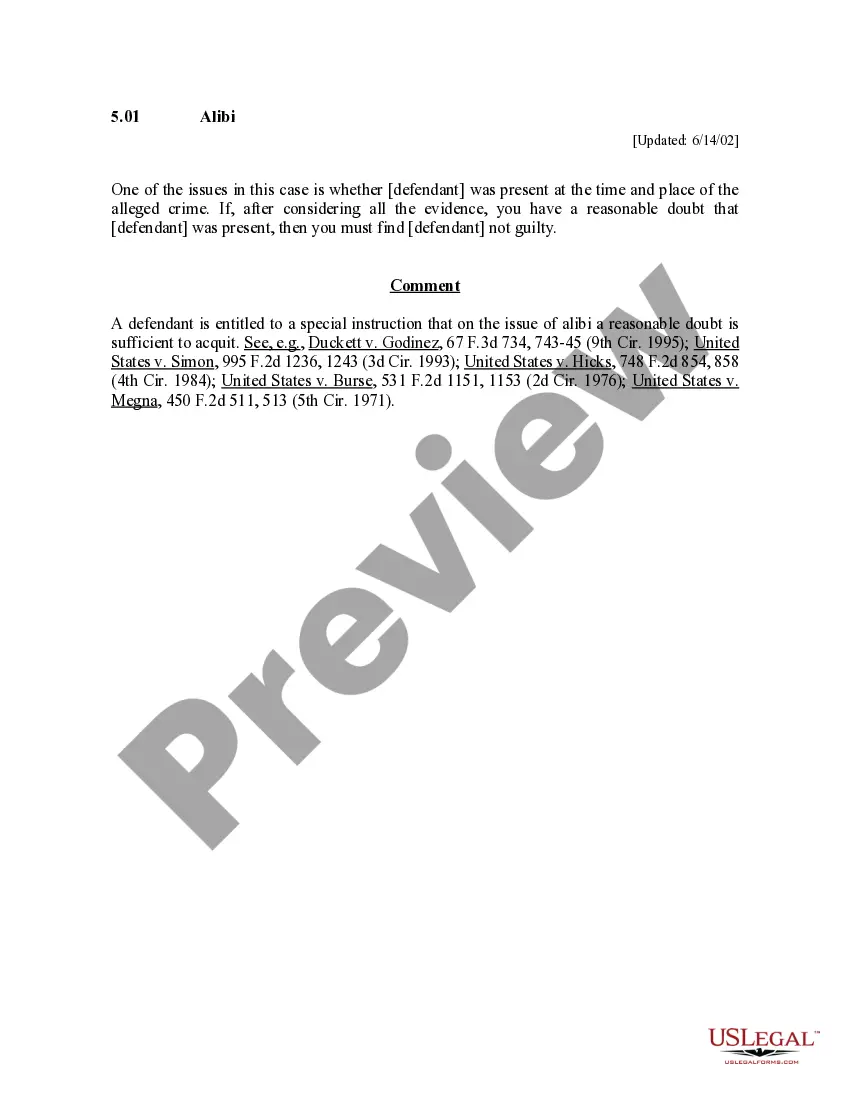
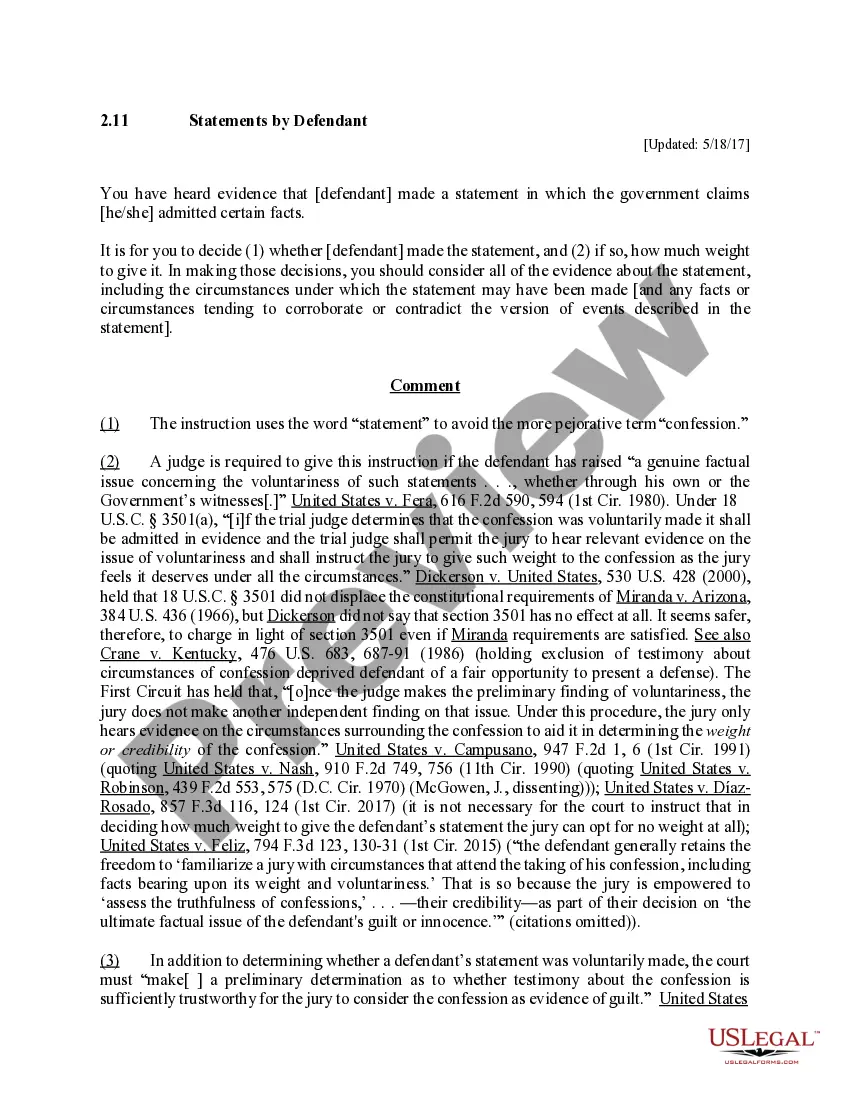
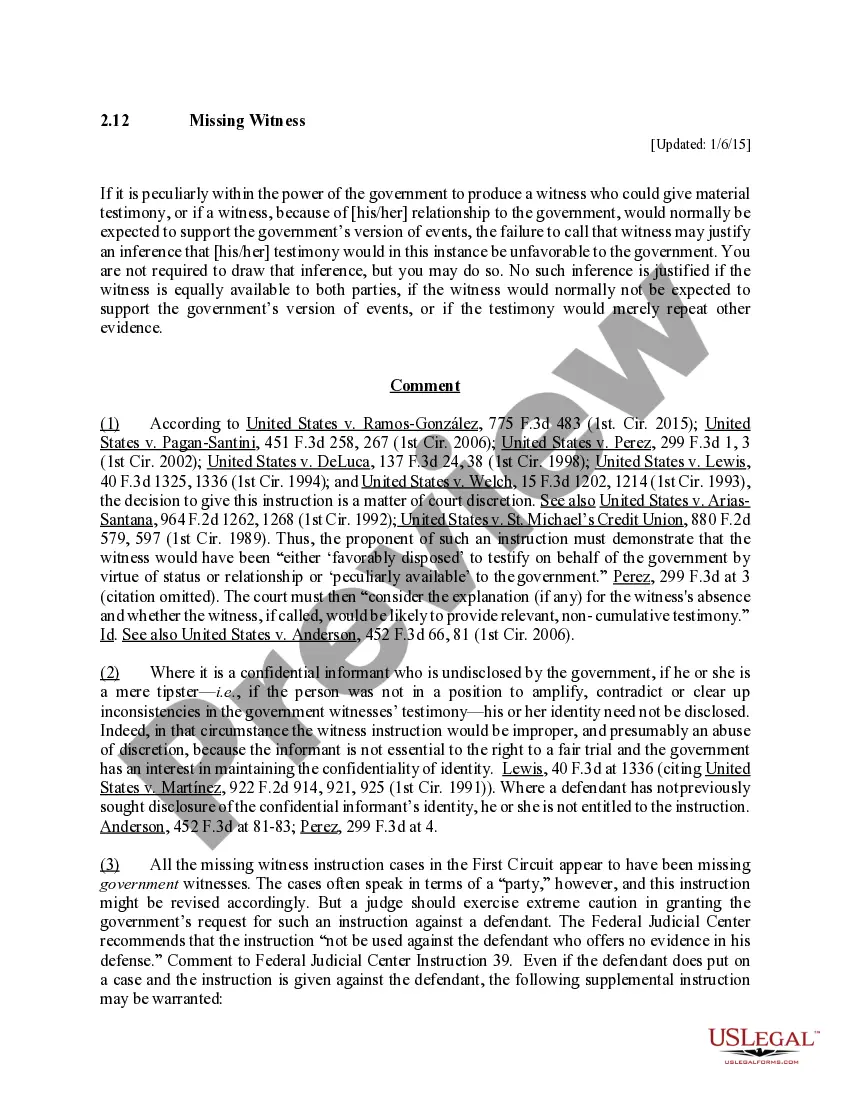
The Alibi form is an official instruction set used in criminal cases within the Federal District Court of Maine. It serves to guide jurors in cases where the defendant claims to have been at a different location during the time of the alleged crime. The purpose of this form is to clarify that if any reasonable doubt exists regarding the defendant's presence, they must be acquitted. This form is distinct from other jury instructions as it specifically addresses the issue of alibi in legal proceedings.
Key components of this form
- Introduction of the alibi issue related to the defendant's presence.
- Legal requirement outlining the reasonable doubt standard for acquittal.
- Reference to applicable case law affirming the importance of reasonable doubt in alibi defenses.
When this form is needed
This form is used in criminal cases when the defendant asserts that they were not present at the scene of the crime. It is applicable during jury deliberations to help jurors understand how to assess the credibility of alibi claims and to ensure they apply the reasonable doubt standard correctly in their verdict.
Who should use this form
This form is intended for:
- Defendants in criminal cases who are claiming an alibi.
- Attorneys representing defendants in federal criminal proceedings.
- Judges overseeing jury instructions in appropriate cases.
How to complete this form
- Review the facts of the case to determine the defendant's claim of alibi.
- Gather any supporting evidence or witnesses to substantiate the alibi.
- Present the alibi details clearly in court during jury instructions.
- Ensure jurors understand the reasonable doubt standard as it relates to the alibi.
Does this form need to be notarized?
Notarization is not commonly needed for this form. However, certain documents or local rules may make it necessary. Our notarization service, powered by Notarize, allows you to finalize it securely online anytime, day or night.
Get your form ready online
Our built-in tools help you complete, sign, share, and store your documents in one place.
Make edits, fill in missing information, and update formatting in US Legal Forms—just like you would in MS Word.
Download a copy, print it, send it by email, or mail it via USPS—whatever works best for your next step.
Sign and collect signatures with our SignNow integration. Send to multiple recipients, set reminders, and more. Go Premium to unlock E-Sign.
If this form requires notarization, complete it online through a secure video call—no need to meet a notary in person or wait for an appointment.
We protect your documents and personal data by following strict security and privacy standards.

Make edits, fill in missing information, and update formatting in US Legal Forms—just like you would in MS Word.

Download a copy, print it, send it by email, or mail it via USPS—whatever works best for your next step.

Sign and collect signatures with our SignNow integration. Send to multiple recipients, set reminders, and more. Go Premium to unlock E-Sign.

If this form requires notarization, complete it online through a secure video call—no need to meet a notary in person or wait for an appointment.

We protect your documents and personal data by following strict security and privacy standards.
Typical mistakes to avoid
- Failing to provide adequate evidence to support the alibi claim.
- Overlooking the importance of clearly communicating reasonable doubt to jurors.
- Misunderstanding the jurisdictional requirements when using this form.
Why complete this form online
- Convenient access to legally binding jury instructions.
- Editability to tailor the form to specific case needs.
- Reliability of having forms drafted by licensed attorneys.
Looking for another form?
Form popularity
FAQ
The song 'Alibi' explores the themes of regret and need for understanding in relationships. It expresses the complexities of human emotions and the necessity of having an excuse in difficult situations. Listeners can relate deeply, as it resonates with the universal experience of needing justification. This can relate to the broader context of legal discussions, such as those surrounding Maine Alibi.
The term 'alibi' translates to 'alibi' in English, referring to a claim or piece of evidence that confirms a person's presence at a certain place during a particular time. This concept is crucial in legal contexts, especially in cases involving defense strategies. Understanding the meaning behind Maine Alibi can help unravel its legal implications. It's essential to grasp these definitions when discussing case scenarios.
(1) If there is unnecessary delay in bringing a defendant to trial, the court may upon motion of the defendant or on the court's own motion dismiss the indictment, information, or complaint. The court shall direct whether the dismissal is with or without prejudice.
RULE 5. INITIAL PROCEEDINGS IN THE UNIFIED CRIMINAL DOCKET (a) Initial Appearance Before the Court. (b) Initial Statement of Rights by the Court. (c) Further Statement of Rights by the Court With Respect to Class C or Higher Crimes in the Absence of an Indictment or Information.
Rule 6 - The Grand Jury (a) Number of Grand Jurors. The grand jury shall consist of not fewer than 13 nor more than 23 jurors and a sufficient number of legally qualified persons shall be summoned to meet this requirement.
Rule 16A - Pretrial Procedure in the District Court (a) Orders Prior to Trial. In any action in the District Court, the court may issue a scheduling order, trial management order, or other order directing the future course of the action.
Rule 41 - Search and Seizure (a) Scope. This Rule does not modify any special statutory provision regulating search, seizure, or the issuance and execution of search warrants. (b) Authority to Issue a Search Warrant. A search warrant may be issued by the court or a justice of the peace as authorized by law.
(1)In General. A defendant may plead not guilty, not criminally responsible by reason of insanity, guilty, or nolo contendere. A defendant may plead both not guilty and not criminally responsible by reason of insanity to the same charge. The court may refuse to accept a plea of guilty or nolo contendere.