Maine Statements by Defendant
What is this form?
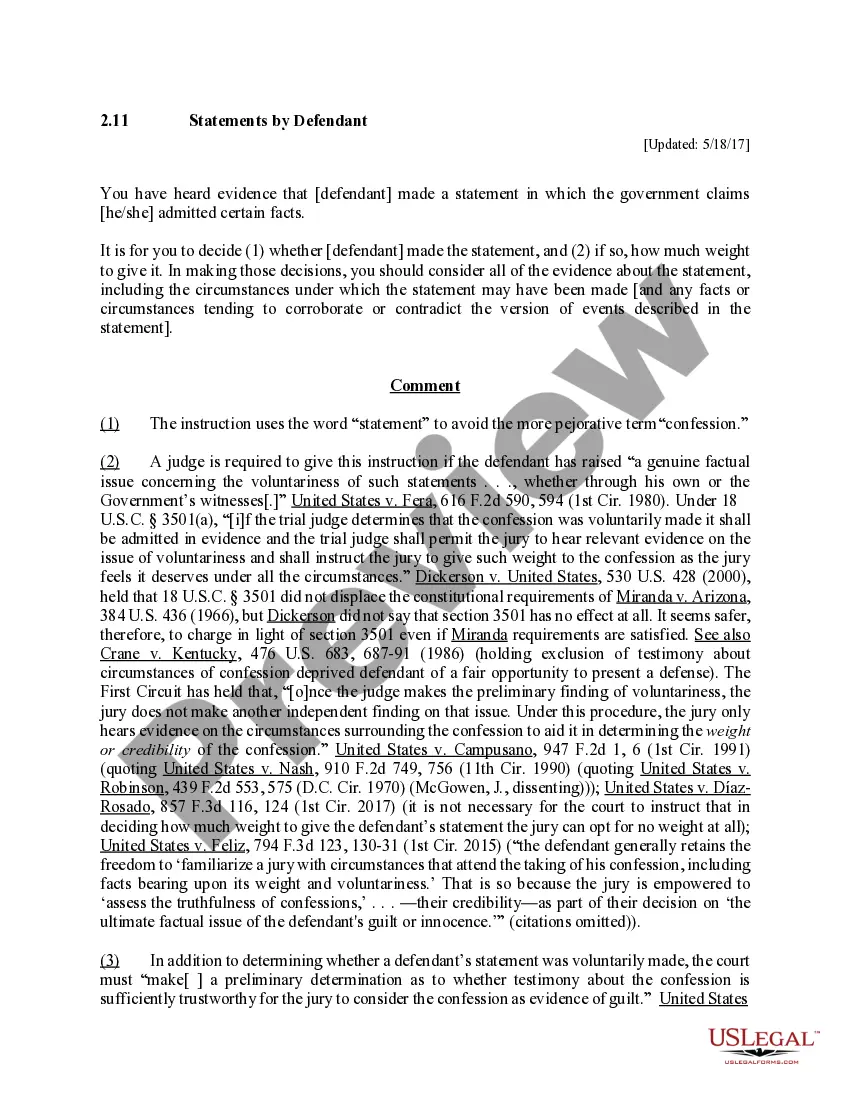
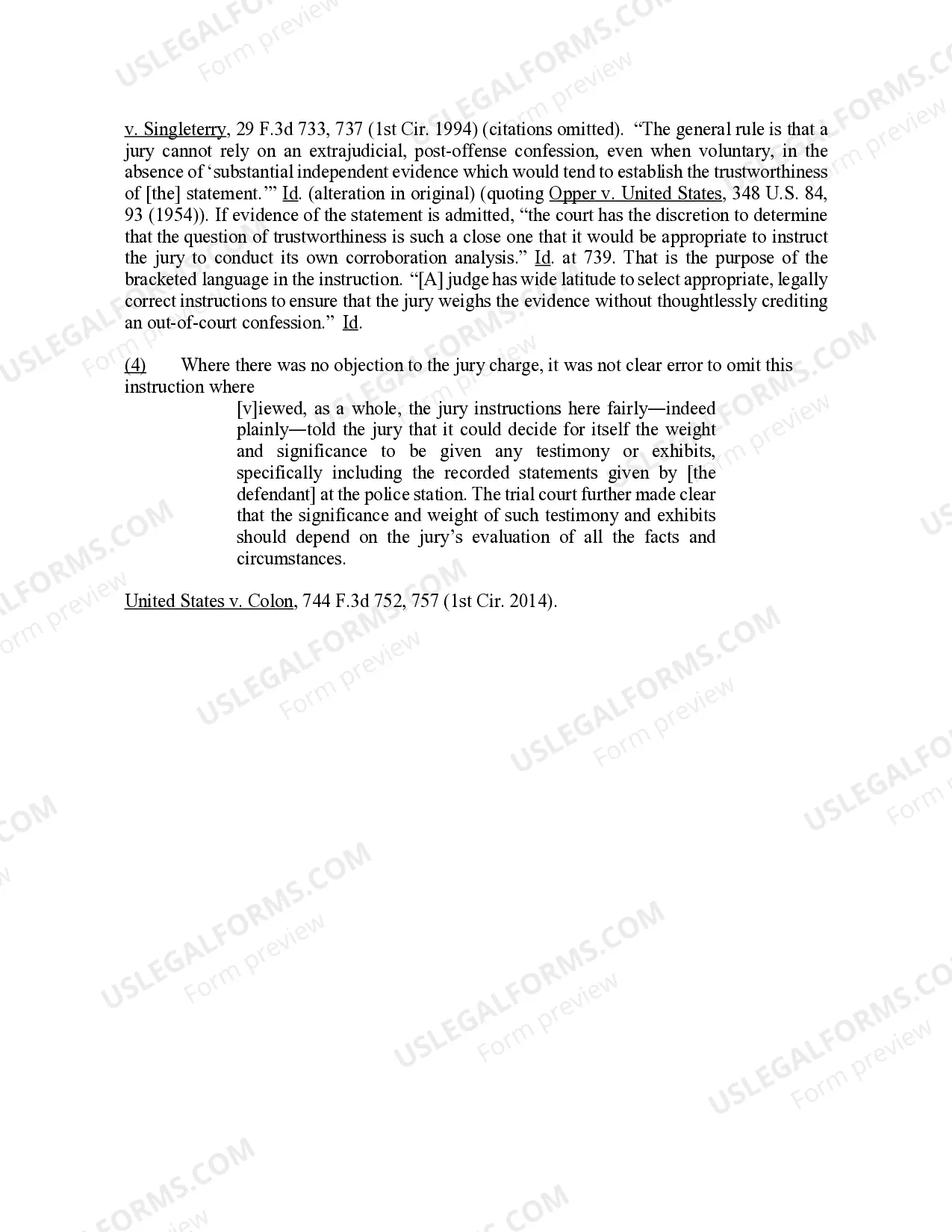
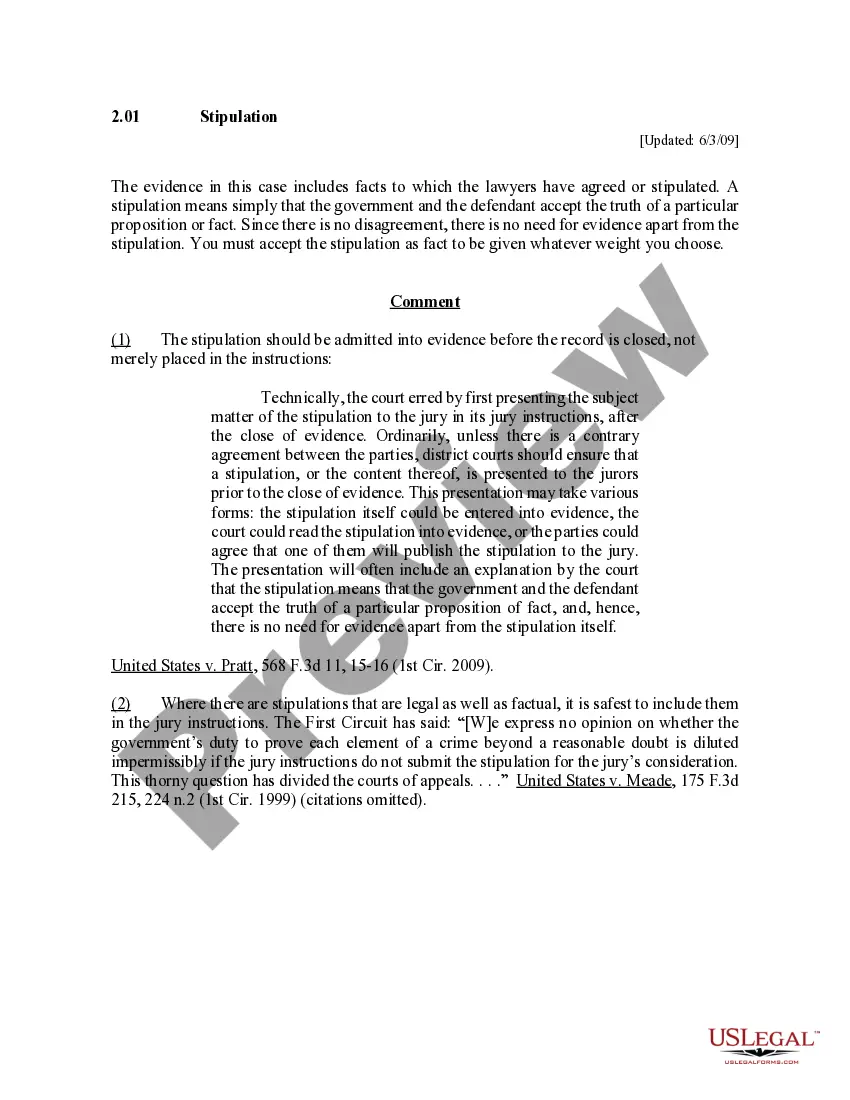
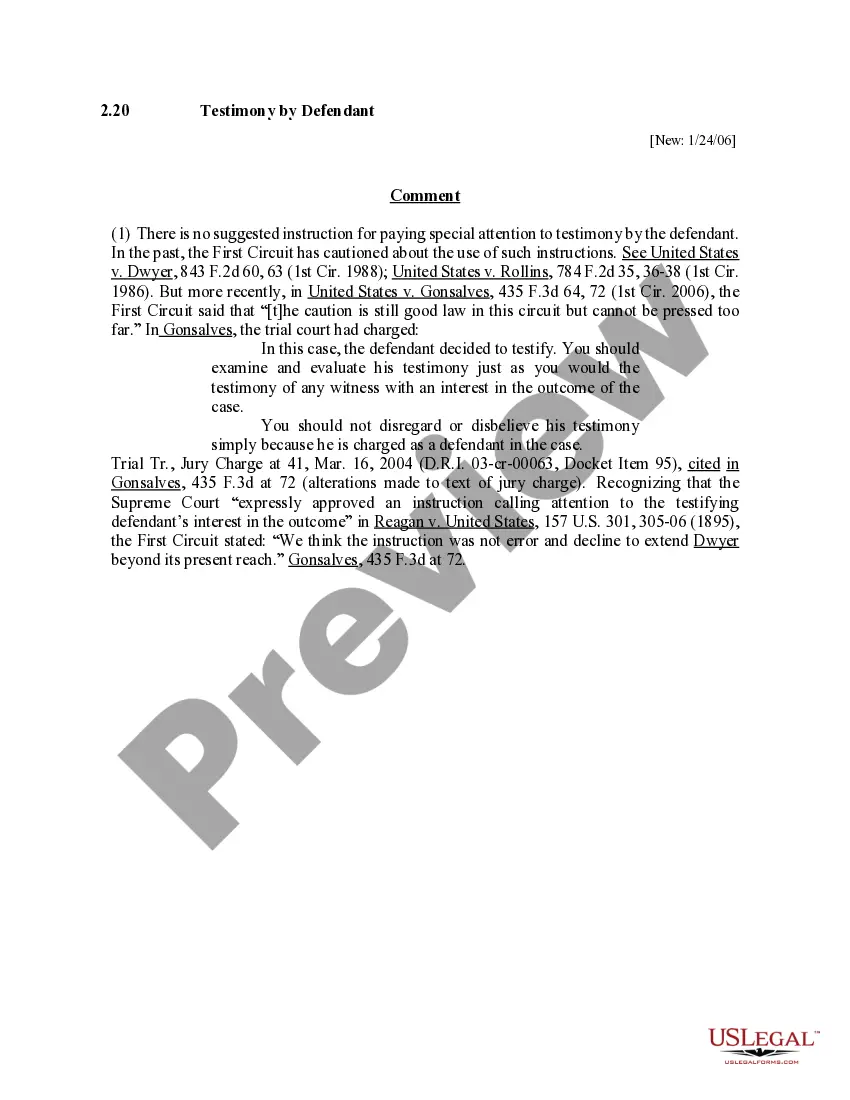
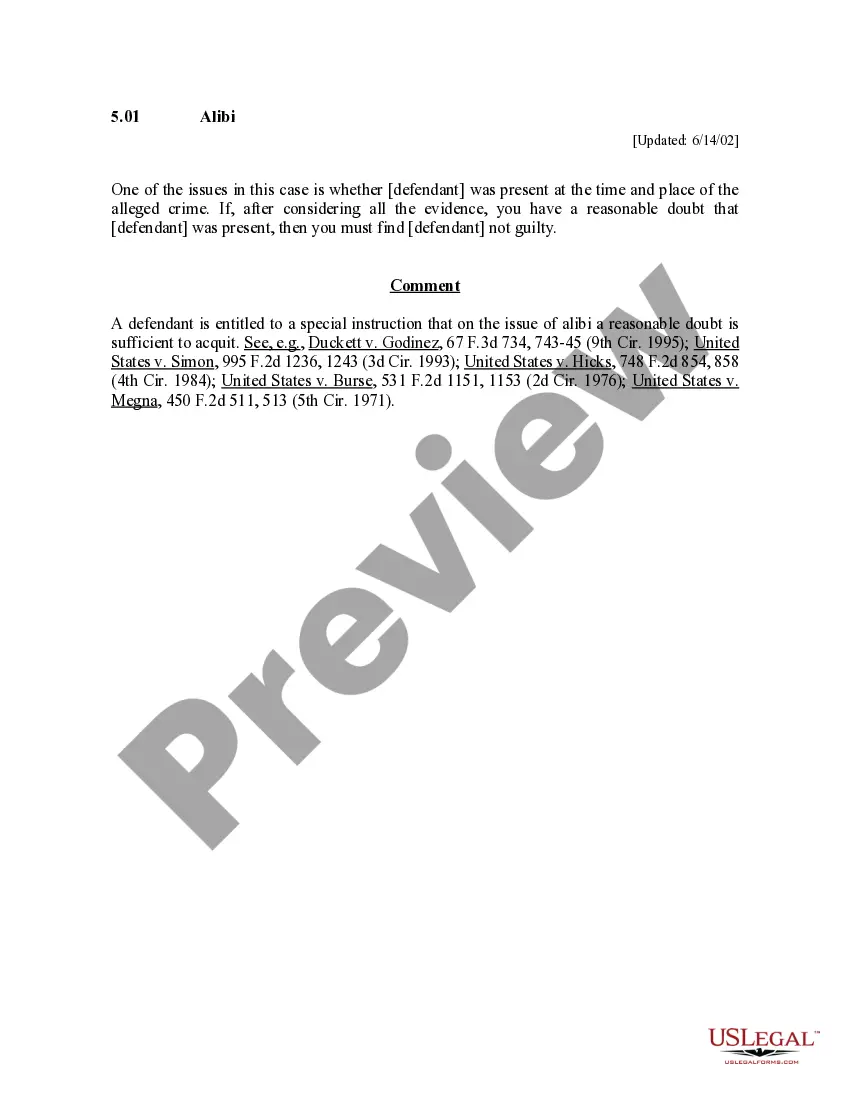
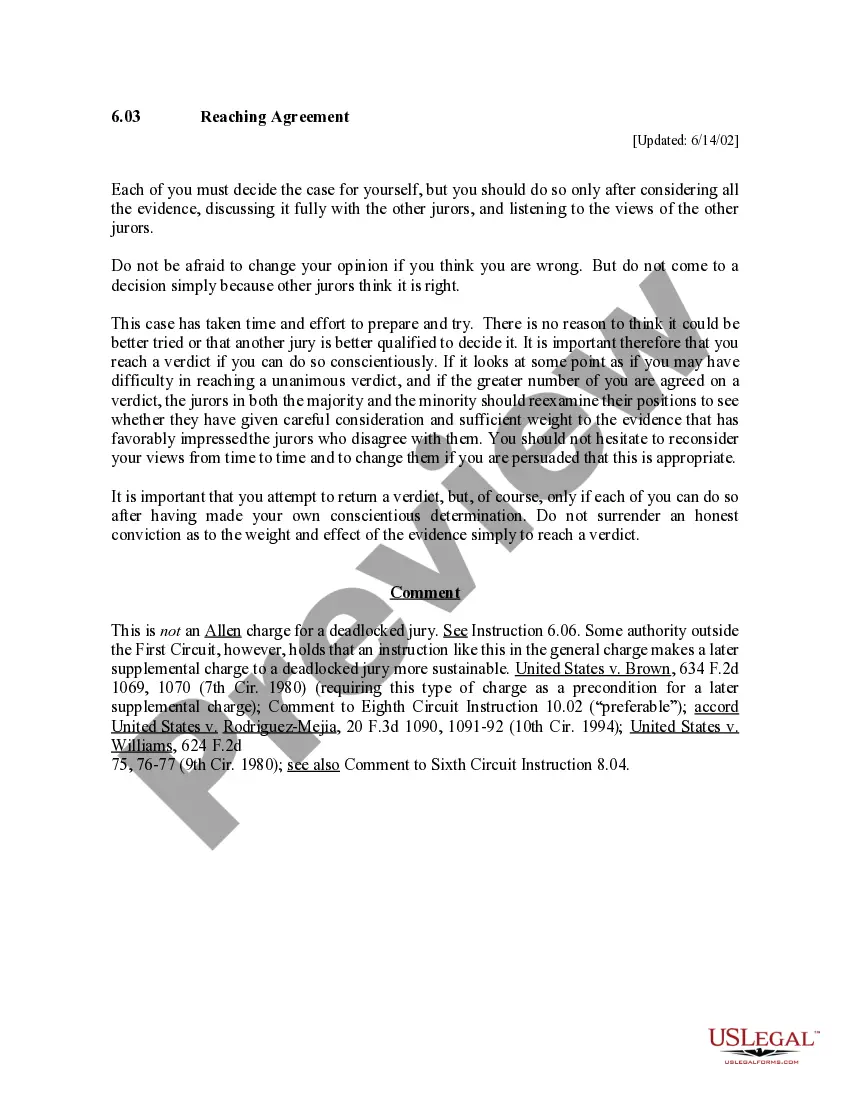
The Statements by Defendant form provides official jury instructions regarding the admissibility and evaluation of statements made by the defendant in a criminal case. It outlines the criteria jurors must consider when determining if a statement was made voluntarily and how much credibility to assign to it. This form is particularly important in federal criminal trials where the defense raises issues about the voluntariness of a defendantâs statements. It serves a different purpose than a confession, as it focuses on the circumstances surrounding the statement rather than viewing it solely as an admission of guilt.
Main sections of this form
- Definition of "statement" to avoid the term "confession."
- Criteria for jurors to determine whether the defendant made the statement.
- Guidelines for assessing the voluntariness and credibility of the statement.
- Judicial requirement for instruction if a factual issue regarding voluntariness is raised.
- Instructions on how to weigh the evidence surrounding the statement's circumstances.
Situations where this form applies
This form is used in criminal trials when the defendant's statements are presented as evidence. It is essential when the defense argues that the statements were made involuntarily or if there is a dispute regarding the circumstances under which the statements were made. This form is applicable in situations where jury instructions are necessary to guide the jury on evaluating the legitimacy and reliability of the defendant's statements.
Who this form is for
- Defense attorneys representing clients in federal criminal cases.
- Prosecutors who need to understand how to present evidence of a defendantâs statement.
- Judges presiding over federal criminal trials who are responsible for jury instructions.
- Law students or legal professionals studying or preparing for trial procedures involving statements made by defendants.
Steps to complete this form
- Review the evidence presented regarding the defendantâs statement.
- Determine if the statement was made by the defendant based on witness testimony.
- Assess the conditions under which the statement was made, considering any factors that may affect its voluntariness.
- Instruct the jury on the weight and credibility of the statement based on all provided evidence.
- Ensure all jury members understand the importance of corroborating evidence when evaluating the statement.
Notarization requirements for this form
Notarization is not commonly needed for this form. However, certain documents or local rules may make it necessary. Our notarization service, powered by Notarize, allows you to finalize it securely online anytime, day or night.
Get your form ready online
Our built-in tools help you complete, sign, share, and store your documents in one place.
Make edits, fill in missing information, and update formatting in US Legal Forms—just like you would in MS Word.
Download a copy, print it, send it by email, or mail it via USPS—whatever works best for your next step.
Sign and collect signatures with our SignNow integration. Send to multiple recipients, set reminders, and more. Go Premium to unlock E-Sign.
If this form requires notarization, complete it online through a secure video call—no need to meet a notary in person or wait for an appointment.
We protect your documents and personal data by following strict security and privacy standards.

Make edits, fill in missing information, and update formatting in US Legal Forms—just like you would in MS Word.

Download a copy, print it, send it by email, or mail it via USPS—whatever works best for your next step.

Sign and collect signatures with our SignNow integration. Send to multiple recipients, set reminders, and more. Go Premium to unlock E-Sign.

If this form requires notarization, complete it online through a secure video call—no need to meet a notary in person or wait for an appointment.

We protect your documents and personal data by following strict security and privacy standards.
Avoid these common issues
- Failing to adequately assess the circumstances surrounding the statement.
- Assuming all statements hold equal weight without considering the individual context.
- Neglecting to provide the necessary jury instructions when the voluntariness of a statement is contested.
Benefits of using this form online
- Convenient access to legal standards and jury instructions without the need for physical documents.
- Editability allows for easier adjustments to meet specific case needs.
- Reliable access to accurate legal language drafted by licensed attorneys.
Legal use & context
- The form guides jurors on how to approach evidence of statements made by the defendant.
- Jurors can only use a statement for determining guilt if there is corroborative evidence that supports its trustworthiness.
- Principles established in U.S. court cases inform the use of this instruction, ensuring adherence to constitutional standards.
What to keep in mind
- This form provides vital instructions for evaluating a defendantâs statements in court.
- It is crucial to ensure the jury understands the difference between a statement and a confession.
- Proper jury instruction can significantly impact a trialâs outcome by guiding jurors on how to assess the reliability of evidence.
Looking for another form?
Form popularity
FAQ
Rule 45 in Maine pertains to subpoenas, which are legal documents that order a person to appear in court or produce documents. This rule plays a crucial role in the litigation process, enabling access to vital information, including Maine Statements by Defendant. Understanding Rule 45 helps parties ensure they comply with the law while gathering necessary evidence for their cases.
A party may obtain without the required showing a statement concerning the action or its subject matter previously made by that party. Upon request, a person not a party may obtain without the required showing a statement concerning the action or its subject matter previously made by that person.
(a) Subsequent remedial measures. When measures are taken that would have made an earlier injury or harm less likely to occur, evidence of the subsequent measures is not admissible to prove: (1) Negligence; (2) Culpable conduct; (3) A defect in a product or its design; or (4) A need for a warning or instruction.
Maine Rule 609 requires all convictions to pass a "reverse Rule 403 " test, i.e. they can be admitted only if their probative value as to credibility outweighs any danger of unfair prejudice to a criminal defendant or any civil party.
Rule 35(a) is amended to permit an order against a party for the examination of a person in his custody or under his legal control. Thus, a parent or guardian suing to recover for injuries to a minor may be ordered to produce the minor for examination.
The court may judicially notice a fact that is not subject to reasonable dispute because it: (1) Is generally known within the trial court's territorial jurisdiction; or (2) Can be accurately and readily determined from sources whose accuracy cannot reasonably be questioned.
The court shall appoint a guardian ad litem for a minor or incompetent person not otherwise represented in an action or shall make such other order as it deems proper for the protection of the minor or incompetent person.
Evidence is relevant if: (a) It has any tendency to make a fact more or less probable than it would be without the evidence; and (b) The fact is of consequence in determining the action.
Rule 601 - COMPETENCY TO TESTIFY IN GENERAL (a) Every person is competent to be a witness unless these rules provide otherwise.