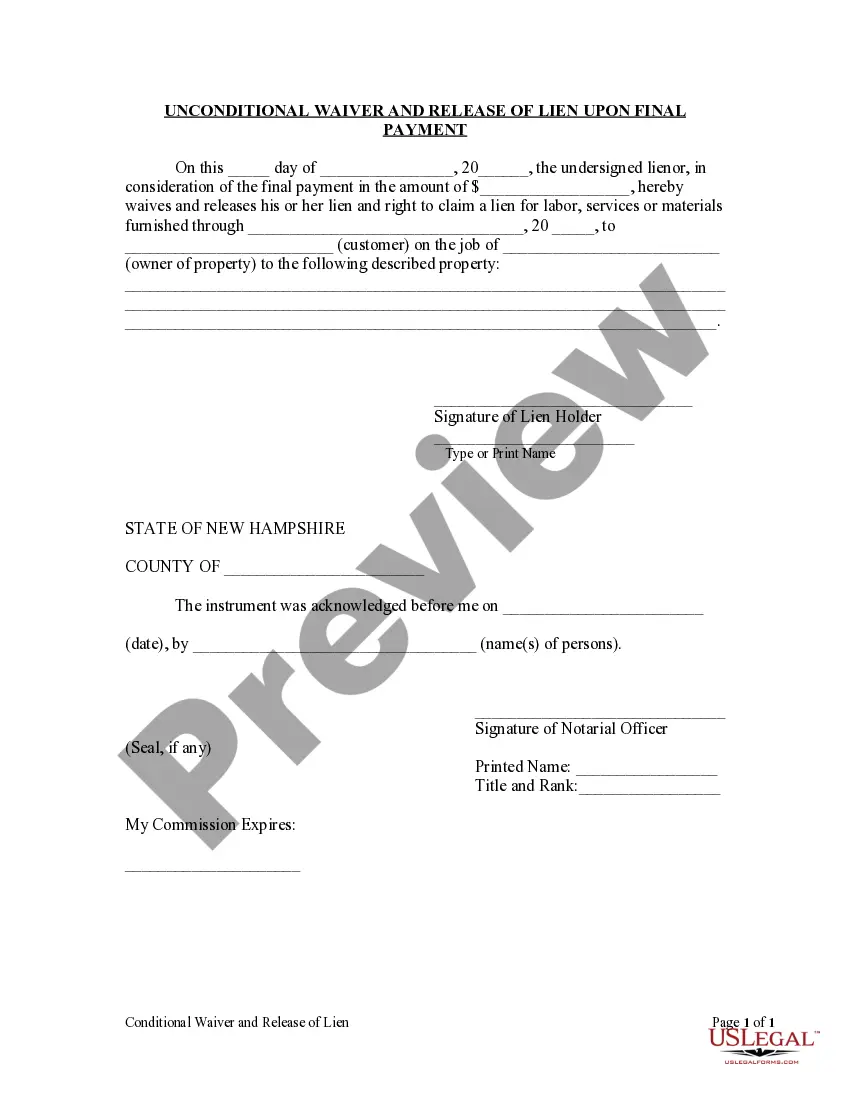
Massachusetts New Resident Guide
The New Resident Guide is an informational form designed to help individuals who have recently moved to a new state understand the essential requirements for establishing residency. This guide provides detailed information on voter registration, obtaining identification cards, securing a driver's license, and registering vehicles. Unlike other legal forms, this guide serves as a comprehensive resource to navigate the various legal obligations that come with being a new resident.
- Voting registration requirements, including deadlines and methods for registration.
- Identification card requirements for residents without a driver's license.
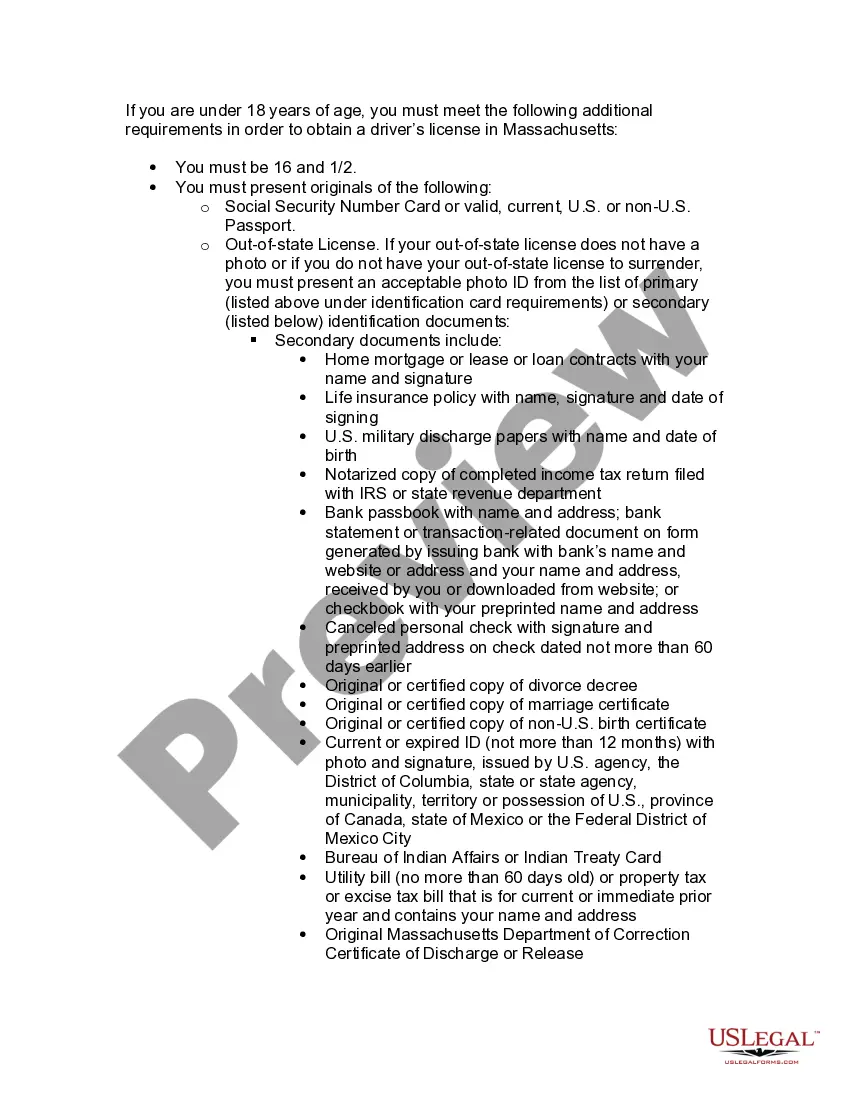
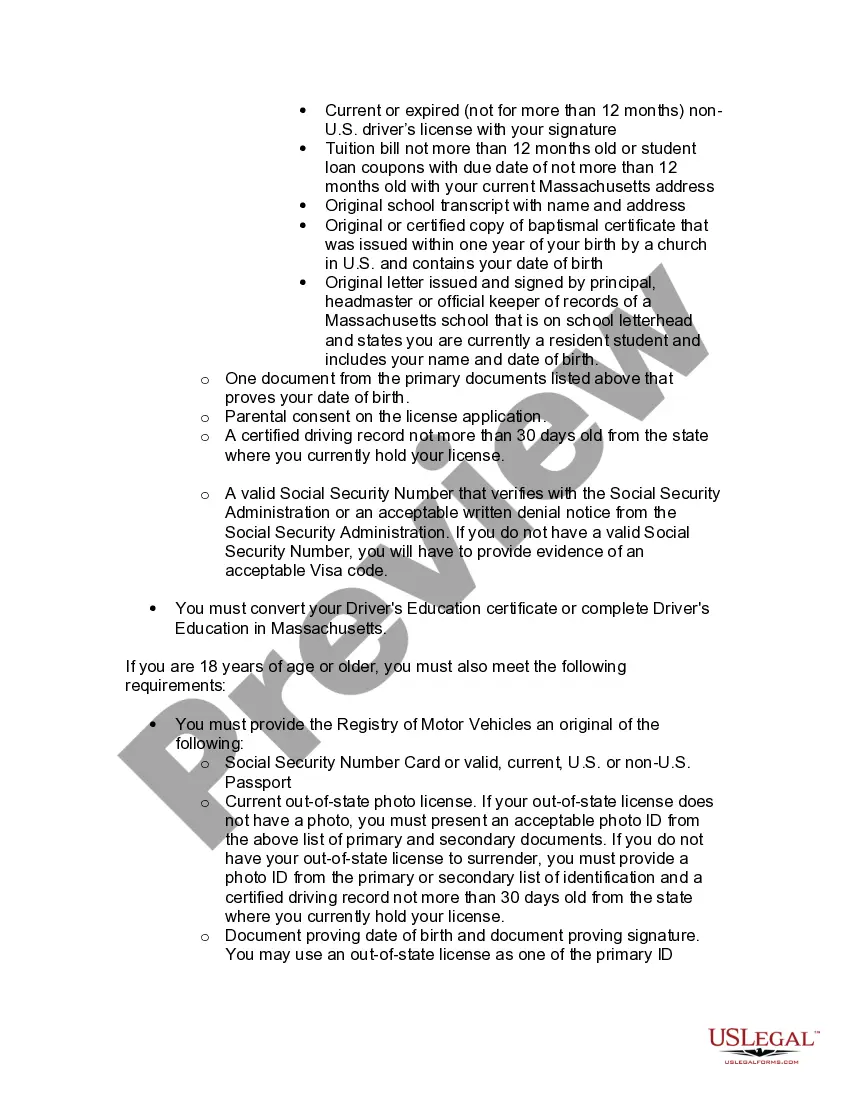
- Driver's license application process and necessary documentation.
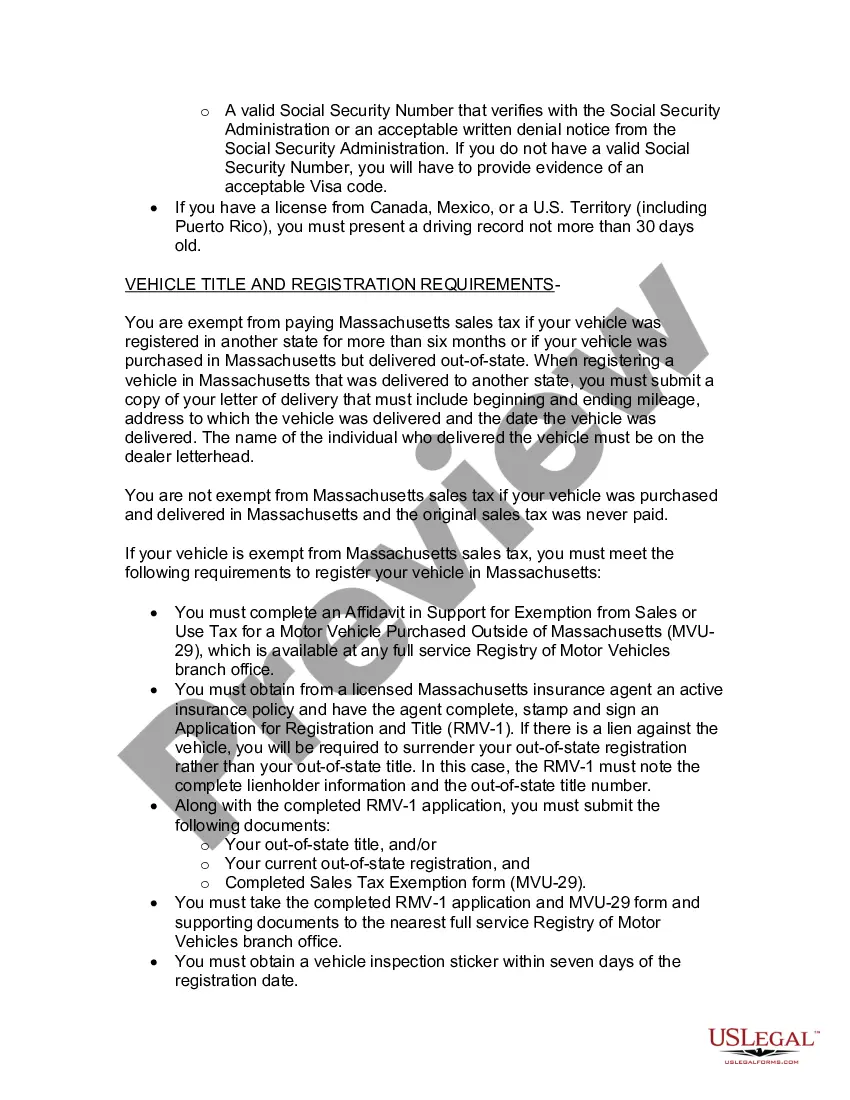
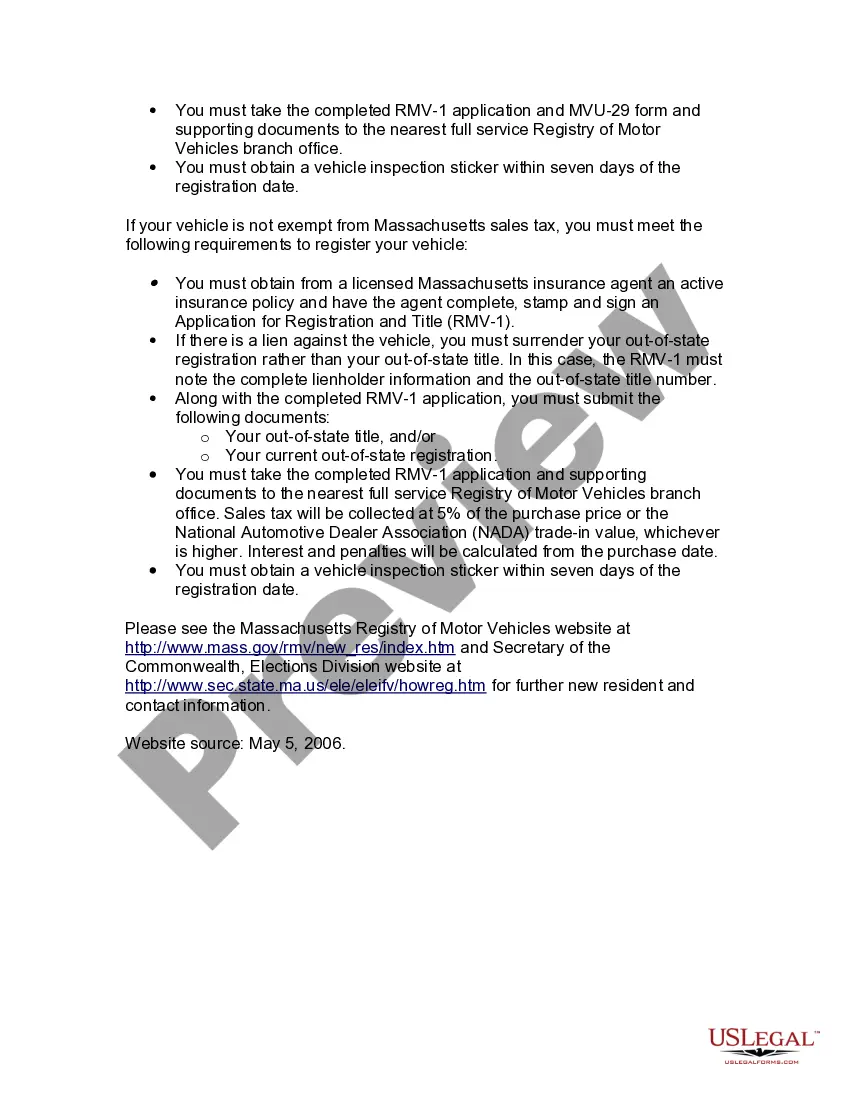
- Vehicle title and registration procedures, including taxation information.
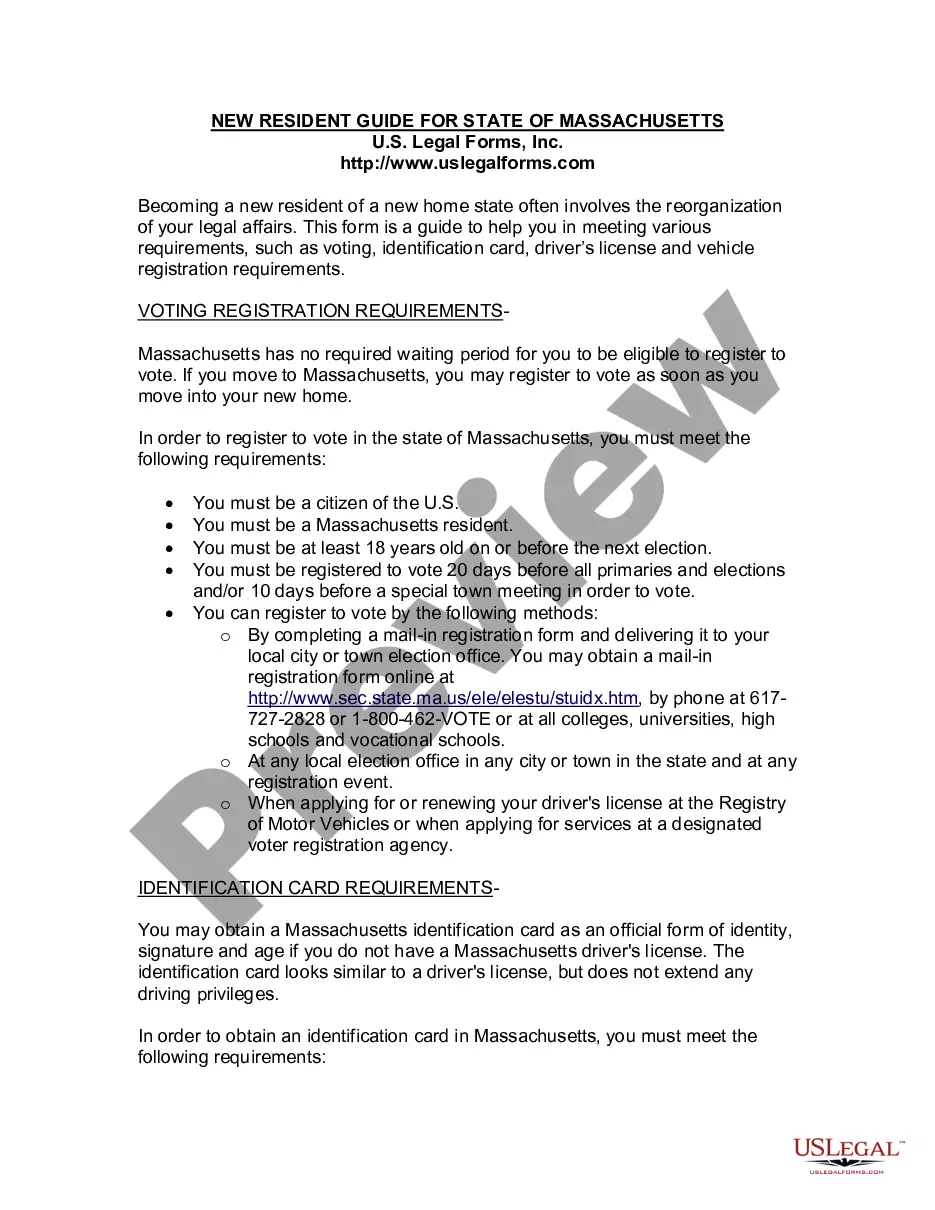
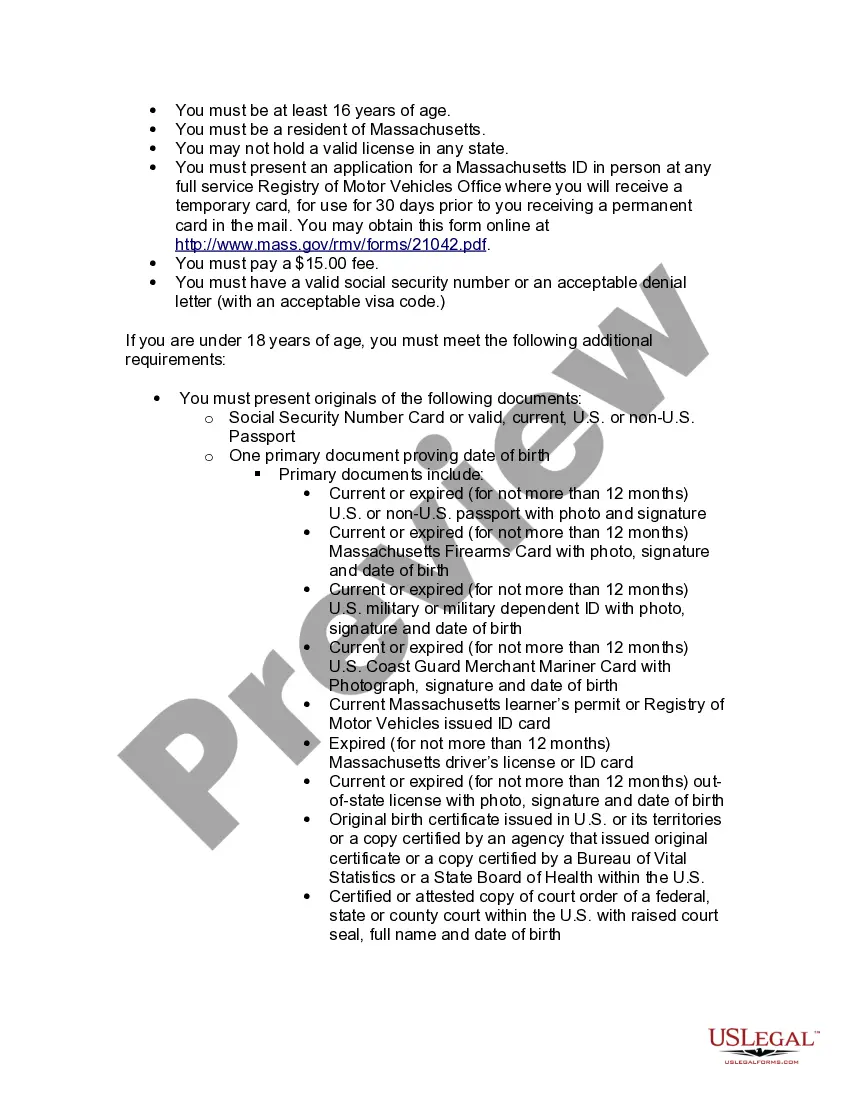
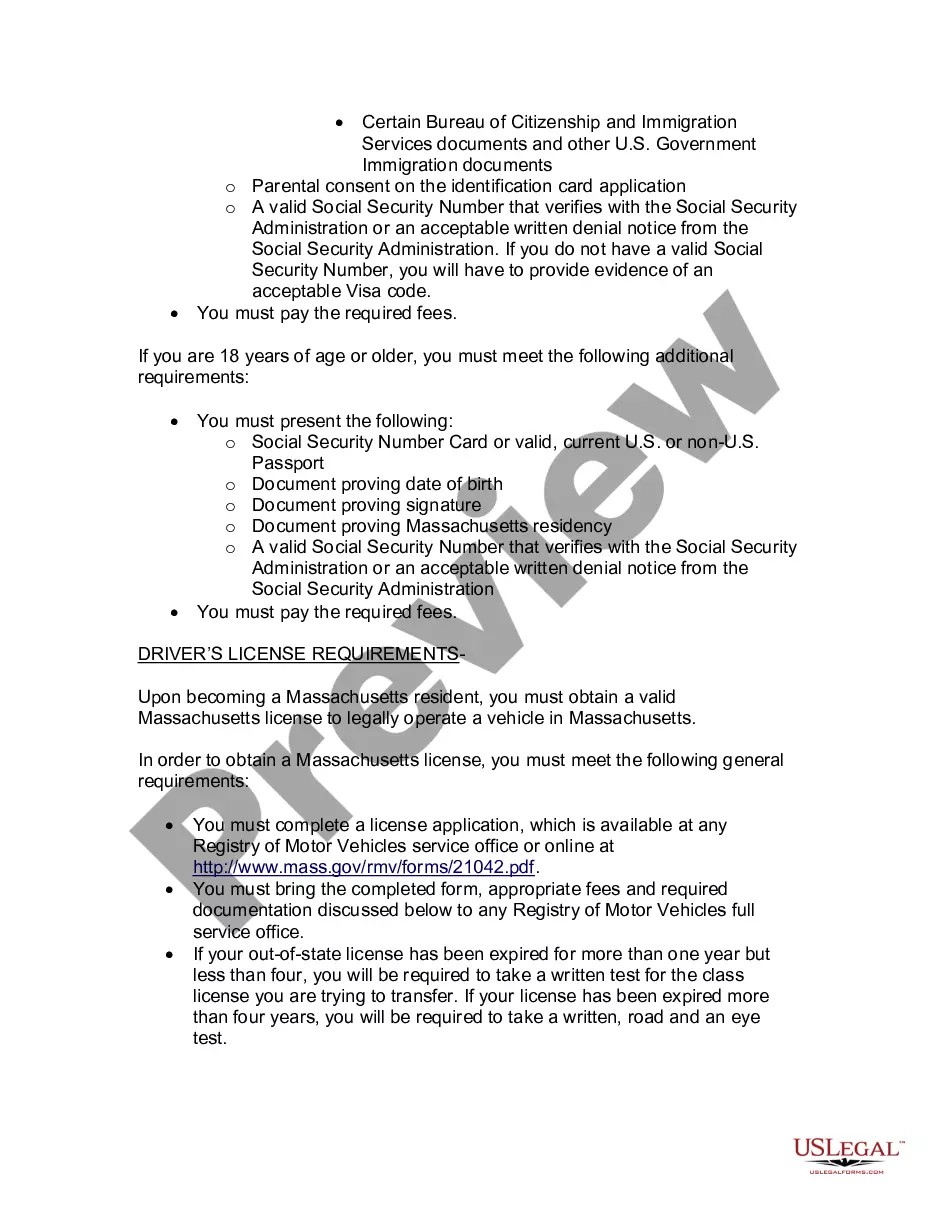
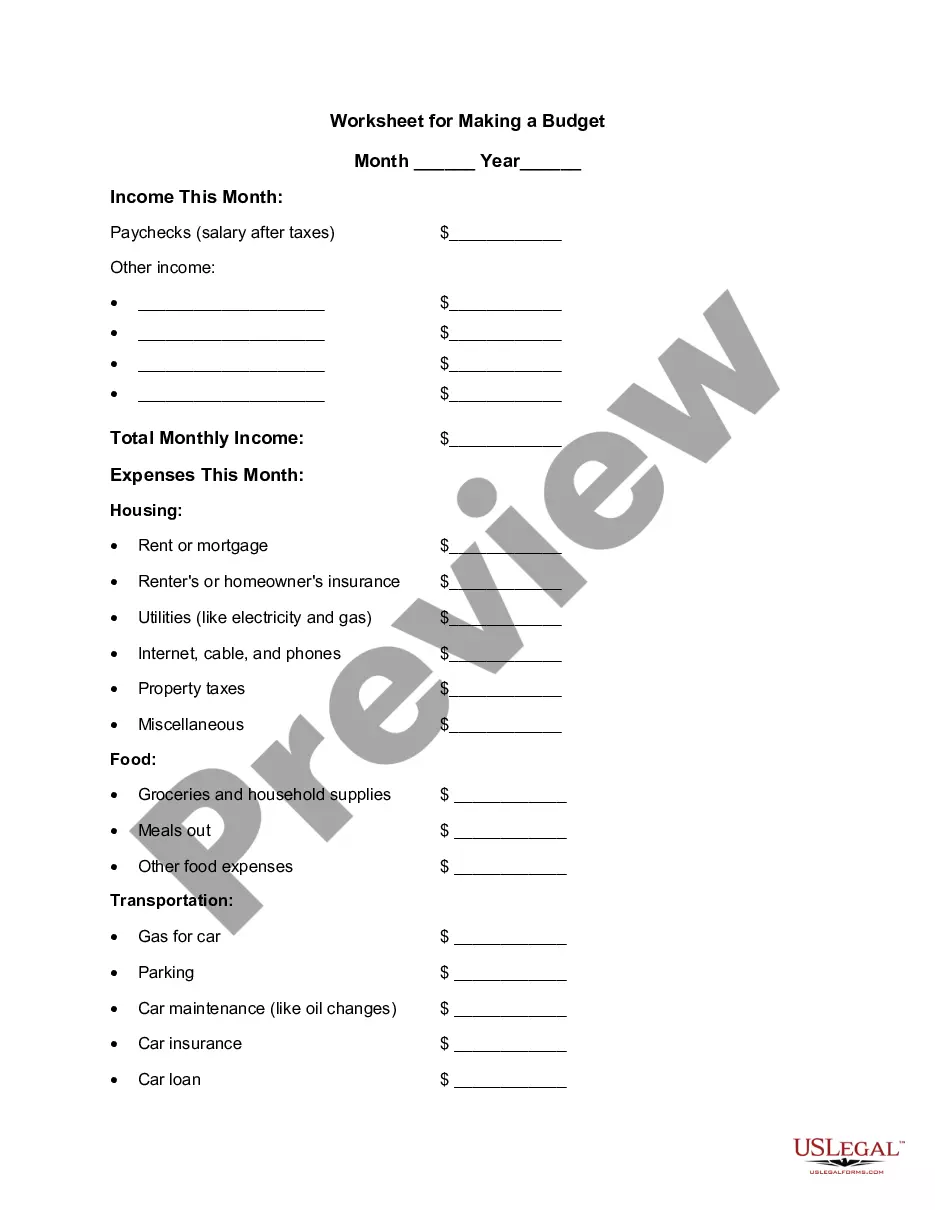
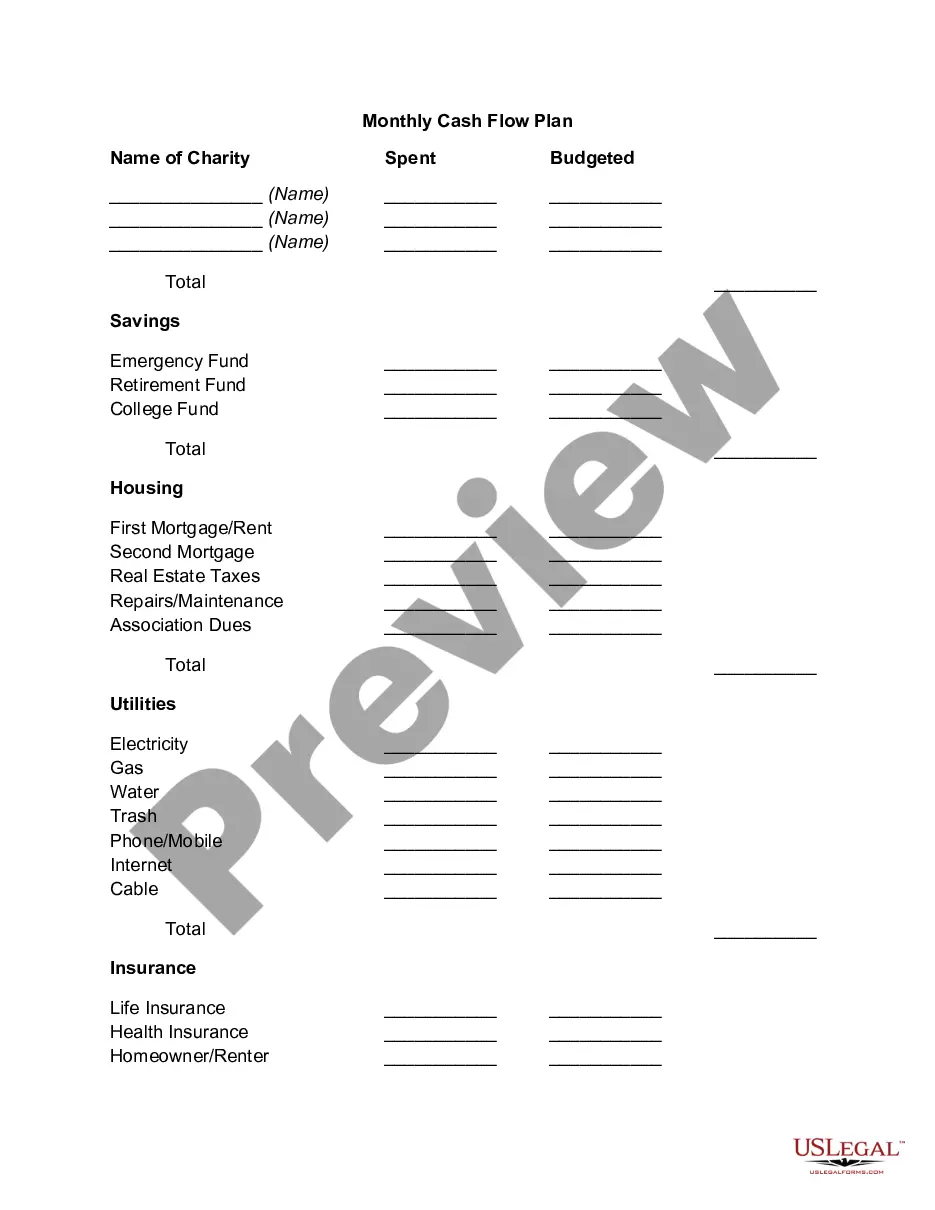
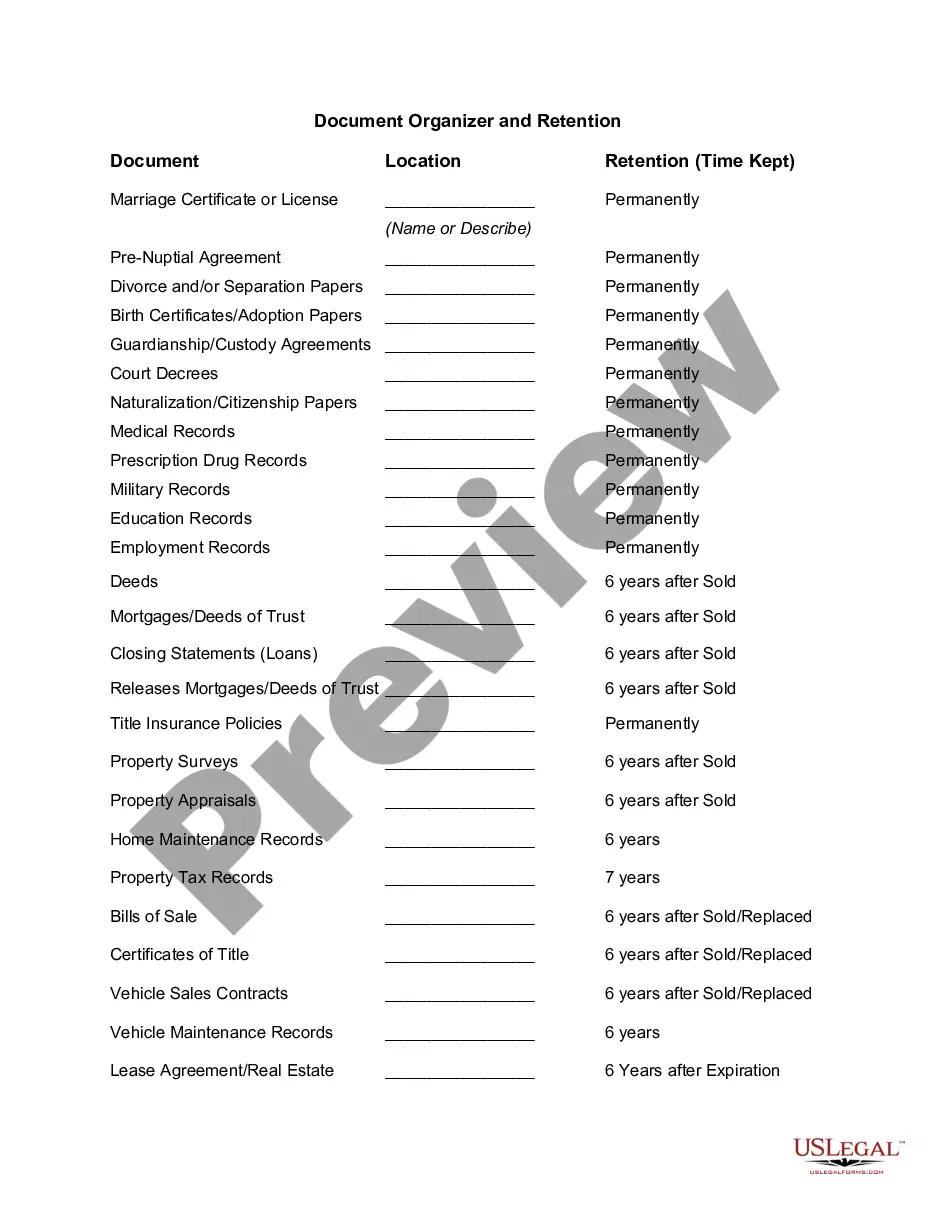
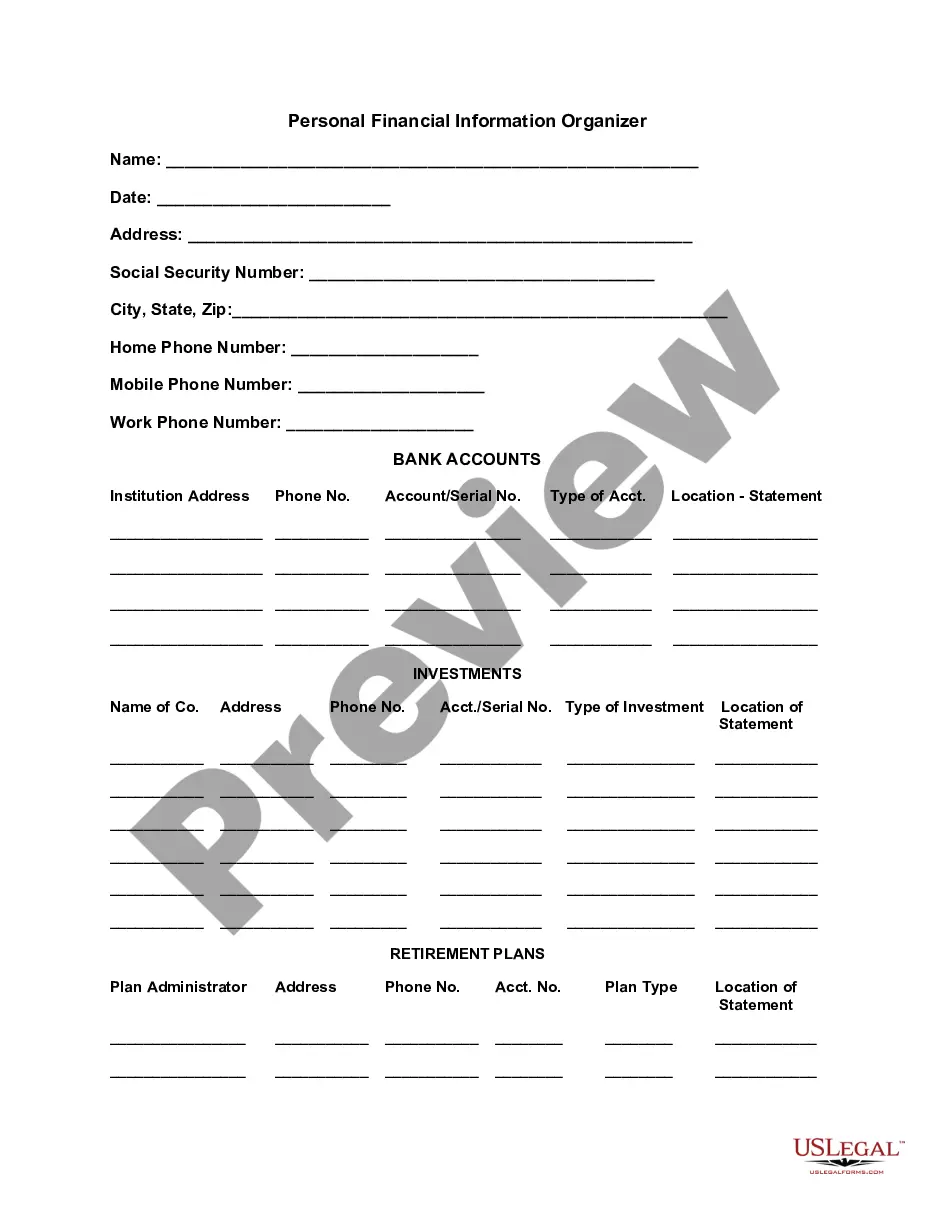
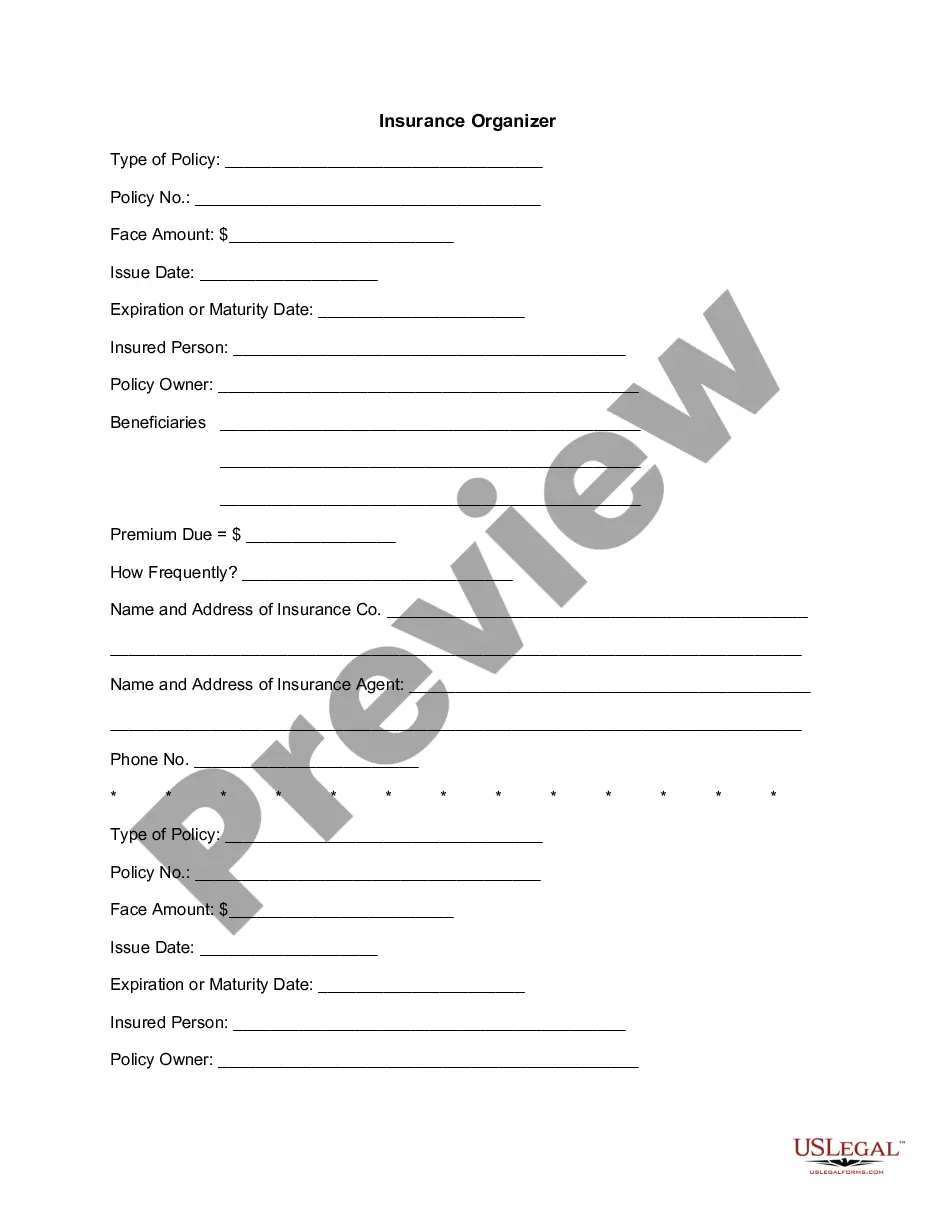
This form is particularly useful when you have recently relocated to a new state and need guidance on fulfilling legal requirements related to residency. It helps you understand how to register to vote, obtain necessary identification, secure a driver's license, and properly register your vehicle in your new state.
Eligibility for this form includes:
- New residents of any U.S. state seeking information about state-specific residency requirements.
- Individuals needing to understand the voting registration process in their new state.
- Those who are applying for identification cards or driver's licenses in a new state.
- People looking to register vehicles after moving.
To complete this form, follow these steps:
- Review the overview of requirements for voter registration, identification, and vehicle registration based on your new state.
- Gather necessary documents, including proof of residency, identity, and any previous vehicle registration.
- Complete the relevant applications for voting and identification cards as applicable.
- Submit your driver's license application according to state guidelines.
- Register your vehicle, ensuring you meet any state-specific tax obligations.
This form does not typically require notarization unless specified by local law.
Get your form ready online
Our built-in tools help you complete, sign, share, and store your documents in one place.
Make edits, fill in missing information, and update formatting in US Legal Forms—just like you would in MS Word.
Download a copy, print it, send it by email, or mail it via USPS—whatever works best for your next step.
Sign and collect signatures with our SignNow integration. Send to multiple recipients, set reminders, and more. Go Premium to unlock E-Sign.
If this form requires notarization, complete it online through a secure video call—no need to meet a notary in person or wait for an appointment.
We protect your documents and personal data by following strict security and privacy standards.
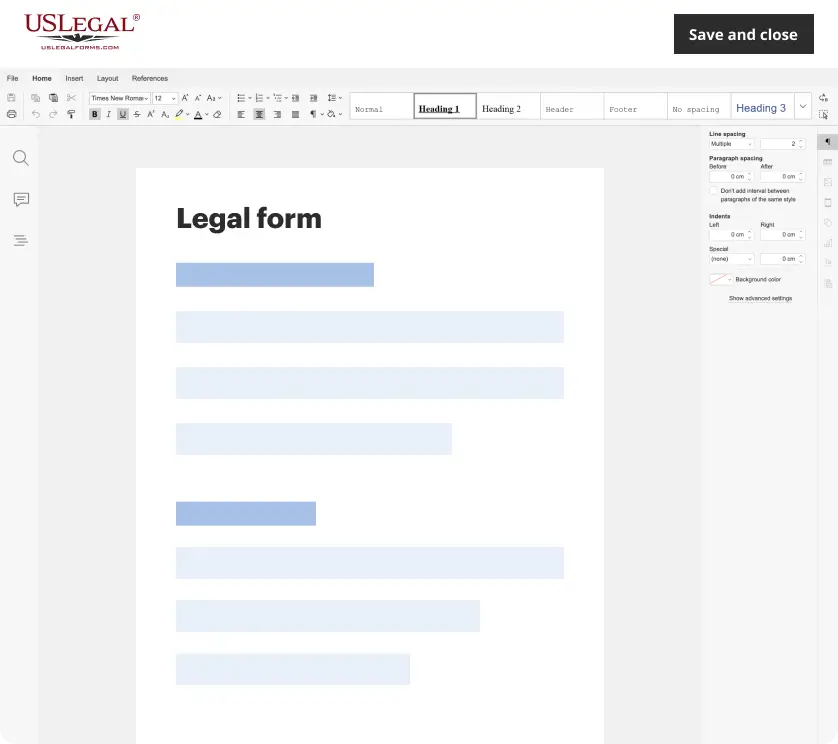
Make edits, fill in missing information, and update formatting in US Legal Forms—just like you would in MS Word.
Download a copy, print it, send it by email, or mail it via USPS—whatever works best for your next step.
Sign and collect signatures with our SignNow integration. Send to multiple recipients, set reminders, and more. Go Premium to unlock E-Sign.

If this form requires notarization, complete it online through a secure video call—no need to meet a notary in person or wait for an appointment.
We protect your documents and personal data by following strict security and privacy standards.
- Failing to register to vote before the designated deadline.
- Not providing the correct documentation for an identification card application.
- Incorrectly filling out the driver's license application, leading to delays.
- Omitting the required taxes or forms when registering a vehicle.
- Easy access to state-specific residency guidelines in one comprehensive guide.
- Streamlined process for gathering and submitting necessary documentation.
- Time-saving information that can simplify legal obligations as a new resident.
- The New Resident Guide serves as an informative tool to navigate your new state's residency laws.
- This guide is not a legally binding document but a resource to assist with compliance.
- Ensure that you follow the most current state guidelines as laws may change.
Looking for another form?





Form popularity
FAQ
Residency. There is no formal procedure for establishing a legal residence in Massachusetts. Voter registration, automobile registration, a driver's license, the appearance of a person's name on a city or town street list, and rent, utility, mortgage or telephone bills normally provide tangible proof of residence.
A Resident of Massachusetts is an individual who is domiciled in Massachusetts or maintains a permanent place of abode in MA and spends more than 183 days in the state. A Nonresident of Massachusetts is an individual who was not domiciled in Massachusetts but earned MA income.
Not only must a person maintain a permanent place of abode in Massachusetts, but a person must also spend more than 183 days in Massachusetts to meet the definition of a resident. For purposes of determining presence in Massachusetts, a day is defined as any part of a day spent in Massachusetts for whatever reason.
Generally, you need to establish a physical presence in the state, an intent to stay there and financial independence. Then you need to prove those things to your college or university. Physical presence: Most states require you to live in the state for at least a full year before establishing residency.
Tech Hub The Future of Jobs is Tech; the Future of Tech is Massachusetts. Higher Education The Best Universities in The World. Public Education Massachusetts is a Model for the Entire Country. Health Care One of the Best in the Country and Getting Better. Sports A Legacy of Winning.
Lawful presence (1 document) If your name differs on the lawful presence document, you must also provide proof of the legal name change. Social Security number (1 document) Massachusetts residency (2 documents)
Generally you are considered a resident if your domicile is that state, or (if your domicile is another state) you maintained a permanent place of abode in that state and spent more than 184 days there during the year. Most state tax authorities have a page explaining what exactly constitutes a resident in their state.
A resident is a person who maintains a permanent place of abode in Massachusetts and spends more than 183 days of the taxable year in Massachusetts. Whether a person maintains a permanent place of abode in Massachusetts is a factual determination.