Louisiana Interim Order
Understanding this form
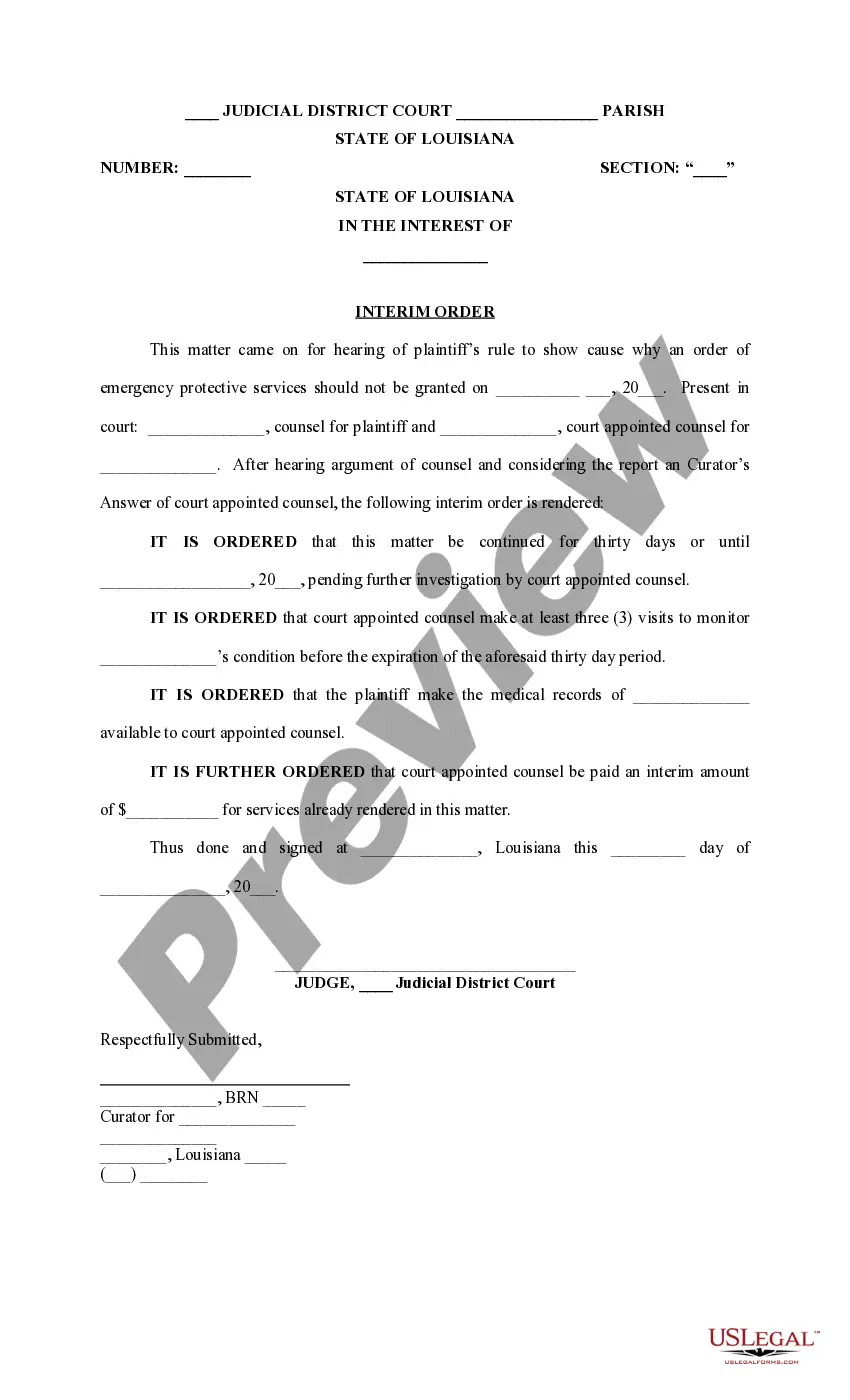
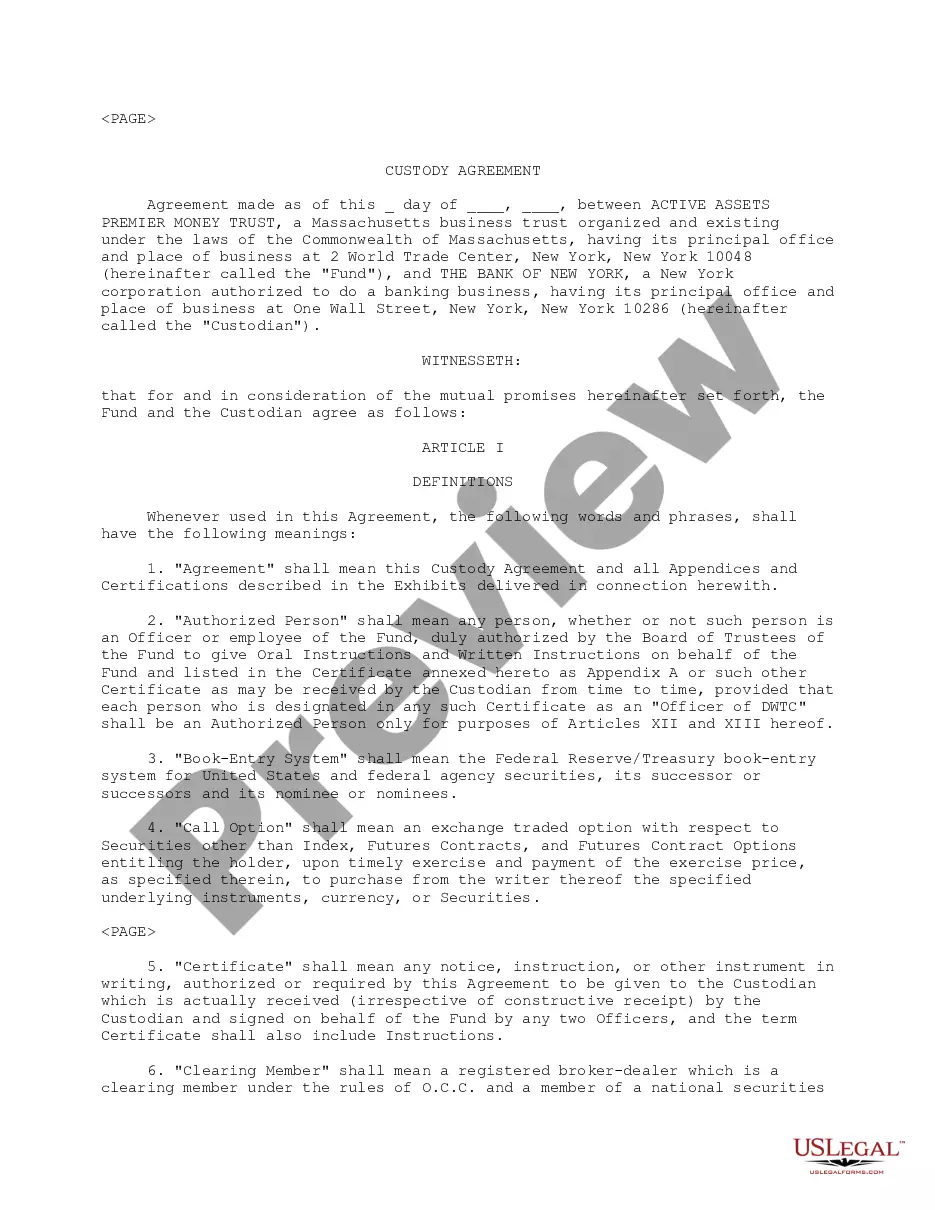
The Interim Order is a legal document issued during a court hearing for emergency protective services for an elderly person. It serves to temporarily extend the proceedings for thirty days while further investigations are conducted. This form is essential for ensuring the ongoing safety and welfare of an individual who may be at risk and differs from a final protective order as it provides a temporary solution pending further review by the court.
Key parts of this document
- Identification of the state and court jurisdiction.
- Details of the hearing date and parties present.
- Order to continue the matter for thirty days.
- Requirements for court-appointed counsel, including monitoring visits.
- Instructions for the plaintiff regarding medical record availability.
- Compensation for services rendered to appointed counsel.

When to use this document
This form should be used during court proceedings when there are immediate concerns for the safety of an elderly individual. It is particularly relevant in situations where a protective order is being sought, but further investigation is required to determine the individual's circumstances. It allows for the necessary legal action to be taken promptly while ensuring that the individual remains protected during the interim period.
Who this form is for
- Individuals seeking protective services for an elderly loved one.
- Guardians or curators appointed to oversee an elderly person's welfare.
- Legal representatives of involved parties in proceedings related to elderly protection.
Instructions for completing this form
- Identify the state and court jurisdiction at the top of the document.
- Fill in the case number and section as required by the court.
- Enter the names of the parties present during the hearing.
- Specify the date the matter is to be continued by filling in the blank.
- Document the number of visits the court-appointed counsel must make.
- Ensure signatures are obtained from the judge and the curator for legal validity.
Does this document require notarization?
This form does not typically require notarization unless specified by local law. It is advisable to check with the court or legal counsel regarding any specific requirements that may apply.
Get your form ready online
Our built-in tools help you complete, sign, share, and store your documents in one place.
Make edits, fill in missing information, and update formatting in US Legal Forms—just like you would in MS Word.
Download a copy, print it, send it by email, or mail it via USPS—whatever works best for your next step.
Sign and collect signatures with our SignNow integration. Send to multiple recipients, set reminders, and more. Go Premium to unlock E-Sign.
If this form requires notarization, complete it online through a secure video call—no need to meet a notary in person or wait for an appointment.
We protect your documents and personal data by following strict security and privacy standards.

Make edits, fill in missing information, and update formatting in US Legal Forms—just like you would in MS Word.

Download a copy, print it, send it by email, or mail it via USPS—whatever works best for your next step.

Sign and collect signatures with our SignNow integration. Send to multiple recipients, set reminders, and more. Go Premium to unlock E-Sign.

If this form requires notarization, complete it online through a secure video call—no need to meet a notary in person or wait for an appointment.

We protect your documents and personal data by following strict security and privacy standards.
Typical mistakes to avoid
- Failing to complete all required fields, leading to potential delays.
- Not providing specific dates for follow-up actions.
- Omitting signatures from necessary parties, rendering the form invalid.
Benefits of completing this form online
- Convenient access to legal forms that can be completed from home.
- Edit and customize the form to fit individual circumstances easily.
- Reliable templates drafted by licensed attorneys ensure legal compliance.
Looking for another form?




Form popularity
FAQ
Can a child choose not to visit a parent? The mere age of your child will not determine your family law matter. There have been cases before the Court where a 17 year old child's wishes were given limited weight because the basis for this child's decision was not balanced.
In cases where parents can't agree, a judge will decide visitation and custody based on the child's best interests.Both parents are bound by the terms of a custody order. If your child refuses to go to visits with the other parent, you could still be on the hook for failing to comply with a custody order.
Temporary alimony or spousal support is an order for support that comes during a divorce, legal separation or even an annulment case after one party has filed such a request with the court.Temporary spousal support is also called pendente lite spousal support, which means an order made during the pendency of a case.
Generally, the petition is filed in a civil district court in the parish in which the interdict is domiciled (permanent home). If the defendant does not have a permanent home, the petition is filed where he resides or where he is physically present if he is not a resident of the state.
An ex parte order of temporary custody shall: (1) Expire by operation of law within thirty days of signing of the order; however, the order may be extended for good cause shown at any time before its expiration for one period not exceeding fifteen days.
Some judges have stated that a 5-year-old child is too young to have an opinion on custody and won't consider such a young child's opinion at all. If the child is at least 12 years old, courts will usually give the child's preference some weight. Courts don't have to follow a child's custodial preference.
Under Louisiana law, interim spousal support ends when the court makes a final judgment about spousal support or 180 days after your divorce is finalized, whichever comes first. Sometimes Louisiana courts extend interim spousal support, but you need to provide a compelling reason.
How Long Must One Pay Alimony (Spousal Support) For longer-term relationships, as well as in cases where the parties' have children, the courts generally do not place a time limit on alimony. This does not mean you'll need to pay spousal support forever or that you'll receive spousal support forever.
An award of interim spousal support is a temporary order that is eventually replaced by a final spousal support order upon the conclusion of divorce proceedings. Just like a final spousal support order, interim alimony is determined based on the parties respective income and expenses.