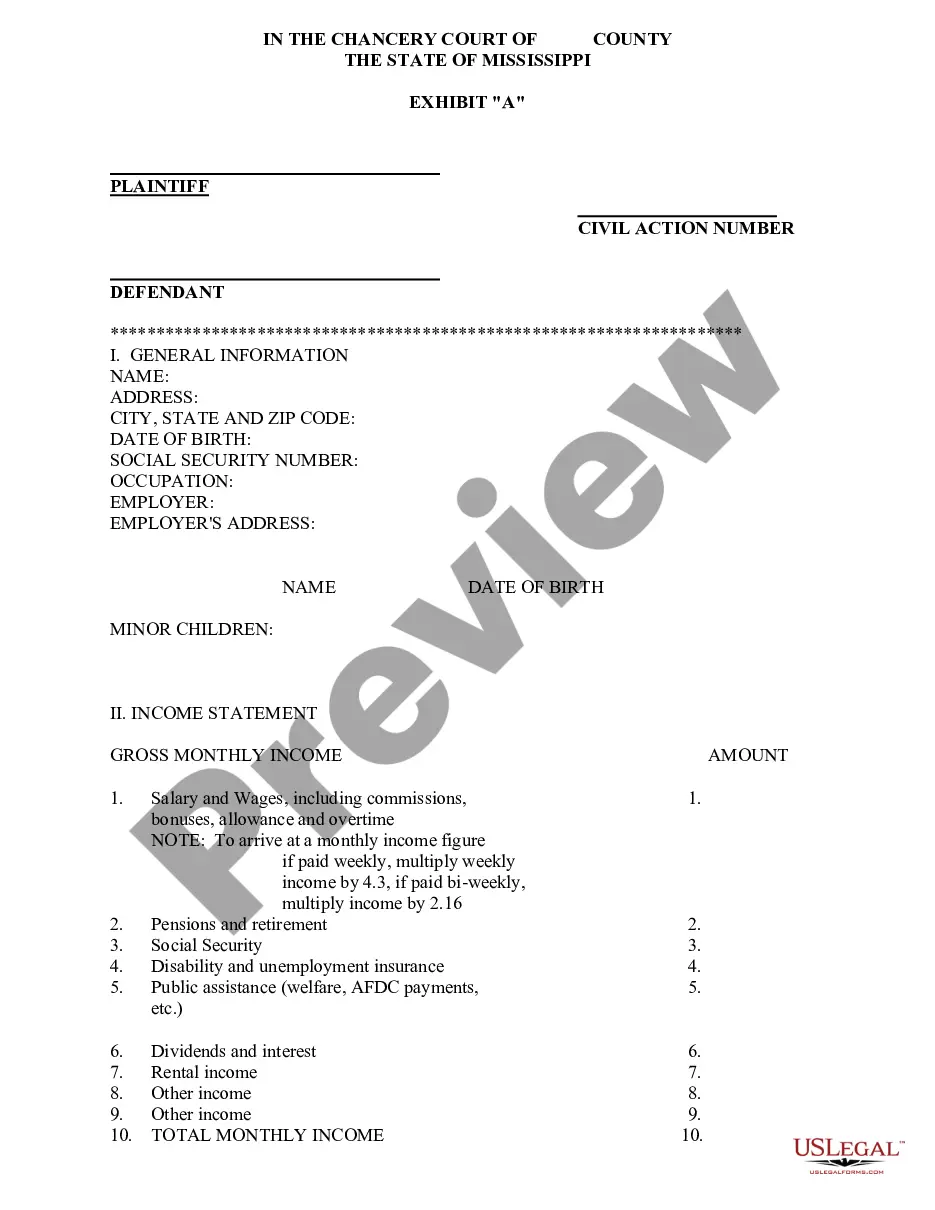
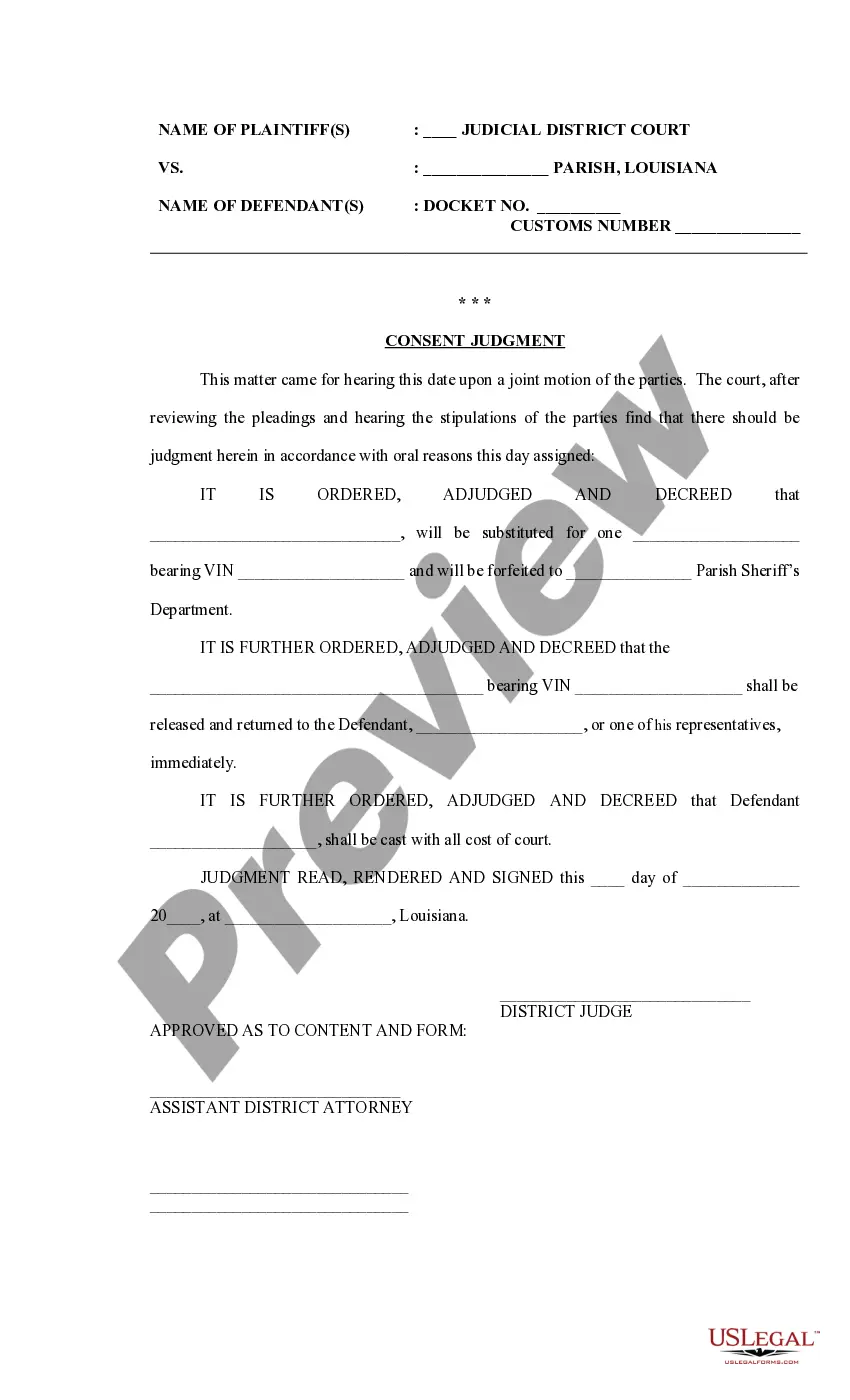
Louisiana Consent Judgment
About this form
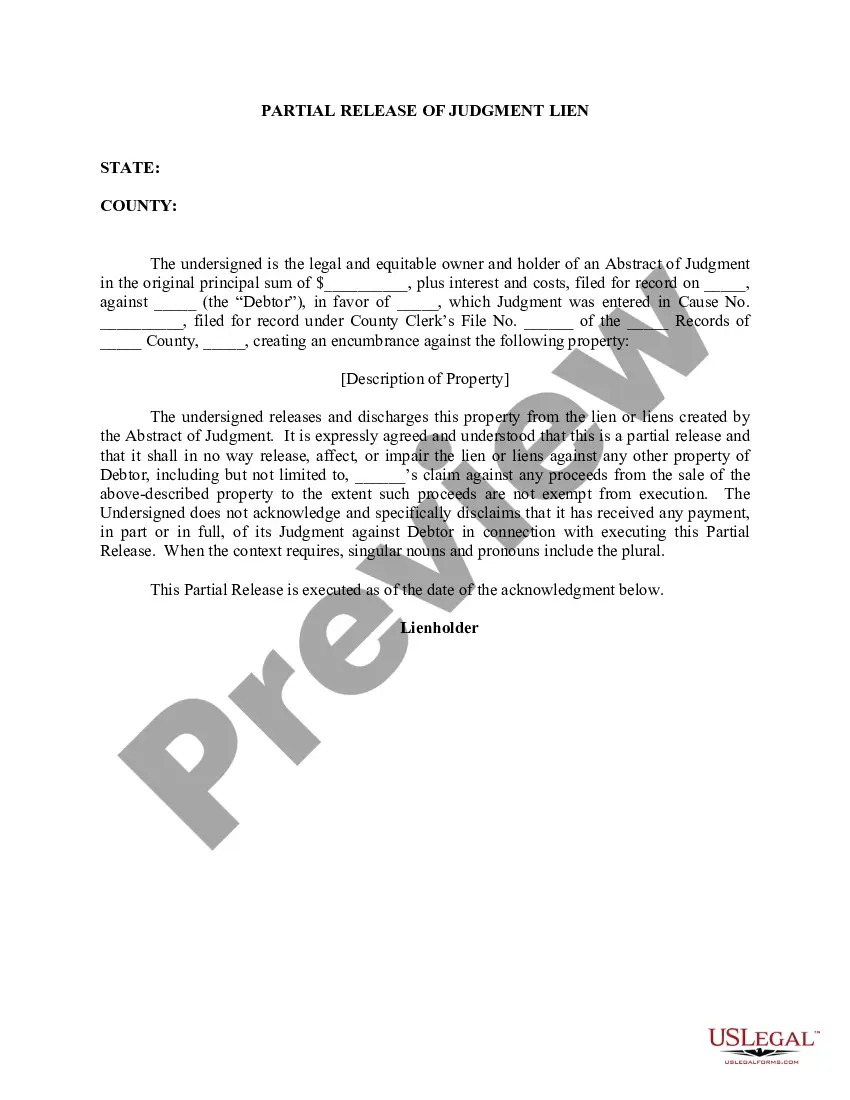
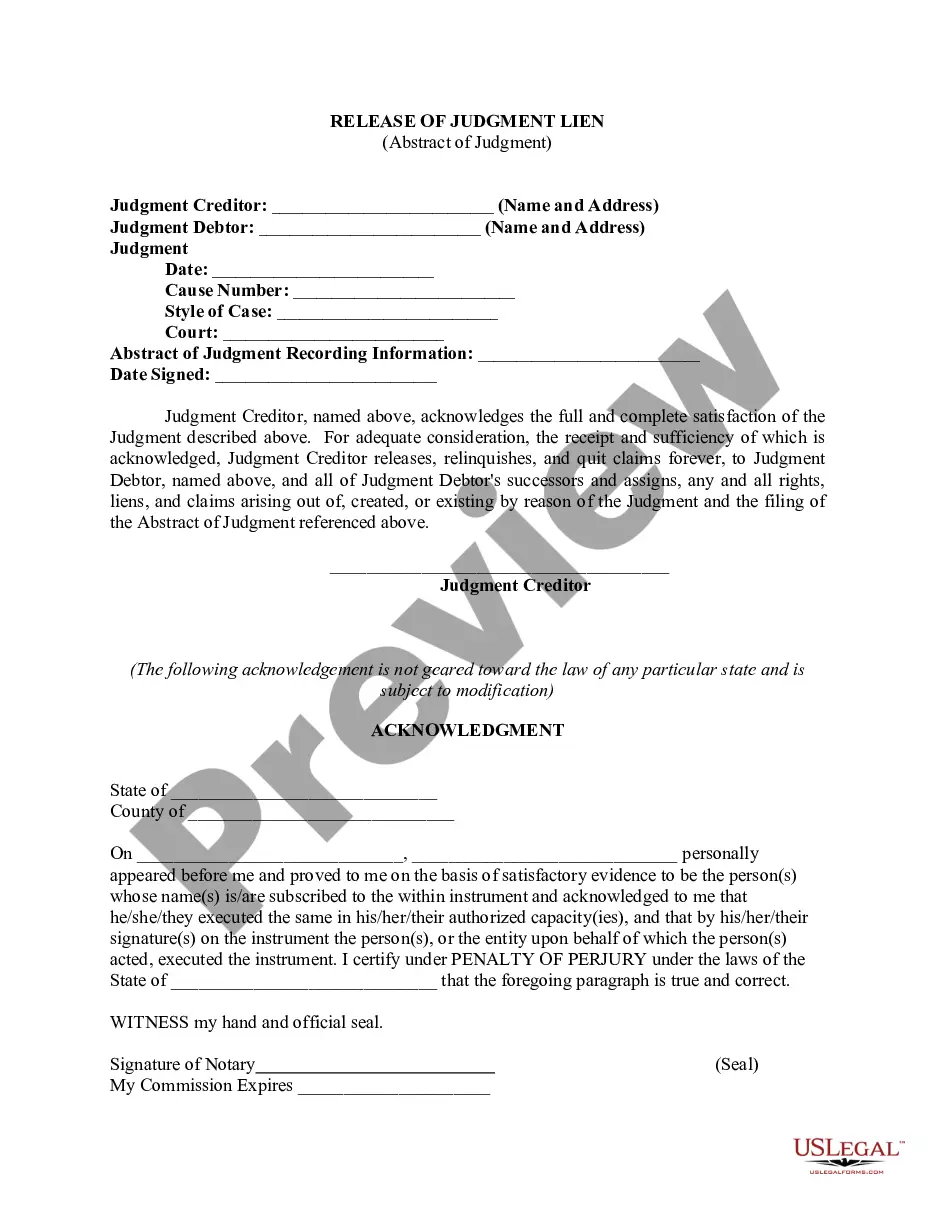
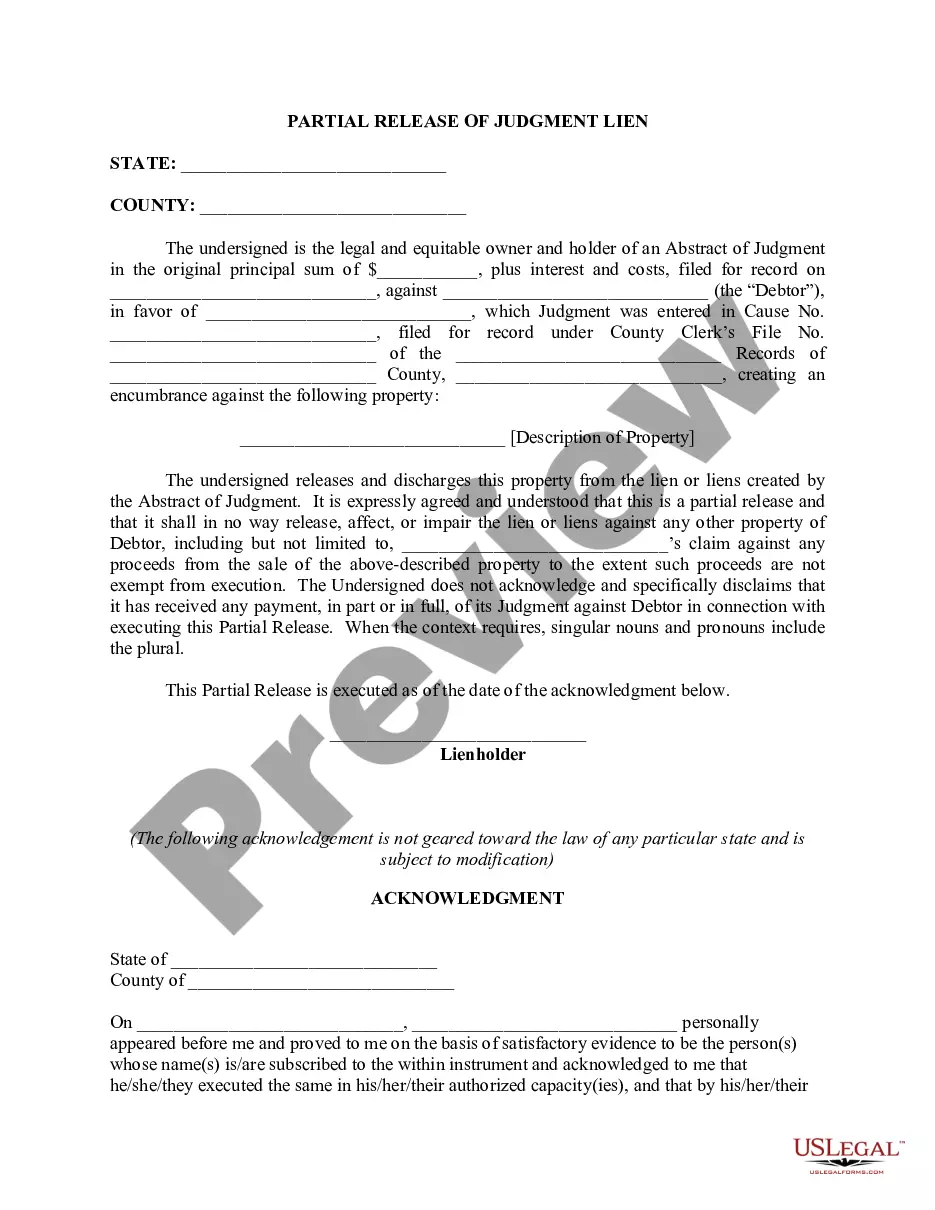
A consent judgment is a legal document resulting from an agreement between parties in a civil lawsuit. It represents a judgment issued by a judge that is based on the mutual consent of the involved parties. Unlike other judgments that may be determined by a court after a trial, a consent judgment aims to settle disputes and end litigation by creating an enforceable agreement. This specific form is used when parties have come to an understanding regarding the resolution of a case, particularly concerning forfeited property.
Key components of this form
- Name of plaintiffs and defendants to identify the parties involved.
- Judicial district and court information to establish the jurisdiction.
- Docket number and customs number for tracking the case.
- Details of the judgment, including the property's substitution and forfeiture specifics.
- Signatures of the district judge and assistant district attorney to validate the agreement.
When to use this document
This form is necessary when parties in a civil action have reached a settlement regarding specific terms, often to resolve issues related to forfeited property. Use a consent judgment when both parties agree on the outcome of a lawsuit and wish to have their agreement officially recognized by the court, avoiding the need for further litigation.
Who can use this document
This form is suitable for:
- Individuals or businesses involved in a civil lawsuit regarding forfeited property.
- Legal representatives seeking to finalize an agreement between disputing parties.
- Anyone looking to obtain a legally enforceable judgment without going to trial.
Instructions for completing this form
- Identify and enter the names of all plaintiffs and defendants.
- Fill in the judicial district and court information.
- State the docket number and customs number.
- Detail the terms of the judgment, including property substitutions and forfeitures.
- Ensure the signatures of the district judge and assistant district attorney are included for authenticity.
Notarization requirements for this form
Notarization is not commonly needed for this form. However, certain documents or local rules may make it necessary. Our notarization service, powered by Notarize, allows you to finalize it securely online anytime, day or night.
Get your form ready online
Our built-in tools help you complete, sign, share, and store your documents in one place.
Make edits, fill in missing information, and update formatting in US Legal Forms—just like you would in MS Word.
Download a copy, print it, send it by email, or mail it via USPS—whatever works best for your next step.
Sign and collect signatures with our SignNow integration. Send to multiple recipients, set reminders, and more. Go Premium to unlock E-Sign.
If this form requires notarization, complete it online through a secure video call—no need to meet a notary in person or wait for an appointment.
We protect your documents and personal data by following strict security and privacy standards.

Make edits, fill in missing information, and update formatting in US Legal Forms—just like you would in MS Word.

Download a copy, print it, send it by email, or mail it via USPS—whatever works best for your next step.

Sign and collect signatures with our SignNow integration. Send to multiple recipients, set reminders, and more. Go Premium to unlock E-Sign.

If this form requires notarization, complete it online through a secure video call—no need to meet a notary in person or wait for an appointment.

We protect your documents and personal data by following strict security and privacy standards.
Common mistakes
- Failing to correctly identify all parties involved in the lawsuit.
- Omitting necessary details about the forfeited property.
- Not signing the form where required, especially by the judge and legal representatives.
Why complete this form online
- Convenience: Access and download the form anytime, from anywhere.
- Editability: Tailor the form accurately to fit your specific case needs.
- Reliability: Ensure compliance with legal standards through professionally drafted templates.
Quick recap
- A consent judgment is an effective way to settle disputes without trial.
- This form should be used when all parties agree on the resolution of their case.
- Completing the form accurately is crucial for enforceability.
Looking for another form?
Form popularity
FAQ
A consent judgment of partition in Louisiana pertains to the division of property between co-owners. This legal agreement allows both parties to agree on how to divide or sell the property, with the Louisiana Consent Judgment formalizing their agreement in court. This process ensures a smooth transition and prevents future disputes over ownership. Utilizing U.S. Legal Forms can simplify this process, guiding you through the necessary steps for a successful partition.
While a consent agreement is simply an understanding between parties, a Louisiana Consent Judgment comes with the weight of the court's authority. A consent judgment formally incorporates the terms agreed upon and makes them legally binding. This means that failure to comply with the consent judgment can lead to enforcement actions. Therefore, a Louisiana Consent Judgment offers a stronger legal safeguard compared to a simple consent agreement.
A Louisiana Consent Judgment serves to resolve disputes between parties without going to trial. It allows both parties to agree on the terms, which then become enforceable by the court. This process helps save time and resources, making it a practical solution for those seeking closure. Overall, a Louisiana Consent Judgment provides a clear path to resolution.
What is a Consent Decree? In private sector situations, consent decrees are sometimes called consent judgments; they work the same way.
If the parties are able to come to an agreement on all the issues before the court, without the need for a trial to take place, the terms of their agreement are placed in a Consent Judgment of Divorce that complies with all applicable statutes and court rules, and is signed, and entered by the Court after the proper
In many situations, one of the best ways to collect a judgment after winning a case is to put a lien on the debtor's property. This gives you a claim to the property and, in some cases, the property will be sold at public auction in order to satisfy the debt that is owed.
Summary judgment - A decision made on the basis of statements and evidence presented for the record without a trial. It is used when there is no dispute as to the facts of the case, and one party is entitled to judgment as a matter of law.
The consent judgment was a final determination of the rights of the parties.Pursuant to California law, a party is allowed to expressly waive his or her right to appeal from any judgment. However, parties are not allowed to confer jurisdiction upon an appellate court by agreement when it otherwise does not exist.
A waiver of any right to challenge or contest the validity of the order and decision entered into in accordance with the agreement; and. That the order and decision of the administrative law judge shall be final agency action.
Record the Judgment. File motion for judgment debtor examination and obtain personal service. File petition for garnishment under writ of fifa. If the garnishee does not timely provide answers, you may file a motion for judgment against garnish.