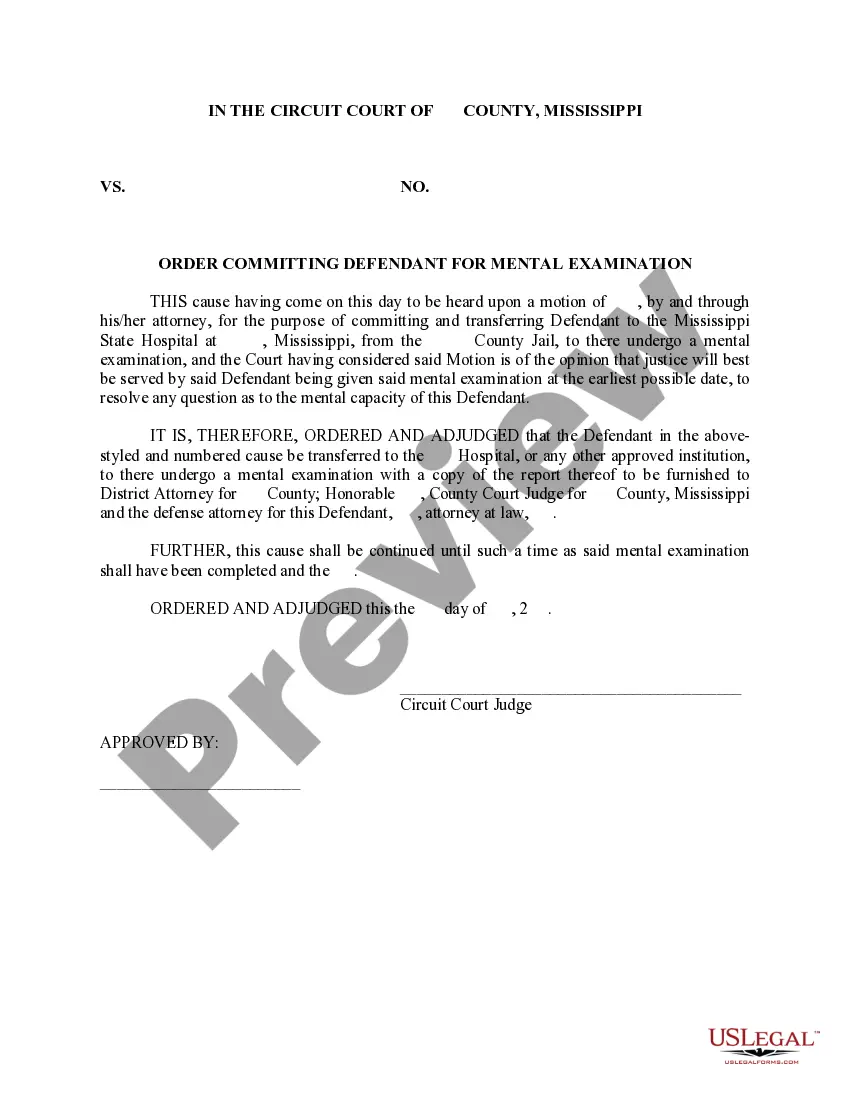
Mississippi Order Committing Defendant for Mental Exam
What is this form?
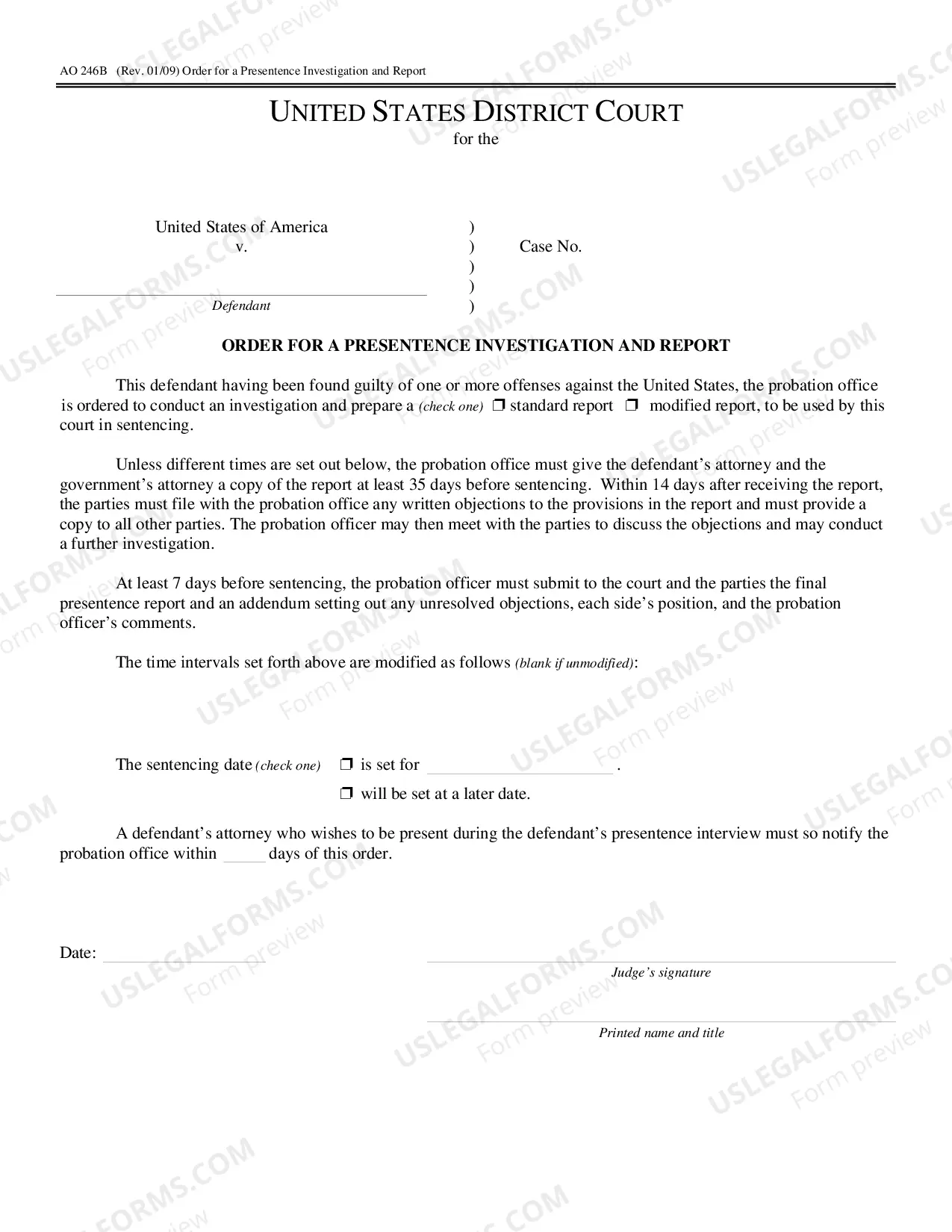
The Order Committing Defendant for Mental Exam is a legal document issued by the court. It commands the transfer of a defendant to a mental health facility for evaluation. This form is utilized to assess the mental capacity of a defendant, which is crucial in determining their competency to stand trial. Unlike other court orders, this document specifically addresses the need for a psychiatric examination as part of legal proceedings.
Form components explained
- Case Caption: Identifies the parties involved in the case.
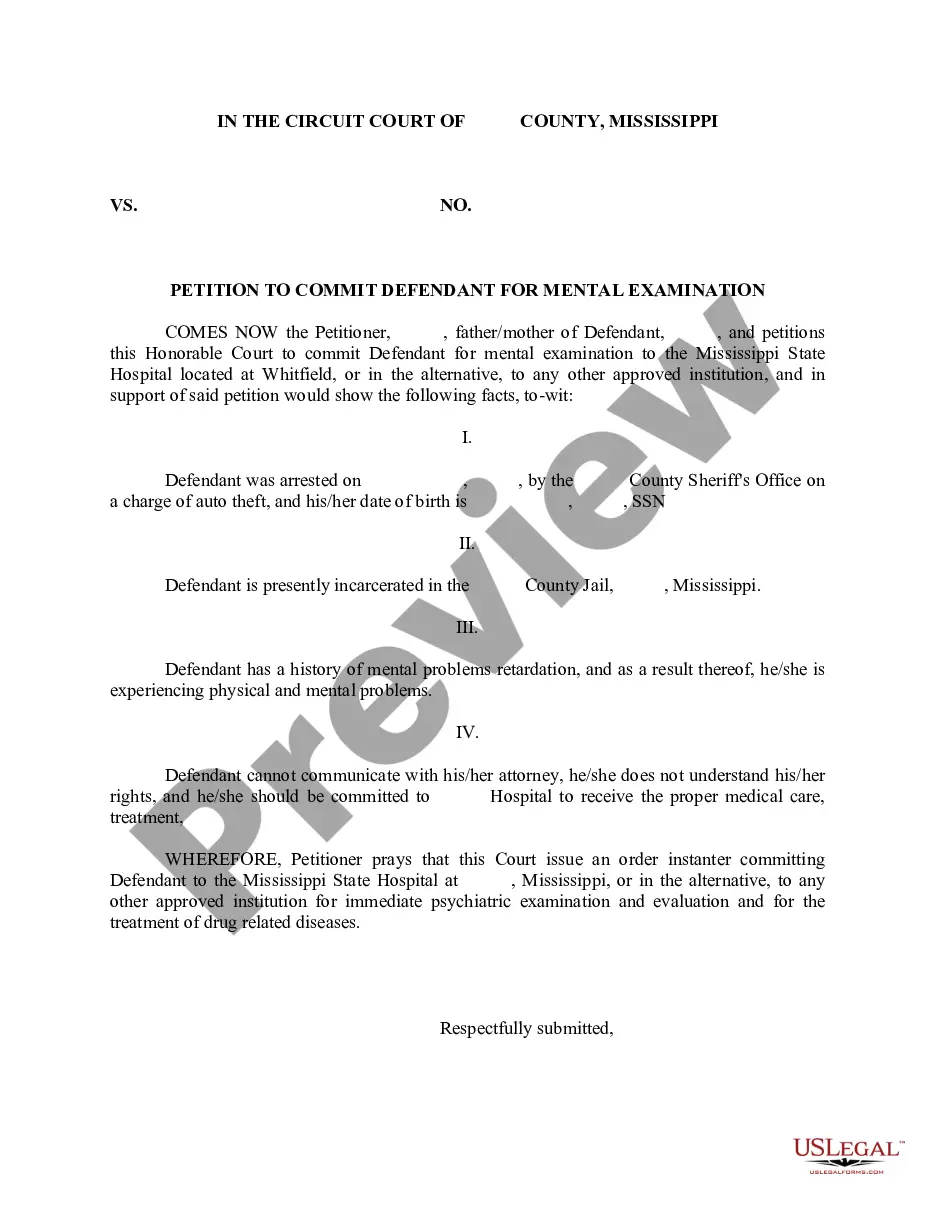
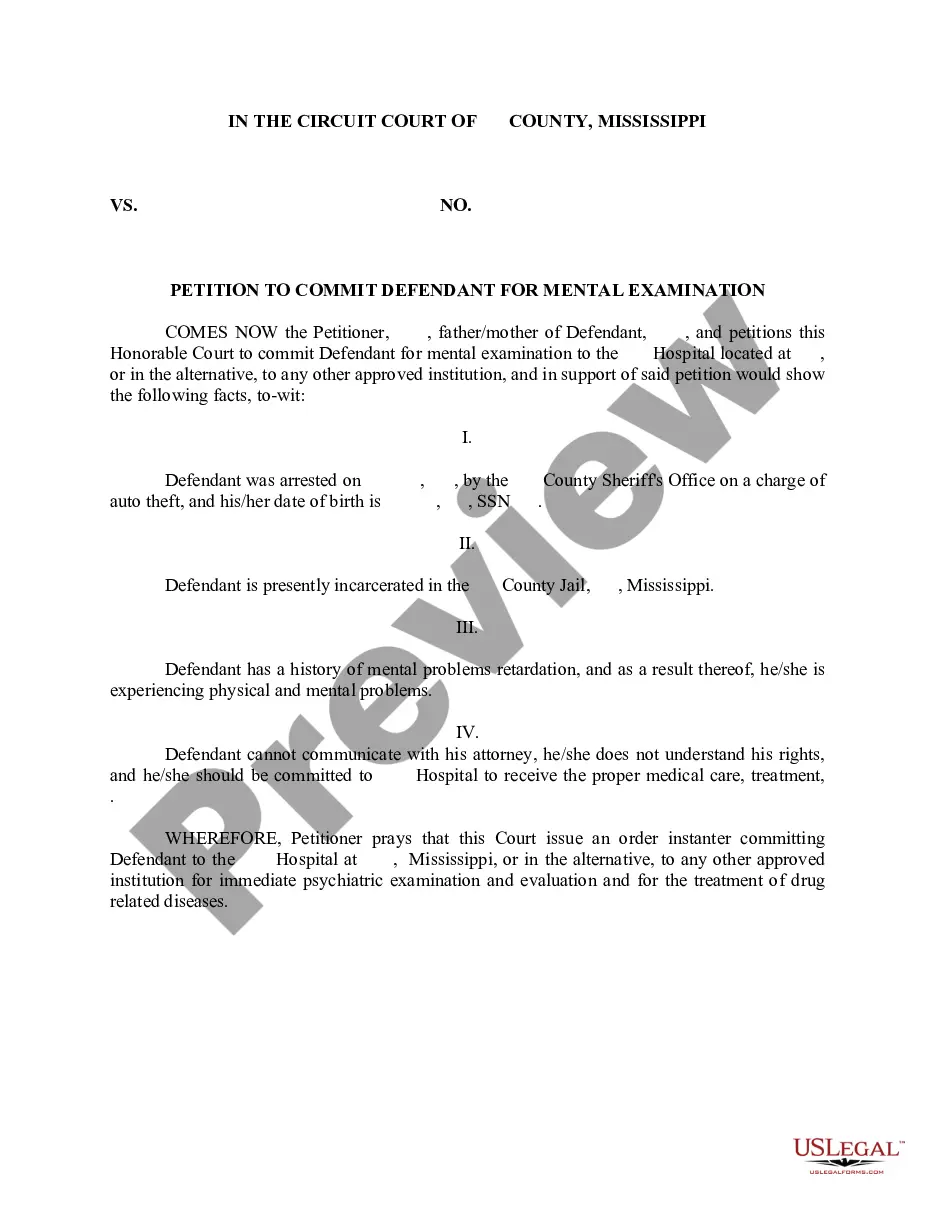
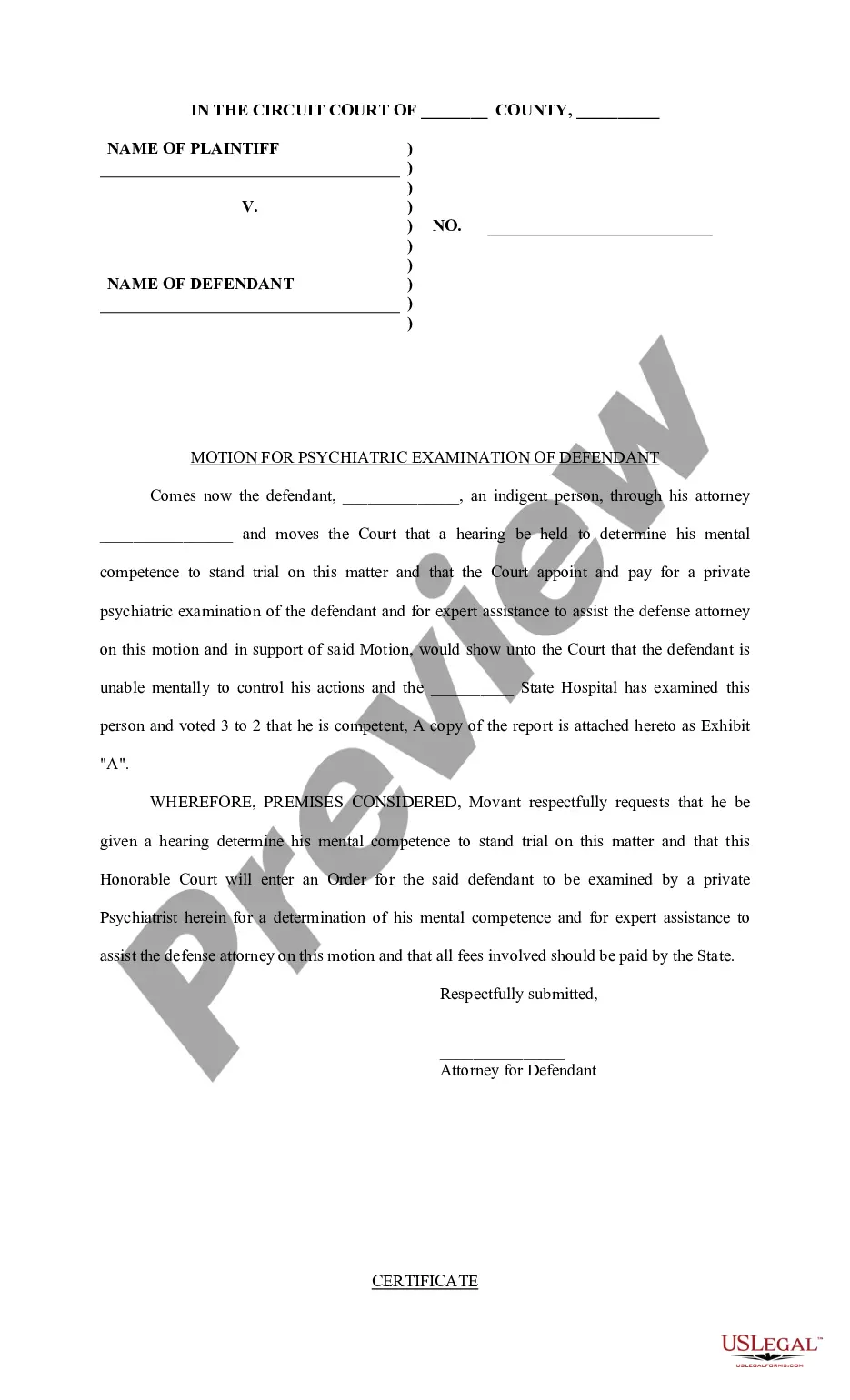
- Motion Statement: Details the request to commit the defendant for a mental examination.
- Transfer Order: Specifies the facility where the examination will occur.
- Legal Citations: References applicable laws and the judgeâs authority.
- Signature Line: Indicates where the judge signs to authorize the order.
When to use this document
This form is necessary in cases where a defendantâs mental health may impact their legal capacity. It is commonly employed when there is uncertainty about a defendant's mental state related to criminal charges, such as during pre-trial procedures or competency hearings. Additionally, this order can facilitate the evaluation process when a defense attorney believes mental health issues are pertinent to their client's case.
Who this form is for
- Defense attorneys seeking a mental examination for their clients.
- Prosecutors involved in cases where mental capacity is questioned.
- Judges who may need to authorize mental health evaluations in legal proceedings.
- Family members or guardians of defendants who are concerned about their mental health.
Instructions for completing this form
- Identify and fill in the case caption with the partiesâ names and case number.
- Outline the motion for committing the defendant, specifying the reason for the mental examination.
- Enter the name and location of the mental health facility for the examination.
- Add the judgeâs name and signature to authorize the order.
- Ensure that copies of the order are circulated to all relevant parties, including the district attorney and defense attorney.
Notarization guidance
This form does not typically require notarization unless specified by local law. Always confirm the specific requirements of your jurisdiction before submission.
Get your form ready online
Our built-in tools help you complete, sign, share, and store your documents in one place.
Make edits, fill in missing information, and update formatting in US Legal Forms—just like you would in MS Word.
Download a copy, print it, send it by email, or mail it via USPS—whatever works best for your next step.
Sign and collect signatures with our SignNow integration. Send to multiple recipients, set reminders, and more. Go Premium to unlock E-Sign.
If this form requires notarization, complete it online through a secure video call—no need to meet a notary in person or wait for an appointment.
We protect your documents and personal data by following strict security and privacy standards.

Make edits, fill in missing information, and update formatting in US Legal Forms—just like you would in MS Word.

Download a copy, print it, send it by email, or mail it via USPS—whatever works best for your next step.

Sign and collect signatures with our SignNow integration. Send to multiple recipients, set reminders, and more. Go Premium to unlock E-Sign.

If this form requires notarization, complete it online through a secure video call—no need to meet a notary in person or wait for an appointment.

We protect your documents and personal data by following strict security and privacy standards.
Common mistakes
- Failing to correctly identify the parties involved in the case.
- Not including all required signatures on the document.
- Omitting important details about the defendant's mental health history.
- Using outdated templates that do not comply with current legal standards.
Benefits of completing this form online
- Convenience of downloading and accessing the form anytime.
- Editability allows for customization based on specific case details.
- Reliability, with forms drafted by licensed attorneys ensuring legal compliance.
- Instant availability, so you can act quickly in urgent situations.
Looking for another form?




Form popularity
FAQ
Any citizen of Mississippi can initiate the process by submitting a sworn statement requesting psychiatric treatment for that person. The statement must include strong evidence that the person is dangerous to him or herself or to others by reason of mental illness.
The criteria for involuntary hospitalization are as follows: patients must exhibit dangerous behavior toward themselves or others, they must be helpless and unable to provide for their basic daily needs, and there is a danger of essential harm to their mental health if they do not receive mental care.
Sixteen-year-old William Haymon has spent more than 500 days in an adult jail in rural Lexington, Mississippi. There are no state rules governing how long a person can be incarcerated without being formally charged with a crime.
The laws for Treatment Orders vary by state, but generally speaking, a mental health professional can apply for an order, which must then be approved by a legal authority such as a magistrate or tribunal.
A defendant cannot be convicted of a crime if they are not mentally competent to stand trial.It does not prevent the police from making an arrest or the prosecution from filing charges, but the proceedings cannot go further until and unless the defendant is found to be competent.
Call 1-800-273-TALK or text MHA to 741741 if you are in crisis. Look up your local MHA affiliate for services in your area. Find a therapist. Find a support group. Plan for crisis by setting up a Psychiatric Advance Directive. Is hospitalization necessary? Read more about inpatient options.
The criminal statute of limitations requires prosecutors to file criminal charges against a suspect within two years for misdemeanors and within five years for certain felonies, but there is no time limit in Mississippi for charges of murder, kidnapping, rape, burglary, robbery, larceny, and several other serious
A mentally-ill defendant can be considered competent to stand trial if the illness does not impair his ability to understand court proceedings or assist in his defense. Judges ultimately determine defendants' competence to stand trial, but psychiatrists' opinions are adopted in 90% of cases.
Commitment Process Any citizen of Mississippi can initiate the process by submitting a sworn statement requesting psychiatric treatment for that person. The statement must include strong evidence that the person is dangerous to him or herself or to others by reason of mental illness.