Louisiana Rule for Contempt for Noncompliance with Visitation Schedule, and Order
Understanding this form
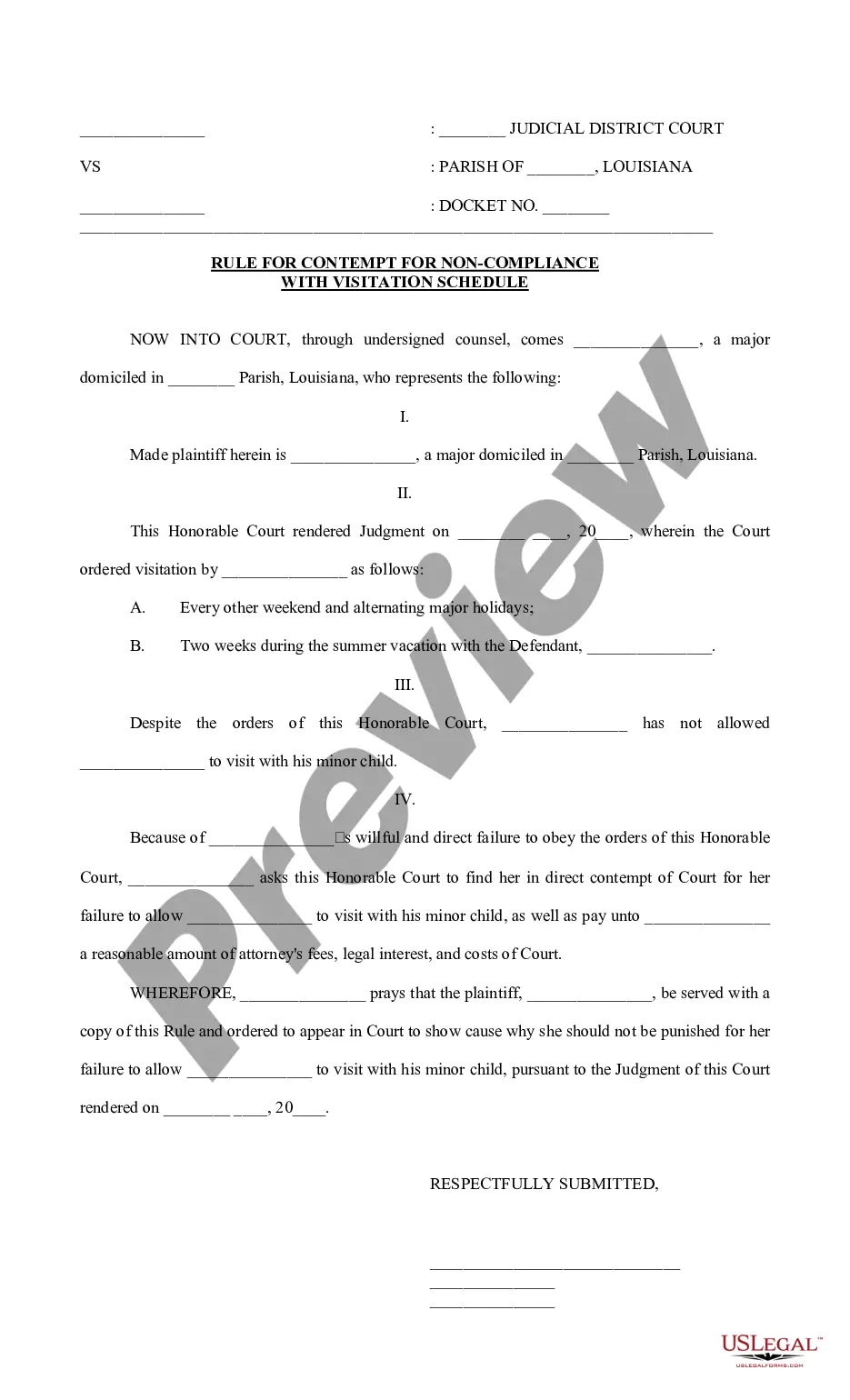
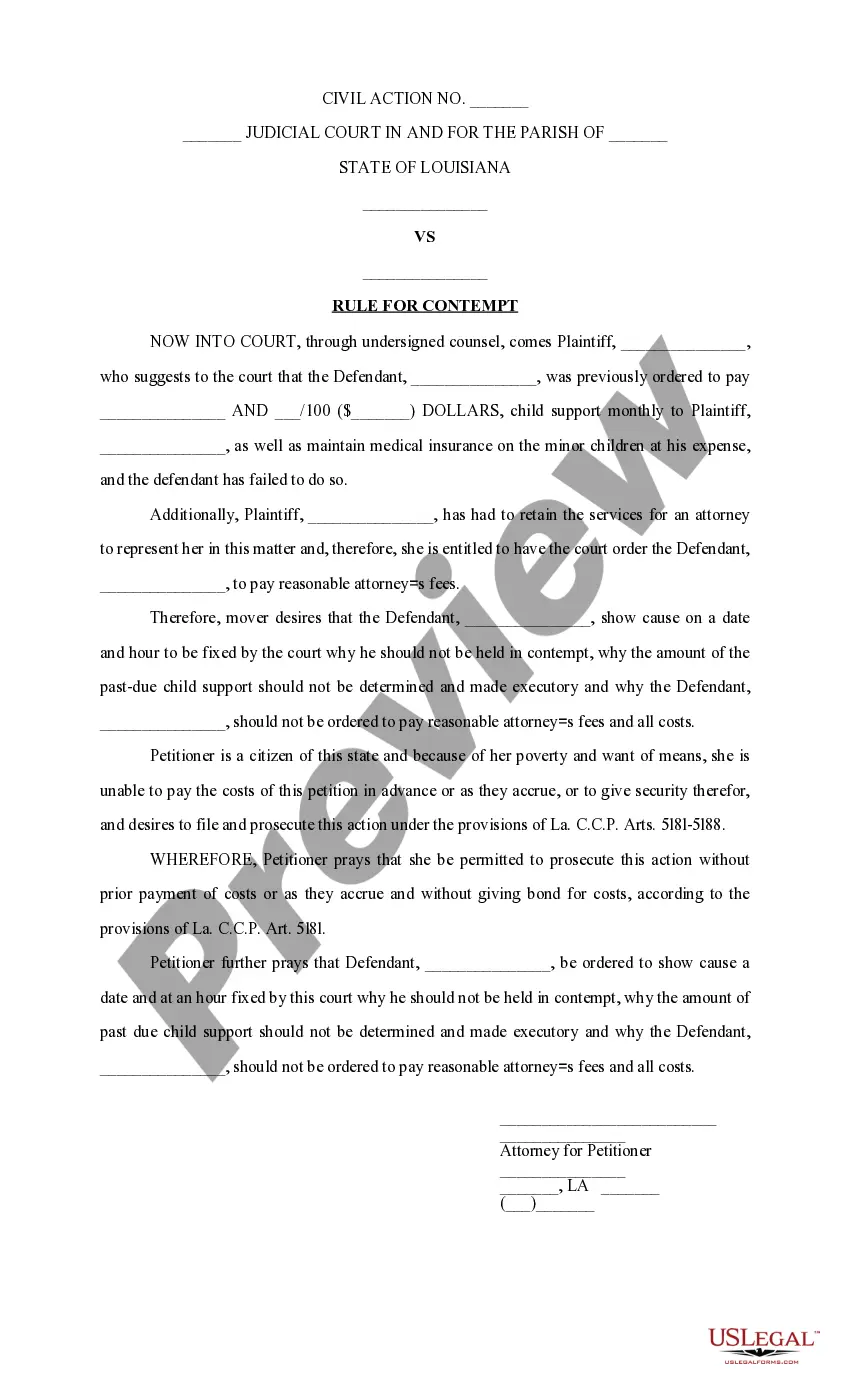
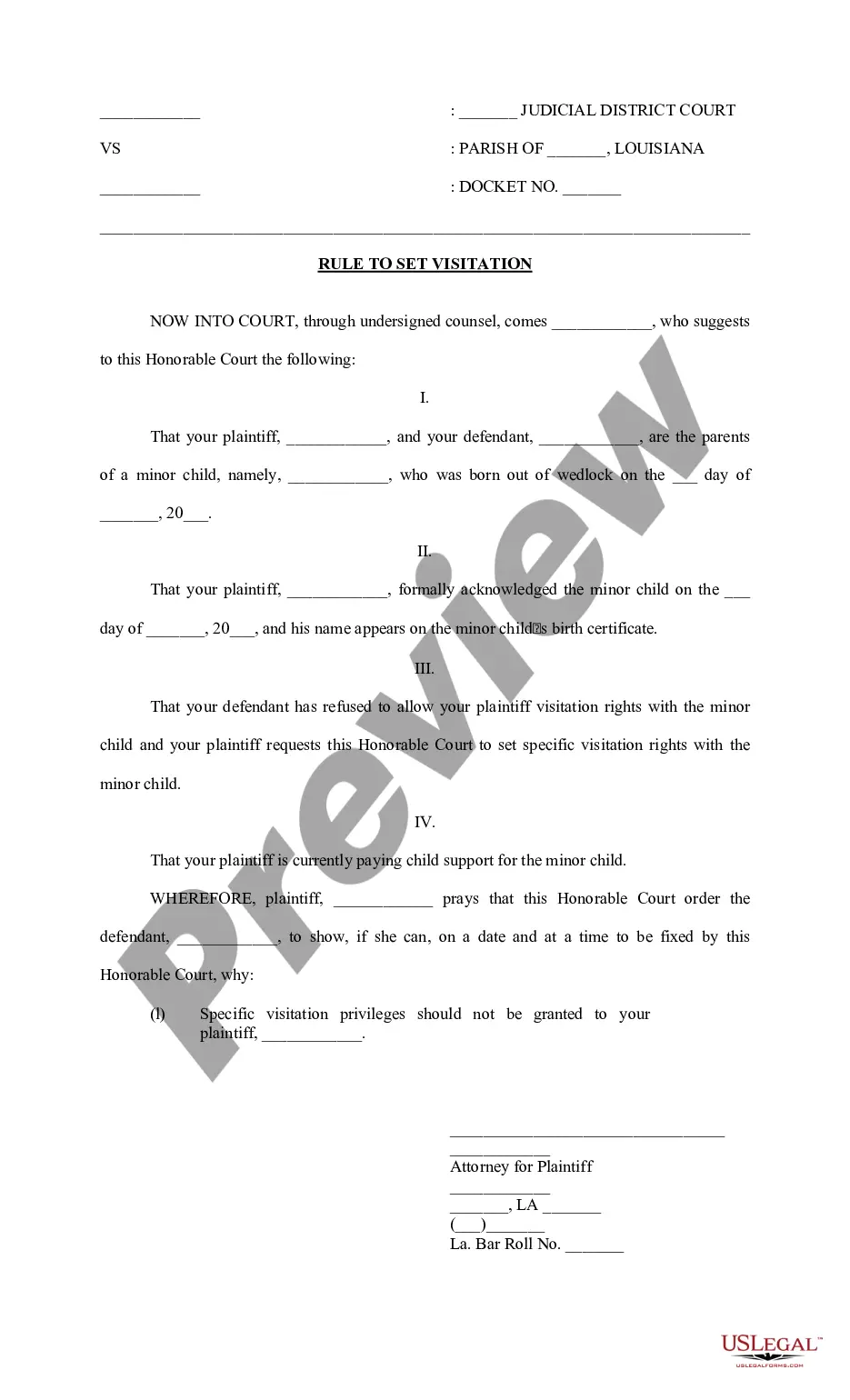
The Rule for Contempt for Noncompliance with Visitation Schedule is a legal document used when one party fails to adhere to a court-ordered visitation arrangement regarding a minor child. This form allows the petitioner to request the court to hold the defendant in contempt for not complying with the visitation schedule, seeking enforcement of visitation rights, including the possibility of recovering attorney's fees and court costs. This form is crucial for ensuring that visitation orders are honored and can help address noncompliance efficiently through the legal system.
Main sections of this form
- Identification of the plaintiff and defendant, including their domiciles.
- Details of the original court judgment regarding visitation rights.
- Specific claims of noncompliance by the defendant concerning the visitation order.
- A request for the court to find the defendant in contempt and impose legal costs.
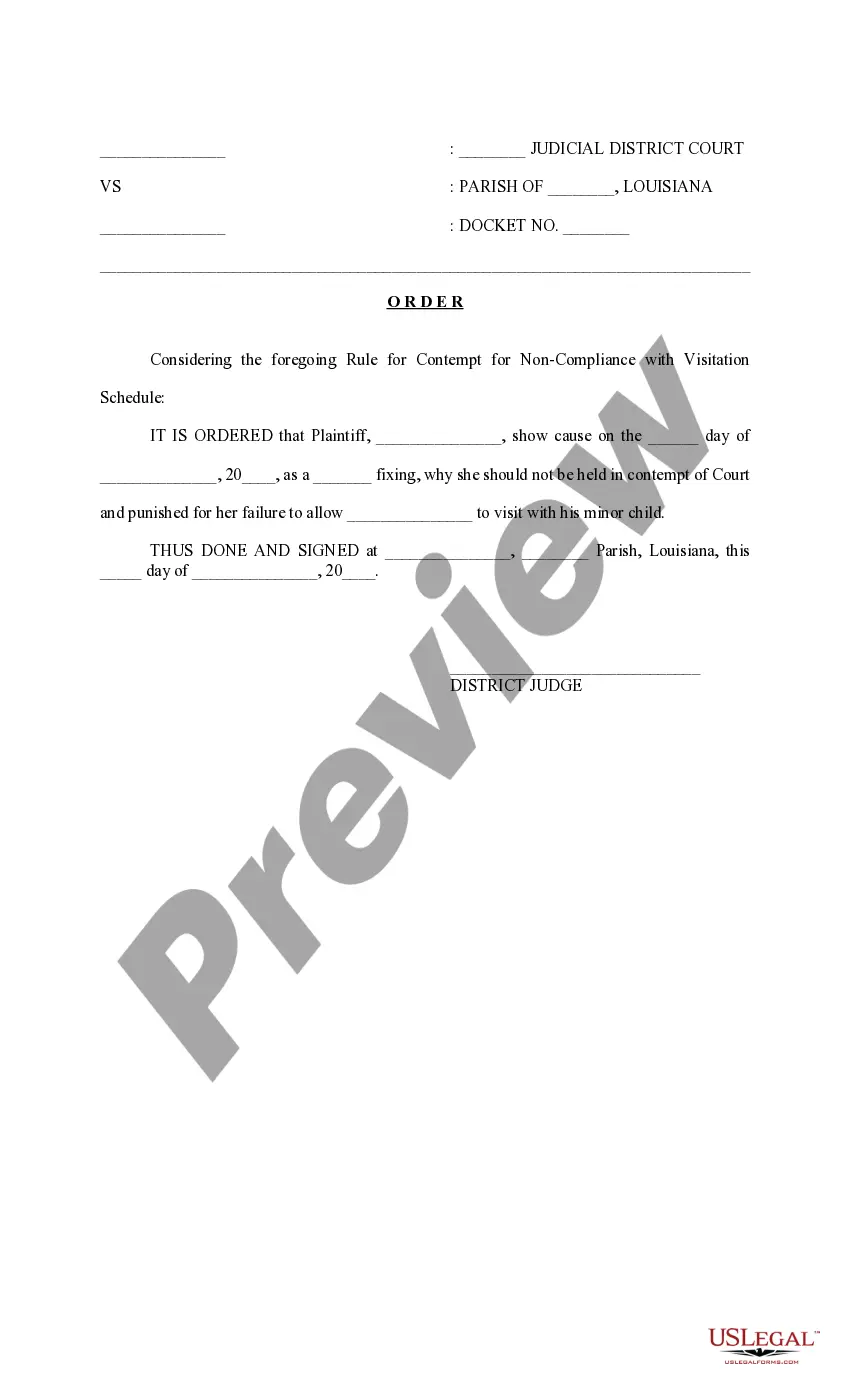
- Order for the defendant to appear in court to show cause for their noncompliance.

When this form is needed
This form should be used when a parent or guardian is not complying with a court-ordered visitation schedule, and the other parent seeks enforcement of their rights. It is applicable in cases where visitation has been denied, interrupted, or otherwise not respected, leading the custodial parent to seek formal court intervention to ensure that their visitation rights are upheld.
Who this form is for
- Parents or legal guardians seeking to enforce a visitation schedule.
- Individuals who have a court order for visitation that is not being honored.
- Parties involved in custody disputes or arrangements where visitation is stipulated by the court.
Steps to complete this form
- Identify the parties involved by entering the names and domiciles of the plaintiff and defendant.
- Fill in the details of the original court judgment, including dates and specific visitation terms.
- Clearly articulate the specific instances of non-compliance by the defendant regarding the visitation schedule.
- Include a request for the court to find the defendant in contempt and specify any legal fees being sought.
- Sign the form and ensure it is served to the defendant through legal channels.
Does this document require notarization?
This form does not typically require notarization unless specified by local law. Be sure to check local regulations or consult with a legal professional to confirm any notarization requirements that may apply.
Get your form ready online
Our built-in tools help you complete, sign, share, and store your documents in one place.
Make edits, fill in missing information, and update formatting in US Legal Forms—just like you would in MS Word.
Download a copy, print it, send it by email, or mail it via USPS—whatever works best for your next step.
Sign and collect signatures with our SignNow integration. Send to multiple recipients, set reminders, and more. Go Premium to unlock E-Sign.
If this form requires notarization, complete it online through a secure video call—no need to meet a notary in person or wait for an appointment.
We protect your documents and personal data by following strict security and privacy standards.

Make edits, fill in missing information, and update formatting in US Legal Forms—just like you would in MS Word.

Download a copy, print it, send it by email, or mail it via USPS—whatever works best for your next step.

Sign and collect signatures with our SignNow integration. Send to multiple recipients, set reminders, and more. Go Premium to unlock E-Sign.

If this form requires notarization, complete it online through a secure video call—no need to meet a notary in person or wait for an appointment.

We protect your documents and personal data by following strict security and privacy standards.
Common mistakes to avoid
- Failing to provide accurate or complete information about previous court orders.
- Not clearly outlining instances of noncompliance.
- Neglecting to sign the form or serve it properly to the opposing party.
Benefits of using this form online
- Convenient access to legally vetted and professionally drafted forms.
- Ability to edit and customize the form to fit specific circumstances easily.
- Reliable source of legal documents that meet current legal standards and requirements.
Key takeaways
- This form is essential for enforcing visitation rights established by court order.
- Noncompliance must be clearly documented to justify a contempt ruling.
- Proper completion and filing are crucial for effective legal action.
Looking for another form?



Form popularity
FAQ
To file your papers, you must go to Clerk of Court's Suit Accounting office, located on the Third Floor of the Nineteenth Judicial District Courthouse, 300 North Boulevard, Baton Rouge, Louisiana. If you want to make other arrangements for filing, you should contact that office at (225) 389-3982.
To file your papers, you must go to Clerk of Court's Suit Accounting office, located on the Third Floor of the Nineteenth Judicial District Courthouse, 300 North Boulevard, Baton Rouge, Louisiana. If you want to make other arrangements for filing, you should contact that office at (225) 389-3982.
Read the summons and make sure you know the date you must answer by. Read the complaint carefully. Write your answer. Sign and date the answer. Make copies for the plaintiff and yourself. Mail a copy to the plaintiff. File your answer with the court by the date on the summons.
If a person is found to be in contempt, the court is able to impose sanctions, which may include the following: jail time (usually 1-30 days) ordering the party held in contempt to pay the money owed. ordering the party held in contempt to pay the other party's attorney's fees.
Paying Fines: the court can order the breaching parent to pay a fine up to $5000 either to the court or the other parent. Police Enforcement: the court can make an order that a police officer can arrest the breaching parent and bring them to court if the police is of the opinion that a custody order has been breached.
There is a valid court order in effect. The other person knows about the court order. The facts show a plain violation of the order. You have given the person notice of the contempt hearing and a chance to be heard. Contempt is an appropriate remedy for the violation.
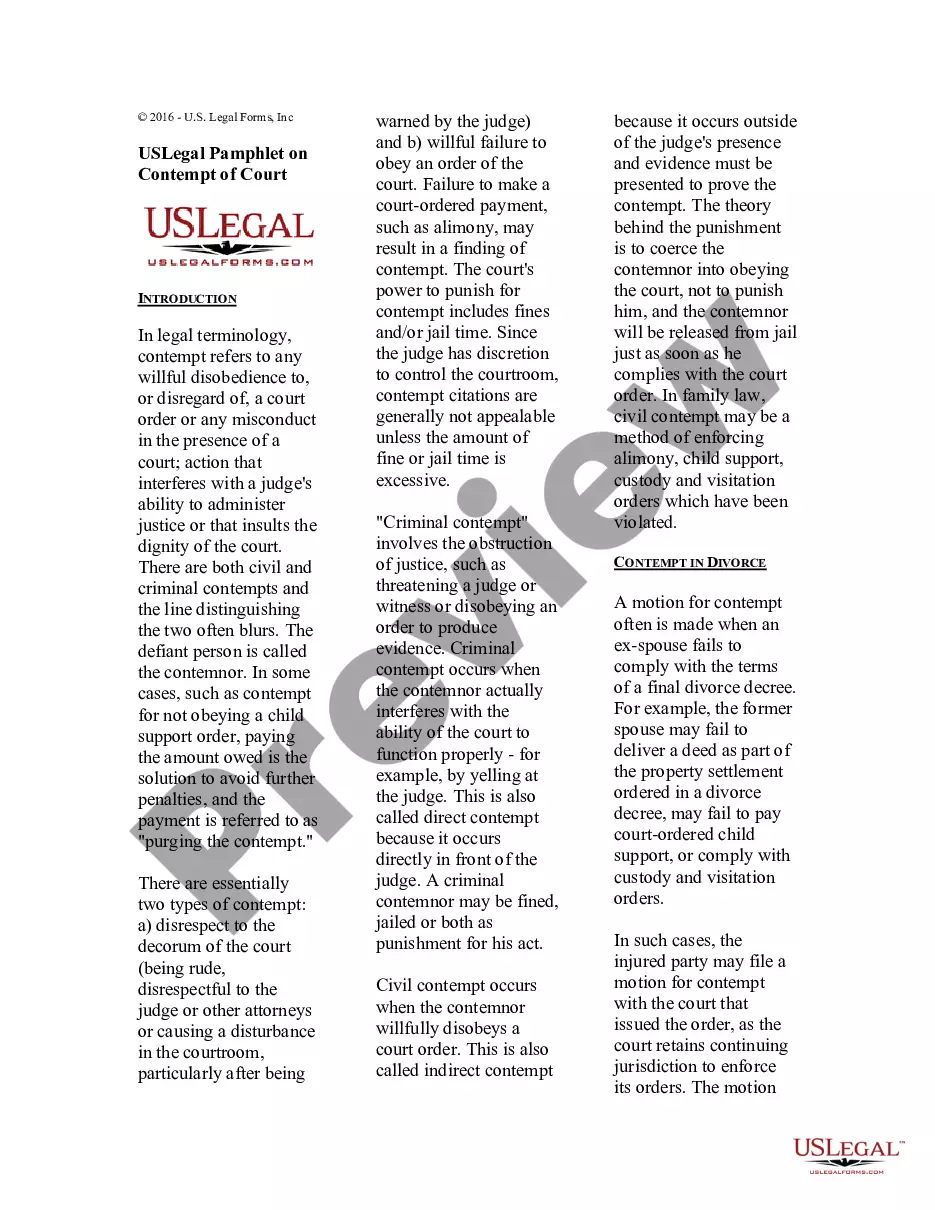
Contempt of court, often referred to simply as "contempt", is the offense of being disobedient to or disrespectful toward a court of law and its officers in the form of behavior that opposes or defies the authority, justice and dignity of the court.
The word contempt is used to describe the situation when an individual has intentionally disobeyed a court order. In family law, a finding of contempt is a way for the Court to enforce child support, spousal support, custody and visitation orders that a party has violated.
Except as otherwise provided in this Article, a court may punish a person adjudged guilty of contempt of court in connection with a criminal proceeding by a fine of not more than five hundred dollars, or by imprisonment for not more than six months, or both.