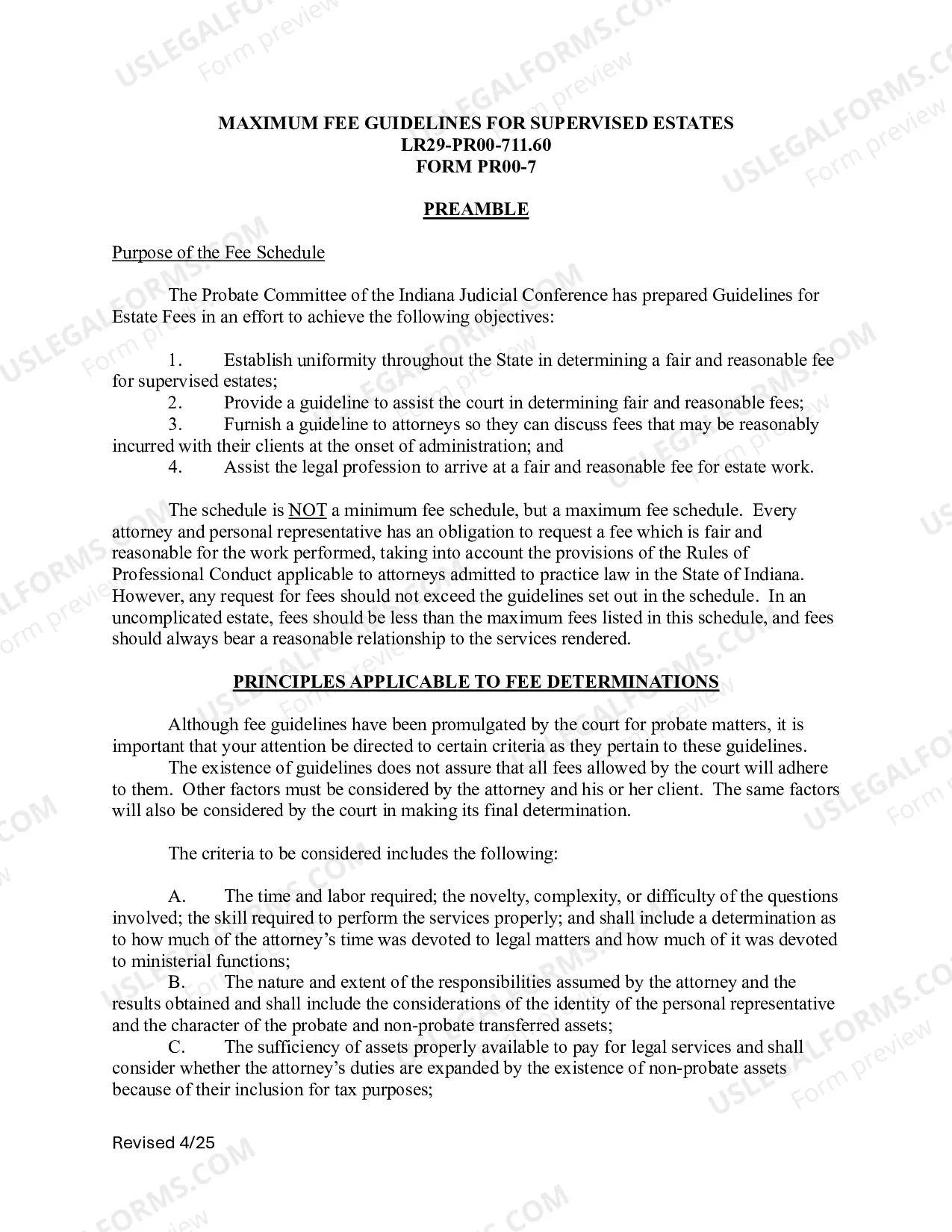
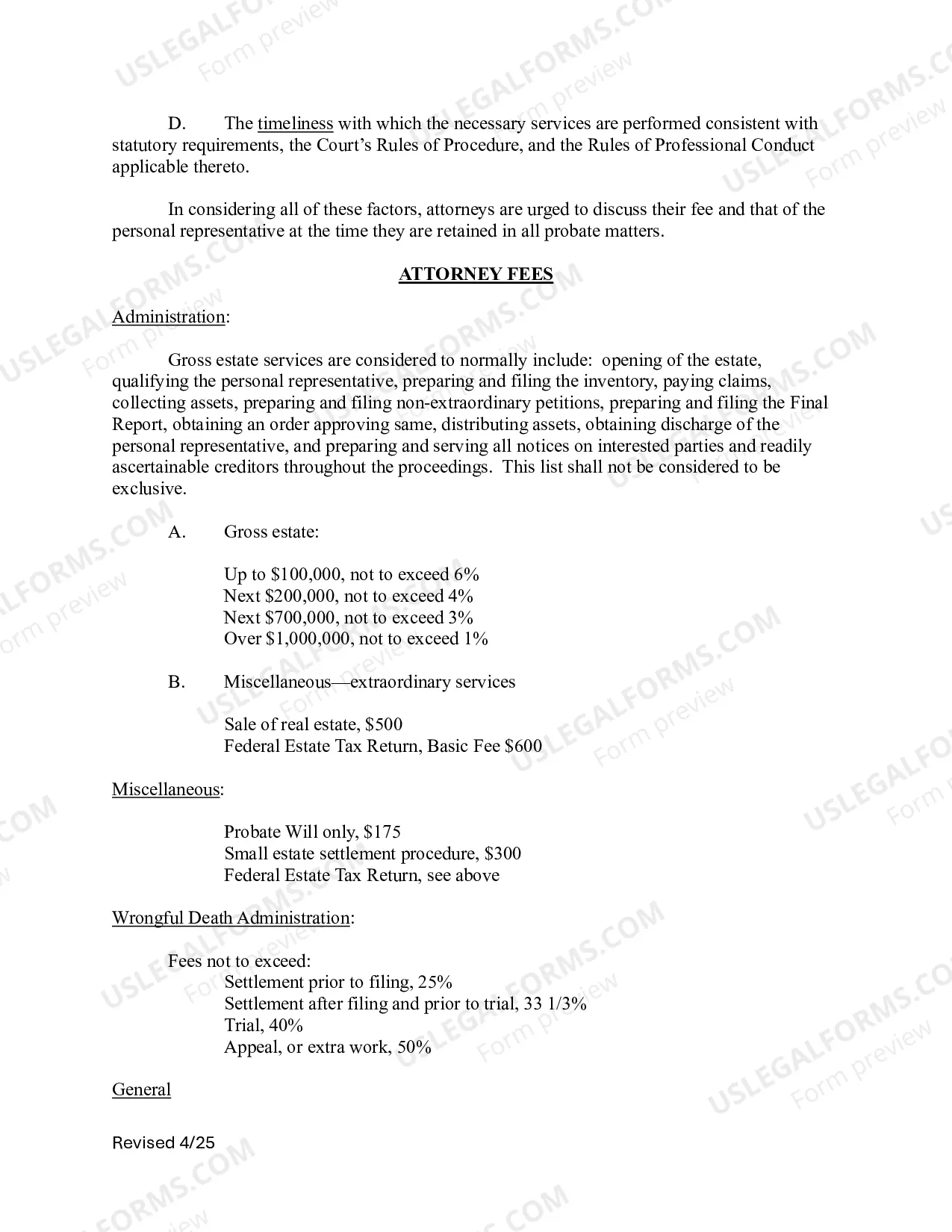
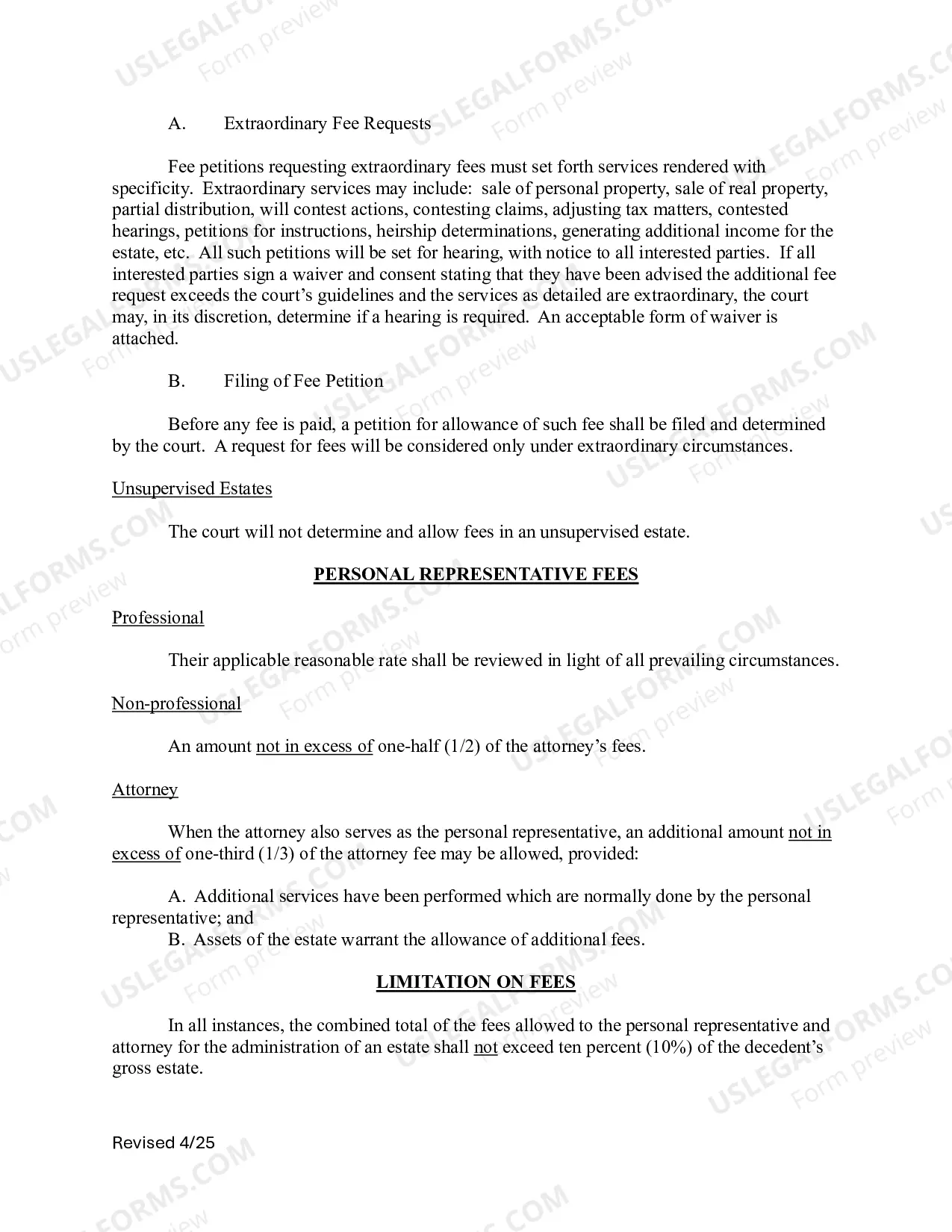
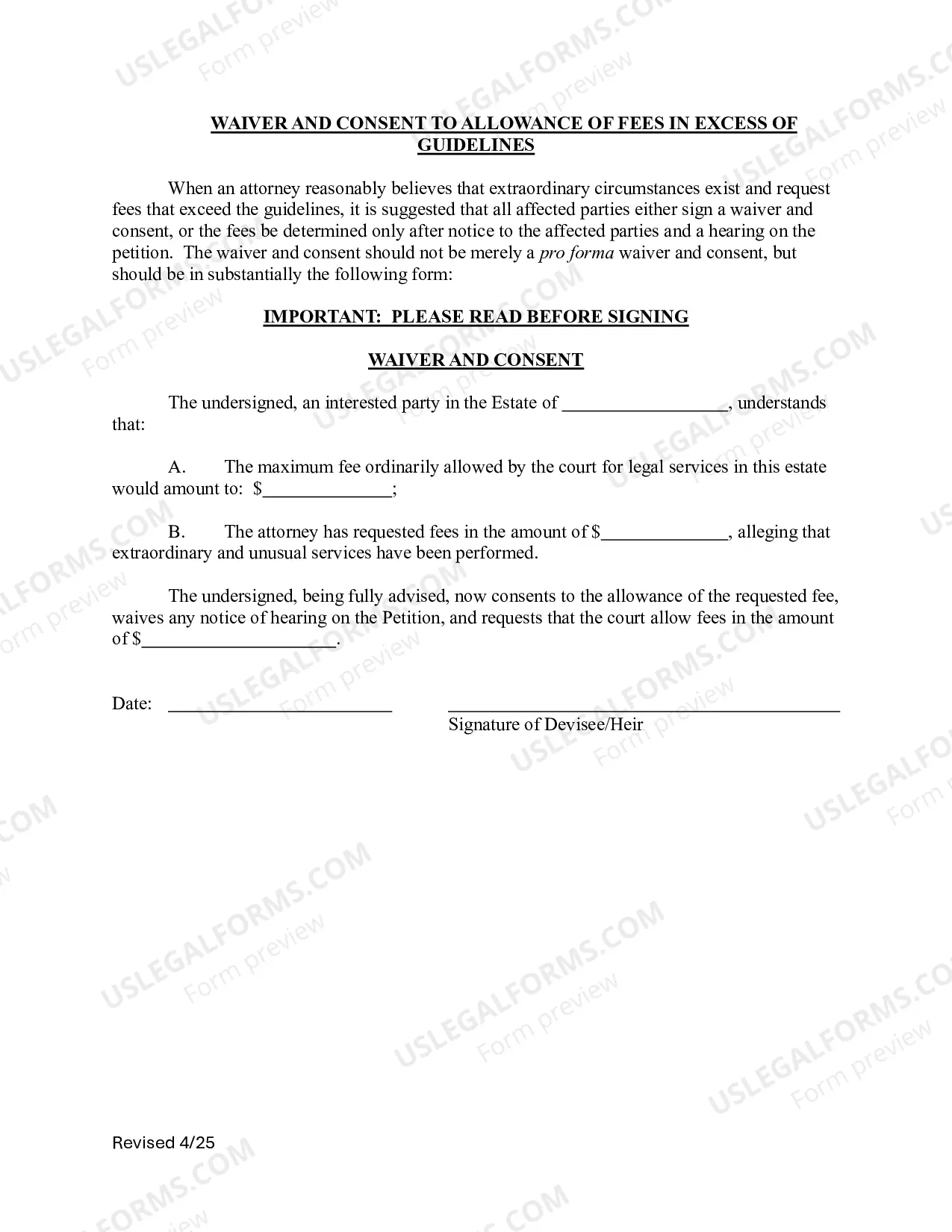
Indiana Maximum Fee Guidelines for Supervised Estates (LR29-PR00-711.60) — Form PR 00-7 (PDF)OpenWindowowoIsiIsisis a form that outlines the maximum allowable fees for a supervised estate in Indiana. The form outlines two types of fees — statutory fees and non-statutory fees. Statutory fees are fees that are paid for handling an estate, such as filing a will, filing an inventory, or filing an estate tax return. Non-statutory fees are fees that are paid for services provided to the estate, such as legal or accounting services, or for the sale of estate assets. The form also provides information on the maximum fees allowed for each type of service, and a list of documents that must be submitted with the application for the fees.
Indiana Maximum Fee Guidelines for Supervised Estates (LR29-PR00-711.60) - Form PR 00-7 (PDF)Opens a New Window.
State:
Indiana
Control #:
IN-PR-7
Format:
PDF
Instant download
This website is not affiliated with any governmental entity
Public form
Description
Maximum Fee Guidelines for Supervised Estates (LR29-PR00-711.60) - Form PR 00-7 (PDF)Opens a New Window.
Free preview



Get your form ready online
Our built-in tools help you complete, sign, share, and store your documents in one place.
Built-in online Word editor
Make edits, fill in missing information, and update formatting in US Legal Forms—just like you would in MS Word.
Export easily
Download a copy, print it, send it by email, or mail it via USPS—whatever works best for your next step.
E-sign your document
Sign and collect signatures with our SignNow integration. Send to multiple recipients, set reminders, and more. Go Premium to unlock E-Sign.
Notarize online 24/7
If this form requires notarization, complete it online through a secure video call—no need to meet a notary in person or wait for an appointment.
Store your document securely
We protect your documents and personal data by following strict security and privacy standards.

Make edits, fill in missing information, and update formatting in US Legal Forms—just like you would in MS Word.

Download a copy, print it, send it by email, or mail it via USPS—whatever works best for your next step.

Sign and collect signatures with our SignNow integration. Send to multiple recipients, set reminders, and more. Go Premium to unlock E-Sign.

If this form requires notarization, complete it online through a secure video call—no need to meet a notary in person or wait for an appointment.

We protect your documents and personal data by following strict security and privacy standards.
Looking for another form?








How to fill out Indiana Maximum Fee Guidelines For Supervised Estates (LR29-PR00-711.60) - Form PR 00-7 (PDF)Opens A New Window.?
US Legal Forms is the easiest and most economical method to find appropriate formal templates.
It features the largest virtual collection of business and personal legal documents created and verified by legal experts.
Here, you can discover printable and fillable forms that adhere to federal and local regulations - similar to your Indiana Maximum Fee Guidelines for Supervised Estates (LR29-PR00-711.60) - Form PR 00-7 (PDF)Opens a New Window..
Review the form description or preview the document to ensure you have selected the correct one for your needs, or search for another one using the tab above.
Press Buy now once you are confident of its suitability for all the requirements, and select the subscription option that you prefer most.
- Acquiring your template involves just a few straightforward steps.
- Users with an existing account and valid subscription just need to Log In to the site and download the document onto their device.
- Following this, they can locate it in their profile under the My documents section.
- Here’s how to get a professionally created Indiana Maximum Fee Guidelines for Supervised Estates (LR29-PR00-711.60) - Form PR 00-7 (PDF)Opens a New Window. if you are using US Legal Forms for the first time.
Form popularity
FAQ
A supervised estate in Indiana refers to a probate estate that is overseen by the court. This arrangement is designed to protect the interests of beneficiaries and ensure compliant management of the estate's assets. The Indiana Maximum Fee Guidelines for Supervised Estates (LR29-PR00-711.60) - Form PR 00-7 (PDF)Opens a New Window. outlines the fees associated with this process. Utilizing USLegalForms will help you access the right forms and guidance to manage supervised estates effectively.
In Indiana, an estate that is valued at $50,000 or more typically must go through probate. This process ensures that the deceased's assets are distributed according to their wishes. It's important to consider the Indiana Maximum Fee Guidelines for Supervised Estates (LR29-PR00-711.60) - Form PR 00-7 (PDF)Opens a New Window. to understand any fees involved. If you need assistance navigating this process, USLegalForms can provide the necessary resources and forms to simplify your experience.
In Indiana, probate rules govern the process of settling a deceased person's estate. This includes the distribution of assets and the payment of debts according to state laws. Under the Indiana Maximum Fee Guidelines for Supervised Estates (LR29-PR00-711.60) - Form PR 00-7 (PDF)Opens a New Window., the fees for court-supervised estates are regulated to ensure transparency and fairness. Understanding these guidelines can help you navigate the probate process more effectively.
In Indiana, estates valued at over $50,000 generally must go through probate. This process is essential for the proper management and distribution of the estate's assets according to state laws and the deceased's wishes. The Indiana Maximum Fee Guidelines for Supervised Estates (LR29-PR00-711.60) - Form PR 00-7 (PDF)Opens a New Window. can help you understand the related costs and fees associated with probate. Moreover, using resources like USLegalForms can simplify the process for you, ensuring that necessary forms are completed correctly and efficiently.
The compensation for an executor in Indiana is governed by the Indiana Maximum Fee Guidelines for Supervised Estates (LR29-PR00-711.60) - Form PR 00-7 (PDF)Opens a New Window. Typically, an executor may receive a percentage of the estate's total value or a flat fee, depending on the complexity of the estate administration. According to these guidelines, executors can earn up to 5% of the estate's first $100,000, and various rates apply for larger estates. These fee structures are designed to ensure appropriate compensation while remaining fair to the beneficiaries.
In Indiana, a supervised estate undergoes close court supervision to oversee the management of assets, while an unsupervised estate allows the executor to operate with minimal court involvement. This distinction affects how assets are managed and distributed. It's important to understand these terms, especially within the context of the Indiana Maximum Fee Guidelines for Supervised Estates (LR29-PR00-711.60) - Form PR 00-7 (PDF)Opens a New Window., which outline relevant procedures and fees.
The main difference between supervised and unsupervised wills lies in the level of court oversight. Supervised wills involve court supervision during the probate process, ensuring a more regulated distribution of assets. In contrast, unsupervised wills allow for more flexible management by the executor without continual court involvement. For clarity on procedures, you may want to reference the Indiana Maximum Fee Guidelines for Supervised Estates (LR29-PR00-711.60) - Form PR 00-7 (PDF)Opens a New Window.
Not all estates in Indiana must go through probate. Some smaller estates may qualify for expedited processes or be exempt altogether based on their total value and the assets involved. It is advisable to review the Indiana Maximum Fee Guidelines for Supervised Estates (LR29-PR00-711.60) - Form PR 00-7 (PDF)Opens a New Window., as they provide valuable insights into when probate is necessary.
To qualify for unsupervised probate in Indiana, the estate must meet certain criteria. Typically, a will must exist, and the deceased's assets should not exceed a specific dollar amount. Additionally, all heirs and beneficiaries must agree to the process. It's essential to consult the Indiana Maximum Fee Guidelines for Supervised Estates (LR29-PR00-711.60) - Form PR 00-7 (PDF)Opens a New Window. to ensure compliance with all requirements.