Summary Administration Package - Under $100,000 - Personal Property - Small Estates
Small Estates General Summary: Small Estate laws were enacted in order to enable heirs to obtain property of the deceased without probate, or with shortened probate proceedings, provided certain conditions are met. Small estates can be administered with less time and cost. If the deceased had conveyed most property to a trust but there remains some property, small estate laws may also be available. Small Estate procedures may generally be used regardless of whether there was a Will. In general, the two forms of small estate procedures are recognized:
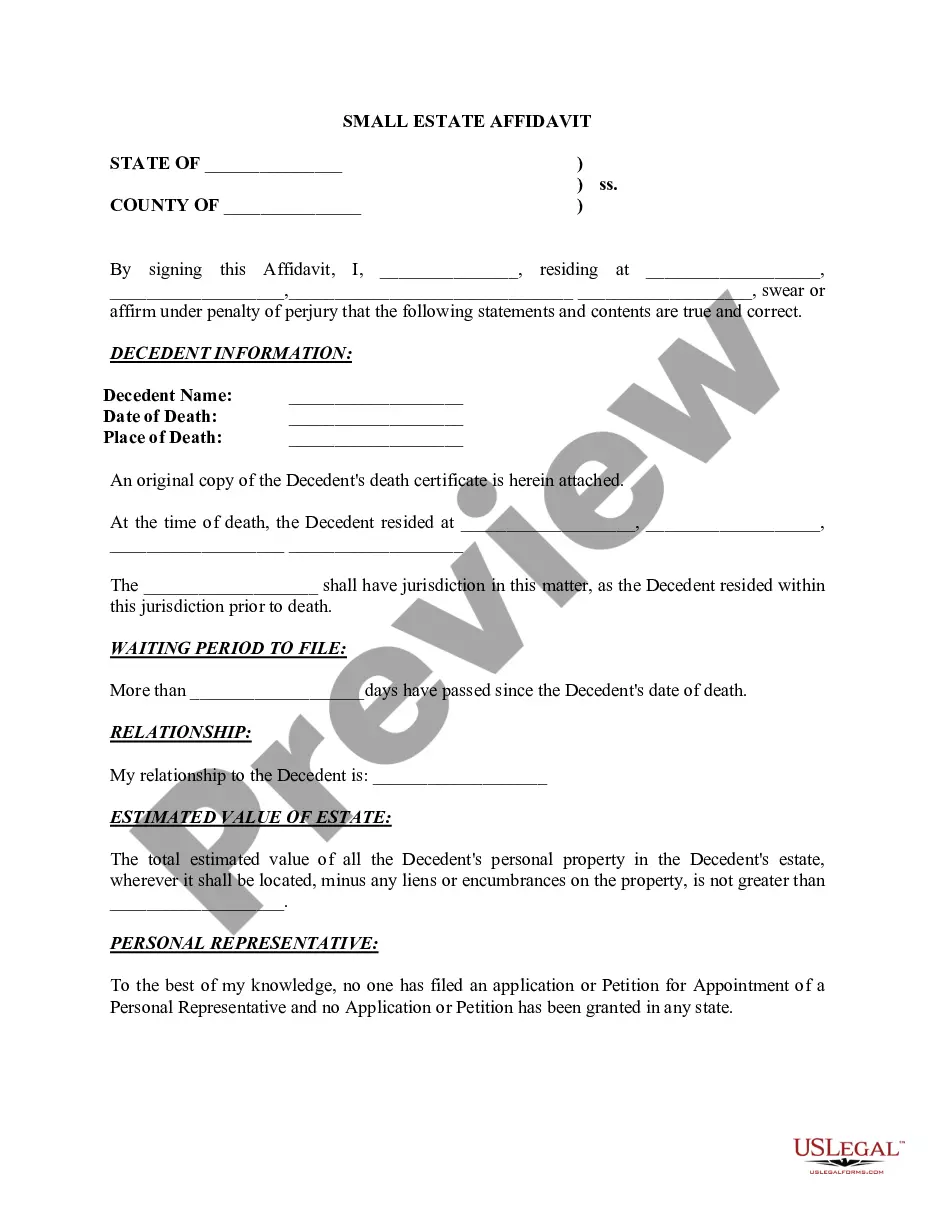
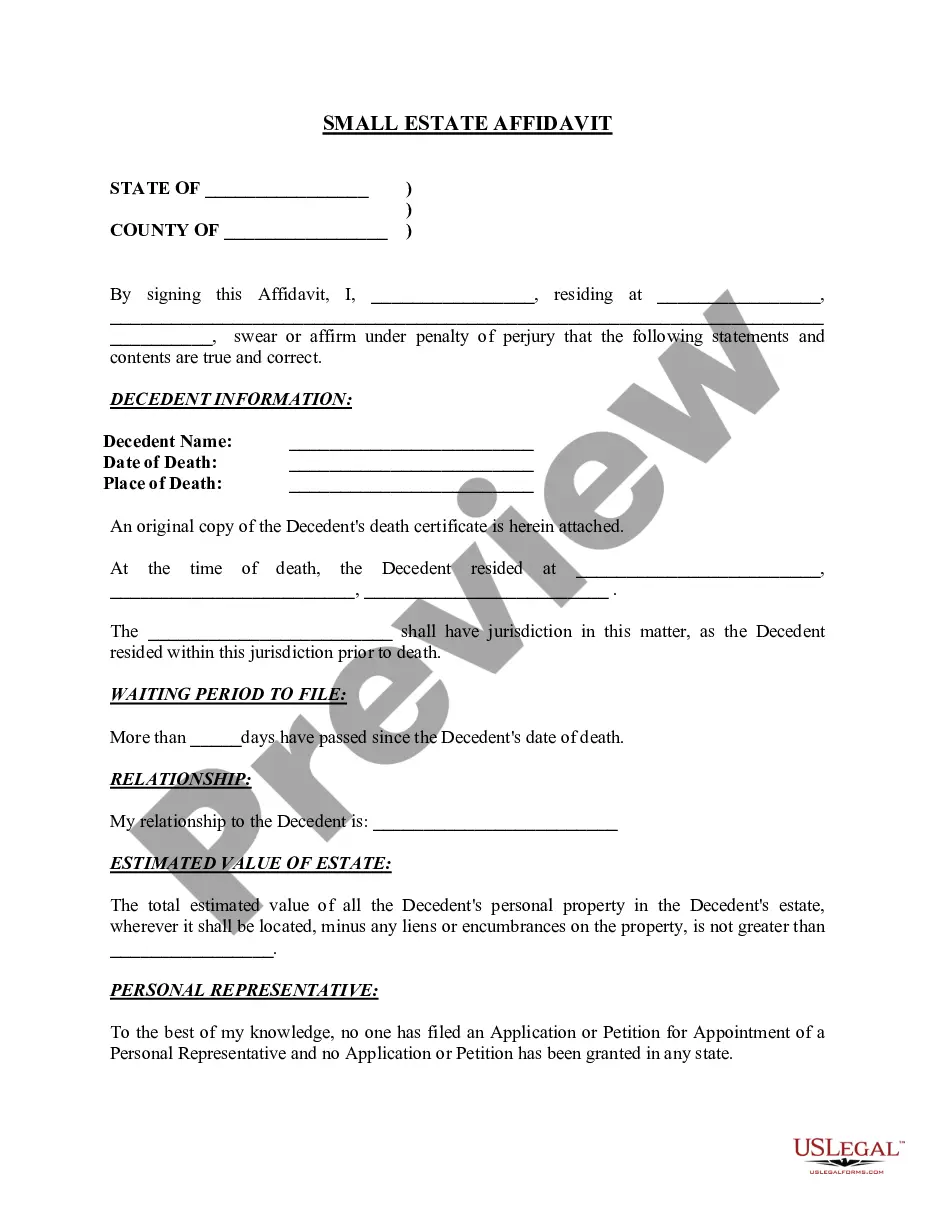
1. Small Estate Affidavit -Some States allow an affidavit to be executed by the spouse and/or heirs of the deceased and present the affidavit to the holder of property such as a bank to obtain property of the deceased. Other states require that the affidavit be filed with the Court. The main requirement before you may use an affidavit is that the value of the personal and/or real property of the estate not exceed a certain value.
2. Summary Administration -Some states allow a Summary administration. Some States recognize both the Small Estate affidavit and Summary Administration, basing the requirement of which one to use on the value of the estate. Example: If the estate value is 10,000 or less an affidavit is allowed but if the value is between 10,000 to 20,000 a summary administration is allowed.
Indiana Summary:
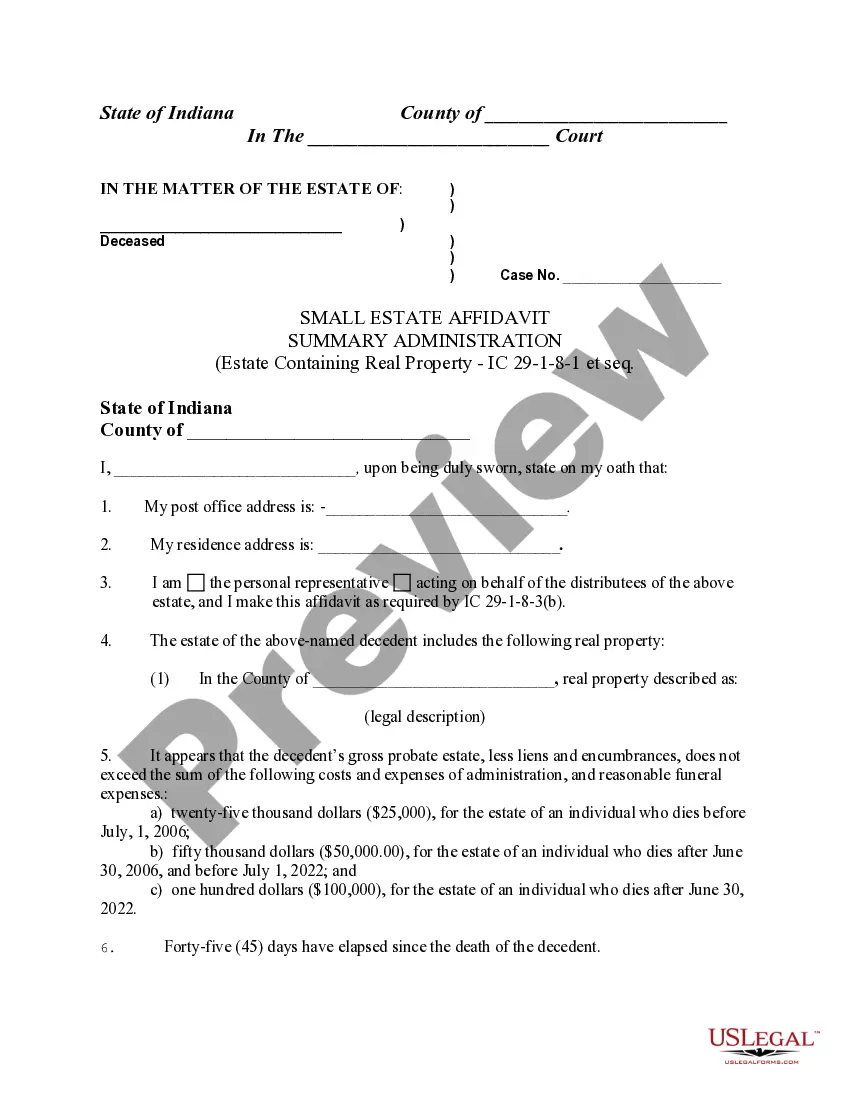
Under Indiana statute, where as estate is valued at no more than $50,000, an interested party may, forty-five (45) days after the death of the decedent, issue a small estate affidavit to collect any debts owed to the decedent.
Indiana Requirements:
Indiana requirements are set forth in the statutes below.
IC 29-1-8-1.5
Affidavit to obtain date of death values for personal property, accounts, and intangible property belonging to a decedent; form of affidavit; duty to furnish information to the affiant.
Sec. 1.5.
(a) This section does not apply to the following:
(1) Real property owned by a decedent.
(2) The contents of a safe deposit box rented by a decedent from a financial institution organized or reorganized under the law of any state (as defined in IC 28-2-17-19) or the United States.
(b) After the death of a decedent, a person:
(1) indebted to the decedent; or
(2) having possession of:
(A) personal property;
(B) an instrument evidencing a debt; Indiana Code 2016
(C) an obligation;
(D) a chose in action;
(E) a life insurance policy;
(F) a bank account; or
(G) intangible property, including annuities, fixed income investments, mutual funds, cash, money market accounts, or stocks; belonging to the decedent; shall furnish the date of death value of the indebtedness or property and the names of the known beneficiaries of property described in this subsection to a person who presents an affidavit containing the information required by subsection (c).
(c) An affidavit presented under subsection (b) must state:
(1) the name, address, Social Security number, and date of death of the decedent;
(2) the name and address of the affiant, and the relationship of the affiant to the decedent;
(3) that the disclosure of the date of death value is necessary to determine whether the decedent's estate can be administered under the summary procedures set forth in this chapter; and
(4) that the affiant is answerable and accountable for the information received to the decedent's personal representative, if any, or to any other person having a superior right to the property or indebtedness.
(d) A person presented with an affidavit under subsection (b) must provide the requested information within three (3) business days after being presented with the affidavit.
(e) A person who acts in good faith reliance on an affidavit presented under subsection (b) is immune from liability for the disclosure of the requested information.
(f) A person who:
(1) is presented with an affidavit under subsection (b); and
(2) refuses to provide the requested information within three (3) business days after being presented with the affidavit;
is liable to the estate of the decedent.
(g) A plaintiff who prevails in an action to compel a person presented with an affidavit under subsection (b) to accept the authority of the affiant or in an action for damages arising from a person's refusal to provide the information requested in an affidavit presented under subsection (b) shall recover the following:
(1) Three (3) times the amount of the actual damages.
(2) Attorney's fees and court costs.
(3) Prejudgment interest on the actual damages from the date the affidavit was presented to the person.
As added by P.L.95-2007, SEC.7.
IC 29-1-8-4.5
Affidavit of entitlement to property; enforcement action; remedies
Sec. 4.5. (a) A distributee entitled to payment or delivery of the property belonging to the decedent or someone acting on a distributee's behalf may present to the court having jurisdiction over the decedent's estate an affidavit containing a statement of the conditions required under section 1(b) of this chapter. Upon receipt of the affidavit, the court may, without notice and hearing, enter an order that the distributees identified in the affidavit are entitled to payment or delivery of the property.
(b) A court may, upon notice and hearing, award attorney's fees and costs to a person bringing an action under subsection (a) if the person indebted to the decedent or holding property of the decedent, other than an insurer regulated under IC 27:
(1) acted in bad faith in refusing to pay or deliver the property belonging to the decedent; or
(2) refused to respond within thirty (30) business days after receiving an affidavit from the person bringing an action under this section, if the affidavit is consistent with section 1 of this chapter.
(c) A court may, upon notice and hearing, award attorney's fees and costs to a person bringing an action under subsection (a) against an insurer regulated under IC 27 if:
(1) the insurer failed to respond pursuant to IC 27 after receiving an affidavit from the person; and
(2) the affidavit is consistent with section 1 of this chapter. As added by Acts 1978, P.L.132, SEC.6. Amended by P.L.61-2006, SEC.5; P.L.51-2014, SEC.4.
IC 29-1-8-1
Small estates; payment upon presentation of affidavit; vehicle or watercraft; securities; insurance death benefit; safe deposit box; digital asset
Sec. 1. (a) Forty-five (45) days after the death of a decedent and upon being presented an affidavit that complies with subsection (b), a person:
(1) indebted to the decedent; or
(2) having possession of personal property or an instrument evidencing a debt, an obligation, a stock, or a chose in action belonging to the decedent;
shall make payment of the indebtedness or deliver the personal property or the instrument evidencing a debt, an obligation, a stock, or a chose in action to a distributee claiming to be entitled to payment or delivery of property of the decedent as alleged in the affidavit.
(b) The affidavit required by subsection (a) must be an affidavit made by or on behalf of the distributee and must state the following:
(1) That the value of the gross probate estate, wherever located (less liens and encumbrances), does not exceed fifty thousand dollars ($50,000).
(2) That forty-five (45) days have elapsed since the death of the decedent.
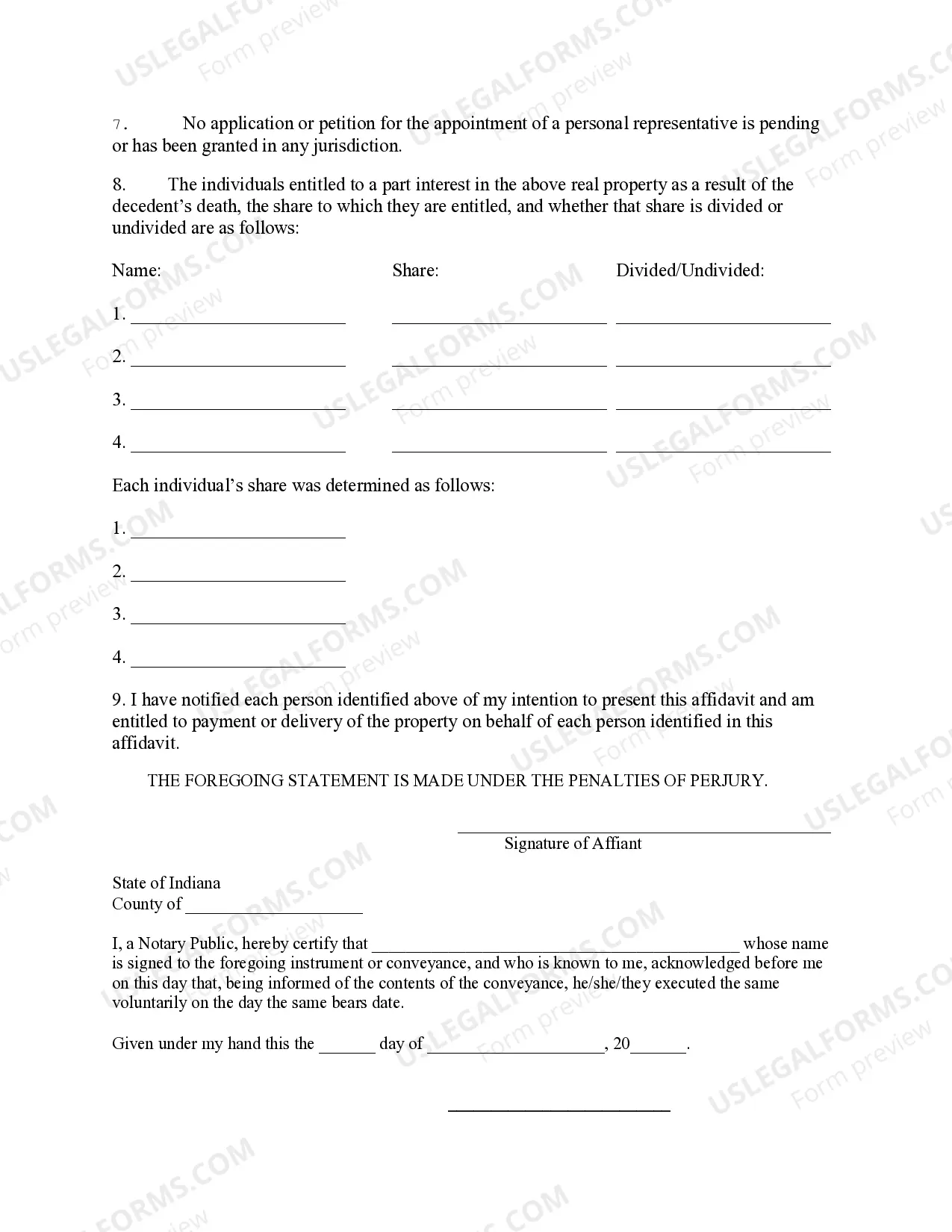
(3) That no application or petition for the appointment of a personal representative is pending or has been granted in any jurisdiction.
(4) The name and address of each distributee that is entitled to a share of the property and the part of the property to which each distributee is entitled.
(5) That the affiant has notified each distributee identified in the affidavit of the affiant's intention to present an affidavit under this section.
(6) That the affiant is entitled to payment or delivery of the Indiana Code 2016 property on behalf of each distributee identified in the affidavit.
(c) If a motor vehicle or watercraft (as defined in IC 9-13-2-198.5) is part of the estate, nothing in this section shall prohibit a transfer of the certificate of title to the motor vehicle if five (5) days have elapsed since the death of the decedent and no appointment of a personal representative is contemplated. A transfer under this subsection shall be made by the bureau of motor vehicles upon receipt of an affidavit containing a statement of the conditions required by subsection (b)(1) and (b)(6). The affidavit must be duly executed by the distributees of the estate.
(d) A transfer agent of a security shall change the registered ownership on the books of a corporation from the decedent to a distributee upon the presentation of an affidavit as provided in subsection (a).
(e) For the purposes of subsection (a), an insurance company that, by reason of the death of the decedent, becomes obligated to pay a death benefit to the estate of the decedent is considered a person indebted to the decedent.
(f) For purposes of subsection (a), property in a safe deposit box rented by a decedent from a financial institution organized or reorganized under the law of any state (as defined in IC 28-2-17-19) or the United States is considered personal property belonging to the decedent in the possession of the financial institution.
(g) For purposes of subsection (a), a distributee has the same rights as a personal representative under IC 32-39 to access a digital asset (as defined in IC 32-39-1-10) of the decedent.
(Formerly: Acts 1953, c.112, s.801; Acts 1965, c.379, s.2; Acts 1971, P.L.406, SEC.1; Acts 1975, P.L.288, SEC.12.) As amended by Acts 1977, P.L.2, SEC.80; Acts 1977, P.L.298, SEC.1; P.L.71-1991,
SEC.15; P.L.77-1992, SEC.5; P.L.118-1997, SEC.16; P.L.59-2000
SEC.1; P.L.61-2006, SEC.4; P.L.51-2014, SEC.3; P.L.137-2016, SEC.1.
IC 29-1-8-2
Personal property; payments; delivery; transfer; release
Sec. 2. The person paying, delivering, transferring, or issuing personal property or the evidence thereof pursuant to affidavit is discharged and released to the same extent as if the person dealt with a personal representative of the decedent. The person is not required to see to the application of the personal property or evidence thereof or to inquire into the truth of any statement in the affidavit. If any person to whom an affidavit is delivered refuses to pay, deliver, transfer, or issue any personal property or evidence thereof, it may be recovered or its payment, delivery, transfer, or issuance compelled upon proof of their right in a proceeding brought for the purpose by or on behalf of the persons entitled thereto. Any person to whom payment, delivery, transfer, or issuance is made is answerable and accountable therefor to any personal representative of the estate or to any other person having a superior right.
Formerly: Acts 1953, c.112, s.802; Acts 1975, P.L.288, SEC.13. As amended by P.L.194-2017, SEC.3.
IC 29-1-8-3
(a) If it appears that the value of a decedent's gross probate
(a) If it appears that the value of a decedent's gross probate estate, less liens and encumbrances, does not exceed the sum of:
(1) twenty-five thousand dollars ($25,000), for the estate of an individual who dies before July 1, 2007, and fifty thousand dollars ($50,000), for the estate of an individual who dies after June 30, 2007;
(2) the costs and expenses of administration; and
(3) reasonable funeral expenses; the personal representative or a person acting on behalf of the distributees, without giving notice to creditors, may immediately disburse and distribute the estate to the persons entitled to it and file a closing statement as provided in section 4 of this chapter.
(b) If an estate described in subsection (a) includes real property, an affidavit may be recorded in the office of the recorder in the county in which the real property is located. The affidavit must contain the following:
(1) The legal description of the real property.
(2) The following statement:
(A) If the individual dies after June 30, 2007, the following statement: It appears that the decedent's gross probate estate, less liens and encumbrances, does not exceed the sum of the following: fifty thousand dollars ($50,000), the costs and expenses of administration, and reasonable funeral expenses.
(B) If the individual dies before July 1, 2007, the following statement: It appears that the decedent's gross probate estate, less liens and encumbrances, does not exceed the sum of the following: twenty-five thousand dollars ($25,000), the costs and expenses of administration, and reasonable funeral expenses.
(3) The name of each person entitled to at least a part interest in the real property as a result of a decedent's death, the share to which each person is entitled, and whether the share is a divided or undivided interest.
(3) The name of each person entitled to at least a part interest in the real property as a result of a decedent's death, the share to which each person is entitled, and whether the share is a divided or undivided interest.
(4) A statement which explains how each person's share has been determined.
(Formerly: Acts 1953, c.112, s.803; Acts 1959, c.239, s.1; Acts 1965, c.379, s.3; Acts 1971, P.L.406, SEC.2; Acts 1975, P.L.288, SEC.14.) As amended by P.L.146-1984, SEC.2; P.L.118-1997, SEC.17; P.L.42-1998, SEC.2; P.L.95-2007, SEC.8; P.L.220-2011, SEC.473.
IC 29-1-8-4 Closing of estate; statement
(a) Unless prohibited by order of the court and except for estates being administered by supervised personal representatives, a personal representative or a person acting on behalf of the distributees may close an estate administered under the summary procedures of section 3 of this chapter by filing with the court, at any time after disbursement and distribution of the estate, a verified statement stating that:
(1) to the best knowledge of the personal representative or person acting on behalf of the distributees the value of the gross probate estate, less liens and encumbrances, did not exceed the sum of:
(A) twenty-five thousand dollars ($25,000), for the estate of an individual who dies before July 1, 2007, and fifty thousand dollars ($50,000), for the estate of an individual who dies after June 30, 2007;
(B) the costs and expenses of administration; and
(C) reasonable funeral expenses;
(2) the personal representative or person acting on behalf of the distributees has fully administered the estate by disbursing and distributing it to the persons entitled to it; and
(3) the personal representative or person acting on behalf of the distributees has sent a copy of the closing statement to all distributees of the estate and to all creditors or other claimants of whom the personal representative or person acting on behalf of the distributees is aware and has furnished a full account in writing of the administration to the distributees whose interests are affected.
(b) If no actions, claims, objections, or proceedings involving the personal representative or person acting on behalf of the distributees are filed in the court within three (3) months after the closing statement is filed, the appointment of the personal representative or the duties of the person acting on behalf of the distributees terminate.
(c) A closing statement filed under this section has the same effect as one (1) filed under IC 29-1-7.5-4.
(d) A copy of any affidavit recorded under section 3(b) of this chapter must be attached to the closing statement filed under this section.
(Formerly: Acts 1953, c.112, s.804; Acts 1971, P.L.406, SEC.3; Acts 1975, P.L.288, SEC.15.) As amended by Acts 1976, P.L.125, SEC.4; Acts 1977, P.L.297, SEC.2; P.L.146-1984, SEC.3; P.L.95-2007, SEC.9; P.L.220-2011, SEC.474.
IC 29-1-8-8 Payment of claims; accounting; closing administration
Whenever, after the inventory has been filed by a personal representative, it is established that the estate of a decedent, exclusive allowance to the surviving spouse or dependent children, does not exceed an amount sufficient to pay the claims of classes 1 to 6 inclusive, the personal representative upon order of the court shall pay the same in the order provided and thereafter present his account with an application for the settlement and allowance thereof. Thereupon, the court, with or without notice, may adjust, correct, settle, allow or disallow such account, and, if the account is settled and allowed, decree final distribution, discharge the personal representative and close the administration.
IC 29-1-8-9 Prepaid funeral expenses; last illness expense
Sec. 9. This article shall not be construed to prevent the application by any person, association or corporation of all or any portion of any obligation owed to a decedent's estate and designed, intended or created for the purpose of paying the funeral expenses or expenses of the last illness of the deceased from directly applying the proceeds of such obligation for such purpose. The payment of such expenses by the obligor or person holding such funds shall be a complete defense to the extent of such payment to the demand of any person on behalf of such estate or any other claimant.
(Formerly: Acts 1953, c.112, s.809.) As amended by Acts 1982, P.L.171, SEC.26.