Indiana Quitclaim Deed - Two Individuals, or Husband and Wife, as Grantors, One Grantor acting through an attorney in fact, to Two Individuals or Husband and Wife as Grantees.
What this document covers
This Quitclaim Deed is a legal document that allows two individuals or a married couple to transfer ownership of property to another pair of individuals or a married couple. One of the Grantors can act through an attorney-in-fact, as authorized by a recorded power of attorney. This deed is specifically designed to comply with state statutory laws and is different from other property transfer forms, such as warranty deeds, as it does not guarantee that the Grantors hold clear title to the property.
What’s included in this form
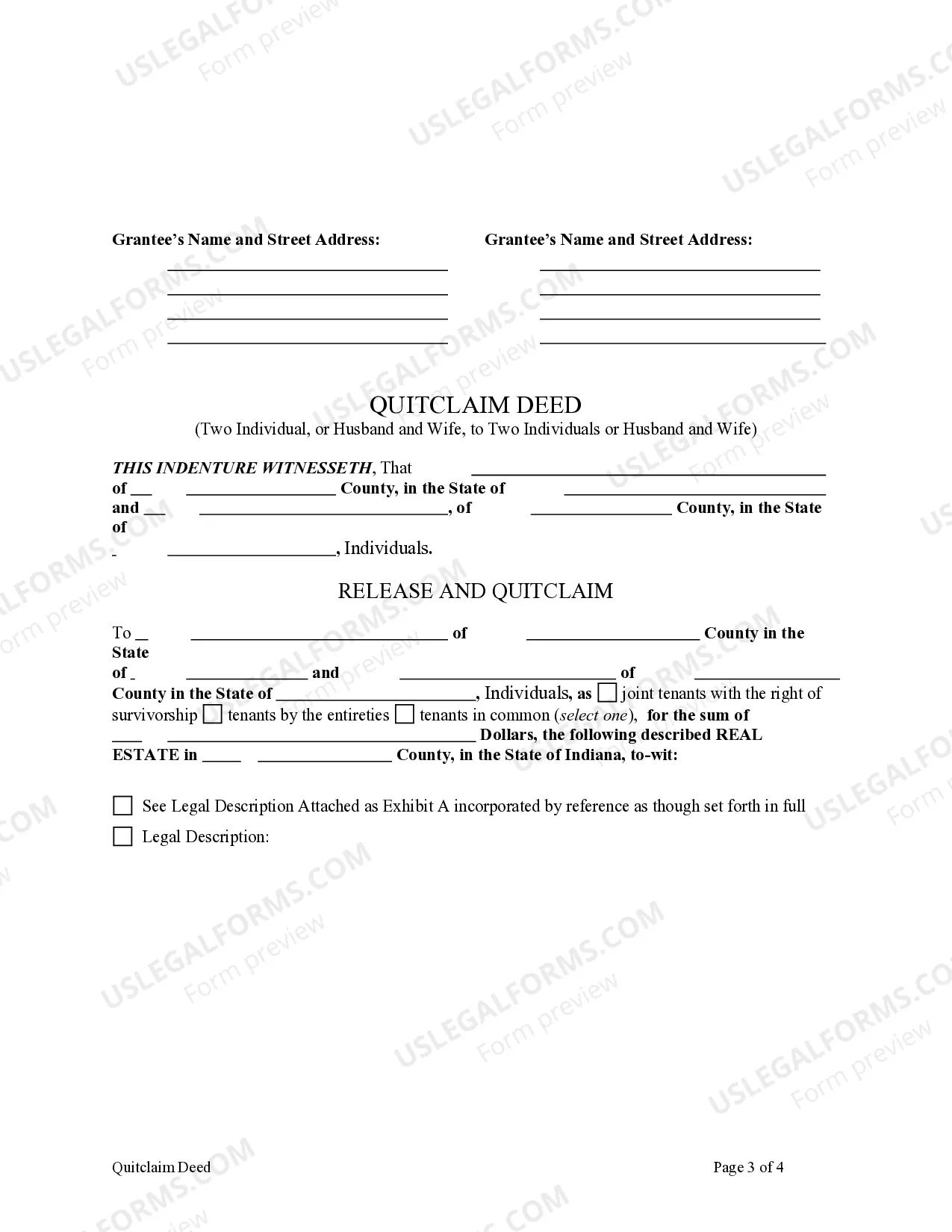
- Identification of the Grantors and Grantees.
- Detailed description of the property being transferred.
- Disclosure of the attorney-in-fact, if applicable, along with the recorded power of attorney information.
- Legal language that complies with state laws.
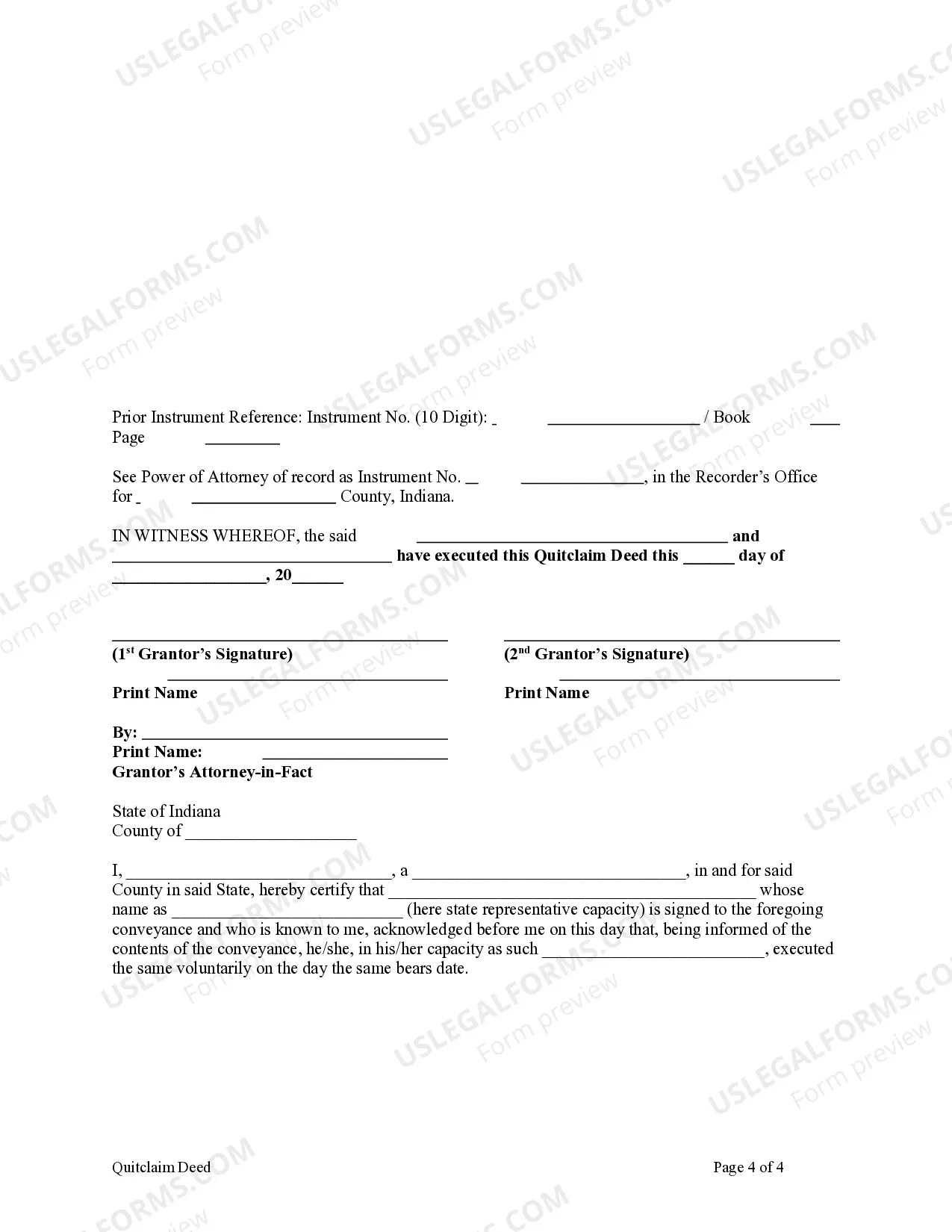
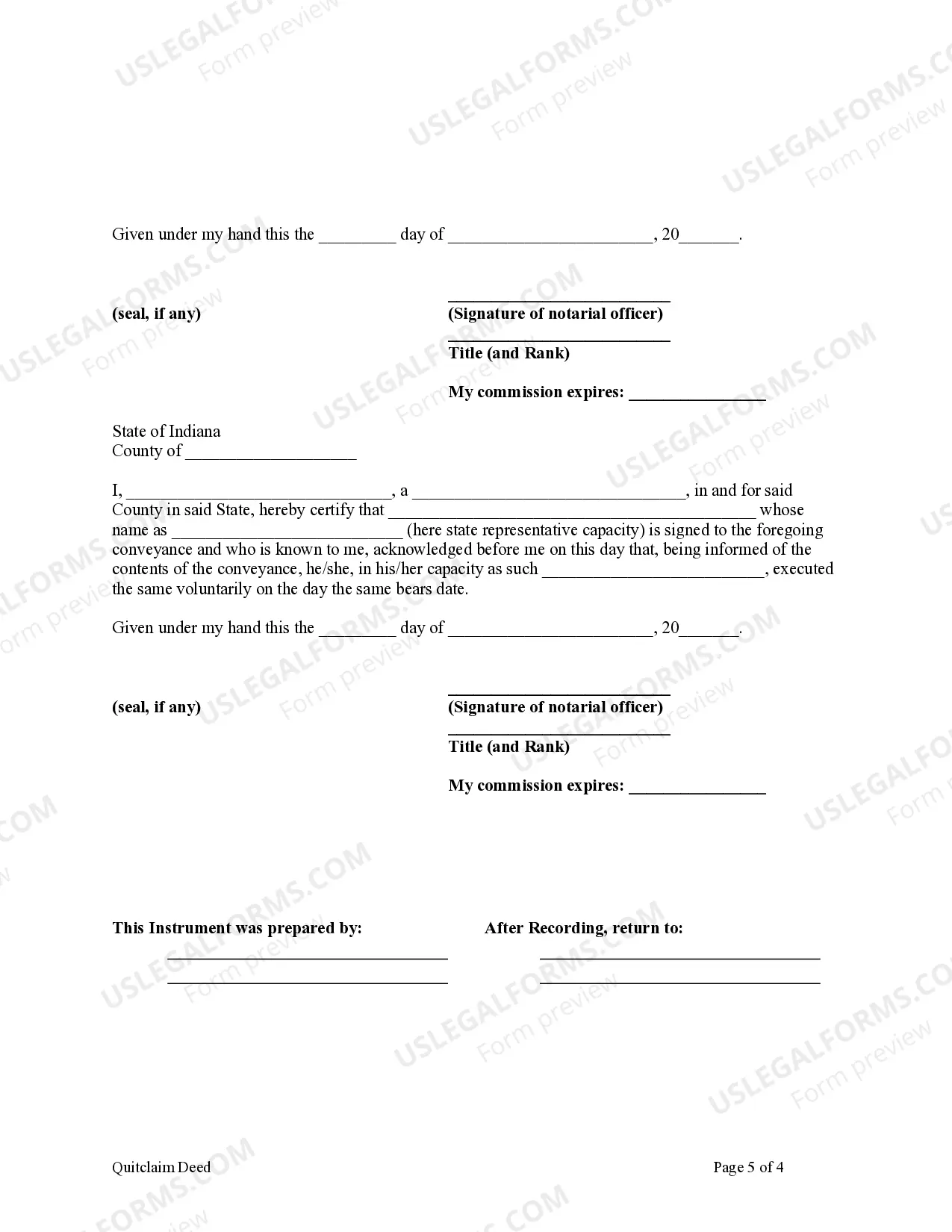
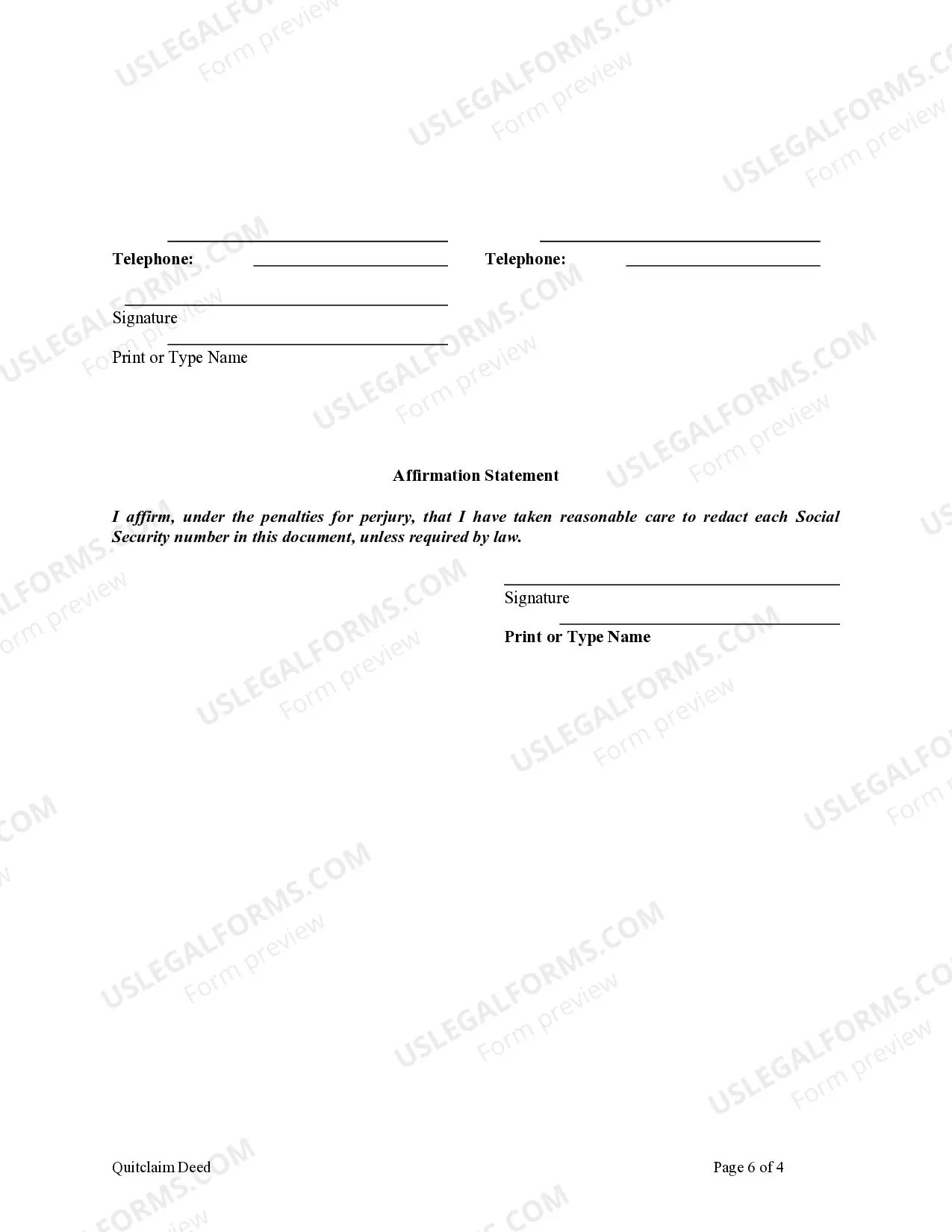
- Signature lines for the Grantors and acknowledgment of the deed by a notary, if required.


When this form is needed
This Quitclaim Deed should be used when individuals or couples need to transfer property ownership without the need for guarantees regarding the title's validity. Situations for its use may include familial transfers, estate settlements, or when one party has a limited power of attorney to act on behalf of another.
Who this form is for
This form is suitable for:
- Owners of property looking to transfer their interest to another party.
- Married couples who are changing ownership arrangements.
- Individuals acting under a power of attorney for another party.
- Real estate professionals assisting clients in property transactions.
How to prepare this document
- Identify the full names and addresses of both the Grantors and Grantees.
- Specify the exact description and address of the property being conveyed.
- If applicable, enter the details of the attorney-in-fact and their authority as noted in the power of attorney.
- Ensure all Grantors sign the document, including the attorney-in-fact if they are acting on behalf of another.
- Notarize the document before submission, if required by local law.
Does this form need to be notarized?
This form does not typically require notarization unless specified by local law. However, to ensure validity and compliance, it is recommended that you have the Quitclaim Deed notarized before recording it with the appropriate authorities.
Get your form ready online
Our built-in tools help you complete, sign, share, and store your documents in one place.
Make edits, fill in missing information, and update formatting in US Legal Forms—just like you would in MS Word.
Download a copy, print it, send it by email, or mail it via USPS—whatever works best for your next step.
Sign and collect signatures with our SignNow integration. Send to multiple recipients, set reminders, and more. Go Premium to unlock E-Sign.
If this form requires notarization, complete it online through a secure video call—no need to meet a notary in person or wait for an appointment.
We protect your documents and personal data by following strict security and privacy standards.

Make edits, fill in missing information, and update formatting in US Legal Forms—just like you would in MS Word.

Download a copy, print it, send it by email, or mail it via USPS—whatever works best for your next step.

Sign and collect signatures with our SignNow integration. Send to multiple recipients, set reminders, and more. Go Premium to unlock E-Sign.

If this form requires notarization, complete it online through a secure video call—no need to meet a notary in person or wait for an appointment.

We protect your documents and personal data by following strict security and privacy standards.
Avoid these common issues
- Failing to accurately describe the property in question.
- Not including the necessary details of the power of attorney when applicable.
- Omitting signatures or not notarizing the document when required.
- Using the form without understanding the implications of a deed transfer.
Why use this form online
- Instant access to professionally drafted forms from licensed attorneys.
- Convenience of completing documents digitally using tools that highlight editable fields.
- Easy printing options that allow for hand or typewritten completion.
- Time-saving features that eliminate the need for extensive legal consultations for standard transactions.
Looking for another form?
Form popularity
FAQ
To add a spouse to a deed, all you have to do is literally fill out, sign and record a new deed in your county recorder's office.
Before adding your spouse to the deed, speak with your attorney. The easiest way to grant your spouse title to your home is via a quitclaim deed (Californians generally use an interspousal grant deed). With a quitclaim deed, you can name your spouse as the property's joint owner.
Write the Deed Fill out the quit claim deed form, which can be obtained online, or write your own using the form as a guide. The person giving up the interest in the property is the grantor, and the person receiving the interest is the grantee.
Step 1: Find your IN quitclaim deed form. Step 2: Gather the information you need. Step 3: Enter the information about the parties. Step 4: Enter the legal description of the property. Step 5: Have the grantor sign the document in the presence of a Notary Public.
Adding someone to your house deed requires the filing of a legal form known as a quitclaim deed. When executed and notarized, the quitclaim deed legally overrides the current deed to your home. By filing the quitclaim deed, you can add someone to the title of your home, in effect transferring a share of ownership.
The Quit Claim Deed form uses the terms of Grantor (Seller or Owner of said property) and Grantee (Buyer of said property) for the two parties involved. First, the parties must fill in the date. Then, write in the name of the county and state in which the property is located.
Yes you can. This is called a transfer of equity but you will need the permission of your lender. If you are not married or in a civil partnership you may wish to consider creating a deed of trust and a living together agreement which we can explain to you.
If the quitclaim deed requires the signature of all co-owners, the deed is invalid unless all co-owners have signed it and the deed is then delivered to the grantee.If one individual owns real estate and desires to add a co-owner such as a spouse, a quitclaim deed might be used.
Documents must be notarized. Documents executed or acknowledged in Indiana must include a statement that includes: The names of all those signing or serving as a witness on the document must be identical throughout the document and must be printed or typewritten under each signature.