Idaho Letters Testamentary
What is this form?
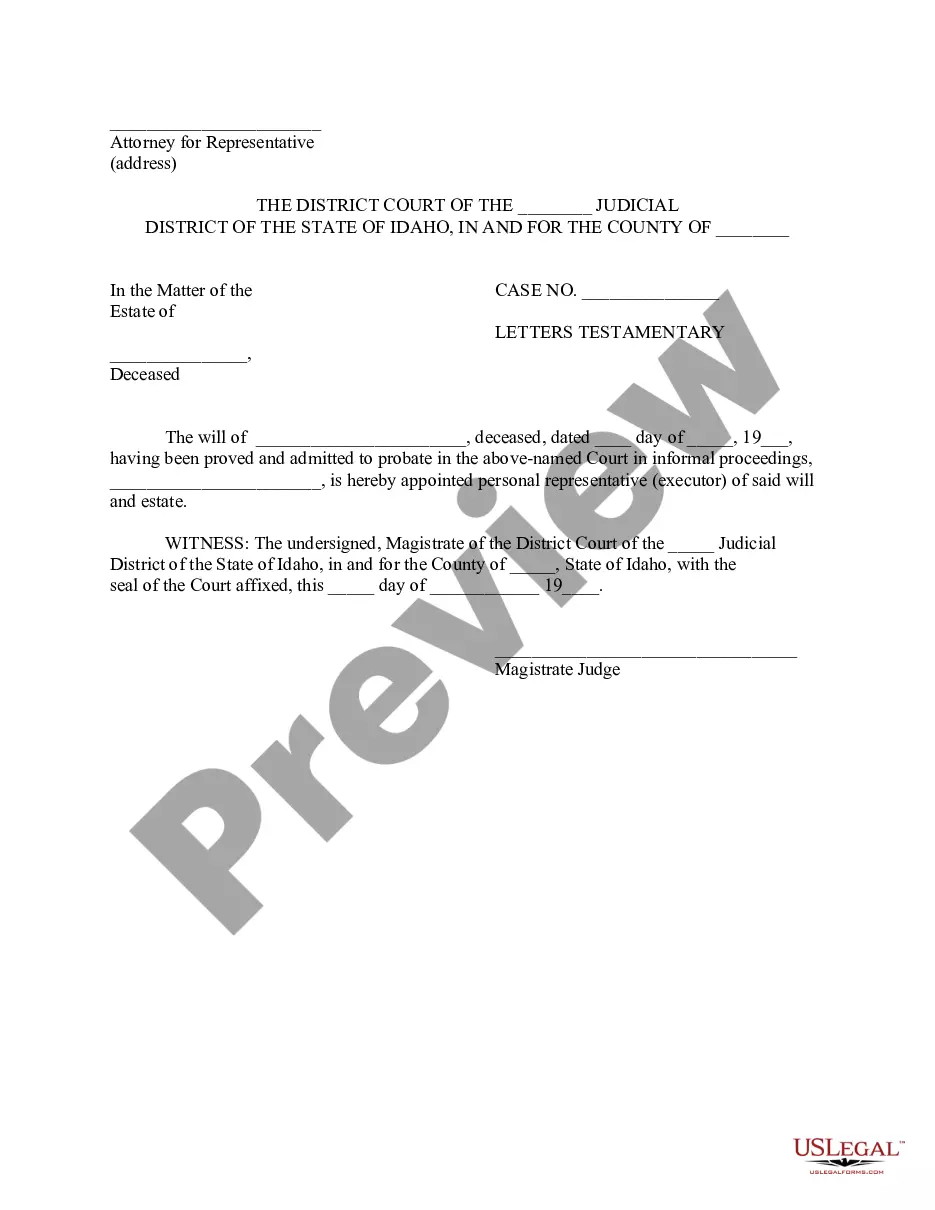
Letters Testamentary is a legal document that officially appoints a personal representative (executor) to administer a deceased person's estate. This form is essential in probate proceedings, as it grants the personal representative the authority to manage the estate's affairs, including filing annual reports of assets and debts. It differs from other probate forms by specifically designating the individual responsible for executing the terms of the will and handling estate matters.
Main sections of this form
- Case number: A unique identifier for the probate case.
- Decedent's name: The individual whose estate is being managed.
- Appointment clause: Specifies the personal representative of the estate.
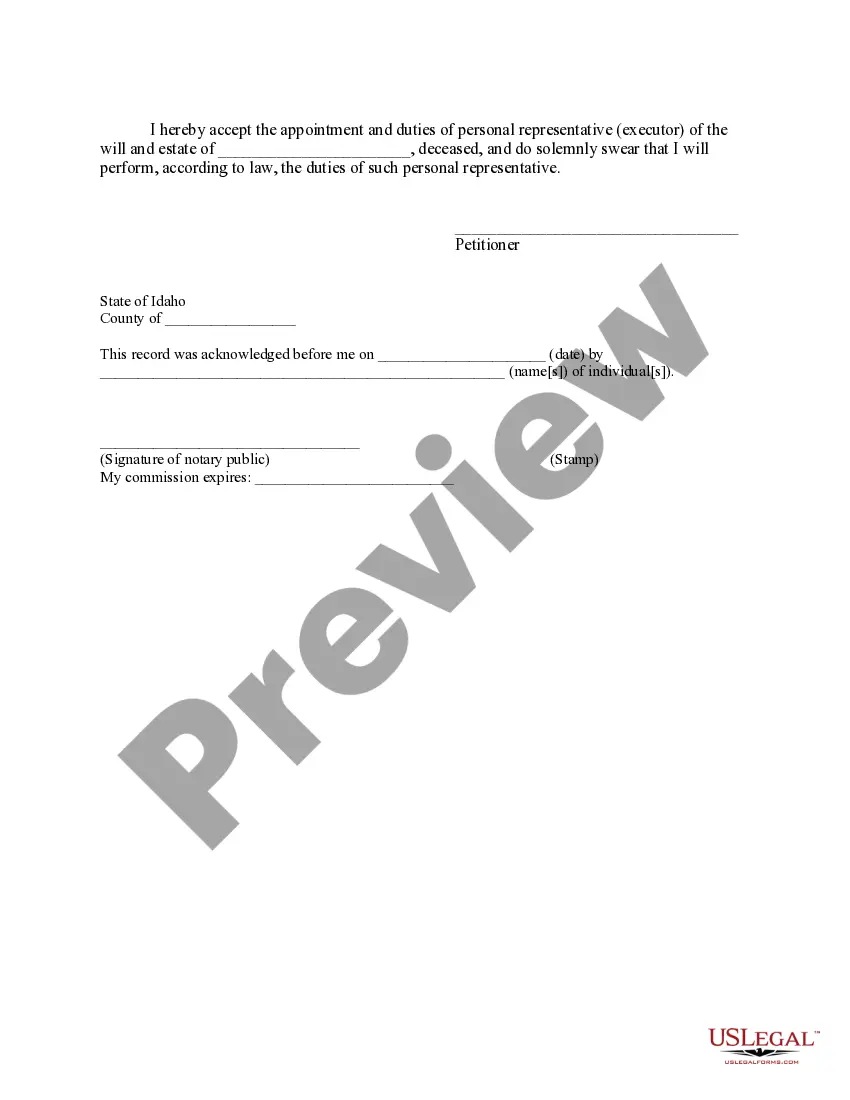
- Signature lines: Spaces for the magistrate, personal representative, and notary public.
- Jurisdiction details: Information regarding the district court overseeing the probate process.

When to use this form
This form should be used when the will of a deceased person has been probated and a personal representative needs to be formally appointed. It is typically required when the personal representative intends to carry out the estate's directives as outlined in the will, such as managing assets, settling debts, and distributing inheritances.
Who should use this form
- Individuals appointed as personal representatives in a will.
- Executors who need formal recognition from the probate court to act on an estate's behalf.
- Legal representatives helping clients navigate the probate process.
Instructions for completing this form
- Identify the case number at the top of the form.
- Enter the name of the deceased individual and the date of the will.
- Specify the appointed personal representative's name in the designated section.
- Have the magistrate sign and date the form to validate the appointment.
- Personal representative should sign to accept their duties, along with a notary's acknowledgment.
Notarization guidance
This document requires notarization to meet legal standards. US Legal Forms provides secure online notarization powered by Notarize, allowing you to complete the process through a verified video call, available 24/7.
Get your form ready online
Our built-in tools help you complete, sign, share, and store your documents in one place.
Make edits, fill in missing information, and update formatting in US Legal Forms—just like you would in MS Word.
Download a copy, print it, send it by email, or mail it via USPS—whatever works best for your next step.
Sign and collect signatures with our SignNow integration. Send to multiple recipients, set reminders, and more. Go Premium to unlock E-Sign.
If this form requires notarization, complete it online through a secure video call—no need to meet a notary in person or wait for an appointment.
We protect your documents and personal data by following strict security and privacy standards.

Make edits, fill in missing information, and update formatting in US Legal Forms—just like you would in MS Word.

Download a copy, print it, send it by email, or mail it via USPS—whatever works best for your next step.

Sign and collect signatures with our SignNow integration. Send to multiple recipients, set reminders, and more. Go Premium to unlock E-Sign.

If this form requires notarization, complete it online through a secure video call—no need to meet a notary in person or wait for an appointment.

We protect your documents and personal data by following strict security and privacy standards.
Common mistakes to avoid
- Failing to include the correct case number.
- Not having the magistrate sign the form.
- Leaving out the personal representative's signature.
- Using incorrect names or titles for the individuals involved.
- Not completing the form in compliance with local court requirements.
Benefits of using this form online
- Convenience of downloading and filling out the form from home.
- Editability allows for easy corrections before final submission.
- Accessible templates ensure you have the correct legal language.
- Designed by licensed attorneys to meet legal standards.
Looking for another form?


Form popularity
FAQ
In order to obtain letters testamentary or letters of administration in California, you need to draft and file a petition for probate requesting the letters. First, you should file California Probate Form DE150 with the probate petition and its various required attachments.
As part of the probate process, letters testamentary are issued by your state's probate court. To obtain the document, you need a copy of the will and the death certificate, which are then filed with the probate court along with whatever letters testamentary forms the court requires as part of your application.
A letter of testamentary is a document issued by a probate court that gives an executor the power to act in a fiduciary manner on behalf of the estate.
Unlike many other states, California does not impose special requirements on executors who live out of state. But that doesn't mean it's a good idea to appoint someone who lives far away. For practical reasons, it's usually best to name an executor who lives near you.
A Letter of Testamentarysometimes called a Letter of Administration or Letter of Representationis a document granted by a local court. The document simply states that you are the legal executor for a particular estate and that you have the ability to act as such.
It generally takes four to six weeks from the time a petition for probate is filed until Letters can be issued to the personal representative.
Find the local probate court or surrogate's court, as it's sometimes called. File the will and a certified copy of the testator's death certificate . Fill out the necessary paperwork , like a petition form, and provide any additional documents.
Most likely you will need an attorney to obtain letters testamentary. Many attorneys offer a free consultation. At least meet with an attorney to make sure letters testamentary is what you need.
There are two components of letter of testamentary cost: the court fee and the attorney's fees. The court fee ranges from $45 to $1,250, depending on the gross value of the estate. The attorney's fees start at about $2,500 and can go up depending on the complexity of the case.