Alabama Executor's Oath
What this document covers
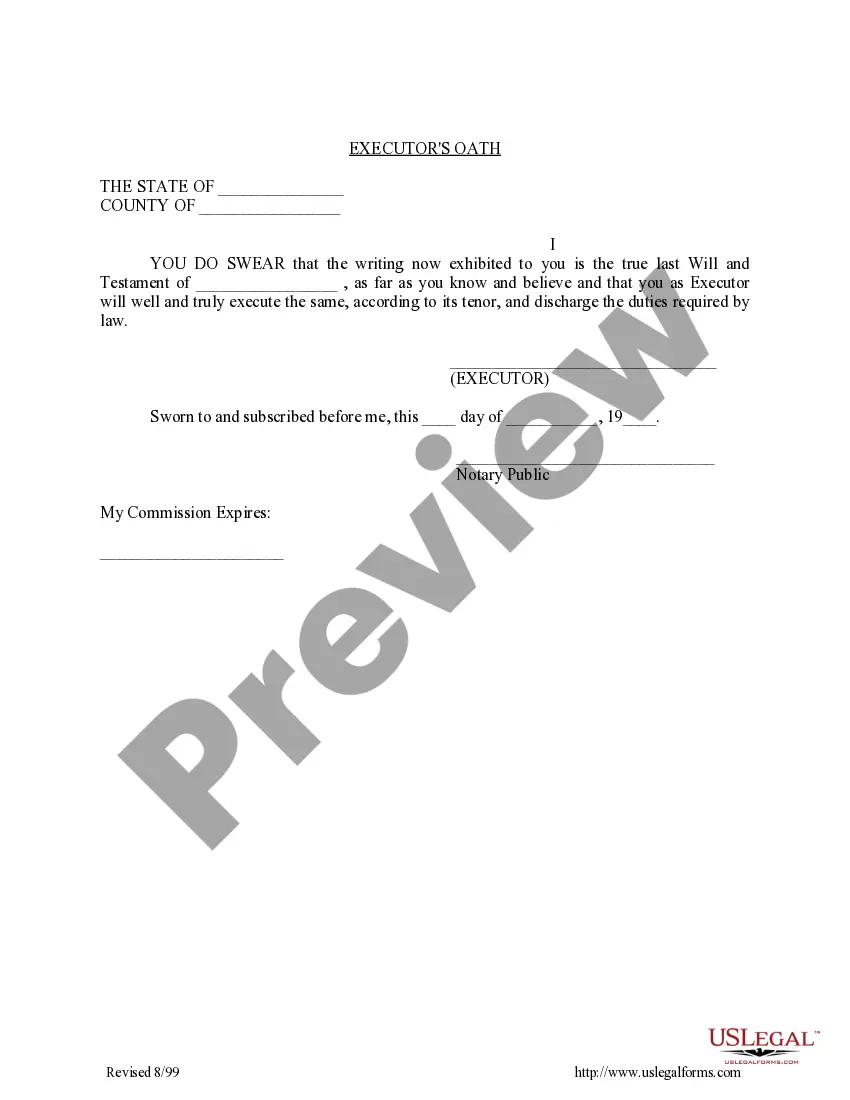
The Executor's Oath is a legal document required in probate proceedings. It affirms that the person appointed as the executor has the genuine last will and testament of the deceased and is committed to fulfilling their responsibilities as designated in that document. This form differs from other probate-related forms by specifically focusing on the executor's declaration of the will's authenticity.
Key parts of this document
- State and county where the oath is being taken.
- The full name of the executor.
- The name of the deceased and acknowledgment of the submitted will.
- A statement of belief in the will's validity.
- Signature of the executor.
- Signature and commission expiration date of the notary public.
When this form is needed
This form is essential when the executor of an estate is required to submit the will to the probate court as part of the estate administration process. It is used to affirm the authenticity of the last will and testament when initiating probate proceedings.
Who this form is for
- Individuals appointed as executors in a will.
- Families handling the estate of a deceased loved one.
- Legal professionals assisting clients with probate matters.
Instructions for completing this form
- Identify the state and county at the top of the form.
- Write the name of the executor in the designated field.
- Fill in the name of the deceased and confirm the submission of their last will.
- Sign the form as the executor, affirming your commitment to the duties.
- Have the form notarized by a recognized notary public.
- Ensure to note the date and expiration of the notary's commission.
Is notarization required?
Notarization is required for this form to take effect. Our online notarization service, powered by Notarize, lets you verify and sign documents remotely through an encrypted video session, available 24/7.
Get your form ready online
Our built-in tools help you complete, sign, share, and store your documents in one place.
Make edits, fill in missing information, and update formatting in US Legal Forms—just like you would in MS Word.
Download a copy, print it, send it by email, or mail it via USPS—whatever works best for your next step.
Sign and collect signatures with our SignNow integration. Send to multiple recipients, set reminders, and more. Go Premium to unlock E-Sign.
If this form requires notarization, complete it online through a secure video call—no need to meet a notary in person or wait for an appointment.
We protect your documents and personal data by following strict security and privacy standards.

Make edits, fill in missing information, and update formatting in US Legal Forms—just like you would in MS Word.

Download a copy, print it, send it by email, or mail it via USPS—whatever works best for your next step.

Sign and collect signatures with our SignNow integration. Send to multiple recipients, set reminders, and more. Go Premium to unlock E-Sign.

If this form requires notarization, complete it online through a secure video call—no need to meet a notary in person or wait for an appointment.

We protect your documents and personal data by following strict security and privacy standards.
Mistakes to watch out for
- Failing to have the form notarized.
- Not providing accurate information about the deceased or the executor.
- Ignoring state-specific requirements for the form's submission.
Benefits of completing this form online
- Convenient access to the form anytime, anywhere.
- Ability to quickly fill out and edit the form as needed.
- Reliable templates created by licensed attorneys to ensure legal compliance.
Looking for another form?
Form popularity
FAQ
If you die in Alabama without a will, your assets will go to your closest relatives. Not all assets are involved only those that would have passed through a will are affected by Alabama's intestate succession laws.If you die with a spouse but no children Spouse inherits everything.
The length of time an executor has to distribute assets from a will varies by state, but generally falls between one and three years.
No, in Alabama, you do not need to notarize your will to make it legal. However, Alabama allows you to make your will "self-proving" and you'll need to go to a notary if you want to do that. A self-proving will speeds up probate because the court can accept the will without contacting the witnesses who signed it.
Determine the Type of Alabama Probate Proceeding to Open. Determine the Appropriate Alabama Probate Court (Jurisdiction) File a Petition with the Alabama Probate Court. Provide Notice to Spouse/Next of Kin. Obtain and Submit a Personal Representative's Bond. The Lawyer Attends a Hearing with the Alabama Probate Court.
Signature: The will must be signed by the testator or by another person in the testator's name, under his direction and in his presence. Witnesses: At least two witnesses must sign an Alabama Last Will in order for it to be valid. Writing: An Alabama will must be written in order to be valid.
Generally, an executor has 12 months from the date of death to distribute the estate. This is known as 'the executor's year'. However, for various reasons the executor may have been delayed and has not distributed the estate within this time frame.
In Alabama, the estate executor is known as a "personal representative". Executors for Alabama estates are entitled to reasonable compensation of up to 2.5% of assets received, and 2.5% of disbursements.
A last will and testament in Alabama must be in writing and signed by the testator (the person writing the will), or at the testator's direction and in his or her presence. The will also has to be witnessed and signed by at least two people.
By law, the probate of an estate in Alabama will take at least six months. This period gives creditors and others with a claim on the estate time to receive notice that the estate is being probated and to submit a claim.