Florida Complaint for Eviction
Understanding this form
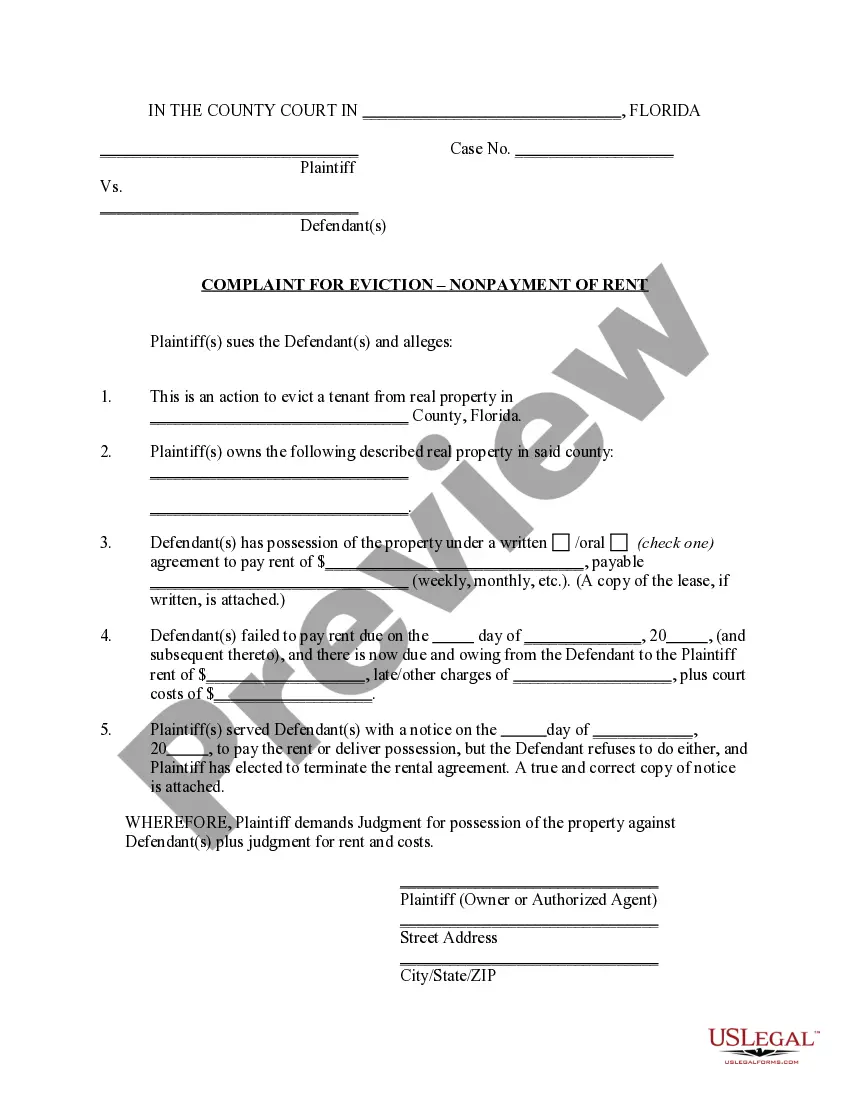
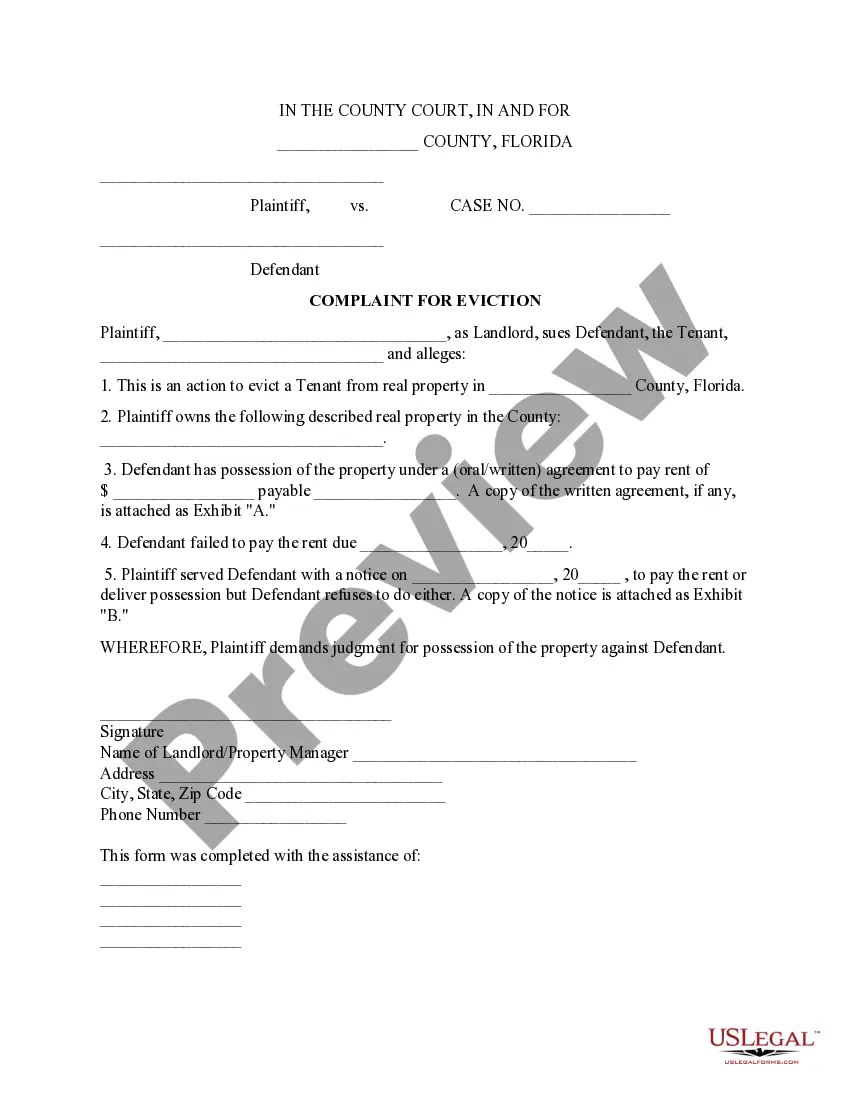
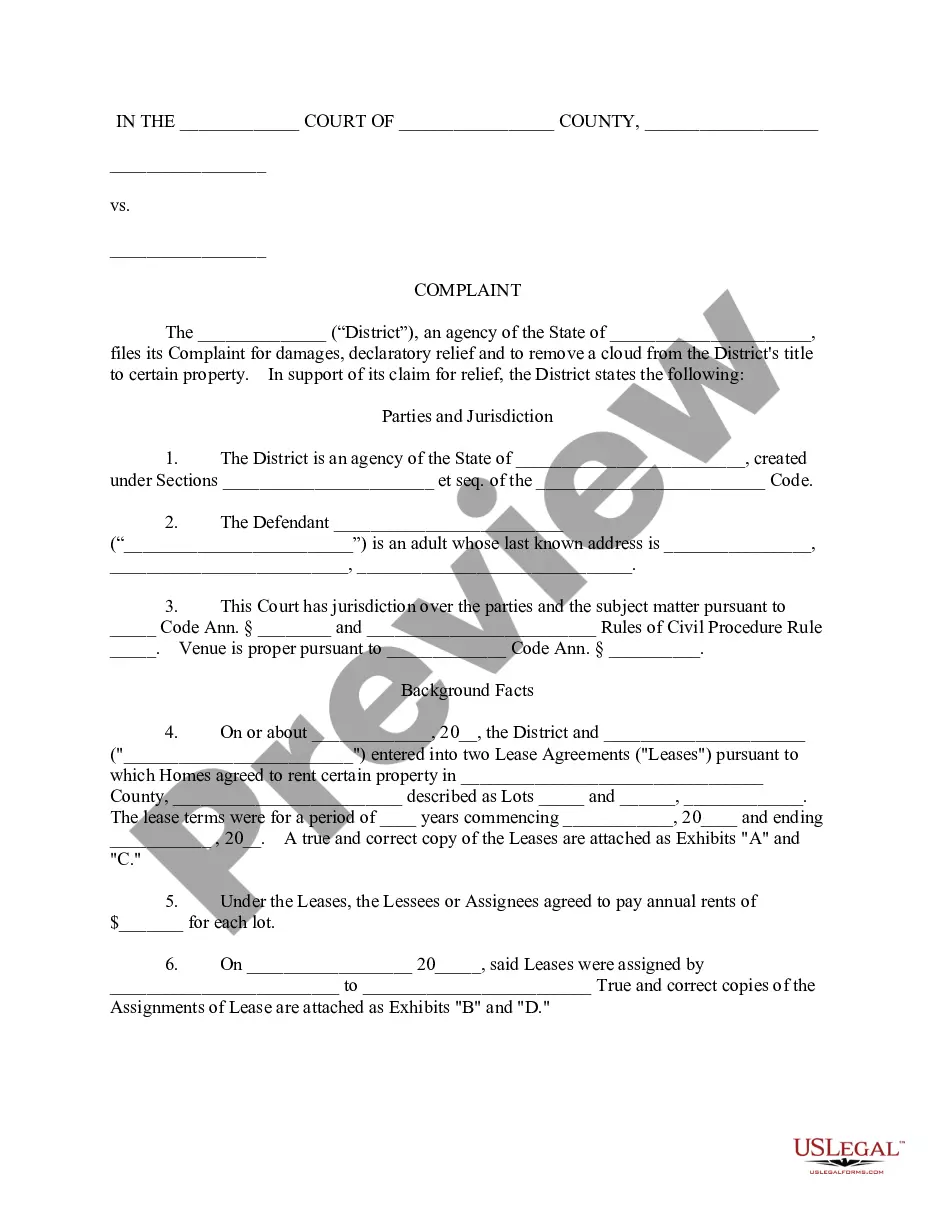
The Complaint for Eviction is a legal document used by a property owner (plaintiff) to initiate eviction proceedings against a tenant (defendant) due to nonpayment of rent. This form is specifically designed to comply with the regulations governed by the state of Florida, making it a crucial step in the legal process of reclaiming possession of the rental property. Unlike other rental agreements or notices, this complaint formally requests the court's intervention to remove a tenant from the premises for failing to fulfill their financial obligations.
Form components explained
- Identification of court, case number, and parties involved (plaintiff and defendant).
- Description of the property being evicted from.
- Details of the rental agreement, including payment terms and amounts.
- Statement of nonpayment of rent and total amount owed.
- Verification of notice served to the tenant regarding their nonpayment and requested actions.
- Signature of the plaintiff or authorized agent at the end of the complaint.
When this form is needed
This form should be used when a landlord needs to legally evict a tenant who has not paid rent. Common situations include tenants who have consistently failed to pay rent on time, those who have not paid for an extended period, or when a landlord wishes to terminate a rental agreement after providing notice of default. The Complaint for Eviction serves as the necessary documentation to formally initiate the eviction process in court.
Who needs this form
- Landlords or property owners seeking to evict tenants.
- Authorized agents representing landlords in eviction proceedings.
- Individuals with no legal background who need a straightforward approach to suing for eviction due to nonpayment.
How to prepare this document
- Identify the court where the eviction is being filed and enter the case number.
- Provide the names of the plaintiff (landlord) and defendant (tenant), along with their contact information.
- Specify the address and description of the rental property in question.
- Fill in the details of the rent payment agreement, including the agreed rent amount and payment frequency.
- Document the specific date the rent was due and the total amount of unpaid rent owed.
- Sign the form as the plaintiff or authorized agent and provide relevant contact information.
Notarization guidance
This form does not typically require notarization unless specified by local law. Ensure to check your local regulations for any additional requirements before filing.
Get your form ready online
Our built-in tools help you complete, sign, share, and store your documents in one place.
Make edits, fill in missing information, and update formatting in US Legal Forms—just like you would in MS Word.
Download a copy, print it, send it by email, or mail it via USPS—whatever works best for your next step.
Sign and collect signatures with our SignNow integration. Send to multiple recipients, set reminders, and more. Go Premium to unlock E-Sign.
If this form requires notarization, complete it online through a secure video call—no need to meet a notary in person or wait for an appointment.
We protect your documents and personal data by following strict security and privacy standards.

Make edits, fill in missing information, and update formatting in US Legal Forms—just like you would in MS Word.

Download a copy, print it, send it by email, or mail it via USPS—whatever works best for your next step.

Sign and collect signatures with our SignNow integration. Send to multiple recipients, set reminders, and more. Go Premium to unlock E-Sign.

If this form requires notarization, complete it online through a secure video call—no need to meet a notary in person or wait for an appointment.

We protect your documents and personal data by following strict security and privacy standards.
Mistakes to watch out for
- Failing to include all necessary party information, leading to delays.
- Not attaching the notice served to the tenant regarding nonpayment.
- Incorrectly filling in the rental amount or payment terms.
- Neglecting to sign the form before submission.
Advantages of online completion
- Convenience of downloading and completing the form at your own pace.
- Editable fields allow for quick customization based on your specific situation.
- Access to reliable legal forms drafted by licensed attorneys, ensuring compliance with state laws.
Legal use & context
- This form initiates a legal action for eviction, providing a clear pathway for landlords to regain possession of their property.
- It is a crucial document in the eviction process, making sure that both parties are aware of rental agreements and obligations.
- Filing this form with the court legally formalizes the eviction process and must be done correctly to be enforceable.
Quick recap
- The Complaint for Eviction is necessary to legally evict a tenant for nonpayment of rent in Florida.
- Accurate completion and proper submission of this form are essential for the eviction process.
- Understanding the details required in the form can help avoid common mistakes and ensure smooth proceedings.
Looking for another form?
Form popularity
FAQ
A Form 5A eviction complaint in Florida is a specific legal document used to initiate the eviction process. It outlines the reasons for eviction and provides the necessary information for the court to act. Understanding this form is essential for both landlords and tenants who may encounter a Florida Complaint for Eviction. For assistance in completing this form correctly, consider using services like US Legal Forms.
The length of time to legally evict a tenant in Florida can vary, but it typically ranges from a few weeks to a couple of months. Factors influencing this timeline include the response of the tenant and any court delays. Thus, a Florida Complaint for Eviction is a vital document that initiates the legal process. To ensure you're prepared, explore resources available on platforms like US Legal Forms.
Following the issuance of a 5-day eviction summons in Florida, you have five days to respond or leave the property. If you fail to respond, the landlord may obtain a default judgment, allowing them to proceed with the eviction. This step underscores the importance of understanding your rights and responsibilities regarding a Florida Complaint for Eviction. For tailored legal guidance, check out US Legal Forms.
When the marshal arrives to carry out an eviction, they will present you with a notice that mandates you to leave the property. You must vacate the premises immediately, as failing to do so may lead to your belongings being forcibly removed. It's crucial to understand that this step is a direct result of a Florida Complaint for Eviction. To navigate this process effectively, consider using platforms like US Legal Forms for assistance.
Challenging an eviction in Florida typically involves filing a written response to the eviction complaint. You must clearly outline your reasons for contesting the eviction and any relevant evidence. Utilizing services like US Legal Forms can guide you through the paperwork and ensure you meet all legal requirements.
You can contest an eviction notice in Florida by filing a legal response to the Florida Complaint for Eviction. It’s important to prepare your defense and present any evidence that supports your case. Engaging with an attorney or using reliable resources like US Legal Forms can help you navigate this process effectively.
Yes, you can look up evictions in Florida by accessing public court records online or visiting your local courthouse. Various databases allow you to search for eviction filings, providing transparency and access to information. This can be helpful if you want to understand the eviction landscape in your area.
To serve an eviction notice in Florida, you must clearly state the reason for the eviction and give the tenant a specific timeframe to respond. You can serve the notice in person, by mail, or through a process server. Properly following these steps sets the foundation for the subsequent Florida Complaint for Eviction.
The recent changes in Florida eviction laws provide additional protections for tenants, especially during specific circumstances like a pandemic. Landlords must now adhere to these regulations and ensure compliance when filing a Florida Complaint for Eviction. Staying informed about these updates is essential for a successful eviction process.
Serving an eviction order in Florida involves notifying the tenant about the court's decision. You can do this through a process server or by certified mail. Once the order is served, keep records of the service as it may be necessary for any future legal proceedings related to the Florida Complaint for Eviction.