Delaware Statutory Uniform Anatomical Gift Act Donation by a Living Minor
About this form
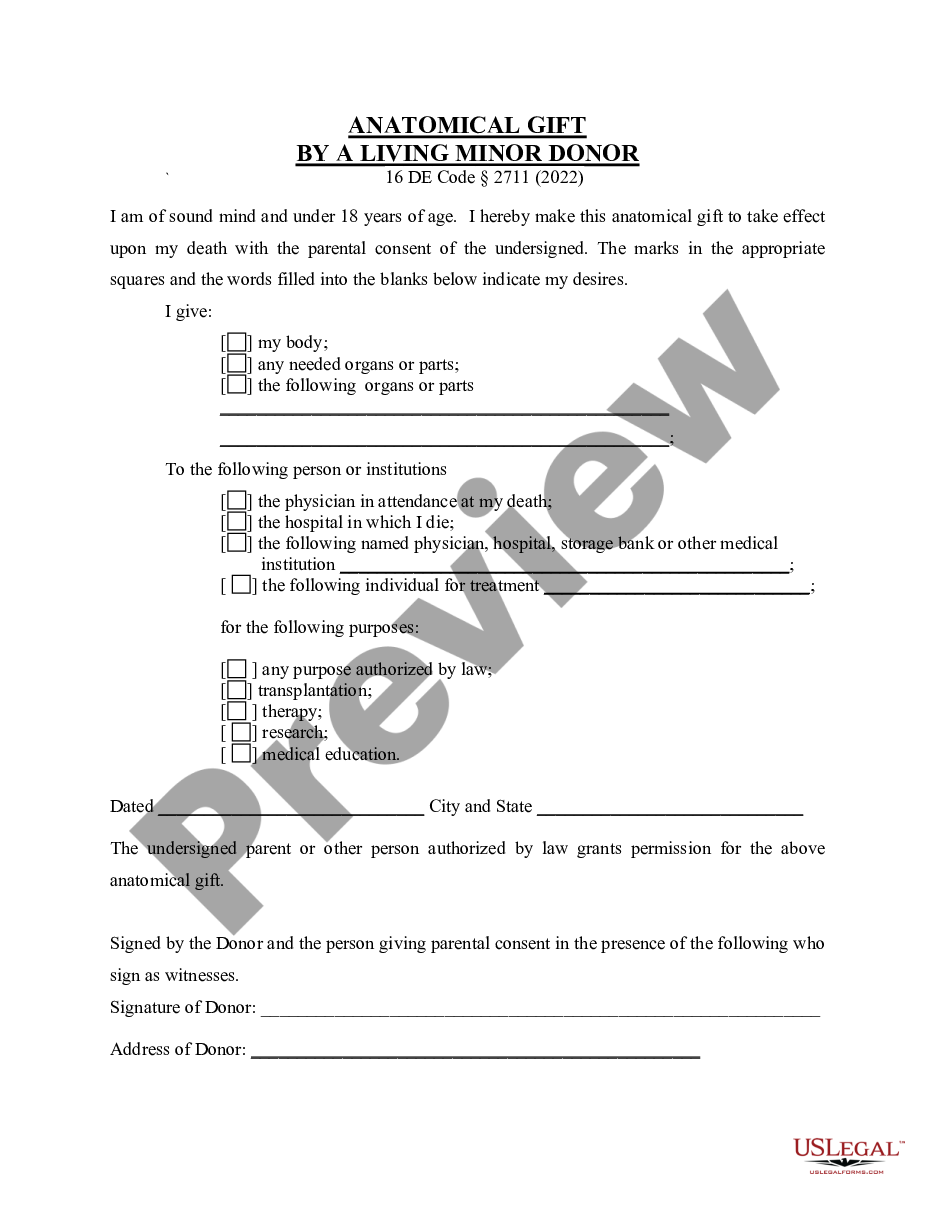
The Statutory Uniform Anatomical Gift Act Donation by a Living Minor is a legal document that allows a minor, under the age of 18, to indicate their wishes regarding the donation of their organs or body parts upon their death. This form is distinct in that it requires parental consent, ensuring that the minor's intentions are legally recognized and respected. It serves as an essential tool for families to navigate the sensitive issues surrounding organ donation and end-of-life decisions.
What’s included in this form
- Identification of the donor as a minor under eighteen years of age.
- Designating specific organs or body parts for donation.
- Providing options for the intended recipient, such as a physician, hospital, or medical institution.
- Selecting the purposes for which the donation can be used, including transplantation, therapy, or medical education.
- Requirement for parental consent as a crucial element of the form.
- Space for signatures of the donor, the consenting parent, and witnesses.

Common use cases
This form should be utilized when a minor wishes to make an anatomical gift upon their passing. It is especially relevant in situations where families are discussing organ donation, whether due to medical conditions, hospital procedures, or personal wishes. Parents may use this form to ensure their child's desires regarding donation are clearly documented and legally valid.
Who needs this form
- Minors under the age of eighteen who are considering organ or body part donation.
- Parents or guardians seeking to support their child's wishes regarding anatomical gifts.
- Medical professionals involved in organ donation processes for minors.
- Families looking for a formal way to document their decisions regarding organ donation.
How to complete this form
- Fill out the minor's information, confirming their age and sound mind.
- Indicate the specific organs or body parts intended for donation.
- Select the appropriate recipient of the anatomical gift.
- Choose the legal purposes for which the organs or parts will be used.
- Ensure parental consent is given by having a consenting parent or guardian sign the form.
- Obtain signatures from witnesses to validate the document.
Is notarization required?
This form does not typically require notarization to be legally valid. However, some jurisdictions or document types may still require it. US Legal Forms provides secure online notarization powered by Notarize, available 24/7 for added convenience.
Get your form ready online
Our built-in tools help you complete, sign, share, and store your documents in one place.
Make edits, fill in missing information, and update formatting in US Legal Forms—just like you would in MS Word.
Download a copy, print it, send it by email, or mail it via USPS—whatever works best for your next step.
Sign and collect signatures with our SignNow integration. Send to multiple recipients, set reminders, and more. Go Premium to unlock E-Sign.
If this form requires notarization, complete it online through a secure video call—no need to meet a notary in person or wait for an appointment.
We protect your documents and personal data by following strict security and privacy standards.

Make edits, fill in missing information, and update formatting in US Legal Forms—just like you would in MS Word.

Download a copy, print it, send it by email, or mail it via USPS—whatever works best for your next step.

Sign and collect signatures with our SignNow integration. Send to multiple recipients, set reminders, and more. Go Premium to unlock E-Sign.

If this form requires notarization, complete it online through a secure video call—no need to meet a notary in person or wait for an appointment.

We protect your documents and personal data by following strict security and privacy standards.
Mistakes to watch out for
- Failing to obtain the necessary parental consent before completing the form.
- Leaving sections of the form blank, which can invalidate the intentions of the donor.
- Not having witnesses sign the form, which is crucial for legal validation.
- Using outdated versions of the form that do not comply with current laws.
Why use this form online
- Convenient access to a legally vetted form without the need for extensive legal knowledge.
- Editable templates that allow customization to meet specific needs and preferences.
- Reliable content drafted by licensed attorneys, ensuring compliance with applicable laws.
- Quick download process, enabling immediate use when necessary.
Looking for another form?
Form popularity
FAQ
To donate your body to science in Delaware, you need to contact a medical school or institution that accepts whole body donations. The Delaware Statutory Uniform Anatomical Gift Act Donation by a Living Minor outlines the procedures for anatomical gifts, including the provision for living minors with parental consent. Ensure that you understand the process and requirements before making your decision. Platforms like uslegalforms can help guide you through the necessary documentation with ease.
An anatomical gift refers to any donation of organs or tissues for transplant or research purposes. Under the Delaware Statutory Uniform Anatomical Gift Act Donation by a Living Minor, this definition extends to living minors but requires parental consent. This act aims to facilitate organ donation and improve access to essential medical services. Understanding the significance of anatomical gifts helps create awareness about the impact these donations can have on individuals in need.
To make an anatomical gift in Delaware, you must complete a specific form that aligns with the Delaware Statutory Uniform Anatomical Gift Act Donation by a Living Minor. This process can often be done through various platforms, including uslegalforms, which offers user-friendly options to create the necessary documentation. Be sure to discuss your choices with your family for support and understanding. Once you finalize the gift, clearly indicate your wishes on your driver's license or state ID.
Under the Delaware Statutory Uniform Anatomical Gift Act Donation by a Living Minor, individuals can receive anatomical gifts from minors if they have the consent of a parent or legal guardian. This provision ensures that younger individuals can still be part of the medical community's advances through organ donation. If you are a minor, discussing your desire to be an organ donor with your family is crucial. This helps clarify intentions and ensures everyone is on the same page.
In Delaware, you can become an organ donor regardless of your age. However, if you are a minor, the Delaware Statutory Uniform Anatomical Gift Act Donation by a Living Minor requires parental consent. It’s essential to discuss your wishes with your parents or guardians. By taking this step, you can help save lives and contribute to life-saving organ donation.
The Uniform Anatomical Gift Act of 1987 is a significant revision of earlier laws governing organ donation. This act aimed to simplify the process of making anatomical gifts and broaden the opportunities for organ procurement. It specifically addresses living donations, which can include minors under certain circumstances in Delaware. This aspect is particularly highlighted in the Delaware Statutory Uniform Anatomical Gift Act Donation by a Living Minor, ensuring that both the donor’s and guardian's rights are protected.
The Uniform Anatomical Gift Act establishes a legal framework for individuals to donate their organs and tissues after death. Additionally, it allows for donations by living individuals, including minors, under specific conditions in states like Delaware. The act emphasizes the importance of consent and legal standards for anatomical gifts, ensuring that the donation process respects the wishes of the donor and their family. Through the Delaware Statutory Uniform Anatomical Gift Act Donation by a Living Minor, potential donors and their guardians can navigate these laws with clarity.
The primary legal document that applies to anatomical gifts is the Uniform Anatomical Gift Act, which governs the entire process of organ donation. This act outlines how anatomical gifts can be made, who can donate, and the necessary procedures to follow. Utilizing a platform like uslegalforms can help you navigate these legalities effectively, ensuring all your intentions concerning the Delaware Statutory Uniform Anatomical Gift Act Donation by a Living Minor are properly documented.
'I hereby make an anatomical gift' is a declaration by an individual expressing their intention to donate their organs or body parts for medical use after death. This statement is an essential part of the process, as it clarifies the donor's wishes and solidifies their commitment to helping others. Under the Delaware Statutory Uniform Anatomical Gift Act Donation by a Living Minor, this declaration is vital for ensuring that a minor's decision is respected.
The most critical clause of the Uniform Anatomical Gift Act allows individuals to make an anatomical gift by specifying their intentions about organ donation. This provision helps facilitate the donation process and ensures that loved ones respect the wishes of the donor. Under the Delaware Statutory Uniform Anatomical Gift Act Donation by a Living Minor, minors can also have their preferences recognized with parental consent.