District of Columbia Option to Purchase Package
Overview of this form package
The District of Columbia Option to Purchase Package provides all the necessary forms for exercising a right to purchase property under agreed-upon terms. This package allows you to secure the option to buy property, whether residential or commercial, at predetermined prices. Unlike other real estate packages, this one is specifically tailored for residents of the District of Columbia and includes various forms that accommodate different types of real estate transactions.
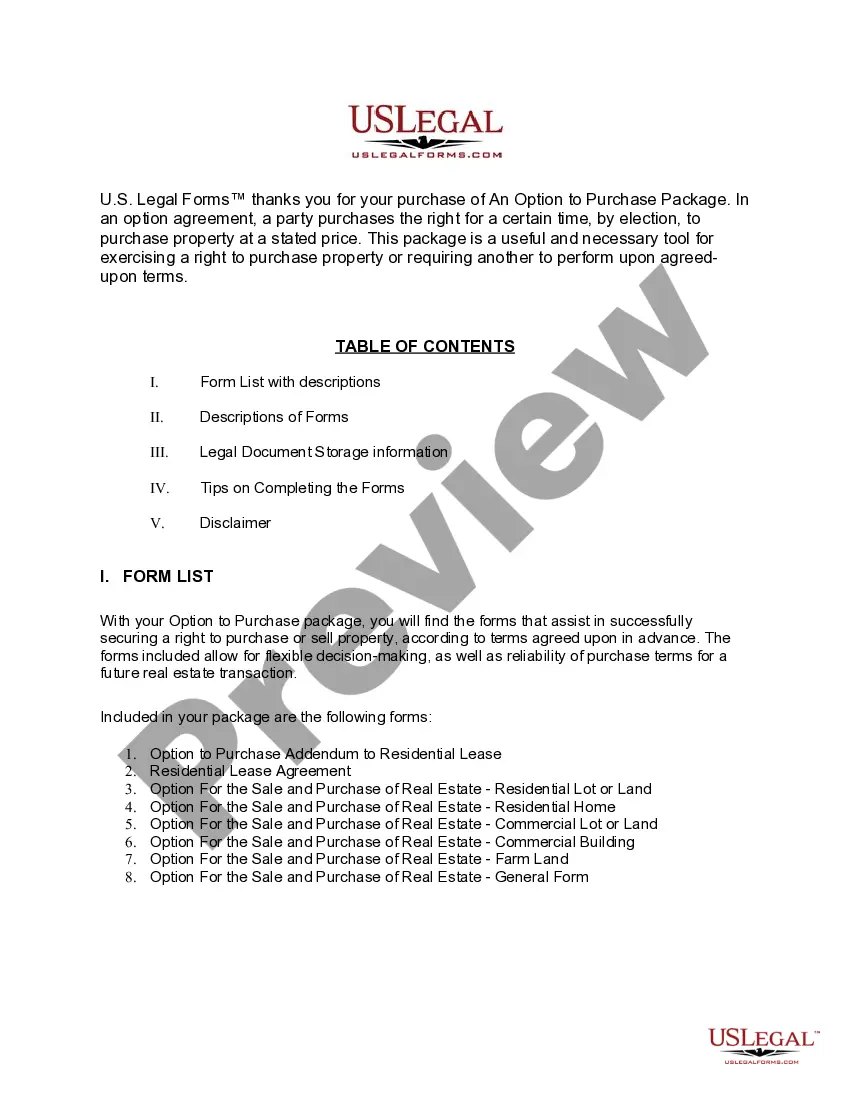
Forms you’ll find in this package
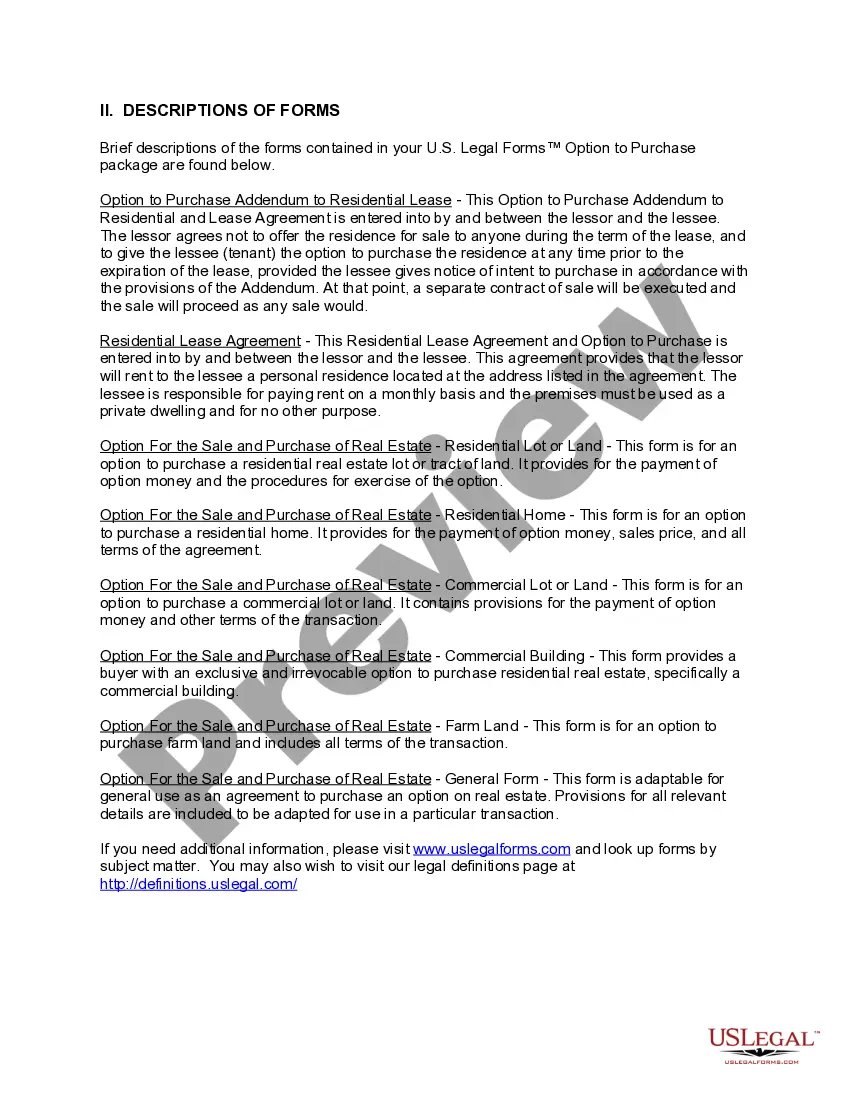
- Option to Purchase Addendum to Residential Lease - Lease or Rent to Own
- Residential Rental Lease Agreement
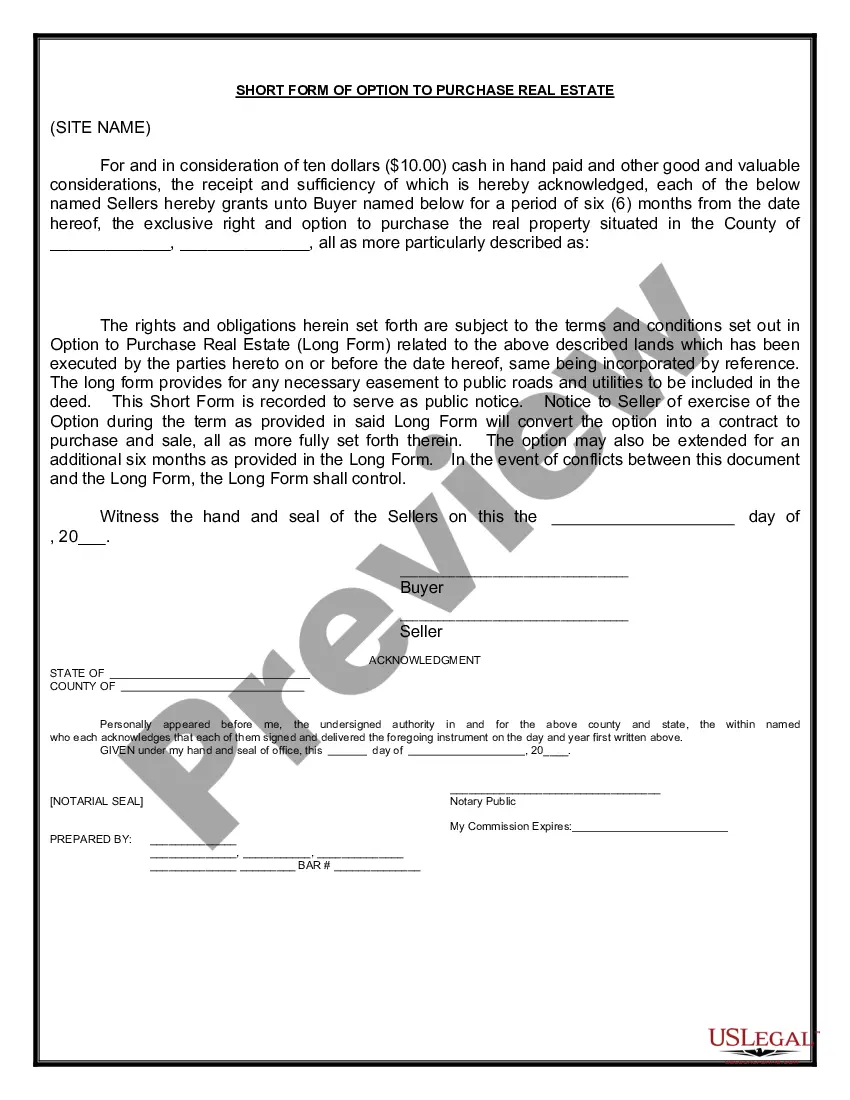
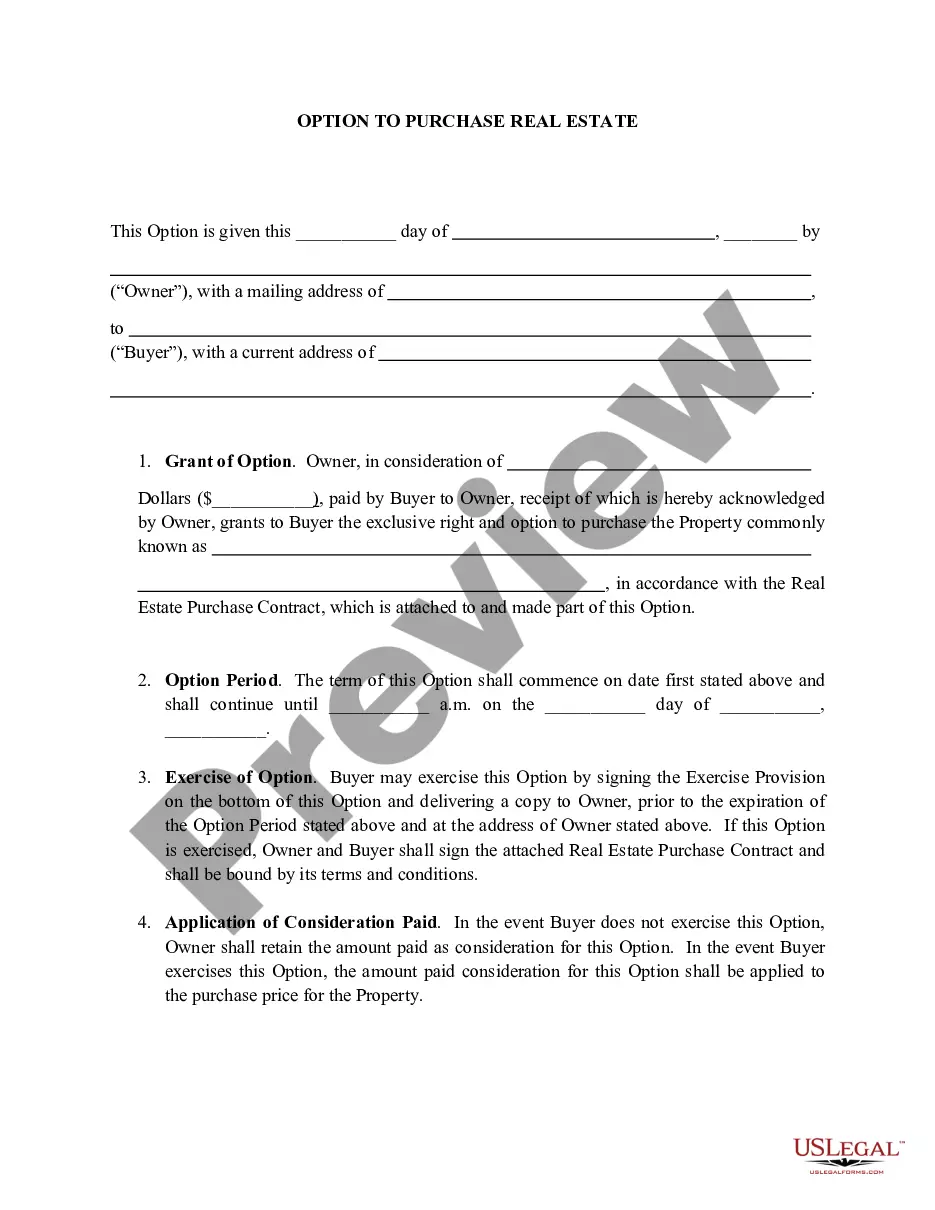
- Option For the Sale and Purchase of Real Estate - Residential Lot or Land
- Option For the Sale and Purchase of Real Estate - Residential Home
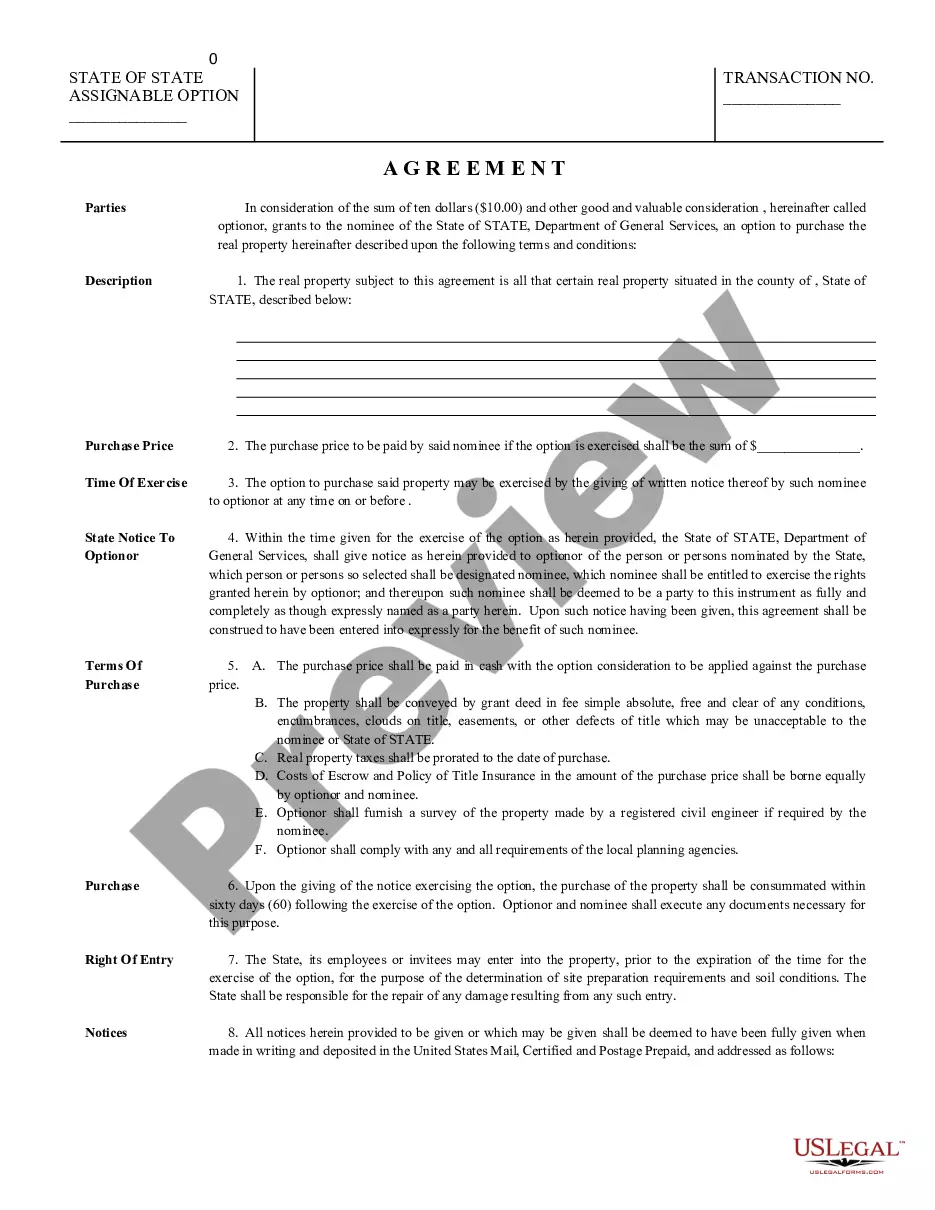
- Option For the Sale and Purchase of Real Estate - Commercial Lot or Land
- Option For the Sale and Purchase of Real Estate - Commercial Building
- Option For the Sale and Purchase of Real Estate - Farm Land
- Option For the Sale and Purchase of Real Estate - General Form
When to use this form package
This package is beneficial in several scenarios:
- When you want to lease a property with a future option to buy.
- When negotiating terms for purchasing residential or commercial real estate.
- If you need to secure the rights to purchase specific types of land or buildings.
- When you want to ensure that the sale conditions are legally binding and clear to all parties.
Intended users of this form package
- Tenants interested in securing the right to purchase the property they are renting.
- Landlords who wish to offer tenants an option to purchase their rental property.
- Homebuyers looking to finalize the terms of purchasing residential homes or lots.
- Commercial property investors seeking to establish purchasing agreements.
Completing these forms step by step
- Review the included forms to understand their purpose and how they relate to each other.
- Identify the parties involved, including lessors and lessees or buyers and sellers.
- Enter case-specific information such as names, property addresses, and terms of the option.
- Include necessary dates for lease agreements and option exercises.
- Have all parties sign the documents to ensure their enforceability.
Do forms in this package need to be notarized?
Notarization is required for one or more forms in this package. US Legal Forms provides secure online notarization powered by Notarize, allowing you to complete the process through a verified video call.
Get your form ready online
Our built-in tools help you complete, sign, share, and store your documents in one place.
Make edits, fill in missing information, and update formatting in US Legal Forms—just like you would in MS Word.
Download a copy, print it, send it by email, or mail it via USPS—whatever works best for your next step.
Sign and collect signatures with our SignNow integration. Send to multiple recipients, set reminders, and more. Go Premium to unlock E-Sign.
If this form requires notarization, complete it online through a secure video call—no need to meet a notary in person or wait for an appointment.
We protect your documents and personal data by following strict security and privacy standards.

Make edits, fill in missing information, and update formatting in US Legal Forms—just like you would in MS Word.

Download a copy, print it, send it by email, or mail it via USPS—whatever works best for your next step.

Sign and collect signatures with our SignNow integration. Send to multiple recipients, set reminders, and more. Go Premium to unlock E-Sign.

If this form requires notarization, complete it online through a secure video call—no need to meet a notary in person or wait for an appointment.

We protect your documents and personal data by following strict security and privacy standards.
Avoid these common issues
- Failing to clearly specify the option price in the agreement.
- Not including all necessary parties in the lease or purchase agreement.
- Omitting key dates, such as the notice period for exercising the option.
- Neglecting to have the forms reviewed for compliance with local laws.
Why use this package online
- Convenience of instant downloads, allowing you to access forms anytime, anywhere.
- Editability to tailor agreements specific to your situation easily.
- Reliability of professionally drafted forms that meet the necessary legal requirements.
Legal use & context
- These forms are designed to ensure that the right to purchase property is legally binding and enforceable.
- Careful completion of these forms can help to prevent disputes and misunderstandings in real estate transactions.
- All parties should retain copies of executed documents for their records and legal protection.
Summary of main points
- The District of Columbia Option to Purchase Package provides essential forms for securing property purchase rights.
- This package is suitable for both residential and commercial property transactions.
- Review and understand all forms included to ensure proper use and legal protection.
Looking for another form?

Form popularity
FAQ
1 The letters D.C. each get a period, since they are abbreviations for the term District of Columbia. 2 Capital, with an a, refers to a city that serves as the seat of a government. 3 Capitol, with an o, refers to a building that houses a legislature.
Washington DC's TOPA Act Washington's program is called TOPA the Tenant's Opportunity to Purchase Act. TOPA generally grants tenants a grace period and right of first refusal to purchase their building if it is to be sold.
Every time there is a drop-down list for "state", DC is an option. It's not a state, of course, but Washington, DC = City, State for address purposes.
Washington, D.C., formally the District of Columbia and also known as D.C. or just Washington, is the capital city of the United States. It is located on the Potomac River bordering Maryland and Virginia, with Congress holding its first session there in 1800.
It is written Washington, D.C. with comma and periods. Except when it's used as a postal address. Although the U.S. Postal Service is very good about making things work, the "official" recommendation is that no periods, commas or other punctuation marks are used in postal addresses.
Taxicab/Limo Drivers Any non-resident taxicab/limo driver who operates a motor vehicle for hire in the District must file a Form D-30. The filing of the D-30 is a requirement for operating or continuing to operate a motor vehicle for hire in the District by a non-resident.
Get the Correct Basic Business License. File a Clean Hands Certification. Register With the Tax and Revenue Office. Get a Housing Inspection. Register for Rent Control. Don't Proceed Without a License. Ask for Help.
On July 3, 2018, a new law became effective that exempts single family dwellings from TOPA, unless occupied by elderly or disabled tenants.Tenant(s) has no further TOPA rights if tenant is not elderly or disabled AND signed a written lease on or before March 31, 2018 AND took occupancy on or before April 15, 2018.
The Tenant Opportunity to Purchase Act (TOPA) is a hot topic in Washington DC. In 1980, TOPA was an honorable regulation set forth to combat the gentrification in the District. Essentially this act gave tenants a first shot at purchasing the home they were renting, if their landlord decided to sell the property.