Connecticut Notice of Intent to Close Estate
Understanding this form
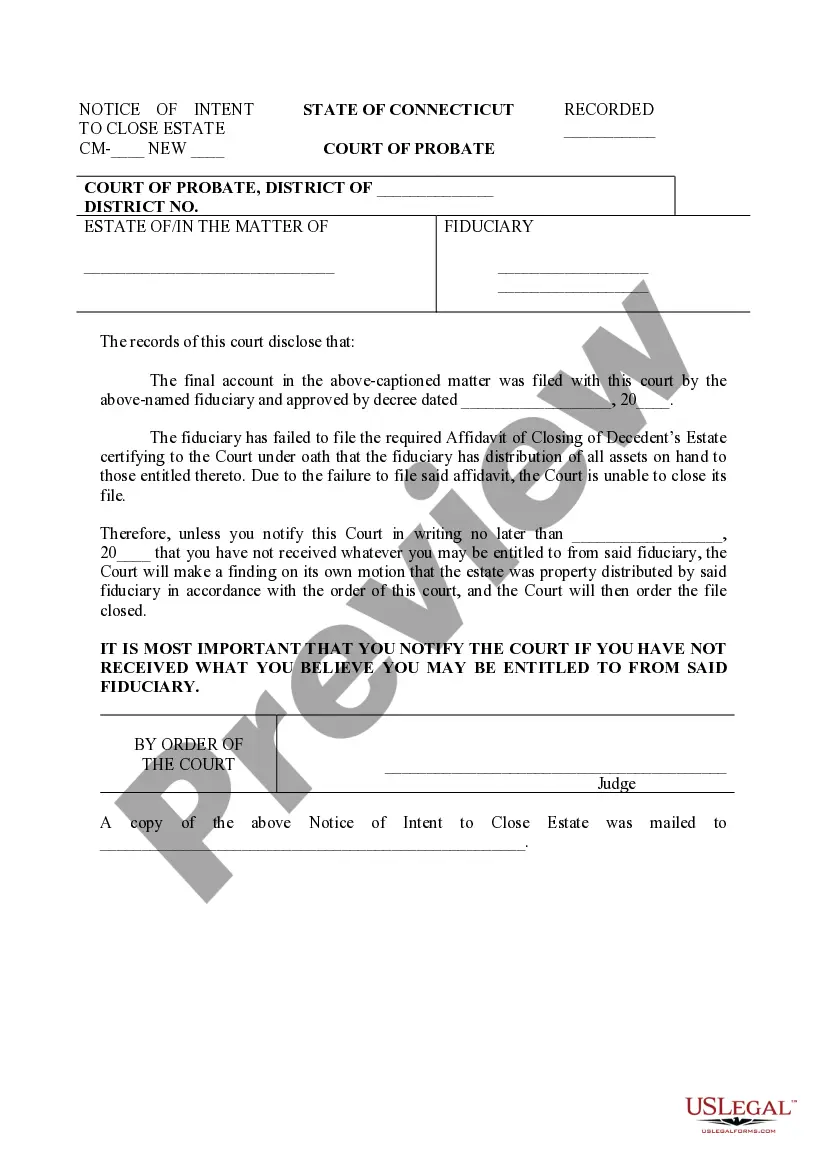
The Notice of Intent to Close Estate is a legal document used by fiduciaries in probate court. This form notifies interested parties that the fiduciary has yet to file an Affidavit of Closing of Decedent's Estate. It serves to alert recipients that the court may proceed to close the estate if no objections are raised within a specified timeframe. This form is distinct as it focuses on the fiduciary's failure to file necessary documentation, rather than other estate matters such as will distribution or asset management.
Key parts of this document
- Information about the probate court and case number.
- Name and contact details of the fiduciary involved.
- Details of the final account approval date by the court.
- Instructions for notifying the court regarding asset distribution concerns.
- Signatures of the judge and any required witnesses.
When to use this document
This form should be used when a fiduciary, responsible for closing a decedent's estate, has not submitted the Affidavit of Closing to the probate court. It is vital for ensuring beneficiaries are aware of their rights and can take necessary actions if they have not received their expected distributions. Using this form helps maintain transparency and facilitates the court's process in closing the estate.
Intended users of this form
- Fiduciaries managing decedent estates.
- Beneficiaries who have not received their share of the estate.
- Legal representatives involved in probate proceedings.
Instructions for completing this form
- Enter the case number and court district name at the top of the form.
- Fill in the name of the fiduciary responsible for estate distribution.
- Provide the date when the final account was approved by the court.
- Specify the deadline date for individuals to notify the court regarding any concerns about asset distribution.
- Sign the form as required and ensure a copy is sent to relevant parties.
Does this document require notarization?
This form does not typically require notarization unless specified by local law. However, it is crucial to check Connecticut probate regulations to ensure compliance with any specific requirements regarding notarization for court documents.
Get your form ready online
Our built-in tools help you complete, sign, share, and store your documents in one place.
Make edits, fill in missing information, and update formatting in US Legal Forms—just like you would in MS Word.
Download a copy, print it, send it by email, or mail it via USPS—whatever works best for your next step.
Sign and collect signatures with our SignNow integration. Send to multiple recipients, set reminders, and more. Go Premium to unlock E-Sign.
If this form requires notarization, complete it online through a secure video call—no need to meet a notary in person or wait for an appointment.
We protect your documents and personal data by following strict security and privacy standards.

Make edits, fill in missing information, and update formatting in US Legal Forms—just like you would in MS Word.

Download a copy, print it, send it by email, or mail it via USPS—whatever works best for your next step.

Sign and collect signatures with our SignNow integration. Send to multiple recipients, set reminders, and more. Go Premium to unlock E-Sign.

If this form requires notarization, complete it online through a secure video call—no need to meet a notary in person or wait for an appointment.

We protect your documents and personal data by following strict security and privacy standards.
Common mistakes to avoid
- Failing to include all parties' names and contact information.
- Missing the deadline for notifying the court.
- Not providing the correct case number or court details.
Advantages of online completion
- Easy download and completion, allowing users to fill the form at their convenience.
- Access to templates drafted by licensed attorneys, ensuring legal accuracy.
- Save time compared to visiting legal offices or waiting for in-person consultations.
Looking for another form?
Form popularity
FAQ
Yes, placing a notice for a deceased estate is often a necessary step in the probate process. It serves to inform creditors and interested parties about the estate's closure. By incorporating a Connecticut Notice of Intent to Close Estate in your proceedings, you can effectively meet legal requirements and facilitate the communication of important information.
In Connecticut, an estate must be worth at least $40,000 to require probate. However, estates below this threshold may still need to go through the probate process if specific conditions apply. Utilizing the Connecticut Notice of Intent to Close Estate can help simplify matters, even for smaller estates, and guide you through necessary legal procedures.
If you fail to file probate in Connecticut, the estate may face numerous issues, such as the inability to legally distribute assets. Creditors can make claims against the estate, which may lead to financial penalties for beneficiaries. Additionally, if you do not file for probate, the Connecticut Notice of Intent to Close Estate remains unfiled, complicating matters when it comes to managing estate affairs. Addressing probate matters promptly is critical to ensuring a smooth transition for beneficiaries.
Yes, Connecticut law sets a time limit for probating a will, usually within six months after the deceased's date of death. If probate is not initiated within this timeframe, complications may arise, potentially affecting the validity of the will. Therefore, it is advisable to act quickly and efficiently, including filing your Connecticut Notice of Intent to Close Estate, to avoid difficulties down the line.
In Connecticut, you typically have six months from the date of death to file for probate. However, it is advisable to start the process sooner to ensure timely management of the estate. By filing promptly, you can also better prepare for possible claims against the estate and properly handle the Connecticut Notice of Intent to Close Estate. Ensuring adherence to this timeline can simplify matters for the beneficiaries.
To initiate probate in Connecticut, first, you need to file the necessary documents with the probate court. This includes submitting the will, if there is one, along with the Connecticut Notice of Intent to Close Estate. Next, you will publish a notice to inform creditors potentially owed by the estate. Lastly, the executor must inventory and distribute the estate's assets according to the state's laws and the will's directives.
A notice to close estate is a formal declaration made by the executor to notify the probate court and beneficiaries of the intent to finalize the estate's affairs. This notice ensures that all parties are informed and provides a timeline for any objections or claims. Utilizing a Connecticut Notice of Intent to Close Estate not only fulfills requirements but also enhances accountability. Platforms like uslegalforms can assist you in preparing this notice accurately.
An executor in Connecticut generally has 18 months to settle an estate, similar to the overall estate settlement timeframe. However, this period can be affected by the estate's complexity or any legal challenges. It's crucial for executors to maintain organization and communication with beneficiaries. Submitting a Connecticut Notice of Intent to Close Estate can help demonstrate compliance with this timeline.
Assets like life insurance policies, retirement accounts, and property held in joint ownership typically do not go through probate. These assets often pass directly to designated beneficiaries. Understanding which of your assets are exempt can simplify your estate planning. You may also utilize a Connecticut Notice of Intent to Close Estate to clarify your estate's status.
To avoid probate fees in Connecticut, you can use strategies such as establishing living trusts or transferring assets jointly. These methods often help bypass the probate process entirely. Additionally, preparing a Connecticut Notice of Intent to Close Estate early in the process can streamline your efforts and possibly minimize costs. Consulting with uslegalforms can provide the necessary resources to navigate this efficiently.