California Assumption Agreement - Unsecured and Subrogated
What is this form?
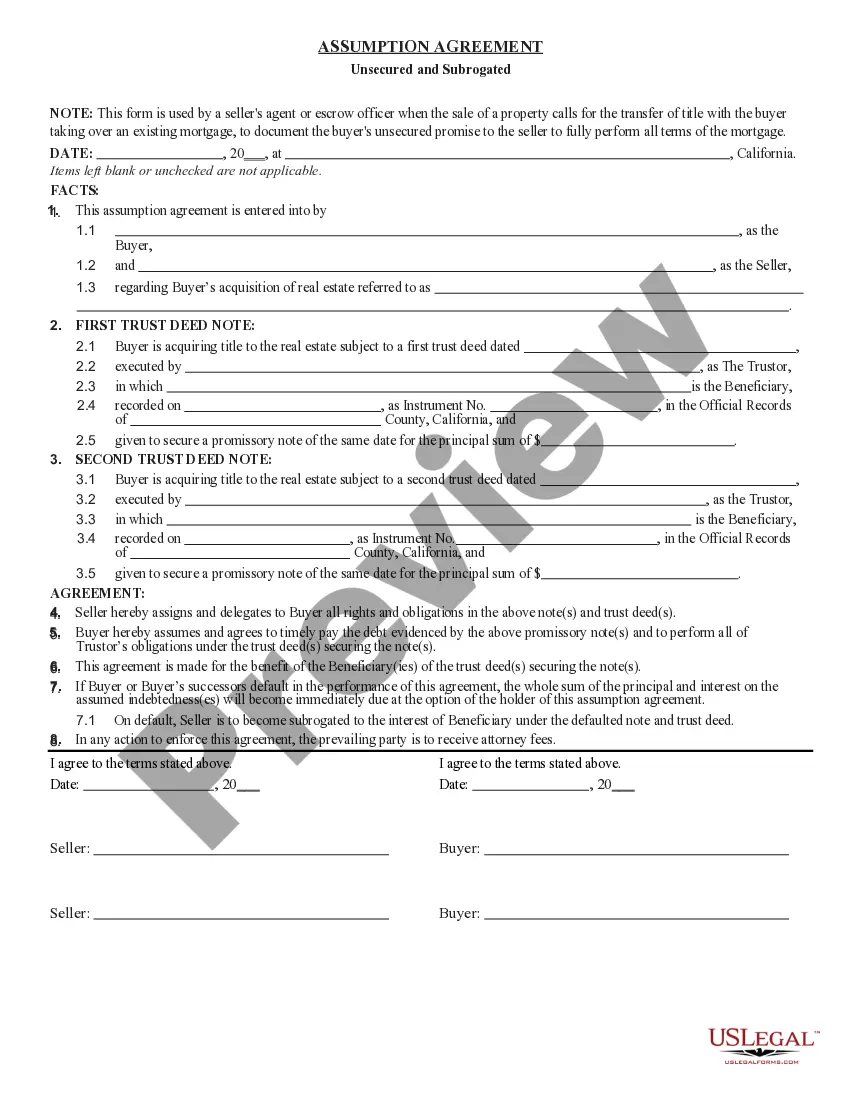
The Assumption Agreement - Unsecured and Subrogated is a legal document used to transfer a buyer's obligations under an existing mortgage after the purchase of real estate. This form enables the buyer to take over an existing mortgage while ensuring they make an unsecured promise to the seller to fulfill all terms outlined in the mortgage. Unlike other assignments or assumption agreements, this specific form includes provisions for subrogation, which protects the seller's interests in the event of the buyer's default.
Key components of this form
- Date of agreement and parties involved (buyer and seller)
- Description of the real estate being acquired
- Details of the first and second trust deeds, including beneficiaries
- Assignment and delegation of rights and obligations to the buyer
- Buyerâs commitment to timely pay the mortgage debts
- Subrogation clause protecting the seller's interests
Situations where this form applies
This form is applicable when selling a property involves transferring title with the buyer assuming an existing mortgage. It should be used during real estate transactions where the buyer agrees to take over payment of the mortgage and the seller wants to ensure compliance with the original mortgage terms.
Who this form is for
- Real estate sellers who want to transfer mortgage obligations to a buyer
- Buyers acquiring real estate and assuming an existing mortgage
- Agents or escrow officers facilitating the sale of real estate properties
Steps to complete this form
- Identify the date of the agreement and the parties involved (buyer and seller).
- Specify the real estate property being acquired with a clear description.
- Enter the details of the first and second trust deeds, including dates, trustor, and beneficiary information.
- Fill in the assignment and delegation of obligations to the buyer.
- Obtain signatures from both the buyer and seller to finalize the agreement.
Is notarization required?
This form does not typically require notarization unless specified by local law. Always check your local jurisdiction for any additional requirements.
Get your form ready online
Our built-in tools help you complete, sign, share, and store your documents in one place.
Make edits, fill in missing information, and update formatting in US Legal Forms—just like you would in MS Word.
Download a copy, print it, send it by email, or mail it via USPS—whatever works best for your next step.
Sign and collect signatures with our SignNow integration. Send to multiple recipients, set reminders, and more. Go Premium to unlock E-Sign.
If this form requires notarization, complete it online through a secure video call—no need to meet a notary in person or wait for an appointment.
We protect your documents and personal data by following strict security and privacy standards.

Make edits, fill in missing information, and update formatting in US Legal Forms—just like you would in MS Word.

Download a copy, print it, send it by email, or mail it via USPS—whatever works best for your next step.

Sign and collect signatures with our SignNow integration. Send to multiple recipients, set reminders, and more. Go Premium to unlock E-Sign.

If this form requires notarization, complete it online through a secure video call—no need to meet a notary in person or wait for an appointment.

We protect your documents and personal data by following strict security and privacy standards.
Common mistakes to avoid
- Failing to complete the property description accurately, which can lead to disputes.
- Omitting necessary signatures, which invalidates the agreement.
- Not specifying the mortgage details correctly, risking future obligations.
Advantages of online completion
- Convenient access to a legally drafted form tailored for real estate transactions.
- Editable format allows for customization based on specific needs.
- Reliable source created by licensed attorneys ensuring legal validity.
Looking for another form?


Form popularity
FAQ
An assumption agreement is a formal contract that allows a buyer to assume the seller's mortgage and is crucial in real estate transactions. Specifically, a California Assumption Agreement - Unsecured and Subrogated highlights the terms that govern this transfer, ensuring a seamless transition of responsibility for the mortgage. This agreement can provide benefits in certain circumstances, such as assuming a lower interest rate than what is currently available.
The parties to an assumption agreement typically include the assignor, who is transferring rights or obligations, and the assignee, who is receiving them. Both parties must understand their responsibilities under the agreement. In a California Assumption Agreement - Unsecured and Subrogated, clear identification of all parties involved is crucial for a successful transfer of obligations.
Assumption agreements generally do not get recorded in public records like real estate transactions. However, conducting proper record-keeping is advisable to clarify responsibilities between involved parties. For a California Assumption Agreement - Unsecured and Subrogated, retaining copies of the agreement can provide necessary documentation should a dispute arise.
The purpose of an assignment contract is to legally transfer rights and obligations from one party to another. This contract helps to clarify which party holds responsibility, particularly in financial arrangements or services. When creating a California Assumption Agreement - Unsecured and Subrogated, you should include all relevant information and terms to avoid misunderstandings.
An assumption agreement template provides a standard format for outlining the responsibilities and liabilities between parties as they transfer obligations. This template simplifies the process of drafting a California Assumption Agreement - Unsecured and Subrogated by providing a clear structure. Utilizing a template can save you time and uncertainty, ensuring all necessary details are included.
A bill of sale primarily focuses on the transfer of ownership of personal property, while an assignment and assumption agreement addresses the transfer of contractual rights and obligations. Each document serves different legal purposes, and understanding these differences can prevent future disputes. In the context of a California Assumption Agreement - Unsecured and Subrogated, clear distinctions help ensure proper legal practices.
You should use an assignment and assumption agreement when you want to transfer rights and obligations from one party to another. This document is crucial in various situations, such as the sale of a business or the transfer of lease agreements. For a California Assumption Agreement - Unsecured and Subrogated, this agreement ensures that all obligations are met and legally recognized by all involved parties.
Yes, a bill of sale is a legally binding document that transfers ownership of personal property from one party to another. It serves as proof of the transaction and outlines the details of the sale, including the parties involved and the property's description. When dealing with a California Assumption Agreement - Unsecured and Subrogated, understanding the differences between these documents is important for accurate legal compliance.
An assumption agreement with release of liability allows one party to take on another’s obligations while releasing the original party from responsibility. In scenarios like a California Assumption Agreement - Unsecured and Subrogated, this can streamline liability management. It benefits involved parties by clarifying roles and reducing potential disputes, making coordinate actions much simpler.
An example of an assumption of liability is when a tenant takes over a lease from a previous tenant, effectively assuming the rental obligations. In the California Assumption Agreement - Unsecured and Subrogated situation, this transfer can happen without the need for securing debt. This means the new tenant must fulfill the lease terms, providing clarity and security to all parties involved.