Arizona Community Property Disclaimer
What is this form?
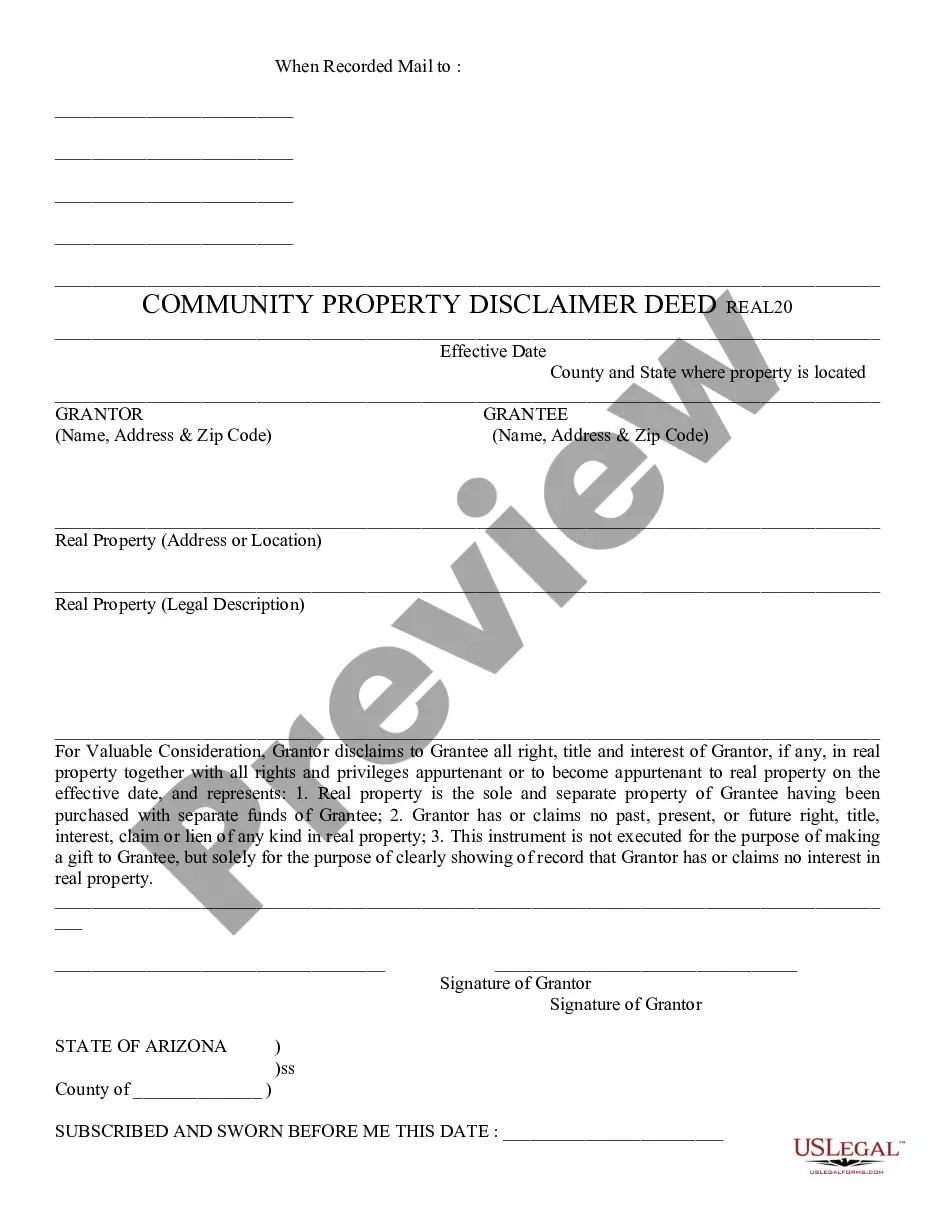
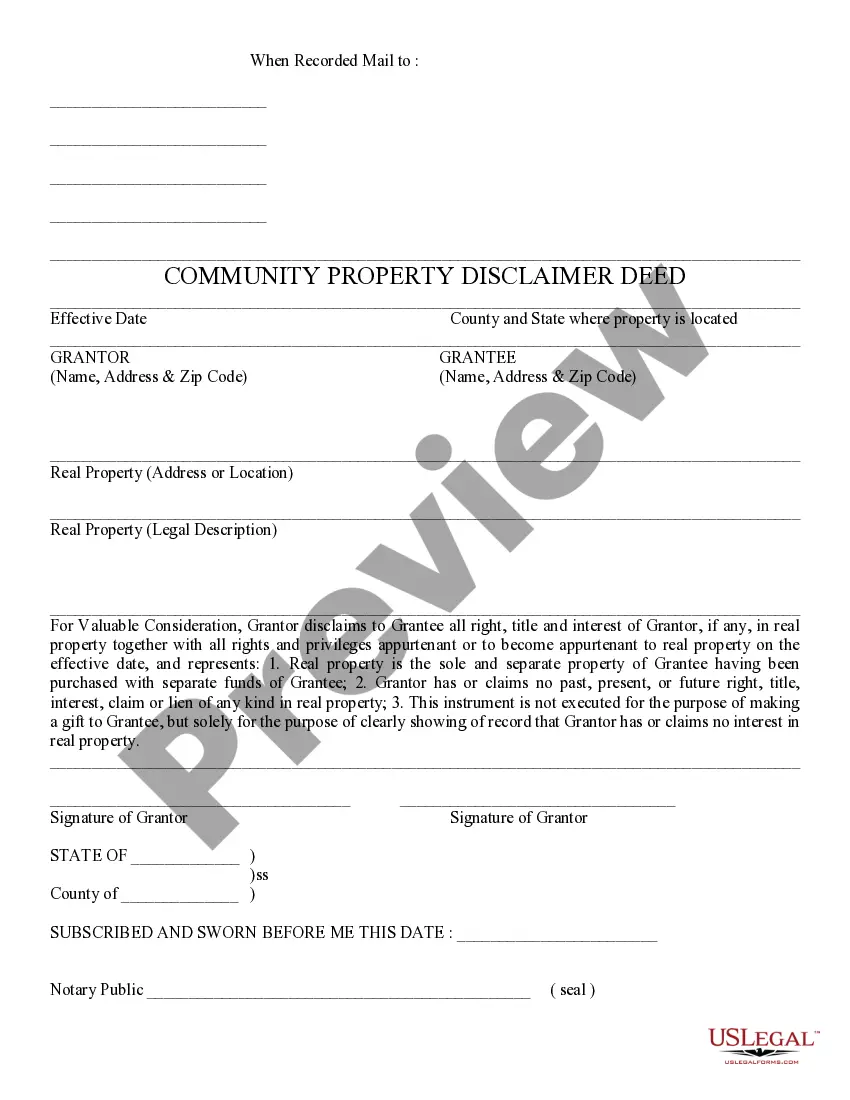
The Community Property Disclaimer is a legal document used in Arizona by a Grantor to relinquish their rights and interests in a parcel of real property. Through this form, the Grantor confirms that they no longer have any claim to the property and that it solely belongs to the Grantee. This disclaimer is particularly important in clarifying property ownership and distinguishing between community and separate property in legal matters, helping to prevent any future disputes regarding the property.
Form components explained
- Grantor and Grantee information, including names and addresses.
- Effective date of the disclaimer.
- Detailed description of the real property being disclaimed.
- Statements clarifying that the property is the Grantee's sole and separate property.
- Signatures of the Grantor, along with a notary acknowledgment.
Common use cases
This form is useful when a property owner, the Grantor, wishes to formally disclaim any rights to a property before transferring it to another party, known as the Grantee. It is commonly used in situations like divorce settlements, estate planning, or when a joint owner wants to clarify that an asset is solely owned by another person.
Who can use this document
This form is ideal for:
- Property owners looking to clarify ownership rights.
- Individuals involved in divorce proceedings wishing to define property distribution.
- Estate planners managing property transfer in a will or trust.
- Anyone needing to formally state that their interest in a property has been relinquished.
How to prepare this document
- Identify and enter the names and addresses of the Grantor and Grantee.
- Fill in the effective date of the disclaimer.
- Provide the address and legal description of the real property involved.
- Include a clear statement disavowing any claim to the property.
- Sign the document in the presence of a notary public.
Does this form need to be notarized?
Yes, this form must be notarized to be legally valid. US Legal Forms offers integrated online notarization, allowing for secure video calls with a notary public, available 24/7, ensuring convenience without the need for travel.
Get your form ready online
Our built-in tools help you complete, sign, share, and store your documents in one place.
Make edits, fill in missing information, and update formatting in US Legal Forms—just like you would in MS Word.
Download a copy, print it, send it by email, or mail it via USPS—whatever works best for your next step.
Sign and collect signatures with our SignNow integration. Send to multiple recipients, set reminders, and more. Go Premium to unlock E-Sign.
If this form requires notarization, complete it online through a secure video call—no need to meet a notary in person or wait for an appointment.
We protect your documents and personal data by following strict security and privacy standards.

Make edits, fill in missing information, and update formatting in US Legal Forms—just like you would in MS Word.

Download a copy, print it, send it by email, or mail it via USPS—whatever works best for your next step.

Sign and collect signatures with our SignNow integration. Send to multiple recipients, set reminders, and more. Go Premium to unlock E-Sign.

If this form requires notarization, complete it online through a secure video call—no need to meet a notary in person or wait for an appointment.

We protect your documents and personal data by following strict security and privacy standards.
Typical mistakes to avoid
- Failing to accurately describe the property being disclaimed.
- Not including the effective date of the disclaimer.
- Omitting necessary signatures or the notary acknowledgment.
- Incorrectly assuming the form is valid without notarization, if required.
Benefits of completing this form online
- Convenient access to legal forms from any location.
- Editable formats available for tailoring to specific needs.
- Reliable templates drafted by licensed attorneys.
- Quick download options for immediate use.
Summary of main points
- The Community Property Disclaimer protects the rights of the Grantee by clearly stating the Grantorâs renunciation of any claims.
- This form is specific to Arizona and reflects local laws regarding community property.
- Completing this form correctly is crucial to avoid future legal disputes over property ownership.
Looking for another form?
Form popularity
FAQ
In Arizona, gifts given to one spouse are generally regarded as separate property, not community property. However, if a gift is made to both spouses or utilized for common benefit, it could be considered community property. Clarifying these complexities can prevent potential disputes in a divorce. For tailored legal advice, refer to the Arizona Community Property Disclaimer and explore options with US Legal Forms.
A house owned by one spouse before marriage is usually classified as separate property in Arizona. However, if both partners contribute to the home after marriage, it may become marital property. This distinction is crucial when assessing property rights during divorce. For a comprehensive understanding of marital property, consult the Arizona Community Property Disclaimer and resources from US Legal Forms.
In Arizona, not all assets qualify as community property. Items acquired before marriage, inheritances, and gifts received by one spouse are typically considered separate property. Understanding the nuances of Arizona community property laws is essential for proper asset classification. For detailed guidance, consider using US Legal Forms to navigate these laws effectively.
In Arizona, even if your name is not on the deed, you still have rights to the property under community property laws, especially if the property was acquired during the marriage. Your spouse cannot unilaterally sell or transfer the property without your consent. To clarify your rights and ensure they are protected, consider using an Arizona Community Property Disclaimer, which can outline ownership interests and help avoid future disputes.
The most common type of deed used in Arizona is the warranty deed, which guarantees that the grantor holds clear ownership of the property. This deed provides security for the buyer by ensuring there are no undisclosed claims against the property. It is essential to understand the benefits of various deed types, including how an Arizona Community Property Disclaimer can help clarify ownership interests when spouses are involved.
Yes, an unrecorded deed is technically valid in Arizona, but it may create challenges for the parties involved. Without recording, third parties may not be aware of the property transfer, which can lead to disputes over ownership. To protect your property rights, consider using an Arizona Community Property Disclaimer and recording your deed to ensure all stakeholders are informed.
In Arizona, a quit claim deed must be in writing and signed by the grantor. Additionally, it should include a clear description of the property and the names of the parties involved. While recording the deed is not mandatory, it is highly recommended to protect your interests and ensure clarity regarding property ownership. Using an Arizona Community Property Disclaimer can also safeguard your rights when dealing with community property.
The freedom of information law in Arizona allows residents to access public records and documents held by government entities. This law promotes transparency and accountability, giving individuals the right to know how state and local governments operate. While it does not directly relate to Arizona Community Property Disclaimers, understanding available information can aid in effective property management strategies.
In Arizona, certain exceptions to community property include property acquired by gift, inheritance, or as a separate entity. This means that if either spouse receives property through these means, it typically remains separate from community property. Understanding these exceptions, along with an Arizona Community Property Disclaimer, can help clarify which assets are individually owned.
The disclaimer law in Arizona enables a property owner to refuse interest in certain assets, which is particularly beneficial in marital situations. This law ensures that individuals can protect their separate property from being classified as community property. Implementing an Arizona Community Property Disclaimer under this law can secure personal assets from unintended sharing.