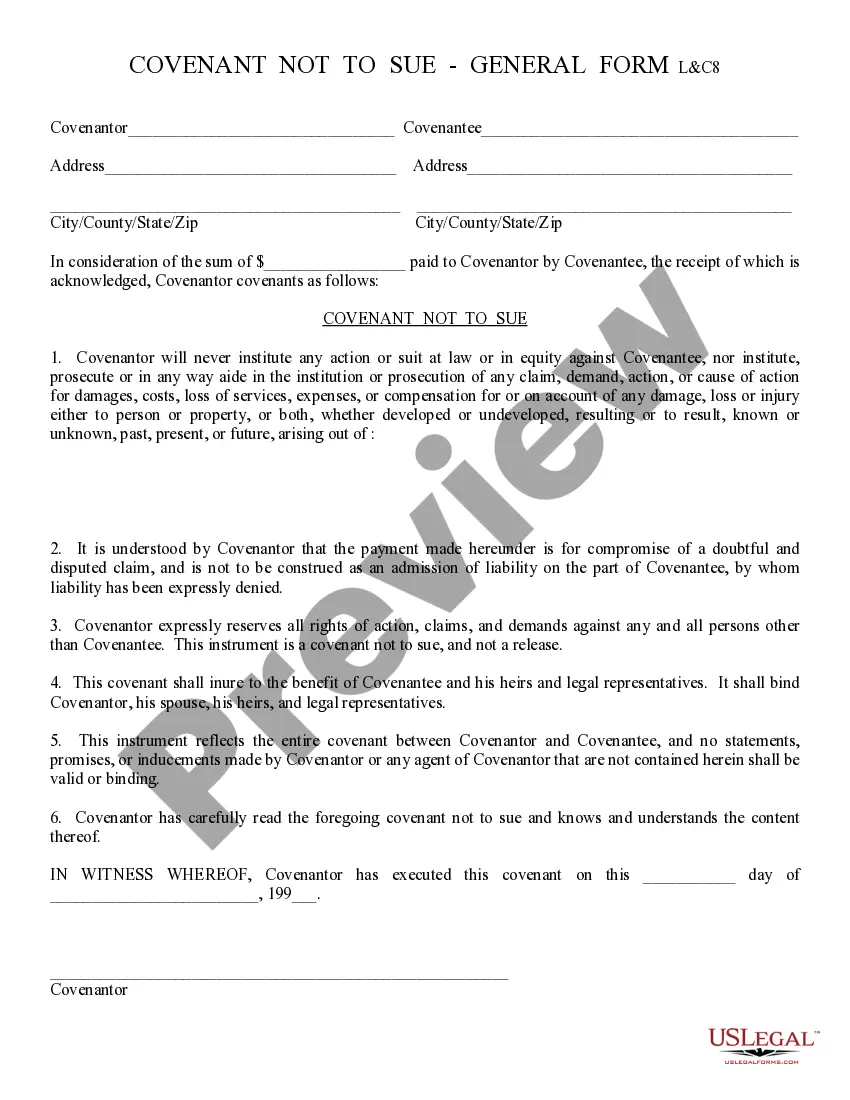
Arizona Covenant Not to Sue
What this document covers
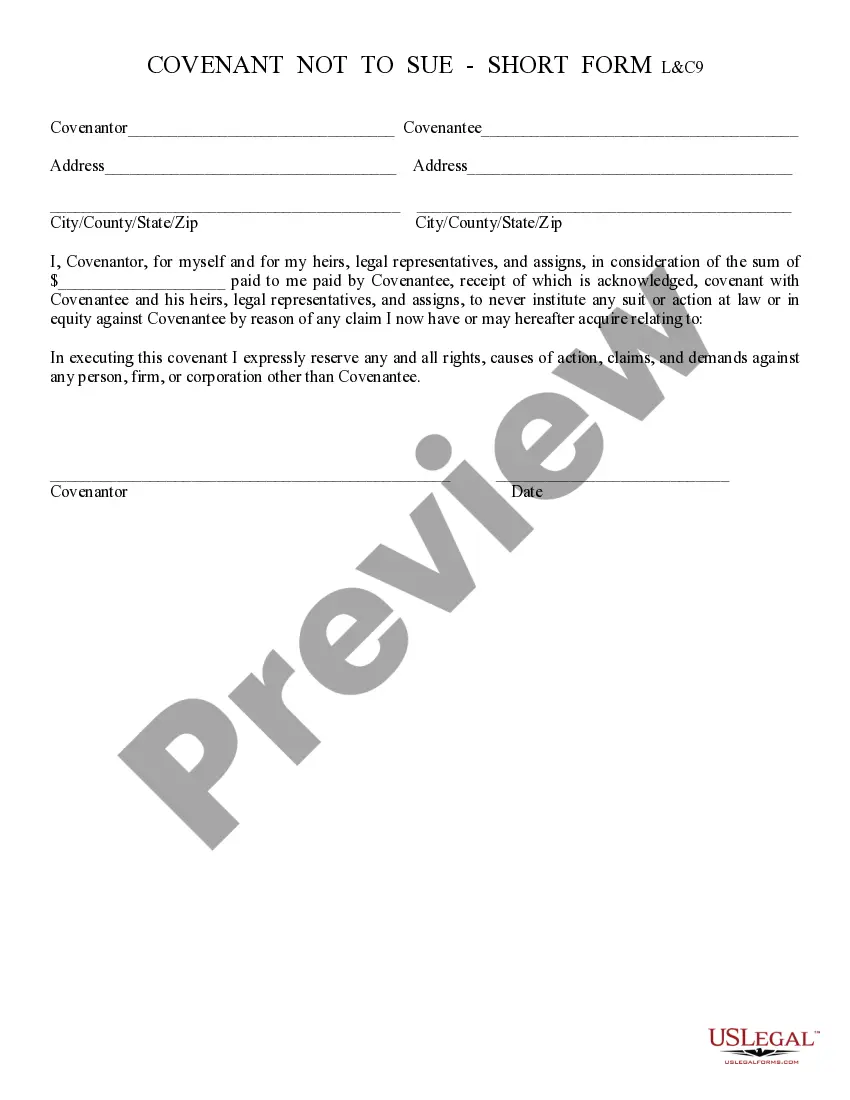
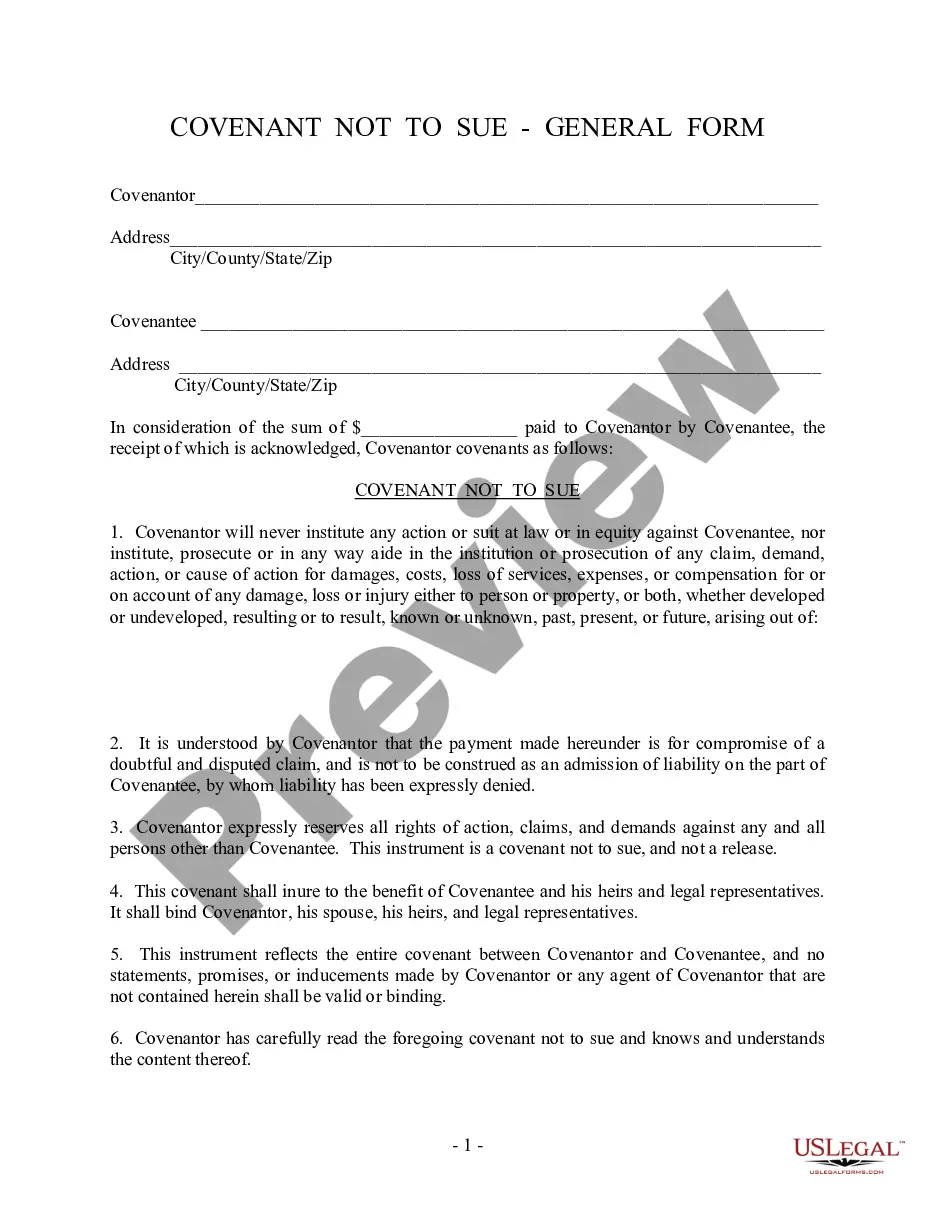
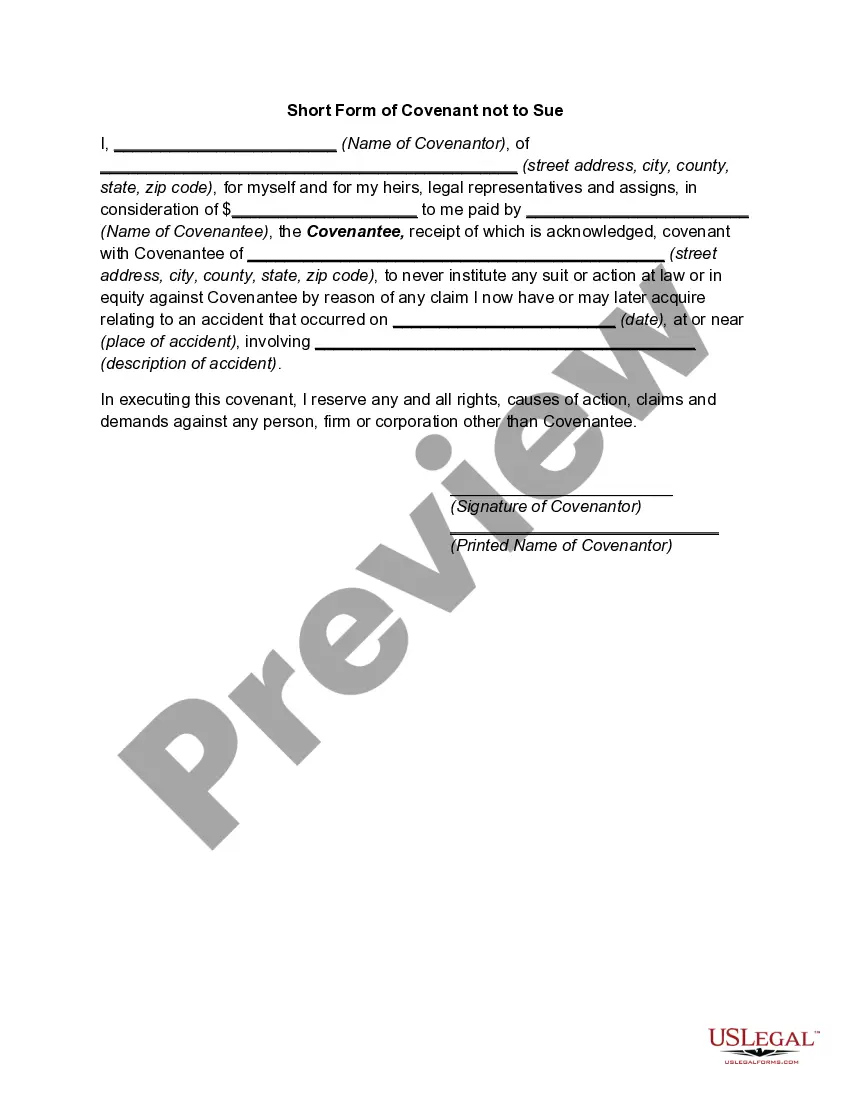
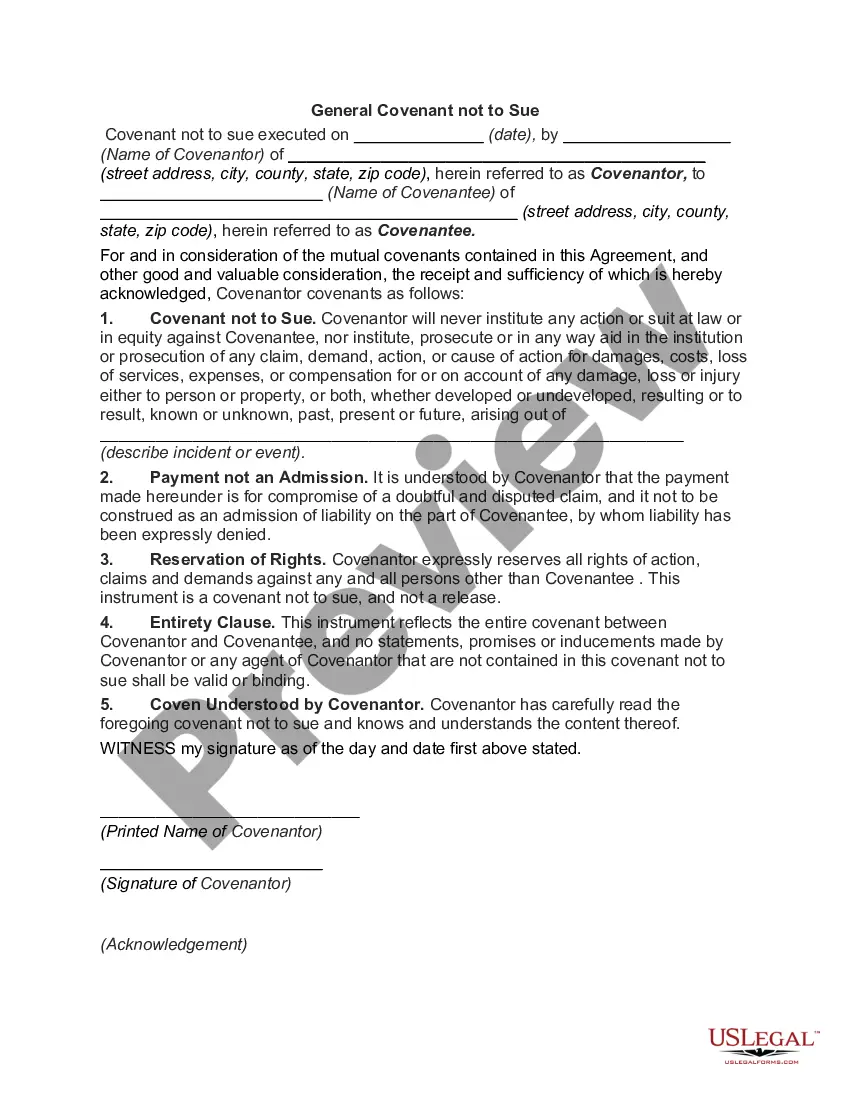
A Covenant Not to Sue is a legally binding agreement between two parties that prevents one party, the Covenantor, from suing the other party, the Covenantee. This form is used when the Covenantor receives a sum of money as compensation, acknowledging that this payment is for settling a disputed claim and does not indicate any admission of liability by the Covenantee. Unlike a release of liability, a covenant not to sue specifies that the Covenantor retains the right to pursue claims against third parties not involved in the agreement.
Key components of this form
- Identification of the Covenantor and Covenantee.
- Details of the amount paid in consideration of the covenant.
- Statement of the Covenantor's agreement not to sue the Covenantee.
- A clause indicating the payment is a compromise of a disputed claim.
- Reservation of rights to pursue claims against third parties.
- Entire agreement clause that limits enforceability to the written covenant.
When to use this document
This form is commonly used after a settlement has been reached in a dispute where the Covenantor agrees to receive compensation in exchange for giving up the right to sue the Covenantee. Scenarios may include personal injury claims, breach of contract disputes, or any legal issue where a party seeks to resolve a conflict without pursuing litigation.
Who this form is for
- Individuals or entities involved in a legal dispute that have reached a settlement.
- Parties who wish to formalize their agreement to not pursue further legal action against each other.
- Those who prefer to resolve disputes outside of court while retaining claims against other parties.
Steps to complete this form
- Identify the parties by entering the names and addresses of the Covenantor and Covenantee.
- Specify the amount paid to the Covenantor in consideration for the covenant.
- Clearly state the agreement not to sue, including the scope of claims covered.
- Include the date of execution of the covenant in the appropriate field.
- Ensure both parties sign the document to validate the agreement.
Notarization guidance
This form does not typically require notarization unless specified by local law. It is advisable to check any jurisdiction-specific requirements that may apply.
Get your form ready online
Our built-in tools help you complete, sign, share, and store your documents in one place.
Make edits, fill in missing information, and update formatting in US Legal Forms—just like you would in MS Word.
Download a copy, print it, send it by email, or mail it via USPS—whatever works best for your next step.
Sign and collect signatures with our SignNow integration. Send to multiple recipients, set reminders, and more. Go Premium to unlock E-Sign.
If this form requires notarization, complete it online through a secure video call—no need to meet a notary in person or wait for an appointment.
We protect your documents and personal data by following strict security and privacy standards.

Make edits, fill in missing information, and update formatting in US Legal Forms—just like you would in MS Word.

Download a copy, print it, send it by email, or mail it via USPS—whatever works best for your next step.

Sign and collect signatures with our SignNow integration. Send to multiple recipients, set reminders, and more. Go Premium to unlock E-Sign.

If this form requires notarization, complete it online through a secure video call—no need to meet a notary in person or wait for an appointment.

We protect your documents and personal data by following strict security and privacy standards.
Common mistakes to avoid
- Failing to include all necessary signatures.
- Not specifying the amount paid in consideration.
- Confusing this form with a release of liability, which serves a different purpose.
Benefits of using this form online
- Immediate access to a legally vetted document prepared by licensed attorneys.
- Ability to customize the form to fit specific circumstances before downloading.
- Convenience of downloading in multiple formats, such as Word and Rich Text.
Looking for another form?
Form popularity
FAQ
Yes, covenants are still enforceable as long as they meet specific legal criteria. Courts recognize and uphold these agreements, provided they are reasonable and clear in their terms. When considering an Arizona Covenant Not to Sue, it is essential to formulate it correctly to ensure its enforceability in legal settings, offering peace of mind to all parties involved.
Covenants not to sue are legally binding agreements wherein one party consents to refrain from taking legal action against another. These covenants can arise in various contexts, such as contracts, settlements, or disputes. An Arizona Covenant Not to Sue clearly delineates the boundaries of legal recourse, ensuring that both parties understand their rights and obligations.
A covenant not to sue for patent infringement is a legal agreement where one party promises not to initiate litigation against another for violating a patent right. This arrangement helps foster innovation while providing security to businesses. Utilizing an Arizona Covenant Not to Sue in this context can simplify disputes and promote collaboration without the specter of legal battles.
A covenant not is essentially a promise made by one party to refrain from taking specific actions that could harm another party's interests. This legal assurance can enhance trust and cooperation in agreements. When discussing the Arizona Covenant Not to Sue, it often relates to providing a clear understanding of the limitations on legal action, benefiting all parties involved.
Covenants in debt refer to promises made by one party to another, often found within loans or credit agreements. These covenants outline specific terms that the borrower must adhere to, ensuring they maintain certain financial conditions. The Arizona Covenant Not to Sue can sometimes be a part of these agreements, ensuring clarity and protection for both parties involved.
Filing a claim against the state of Arizona involves following specific procedures. You must submit a written notice detailing your claim to the Arizona Attorney General’s Office. It’s essential to understand how the Arizona Covenant Not to Sue can affect your claim, as it may limit your legal options. Using platforms like US Legal Forms can help you navigate this process smoothly and provide the necessary forms and guidance.
In Arizona, you generally have two years from the date of the injury or damage to file a lawsuit. However, if the case involves a government entity, the timeline may be shorter. Timeliness is crucial, especially regarding the Arizona Covenant Not to Sue, as it could impact your legal rights. Consider consulting with a legal professional to ensure you meet all necessary deadlines.
A covenant lawsuit arises when one party alleges that another has violated the terms of a covenant, such as a covenant not to sue or a covenant not to compete. This type of legal action can involve various disputes and interpretations of the agreements involved. In cases related to the Arizona Covenant Not to Sue, understanding the implications of these covenants is crucial for both parties. Consulting a legal expert is advisable to navigate the legal intricacies of covenant lawsuits.
A covenant not to assert is a promise not to make certain claims or arguments against another party. This type of agreement can play a significant role in protecting parties from future lawsuits over the same issue. The Arizona Covenant Not to Sue often incorporates elements of a covenant not to assert, ensuring that both parties agree to limit their claims. Seeking professional advice can help you determine the best course of action.
A plaintiff who enters into a covenant not to sue agrees to forgo any legal action against the other party, usually in exchange for some form of compensation or settlement. This agreement can streamline the resolution process and offer peace of mind to both parties. In the context of the Arizona Covenant Not to Sue, it serves to clarify and limit the scope of potential claims. It's essential to fully understand the terms of such an agreement before signing.