Covenant Not to Sue
Overview of this form
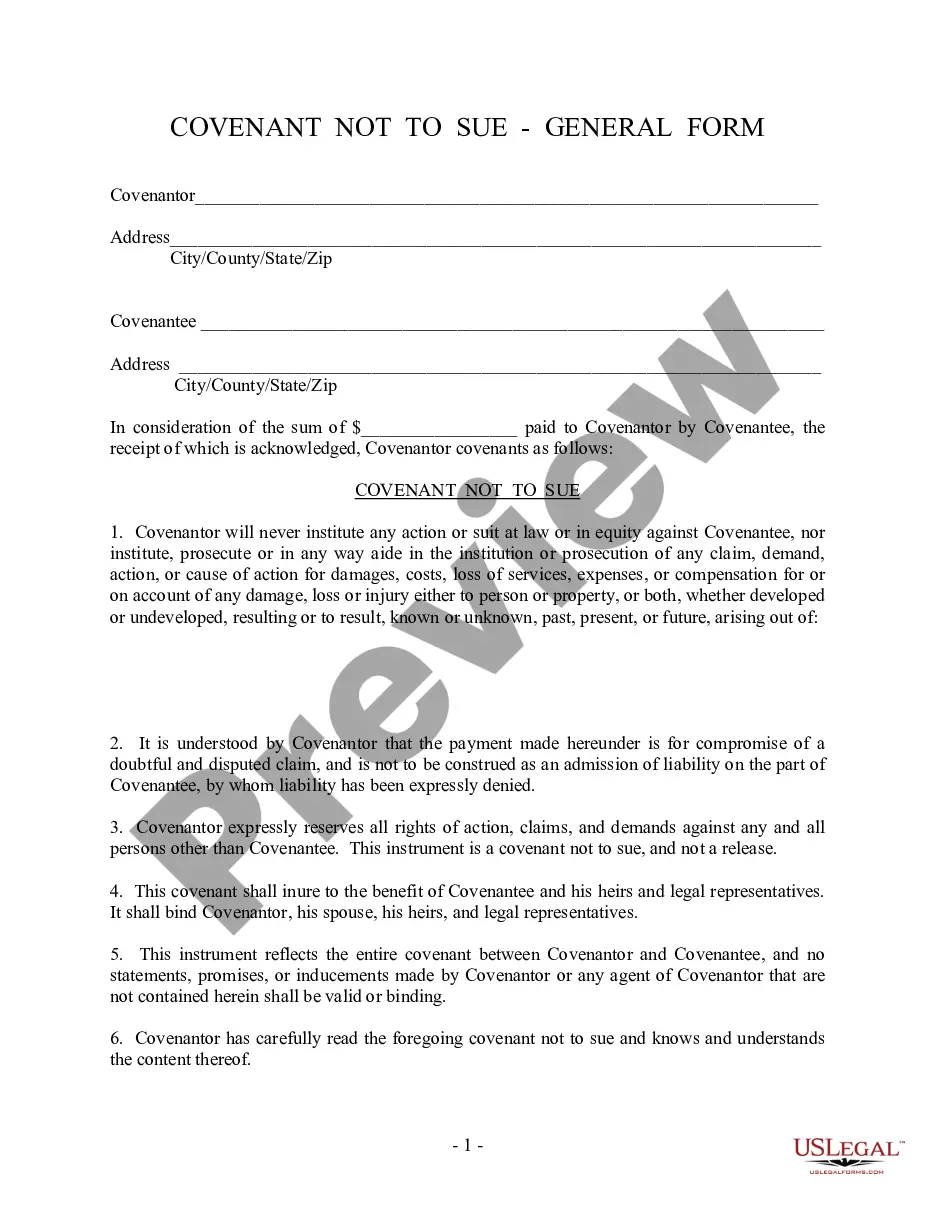
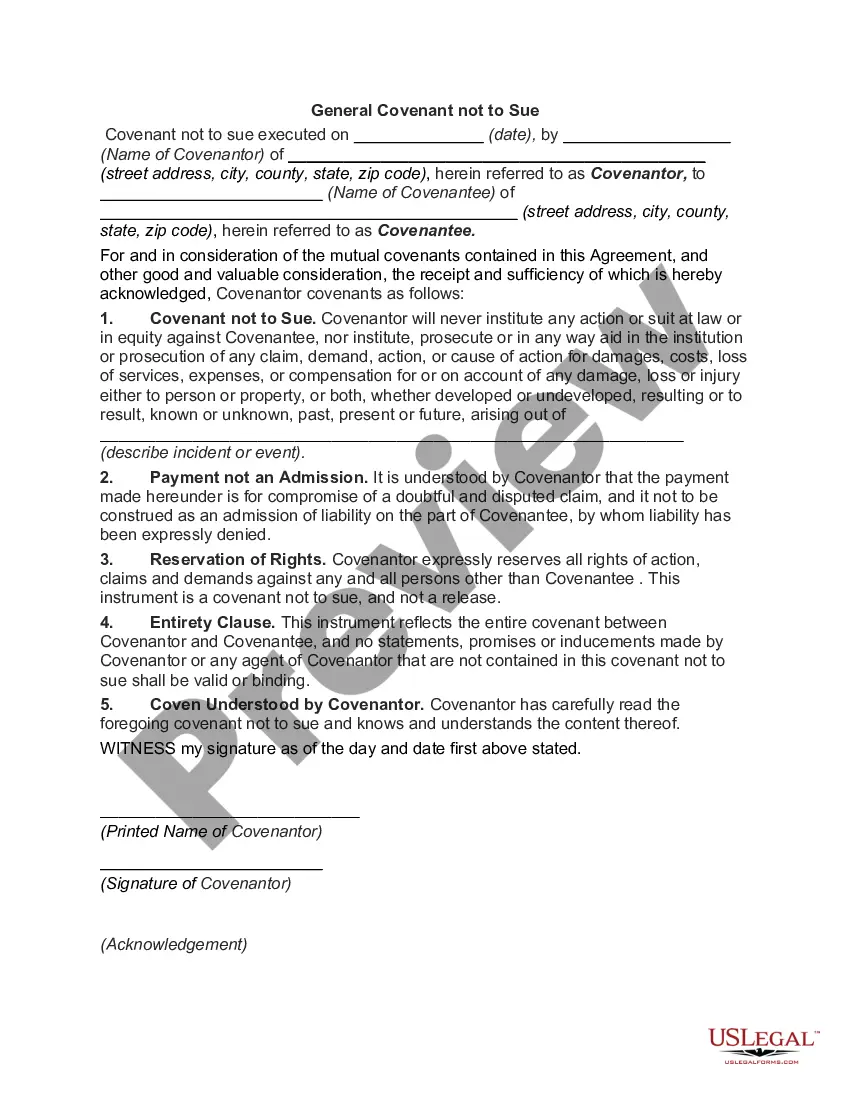
A Covenant Not to Sue is a legal agreement in which one party, known as the Covenantor, agrees not to take legal action against another party, the Covenantee, regarding past events. This form is typically used in the context of settlement agreements to resolve disputes without further litigation. It is distinct from a release agreement since it preserves the Covenantor's right to pursue claims against other parties while prohibiting claims against the Covenantee.
Main sections of this form
- Identification of the Covenantor and Covenantee with their addresses.
- Statement acknowledging the financial consideration received by the Covenantor.
- Specific clauses indicating the Covenantor's agreement not to sue the Covenantee.
- Clarification that the agreement does not imply admission of liability by the Covenantee.
- Confirmation that rights against other parties are reserved by the Covenantor.
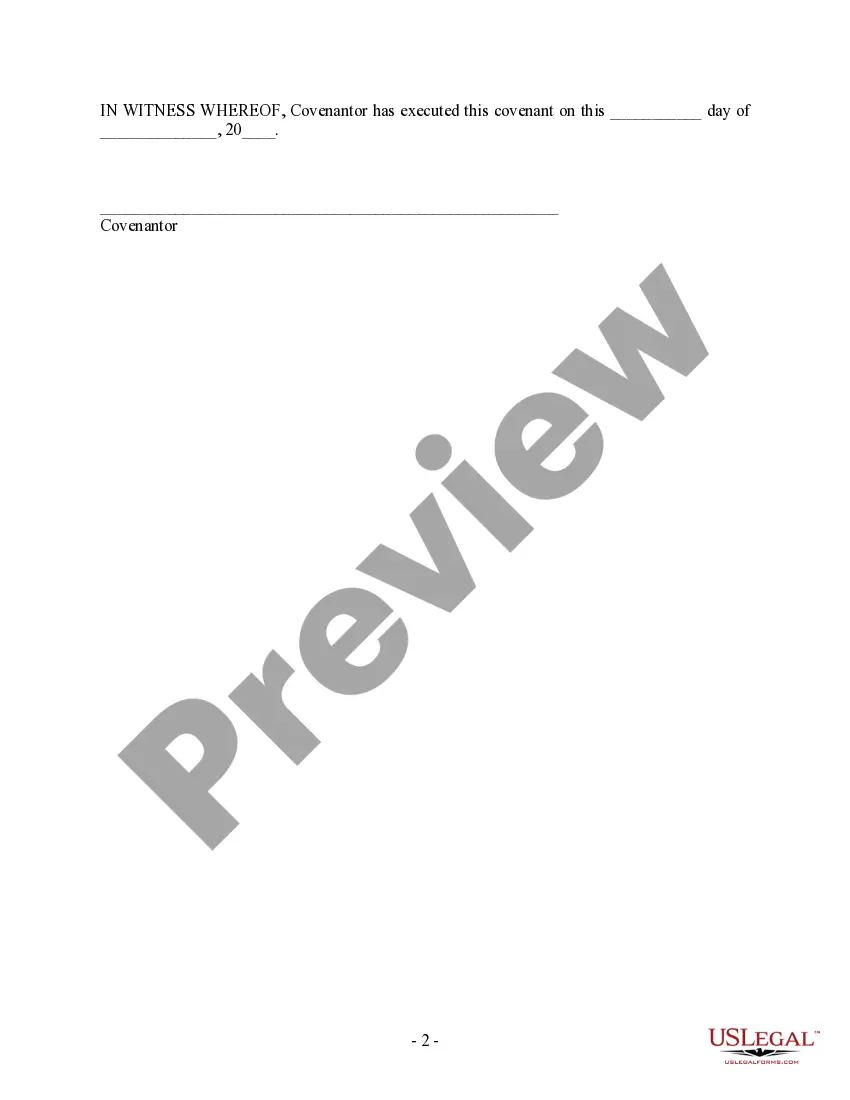
- Execution date and signature section for the Covenantor.
When to use this document
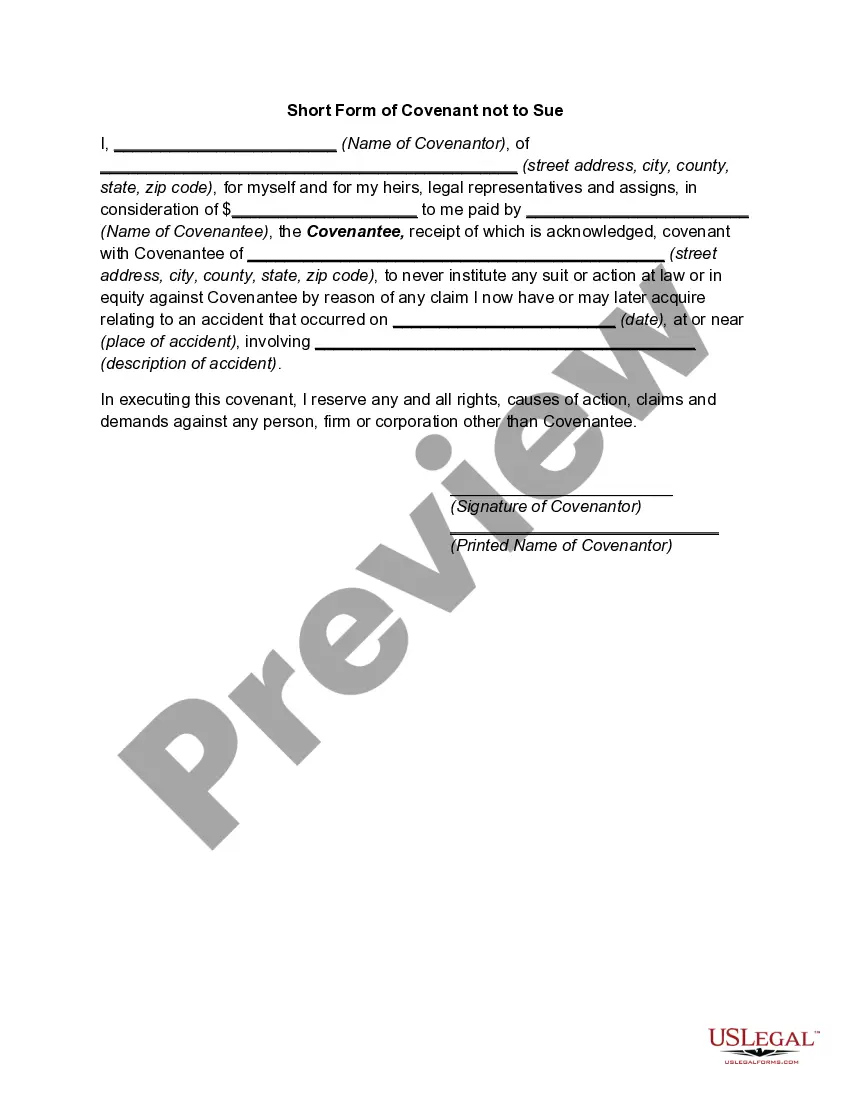
This form is useful in situations where two parties have reached a settlement regarding a dispute. For instance, if an individual (Covenantor) has a claim related to an incident such as a minor accident and they agree to accept a payment from the other party (Covenantee) in exchange for not pursuing further legal action, this form formalizes that agreement.
Intended users of this form
This form is suitable for:
- Individuals or parties involved in a dispute seeking to settle without litigation.
- Anyone who wants to ensure that a previous claim is settled and cannot be pursued against the other party.
- Legal representatives who are drafting settlement agreements on behalf of clients.
Steps to complete this form
- Identify and enter the full names and addresses of both the Covenantor and the Covenantee.
- Indicate the amount of compensation agreed upon in the designated field.
- Read each clause carefully to understand the terms of the covenant.
- Sign and date the form in the presence of any required witnesses, if applicable.
- Keep a signed copy for your records after the completion of the document.
Is notarization required?
This form does not typically require notarization unless specified by local law. To ensure its legality, users should verify any requirements based on their jurisdiction.
Get your form ready online
Our built-in tools help you complete, sign, share, and store your documents in one place.
Make edits, fill in missing information, and update formatting in US Legal Forms—just like you would in MS Word.
Download a copy, print it, send it by email, or mail it via USPS—whatever works best for your next step.
Sign and collect signatures with our SignNow integration. Send to multiple recipients, set reminders, and more. Go Premium to unlock E-Sign.
If this form requires notarization, complete it online through a secure video call—no need to meet a notary in person or wait for an appointment.
We protect your documents and personal data by following strict security and privacy standards.

Make edits, fill in missing information, and update formatting in US Legal Forms—just like you would in MS Word.

Download a copy, print it, send it by email, or mail it via USPS—whatever works best for your next step.

Sign and collect signatures with our SignNow integration. Send to multiple recipients, set reminders, and more. Go Premium to unlock E-Sign.

If this form requires notarization, complete it online through a secure video call—no need to meet a notary in person or wait for an appointment.

We protect your documents and personal data by following strict security and privacy standards.
Common mistakes
- Failing to accurately fill in the names and addresses of the parties involved.
- Not specifying the full consideration amount being paid to the Covenantor.
- Signing the document without fully understanding all terms and implications.
- Neglecting to keep a copy of the signed covenant for personal records.
Benefits of using this form online
- Immediate access to a professionally drafted legal document.
- Easy customization to fit specific settlement situations.
- Convenient download process to obtain the form whenever needed.
- Secure storage options for completed documents.
Legal use & context
- This covenant is enforceable in most jurisdictions provided that it is executed correctly and all parties understand its terms.
- It does not prevent the Covenantor from pursuing claims against other parties not mentioned in the agreement.
- The covenant should be executed thoughtfully to ensure that all rights and obligations are clear and understood.
Quick recap
- The Covenant Not to Sue allows parties to settle disputes without pursuing litigation.
- It includes important clauses regarding compensation and non-admission of liability.
- Both parties must sign the form to enforce its terms legally.
- Ensure compliance with your stateâs legal requirements for effectiveness.
Looking for another form?

Form popularity
FAQ
In California, a liability waiver must be clear, unambiguous, and explicit. In other words, waivers cannot be printed in faded ink, in small font, on the back of a paper, or in an otherwise ambiguous form. If the waiver that you sign is not represented clearly, it may not hold up in the event of a lawsuit.
While courts typically frown upon adhesiontype (i.e., take it or leave it) contracts where the weaker party is unrepresented and asked to give up certain rights they would otherwise have without fully understanding the consequences, No Sue Agreements have been found to be enforceable by various courts in a variety of
A covenant not to sue legally obliges a party that could initiate a lawsuit not to do so. The covenant is made explicitly between two parties, and any third party that wants to make a claim is legally allowed to do so. Covenants not to sue are used to settle specific legal issues outside of the court system.
While signing a waiver does not mean an injured person cannot sue, it also weakens an injured person's claim and in some cases can lead to the case being dismissed.Waivers most often attempt to limit a business owner's liability in the event of injury to business customers.
California law doesn't permit covenants not so sue if it is to exempt someone from fraud, willful injury or violation of the law. The court determined that that wasn't the case here. consultation over a two-year period, militates against a conclusion that the covenant not to sue is procedurally unconscionable.
Under California law, a liability waiver cannot excuse an injury caused by a defendant's gross negligence, recklessness or intentional wrongful act.
You cannot just - "sign your rights away" to a child. It requires an agreement of the other parent at a minimum and a finding by the court that it is in the best interest of the child. In other words, it generally will not occur unless there is someone else willing to adapt.