Arizona List of Witnesses
Understanding this form
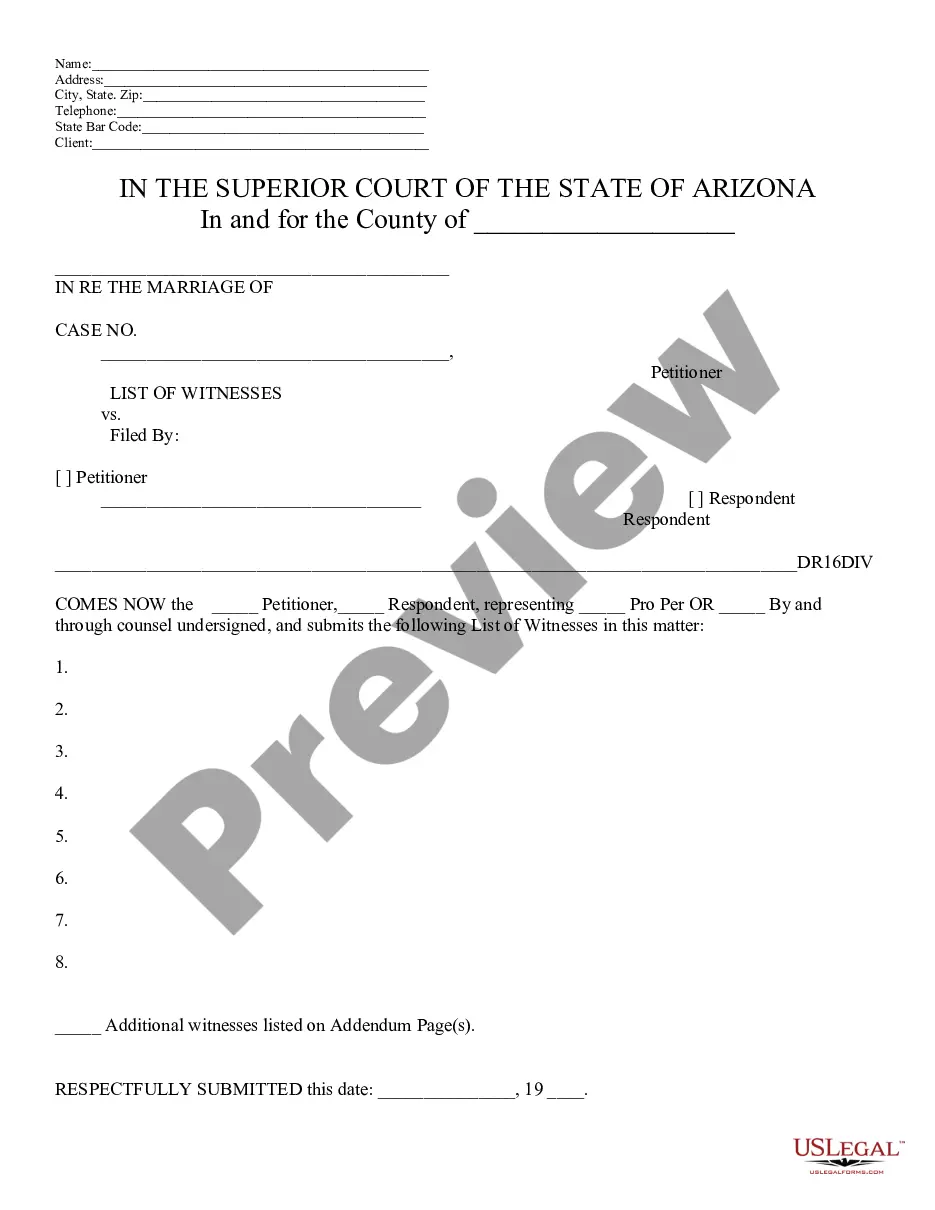
The List of Witnesses is a legal document used to identify individuals who will provide testimony in a court trial. This form ensures that both the Plaintiff and the Defendant are aware of whom the other party intends to call as witnesses, promoting transparency and fairness in legal proceedings. It differs from other forms by specifically focusing on witness identification rather than general case information.
Key parts of this document
- Address and contact information for filing party
- Identification of the court and case number
- Specification of whether the filing party is the Petitioner or Respondent
- List of planned witnesses, with space for additional names on an addendum
- Date of submission
- Signature of the filing party


Common use cases
This form should be used when either party in a legal case intends to present witnesses at trial. It is crucial to file this document well in advance of the trial date to ensure that all parties are informed and can prepare accordingly. Typical scenarios include divorce proceedings, custody disputes, or any civil litigation requiring witness testimony.
Who should use this form
This form is intended for:
- Plaintiffs in legal cases who plan to call witnesses
- Defendants in legal disputes who wish to inform the court of their witnesses
- Individuals representing themselves in court (pro se litigants)
- Attorneys on behalf of their clients in formal legal proceedings
Instructions for completing this form
- Provide your address and contact information at the top of the form.
- Fill in the name of the court and the case number at the designated sections.
- Identify yourself as either the Petitioner or Respondent.
- List all witnesses you intend to call, ensuring the names are clear and complete.
- Add the date of submission at the bottom of the form.
- Sign the form to affirm the information provided is accurate.
Notarization requirements for this form
In most cases, this form does not require notarization. However, some jurisdictions or signing circumstances might. US Legal Forms offers online notarization powered by Notarize, accessible 24/7 for a quick, remote process.
Get your form ready online
Our built-in tools help you complete, sign, share, and store your documents in one place.
Make edits, fill in missing information, and update formatting in US Legal Forms—just like you would in MS Word.
Download a copy, print it, send it by email, or mail it via USPS—whatever works best for your next step.
Sign and collect signatures with our SignNow integration. Send to multiple recipients, set reminders, and more. Go Premium to unlock E-Sign.
If this form requires notarization, complete it online through a secure video call—no need to meet a notary in person or wait for an appointment.
We protect your documents and personal data by following strict security and privacy standards.

Make edits, fill in missing information, and update formatting in US Legal Forms—just like you would in MS Word.

Download a copy, print it, send it by email, or mail it via USPS—whatever works best for your next step.

Sign and collect signatures with our SignNow integration. Send to multiple recipients, set reminders, and more. Go Premium to unlock E-Sign.

If this form requires notarization, complete it online through a secure video call—no need to meet a notary in person or wait for an appointment.

We protect your documents and personal data by following strict security and privacy standards.
Avoid these common issues
- Failing to list all intended witnesses.
- Not updating the list if additional witnesses are identified close to the trial date.
- Missing the filing deadline for submitting the list to the court and the opposing party.
- Neglecting to include the required case information, such as case number and court name.
Why use this form online
- Convenience of filling out the form from anywhere at any time.
- Easy to edit and update information as needed before submission.
- Access to professionally drafted templates for peace of mind.
- Fast download and printing options available for immediate use.
Looking for another form?


Form popularity
FAQ
In Arizona, a valid will must be signed by at least two witnesses. These witnesses should not be beneficiaries of the will to ensure impartiality. Their signatures confirm the authenticity of the document and help establish the Arizona List of Witnesses. This essential process protects the intentions of the testator and supports the will's validity in court.
To obtain a copy of a will in Arizona, you can start by contacting the probate court in the county where the will was filed. Most courts allow you to request copies online, by mail, or in person. Once you provide the necessary details, such as the name of the deceased and the case number, you can access the Arizona List of Witnesses related to the will. This information is crucial for verifying the legitimacy of the document.
Factors that contribute to the effectiveness of a witness include their credibility, clarity of communication, and overall demeanor during testimony. A witness must convey their account in a straightforward manner, which enhances the understanding of their role within the case. It's also important to consider how a witness interacts with both legal teams and the court, as these factors can influence the outcome of a case significantly.
To qualify as a witness, an individual needs to have firsthand information regarding the events of the case. This information must be related to matters being litigated. Additionally, a witness should demonstrate honesty and integrity, ensuring that what they testify reflects the truth of their experiences related to the Arizona List of Witnesses.
The basic requirements of a witness in Arizona include being at least 18 years old and possessing the mental capacity to understand the questions being asked. A witness must also be willing to testify voluntarily and truthfully. This willingness is key, as a testimony lacking sincerity or willingness may lead to complications in legal proceedings.
When requesting someone to testify, it is important to approach them respectfully and clearly explain the purpose of their testimony. You may wish to detail how their account relates to the case at hand. Additionally, providing assurances of their rights and potential legal protections can help ease any concerns they may have about participating as a witness.
The criteria for being a witness in Arizona involve having personal knowledge of the facts pertinent to the case. It is essential for the witness to be capable of recounting events clearly and accurately. Furthermore, the individual's reliability and ethical standing are also crucial, as these aspects will impact how their testimony is perceived in court.
To be included in the Arizona List of Witnesses, a person must typically be of legal age, which is 18 years or older. They must also possess the ability to understand and communicate relevant information effectively. Additionally, witnesses should not have any disqualifying factors, such as a felony conviction, that could undermine their credibility in a legal situation.
Creating a witness list involves identifying individuals who can provide relevant testimony about your case. Start by compiling names, contact information, and notes on their potential contributions. Using a tool or resource designed for the Arizona List of Witnesses can streamline this process, ensuring accuracy and completeness. Legal platforms like uslegalforms can provide templates and guidance for assembling your list effectively.
Yes, individuals can testify over the phone in certain circumstances. This often depends on the court’s rules and the specifics of the case. Using technology to facilitate testimony helps streamline the process and can be included in an Arizona List of Witnesses, allowing flexibility for those who may have difficulty attending in person. Always consult with legal counsel to understand the requirements.