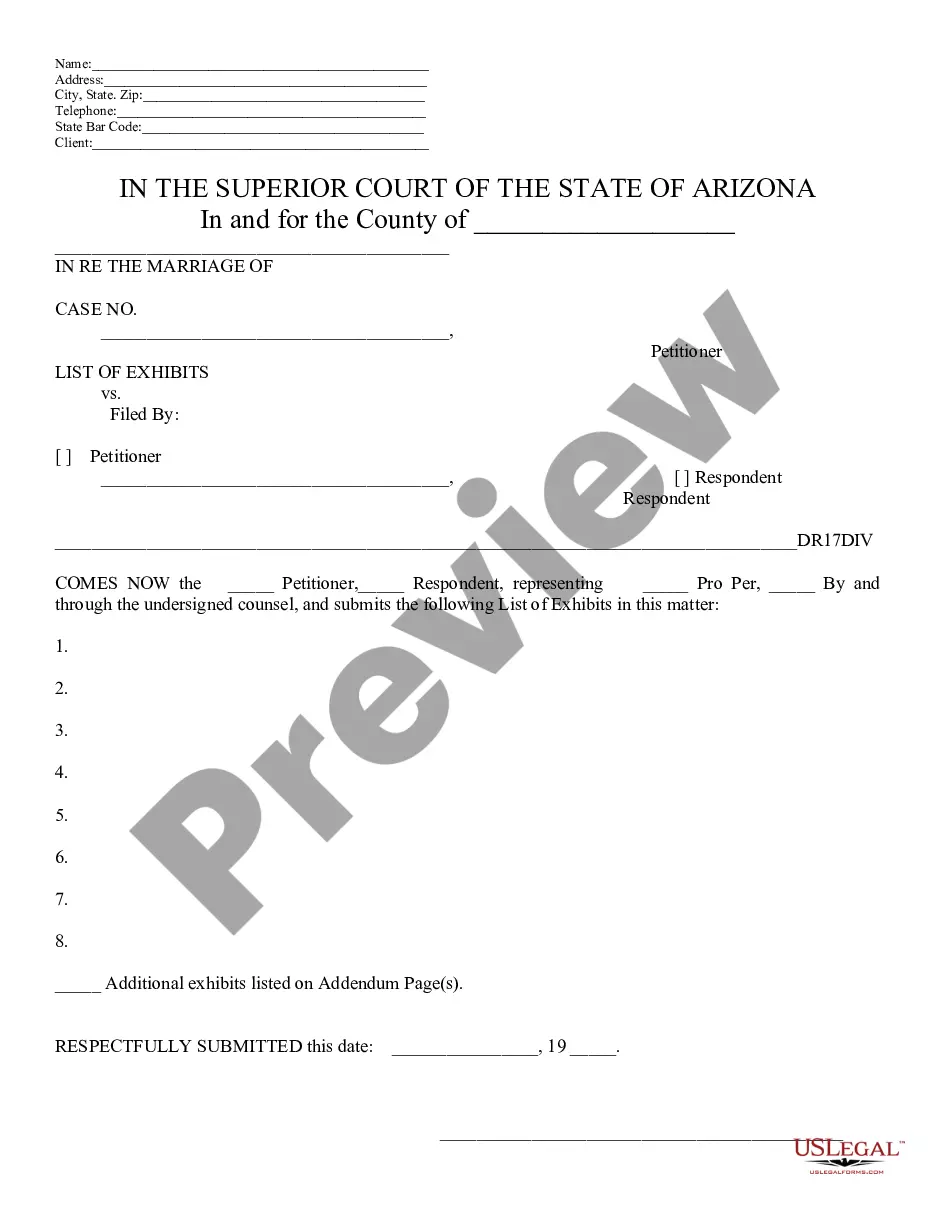
Arizona List of Exhibits
Overview of this form
The List of Exhibits is a vital legal document used in court cases to outline all the exhibits that either the Plaintiff or Defendant plans to present during the trial. This form serves to provide a clear inventory of evidence, ensuring both parties are informed about the materials that will be introduced. Unlike other court documents, the List of Exhibits is specifically focused on detailing the supporting materials for a case.
What’s included in this form
- Address and contact details of the filing party
- Identification of the court and case number
- Names of the Petitioner and Respondent
- Space for listing all intended exhibits
- Signature of the filing party


When to use this form
This form is used in legal proceedings when a party needs to submit a formal list of exhibits for trial. It is essential when preparing for court to ensure that the opposing party is aware of the evidence being brought forth, and it can be used in various case types, including divorce and civil litigation.
Who can use this document
- Individuals acting as Plaintiffs or Defendants in a court case
- Representatives of legal entities involved in litigation
- Self-representing individuals (Pro Per) in need of organized documentation for trial
How to complete this form
- Fill in your contact information, including your address and telephone number.
- Identify the court and case number at the top of the form.
- Clearly list all intended exhibits in the provided spaces.
- Sign and date the document to verify submission.
- Send a copy of this form to the opposing party for their records.
Notarization guidance
This form does not typically require notarization to be legally valid. However, some jurisdictions or document types may still require it. US Legal Forms provides secure online notarization powered by Notarize, available 24/7 for added convenience.
Get your form ready online
Our built-in tools help you complete, sign, share, and store your documents in one place.
Make edits, fill in missing information, and update formatting in US Legal Forms—just like you would in MS Word.
Download a copy, print it, send it by email, or mail it via USPS—whatever works best for your next step.
Sign and collect signatures with our SignNow integration. Send to multiple recipients, set reminders, and more. Go Premium to unlock E-Sign.
If this form requires notarization, complete it online through a secure video call—no need to meet a notary in person or wait for an appointment.
We protect your documents and personal data by following strict security and privacy standards.

Make edits, fill in missing information, and update formatting in US Legal Forms—just like you would in MS Word.

Download a copy, print it, send it by email, or mail it via USPS—whatever works best for your next step.

Sign and collect signatures with our SignNow integration. Send to multiple recipients, set reminders, and more. Go Premium to unlock E-Sign.

If this form requires notarization, complete it online through a secure video call—no need to meet a notary in person or wait for an appointment.

We protect your documents and personal data by following strict security and privacy standards.
Common mistakes
- Failing to list all intended exhibits before submission.
- Not providing copies to the opposing party.
- Incorrectly citing the case number or court.
Why use this form online
- Convenience of downloading and editing the form from anywhere.
- Access to templates drafted by licensed attorneys for accuracy.
- Immediate availability to facilitate timely submission to court.
Legal use & context
- A properly completed List of Exhibits enhances the organization of evidence in court.
- Failure to submit this form could lead to exclusion of exhibits during trial.
- This document is essential for maintaining transparency during legal proceedings.
Quick recap
- The List of Exhibits is crucial for clearly presenting evidence at trial.
- Ensure all intended exhibits are listed and shared with the opposing party.
- Complete the form accurately to comply with court requirements.
Looking for another form?
Form popularity
FAQ
An exhibition guide is a resource that outlines how to properly prepare and understand the presentation of exhibits in a legal context. This guide often includes best practices, formats, and tips to streamline the process. Using an exhibition guide can simplify your efforts when assembling your Arizona List of Exhibits. This resource aligns your preparations with legal requirements and enhances your confidence in court.
In legal terms, an exhibition refers to a collection of items or documents showcased for evidentiary purposes in court. Essentially, it serves to support arguments or claims made by either party. Understanding the exact meaning of exhibition is important when creating your Arizona List of Exhibits, as it ensures all documents meet legal standards and fulfill their intended purpose.
An exhibition list is a comprehensive compilation of all exhibits intended for presentation in a legal case. This list summarizes the items, their descriptions, and their relevance to your case. Creating an effective exhibition list is crucial for your Arizona List of Exhibits because it helps organize evidence and presents it clearly to the court. This organization boosts your chances of making a strong case.
An exhibit record is a formal documentation of all items presented as evidence during a legal proceeding. This record serves as a checklist to track each exhibit's introduction and its relevance to the case. Having an accurate exhibit record is essential for the integrity of your Arizona List of Exhibits. It allows all parties to reference inclusion without disputes during the trial.
An exhibition generally refers to a presentation of items or documents that serve as evidence in a legal case. In a legal context, an exhibition can include photographs, contracts, or any relevant materials. Understanding what constitutes an exhibition is crucial when preparing your Arizona List of Exhibits. This ensures that you include all necessary documents that support your case.
The word exhibit can refer to the act of presenting evidence, as in 'to exhibit a document in court.' It emphasizes the importance of showcasing your materials to clarify your arguments. Understanding the Arizona List of Exhibits will help you use the word effectively, ensuring each item you exhibit strengthens your position in the legal arena.
Exhibition items can include any physical materials presented in a legal setting, such as models, videos, or even digital presentations. In family court, these items must be relevant and support your narrative or claims effectively. Remember to reference the Arizona List of Exhibits to ensure each item is categorized correctly and follows court rules.
Examples of exhibits include medical records, emails, photographs from an event, or any documents that reinforce your case. Each of these items can establish facts or provide context within a legal dispute. By utilizing the Arizona List of Exhibits, you can better organize and present these various types of evidence.
To submit evidence in family court in Arizona, you must prepare your exhibits in accordance with the Arizona List of Exhibits guidelines. This preparation often entails labeling each exhibit clearly, making copies for the judge, and ensuring all items are relevant to your case. Utilizing platforms like uslegalforms can simplify the submission process, as they provide templates and instructions tailored to family law.
An example of an exhibit might include a signed contract that details an agreement between two parties. This contract can be crucial evidence in divorce proceedings, for instance, helping to establish asset distribution or obligations. Referring to the Arizona List of Exhibits can guide you in categorizing and presenting such documents appropriately.