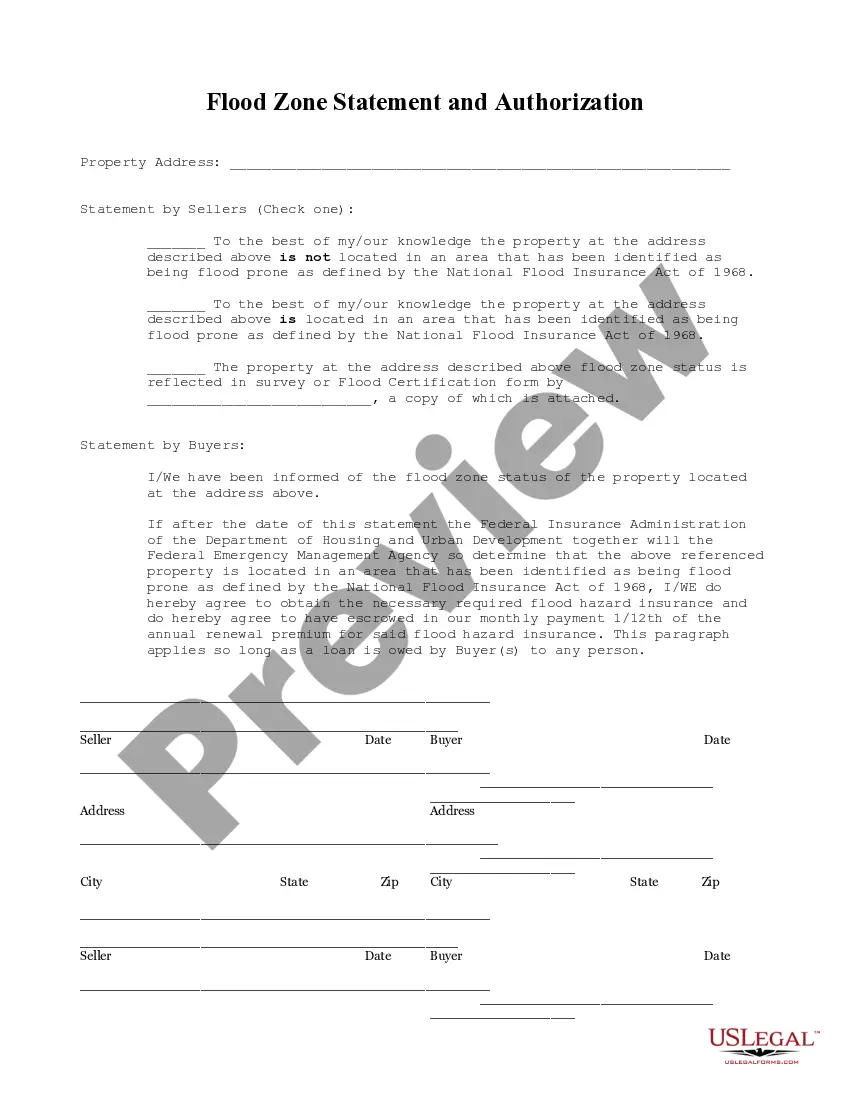
Wyoming Flood Zone Statement and Authorization
Overview of this form
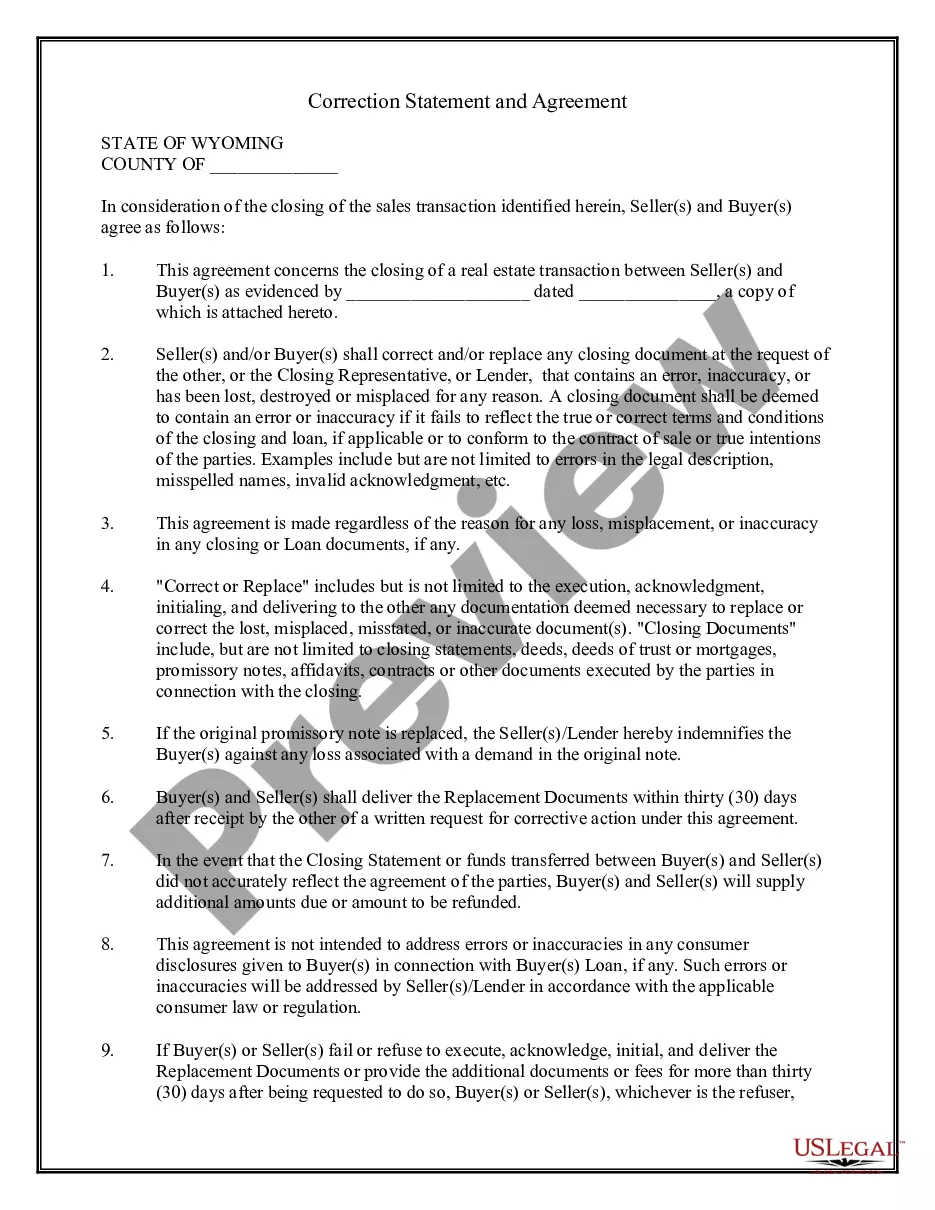
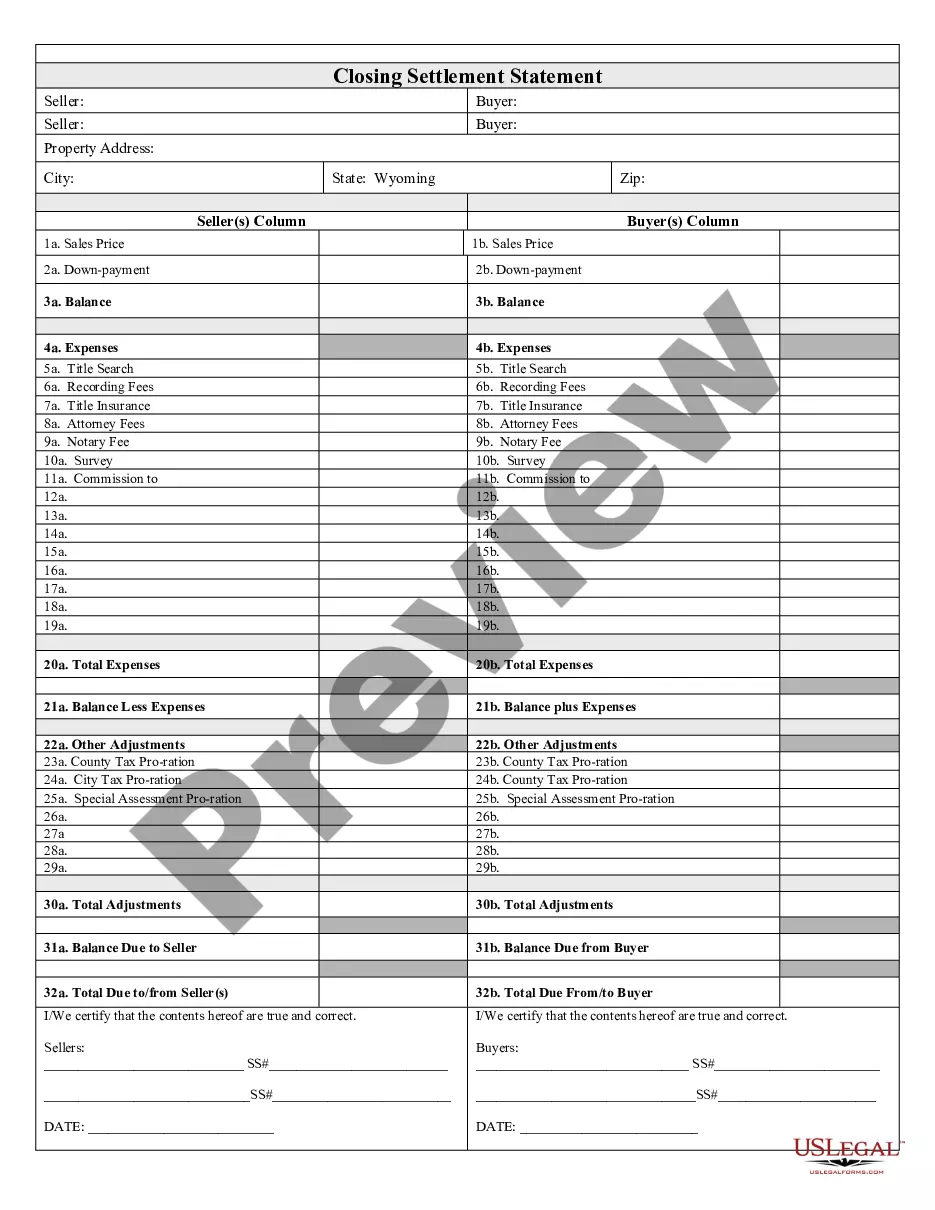
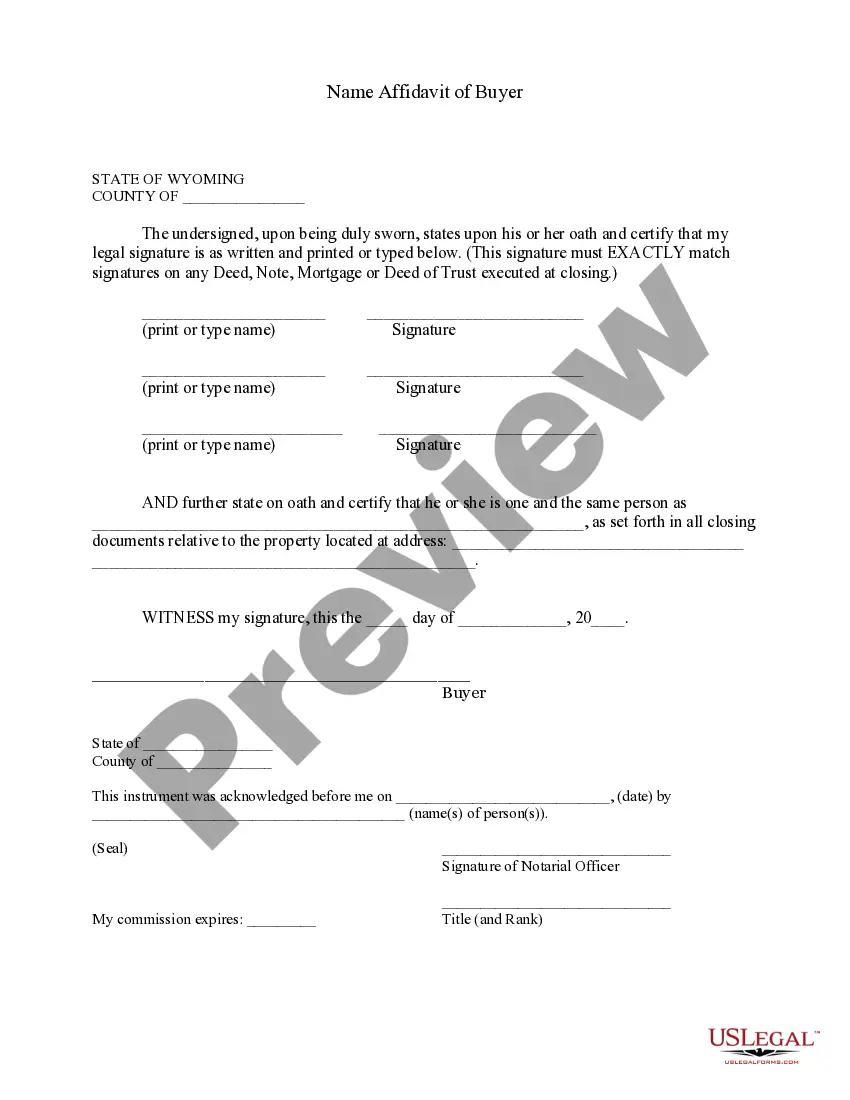
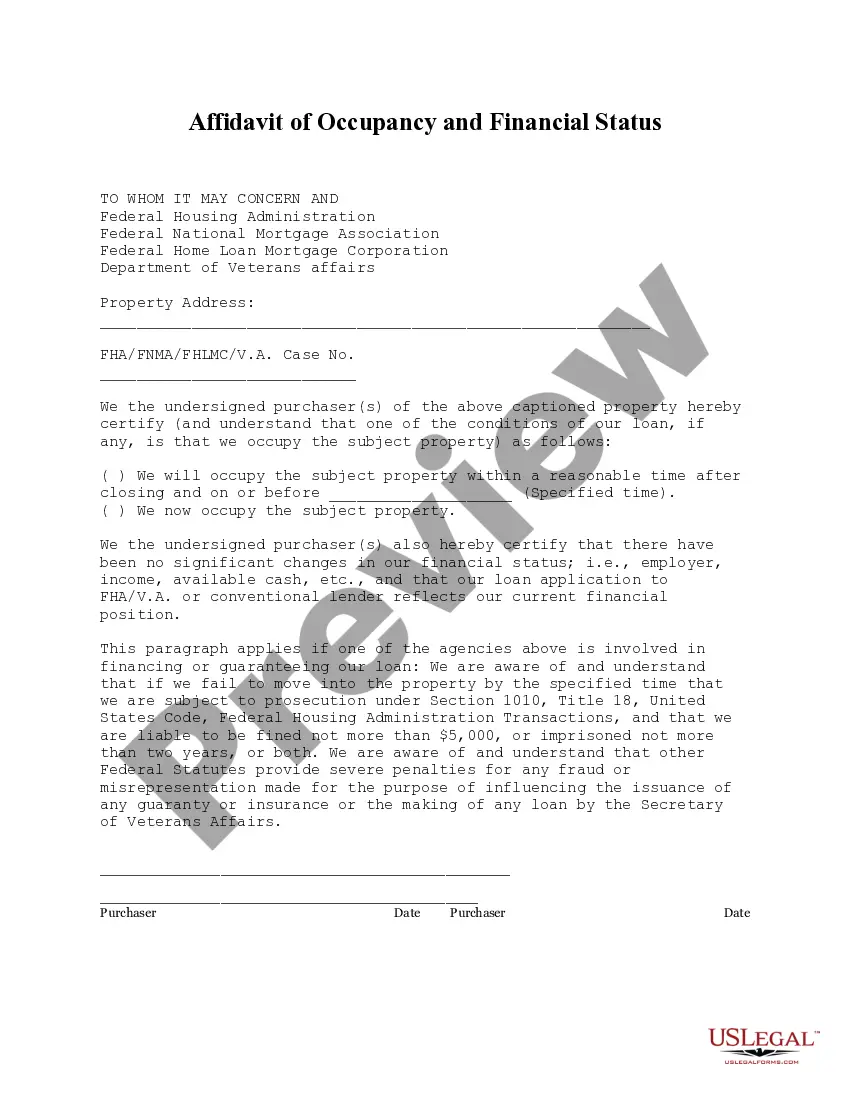
The Flood Zone Statement and Authorization form is a legal document used in real estate transactions. It is designed for sellers to declare the flood zone status of a property while allowing buyers to acknowledge this information. This form is crucial for ensuring both parties understand the flood risk associated with the property and the necessity of obtaining flood insurance if the property is in a designated flood zone. Unlike general property disclosure forms, this specifically addresses flood risks, making it an essential tool for real estate transactions in susceptible areas.
Main sections of this form
- Property Address: To identify the specific location of the property.
- Seller's Statement: Sellers indicate whether the property is in a flood-prone area per federal guidelines.
- Buyer's Acknowledgment: Buyers affirm their understanding of the flood zone status and obligations regarding flood insurance.
- Escrow Agreement: Details on how flood insurance premiums will be handled if necessary.
When to use this form
This form should be used during the sale of real estate, particularly in areas that may be at risk for flooding. It is essential when the property owners need to disclose the flood zone status to potential buyers. If you in the process of purchasing property in a flood-prone area or if your property is located in a region identified by the Federal Insurance Administration as at risk for flooding, using this form is crucial for protecting your interests.
Who this form is for
- Sellers of real estate in flood-prone areas who need to disclose property conditions.
- Buyers interested in properties potentially affected by flooding who want to ensure compliance with insurance requirements.
- Real estate agents and brokers facilitating transactions in flood-affected regions.
Steps to complete this form
- Identify the parties involved: Enter the names and addresses of all sellers and buyers.
- Specify the property: Clearly write the property address at the top of the form.
- Select the appropriate seller statement: Indicate the flood zone status as known by the sellers.
- Obtain buyer acknowledgment: Ensure buyers sign to confirm understanding of the flood zone status and insurance obligations.
- Enter dates and signatures: All parties must date and sign the form to finalize the agreement.
Does this document require notarization?
In most cases, this form does not require notarization. However, some jurisdictions or signing circumstances might. US Legal Forms offers online notarization powered by Notarize, accessible 24/7 for a quick, remote process.
Get your form ready online
Our built-in tools help you complete, sign, share, and store your documents in one place.
Make edits, fill in missing information, and update formatting in US Legal Forms—just like you would in MS Word.
Download a copy, print it, send it by email, or mail it via USPS—whatever works best for your next step.
Sign and collect signatures with our SignNow integration. Send to multiple recipients, set reminders, and more. Go Premium to unlock E-Sign.
If this form requires notarization, complete it online through a secure video call—no need to meet a notary in person or wait for an appointment.
We protect your documents and personal data by following strict security and privacy standards.

Make edits, fill in missing information, and update formatting in US Legal Forms—just like you would in MS Word.

Download a copy, print it, send it by email, or mail it via USPS—whatever works best for your next step.

Sign and collect signatures with our SignNow integration. Send to multiple recipients, set reminders, and more. Go Premium to unlock E-Sign.

If this form requires notarization, complete it online through a secure video call—no need to meet a notary in person or wait for an appointment.

We protect your documents and personal data by following strict security and privacy standards.
Common mistakes to avoid
- Failing to accurately disclose the flood zone status of the property.
- Not obtaining signatures from all parties involved.
- Omitting details regarding flood insurance obligations in the buyer's acknowledgment section.
Benefits of completing this form online
- Convenient access: Complete the form at your own pace and from anywhere.
- Editability: Easily fill out or modify details as needed before finalizing the document.
- Legal reliability: Utilize professionally drafted forms to ensure compliance with legal standards.
Legal use & context
- This form is an essential part of real estate transactions in flood-prone areas, safeguarding parties from unforeseen liabilities.
- It establishes an agreement on flood zone status, making it easier to secure necessary insurance.
- Failure to complete this form accurately may lead to legal complications post-sale.
Quick recap
- The Flood Zone Statement and Authorization form clarifies the flood status of a property in real estate transactions.
- Understanding flood risks is critical for buyers and sellers to avoid future liabilities.
- Complete the form accurately, ensuring both parties are informed about the property's flood insurance requirements.
Looking for another form?
Form popularity
FAQ
Google Earth will open and display the FEMA NFHL welcome button (see area a in Figure 1), a map overlay that shows the status of data coverage (see area b), and the "National Flood Hazard Layer (FEMA)" folder under Temporary Places in the "Places"panel (area c).
Zone A. Zone A is the flood insurance rate zone that corresponds to the I-percent annual chance floodplains that are determined in the Flood Insurance Study by approximate methods of analysis.
How to View and Obtain Flood Maps. The FEMA Flood Map Service Center (MSC) is the official online location to find all flood hazard mapping products created under the NFIP, including your community's flood map.
Areas that are likely to be flooded are displayed on the map with a blue overlay. It is also possible to right-click on any location and view the elevation level at that point. If you want to share a Flood Map search you can cut and paste a link to the current map view.
Simply enter a property's address on the FEMA Flood Map Service Center website, and a map showing its flood zone hazard will pop up. Zones B, X, and C are at the lowest risk, while high-risk zones start with either an A or a V (V zones are coastal areas) on the map.
How to View and Obtain Flood Maps. The FEMA Flood Map Service Center (MSC) is the official online location to find all flood hazard mapping products created under the NFIP, including your community's flood map.
Simply enter a property's address on the FEMA Flood Map Service Center website, and a map showing its flood zone hazard will pop up. Zones B, X, and C are at the lowest risk, while high-risk zones start with either an A or a V (V zones are coastal areas) on the map.
Use the zone designation letters to gauge the flooding risk. The lettering starts at A in most areas and V for coastal areas. Later letters in the alphabet indicate a lower flooding risk. For example, any area labeled A has a high risk of flooding. An area labeled D has a minimal flooding risk.