Alabama Trial motion in Limine to exclude
Understanding this form
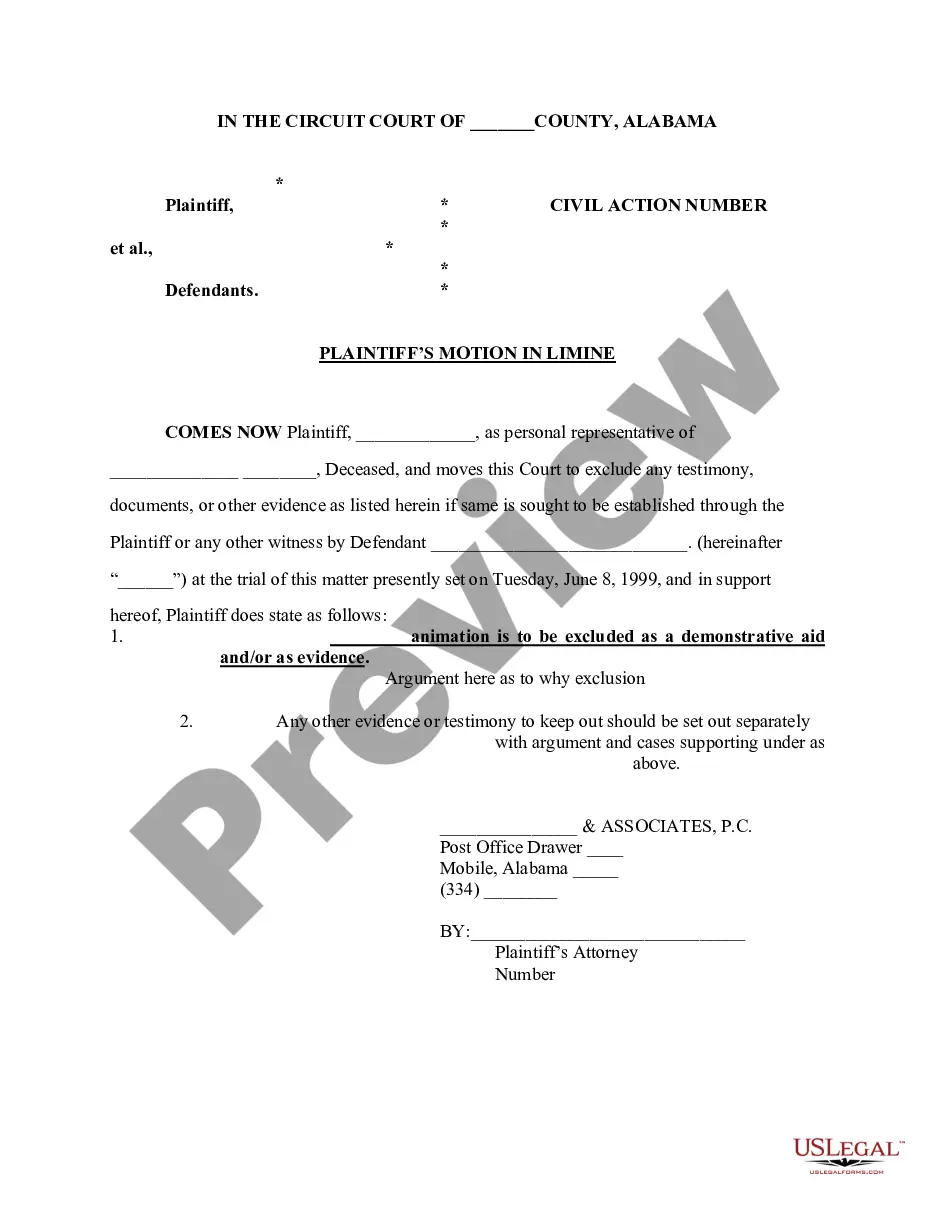
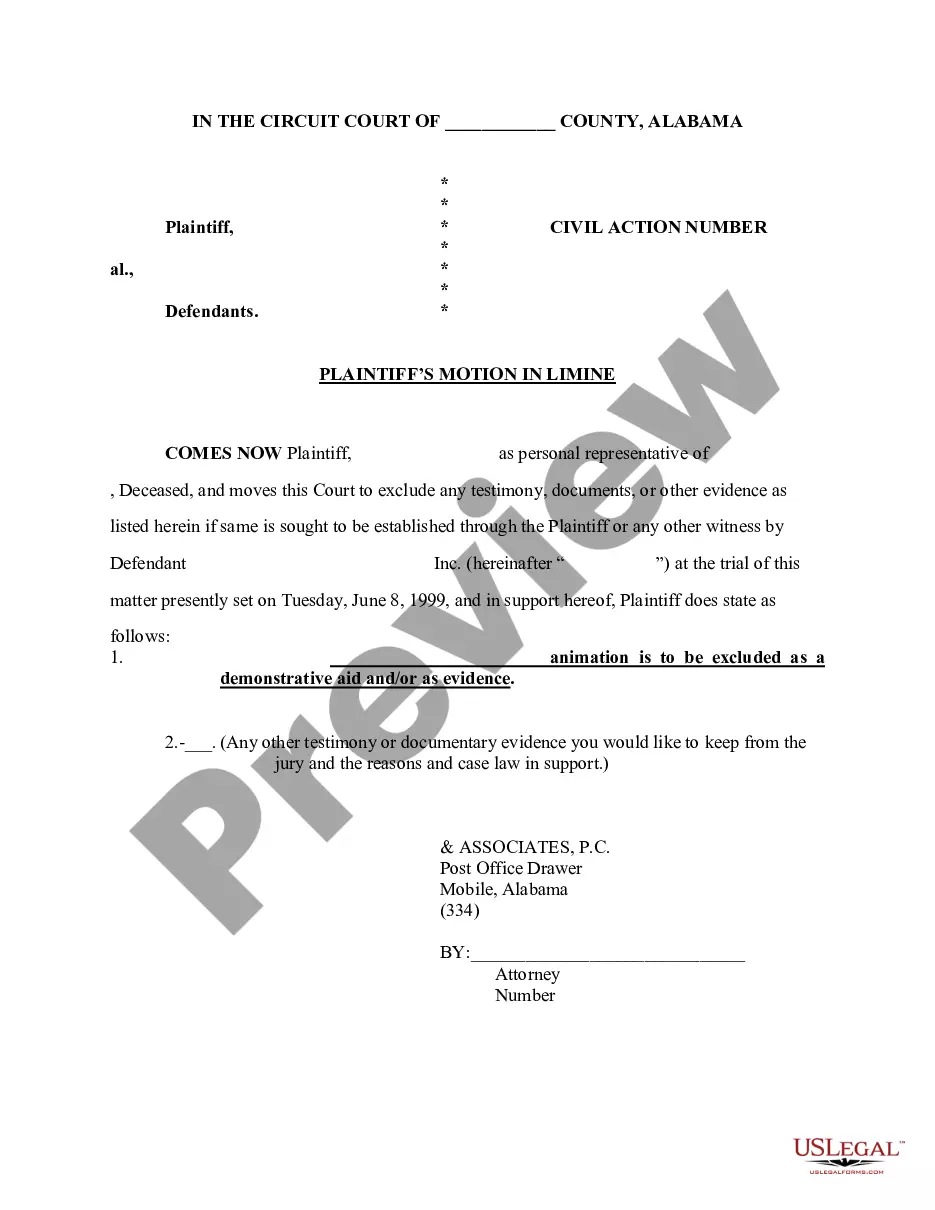
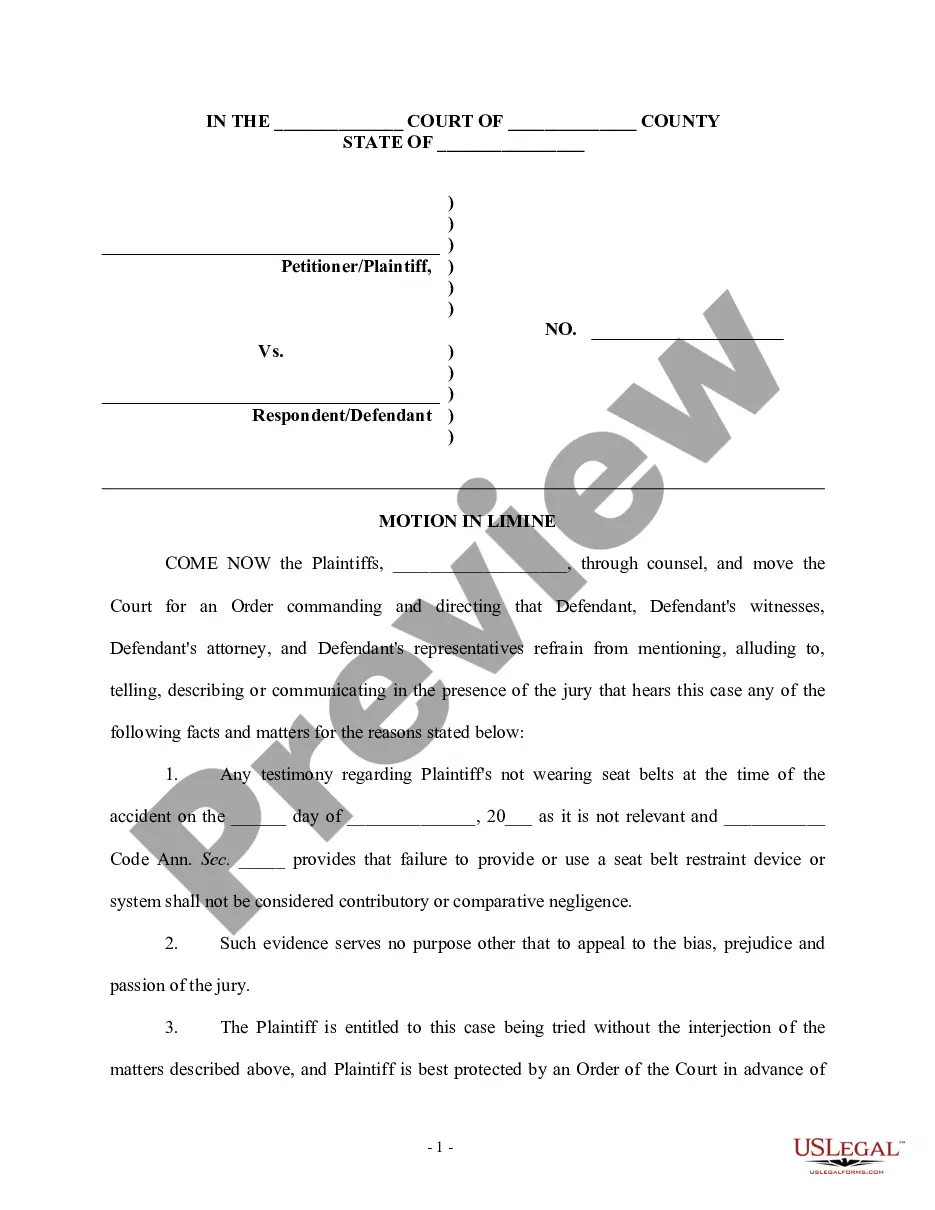
A Trial Motion in Limine to Exclude is a legal document used by a plaintiff to request the court to prevent certain testimony or evidence from being presented during a trial. This form is particularly relevant for cases in Alabama, allowing the requesting party to specify the evidence they wish to exclude. It serves a distinct purpose compared to other motions, as it focuses solely on excluding evidence that could unfairly influence the jury.
What’s included in this form
- Identification of the plaintiff and defendants involved in the case.
- Civil action number associated with the case.
- Detailed list of evidence or testimony the plaintiff wishes to exclude.
- Arguments supporting the request for exclusion, including relevant case law.
- Certification of service to ensure that all parties have received the motion.

Situations where this form applies
This form is typically used when a party believes that certain evidence may be harmful to their case if introduced during a trial. Common scenarios include instances where testimony is deemed irrelevant, hearsay, or prejudicial, which could mislead the jury or create unfair bias. It is advisable to file this motion prior to the trial to address potential evidence issues effectively.
Who this form is for
Individuals who may need to use this form include:
- Plaintiffs in civil lawsuits seeking to protect their case from unfavorable evidence.
- Attorneys representing plaintiffs in litigation who need to ensure a fair trial.
- Personal representatives in wrongful death cases or similar matters.
How to complete this form
- Identify the plaintiff and defendants, ensuring accurate names and designations.
- Enter the civil action number related to the case for identification.
- Clearly list and describe each piece of evidence or testimony that is to be excluded.
- Provide strong arguments as to why the evidence should be excluded, citing relevant laws or precedents where applicable.
- Complete the certification of service to confirm the motion has been distributed to all relevant parties.
Is notarization required?
This form does not typically require notarization to be legally valid. However, some jurisdictions or document types may still require it. US Legal Forms provides secure online notarization powered by Notarize, available 24/7 for added convenience.
Get your form ready online
Our built-in tools help you complete, sign, share, and store your documents in one place.
Make edits, fill in missing information, and update formatting in US Legal Forms—just like you would in MS Word.
Download a copy, print it, send it by email, or mail it via USPS—whatever works best for your next step.
Sign and collect signatures with our SignNow integration. Send to multiple recipients, set reminders, and more. Go Premium to unlock E-Sign.
If this form requires notarization, complete it online through a secure video call—no need to meet a notary in person or wait for an appointment.
We protect your documents and personal data by following strict security and privacy standards.

Make edits, fill in missing information, and update formatting in US Legal Forms—just like you would in MS Word.

Download a copy, print it, send it by email, or mail it via USPS—whatever works best for your next step.

Sign and collect signatures with our SignNow integration. Send to multiple recipients, set reminders, and more. Go Premium to unlock E-Sign.

If this form requires notarization, complete it online through a secure video call—no need to meet a notary in person or wait for an appointment.

We protect your documents and personal data by following strict security and privacy standards.
Typical mistakes to avoid
- Failing to provide adequate legal arguments for exclusion, which may result in the motion being denied.
- Not serving the motion to all opposing parties, which can lead to procedural issues.
- Missing the filing deadline for the motion, potentially allowing unfavorable evidence to be presented.
Why use this form online
- Easy accessibility to legal templates drafted by experienced attorneys.
- Convenient download options for quick and efficient use in legal proceedings.
- Editable forms that allow users to tailor the motion to their specific case circumstances.
Legal use & context
The Motion in Limine is a procedural tool used within trial litigation. It is intended to streamline the trial process by addressing evidentiary issues before they arise in front of a jury, thus promoting fairness and efficiency in legal proceedings. Proper use of this form can significantly influence the outcome of a case by preventing prejudicial evidence from being heard.
Main things to remember
- This form is essential for excluding certain evidence from a trial in Alabama.
- Properly filling out and serving the motion is critical for its success.
- Understanding the legal grounds for exclusion is key to crafting a strong motion.
Looking for another form?


Form popularity
FAQ
Whereas the motion in limine is based on the trial court's inherent discretion to exclude prejudicial evidence, the motion to suppress is based on the court's duty to exclude evidence which has been im- properly Qbtained.
Importantly, motions in limine are generally made before a trial begins, and always argued outside the presence of the jury. Thus, a motion in limine allows key evidentiary questions to be decided without the jury present and, if the motion is granted, will preclude the jury from ever learning of the disputed evidence.
Something is not right. Motions in Limine are generally filed shortly before trial and not months prior. Also, the terms used here ("amend" and "modify") are confusing and not generally used with motions but are used in connections with...
There is also authority for the proposition that if a motion in limine is denied, the party opposing the evidence can be the first to offer the objectionable evidence without waiving the merits of the evidentiary objection on appeal.
A motion in limine is a powerful weapon for advocates that can alter the entire makeup of the case. This type of motion is a pretrial request of the court to rule on the admissibility of a certain piece of evidence.
Generally, a party in a lawsuit files a motion in limine to exclude evidence from a trial because the evidence isn't relevant or because its prejudicial effect substantially outweighs its probative value. You can oppose the motion in limine by drafting and filing your own motion in opposition.
Stated in the most general terms, a proper motion in limine is an evidentiary motion that seeks a determination as to whether to exclude (or admit) evidence before it is offered at trial.
A motion in limine is a powerful weapon for advocates that can alter the entire makeup of the case. This type of motion is a pretrial request of the court to rule on the admissibility of a certain piece of evidence.
Motions in limine should be used only for their original purpose to challenge evidence that is so inadmissible and prejudicial that its mere mention in the presence of the jury would lead to an unfair trial.On appeal this ruling of the trial court was affirmed.