Hepatitis B Vaccine Acceptance Declination Form
About this form
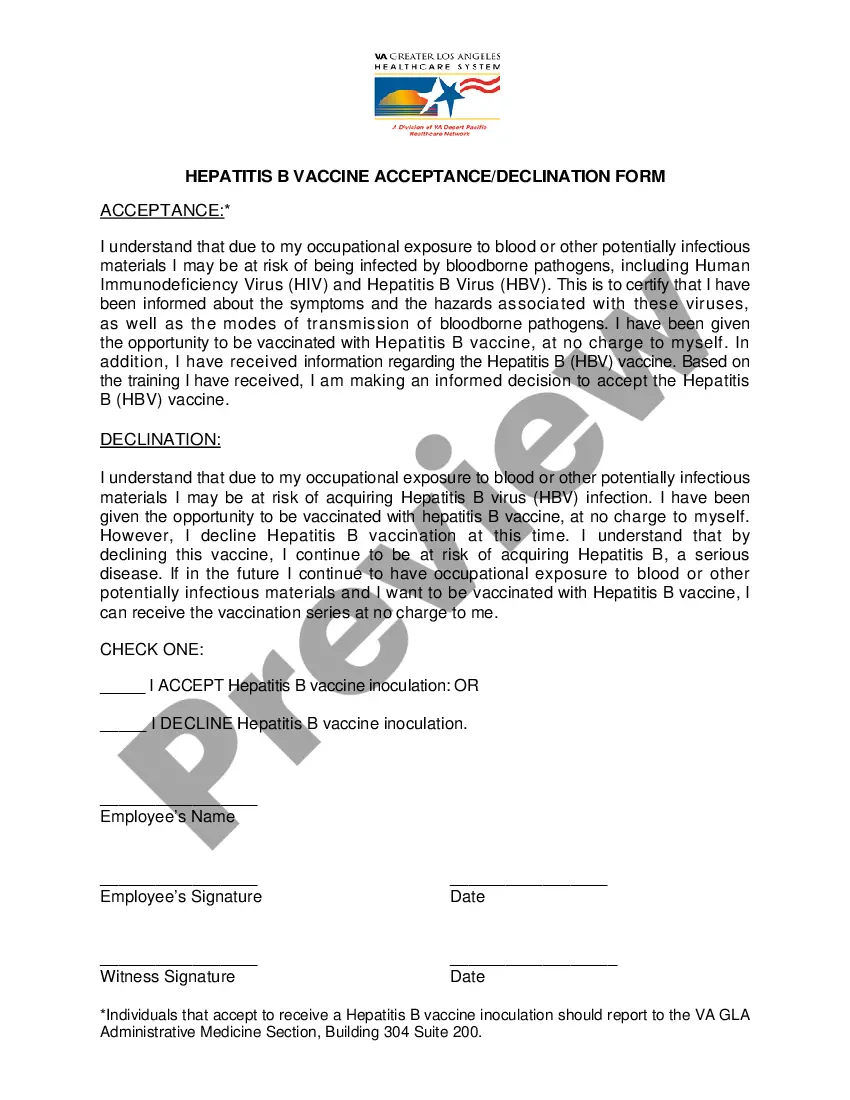
The Hepatitis B Vaccine Acceptance Declination Form is a legal document used by employees to acknowledge the risks of Hepatitis B exposure and their decision either to accept or decline the Hepatitis B vaccination provided by their employer. This form is essential in maintaining workplace safety and compliance with the Occupational Safety and Health Administration (OSHA) regulations regarding bloodborne pathogens.
Form components explained
- Employee acknowledgment of occupational exposure risks to bloodborne pathogens.
- Certification of informed decision regarding acceptance or declination of the Hepatitis B vaccine.
- Signature fields for the employee and a witness to validate the form.
- Information regarding the opportunity to receive the vaccine at no cost.
When to use this document
This form should be used when an employee is at risk for exposure to blood or other potentially infectious materials due to their occupation. It is typically utilized in healthcare settings, laboratories, and other environments where blood exposure may occur. Completing this form is necessary whether the employee chooses to receive the vaccination or decides to decline it, ensuring they understand the risks involved.
Intended users of this form
- Employees working in healthcare or related fields with potential occupational exposure to blood.
- Employers who need to document employee decisions regarding Hepatitis B vaccination.
- Healthcare providers or safety officers responsible for ensuring workplace health and safety compliance.
How to complete this form
- Read the information provided about the Hepatitis B virus and the vaccine.
- Decide whether to accept or decline the vaccination, and check the appropriate box.
- Write your name in the designated field.
- Sign and date the form to acknowledge your decision.
- Have a witness sign and date the form to validate the documentation.
Notarization guidance
This form does not typically require notarization unless specified by local law. The signatures of the employee and witness are sufficient to validate the document for workplace compliance.
Get your form ready online
Our built-in tools help you complete, sign, share, and store your documents in one place.
Make edits, fill in missing information, and update formatting in US Legal Forms—just like you would in MS Word.
Download a copy, print it, send it by email, or mail it via USPS—whatever works best for your next step.
Sign and collect signatures with our SignNow integration. Send to multiple recipients, set reminders, and more. Go Premium to unlock E-Sign.
If this form requires notarization, complete it online through a secure video call—no need to meet a notary in person or wait for an appointment.
We protect your documents and personal data by following strict security and privacy standards.

Make edits, fill in missing information, and update formatting in US Legal Forms—just like you would in MS Word.

Download a copy, print it, send it by email, or mail it via USPS—whatever works best for your next step.

Sign and collect signatures with our SignNow integration. Send to multiple recipients, set reminders, and more. Go Premium to unlock E-Sign.

If this form requires notarization, complete it online through a secure video call—no need to meet a notary in person or wait for an appointment.

We protect your documents and personal data by following strict security and privacy standards.
Mistakes to watch out for
- Not reading the information about the risks associated with Hepatitis B before signing.
- Failing to check the acceptance or declination box.
- Not providing the date of signature.
- Not having a witness sign the form, if required by employer policy.
Benefits of completing this form online
- Quick and easy access to the form without the need for paper printing.
- Ability to fill out the form at your convenience and save it for later.
- Reduced risk of losing the form, as digital copies can be stored securely.
Looking for another form?
Form popularity
FAQ
If you do not complete the series, you will not have adequate, longterm protection from hepatitis B.
Employers must ensure that workers who decline vaccination sign a declination form. The purpose of this is to encourage greater participation in the vaccination program by stating that a worker declin- ing the vaccination remains at risk of acquiring hepatitis B.
Hepatitis B vaccine should be administered by intramuscular injection. Injection into the buttock is associated with decreased immunogenicity (15--18).
3-Dose Vaccine Series for Children and Adults The vaccine is given at 0, 1 and 6 months. The third dose is needed for complete, long-term protection. If an alternative schedule is considered, ensure that a 4th booster dose is given at 1 year to provide maximum, long term protection.
Recommended doses of hepatitis B by vaccine type, age, formulation, dosage and schedule. The schedule for hepatitis B is flexible, but minimal intervals and minimum ages need to be observed: There should be at least 4 weeks between doses 1 and 2, and at least 8 weeks between doses 2 and 3.
Give a 3-dose series at 0, 1, and 6 mos. 1 dose Give dose #2 at least 4 wks after dose #1 to complete the series. Give dose #2 at least 4 wks after #1; then, give dose #3 at least 8 wks after dose #2 and at least 16 wks after dose #1. 2 doses Give dose #3 at least 8 wks after dose #2 and at least 16 wks after dose #1.
This vaccine is usually given by injection into a muscle (shoulder or thigh) by a health care professional. Injection under the skin may be used if you have a bleeding disorder.
It is important to get vaccinated to protect your health and prevent spreading the disease to others. The hepatitis A and hepatitis B vaccines can be given separately or as a combination vaccine. All the shots in the series are needed for long-term protection.
Hepatitis B vaccination is recommended for healthcare workers who may have direct contact with patients' blood or blood-stained body fluids.