Child Pornography Receiving, Possessing, Distributing (Computer or Digital Image that Appears Indistinguishable from Actual Minor but may not be of an Actual Person)
Overview of this form
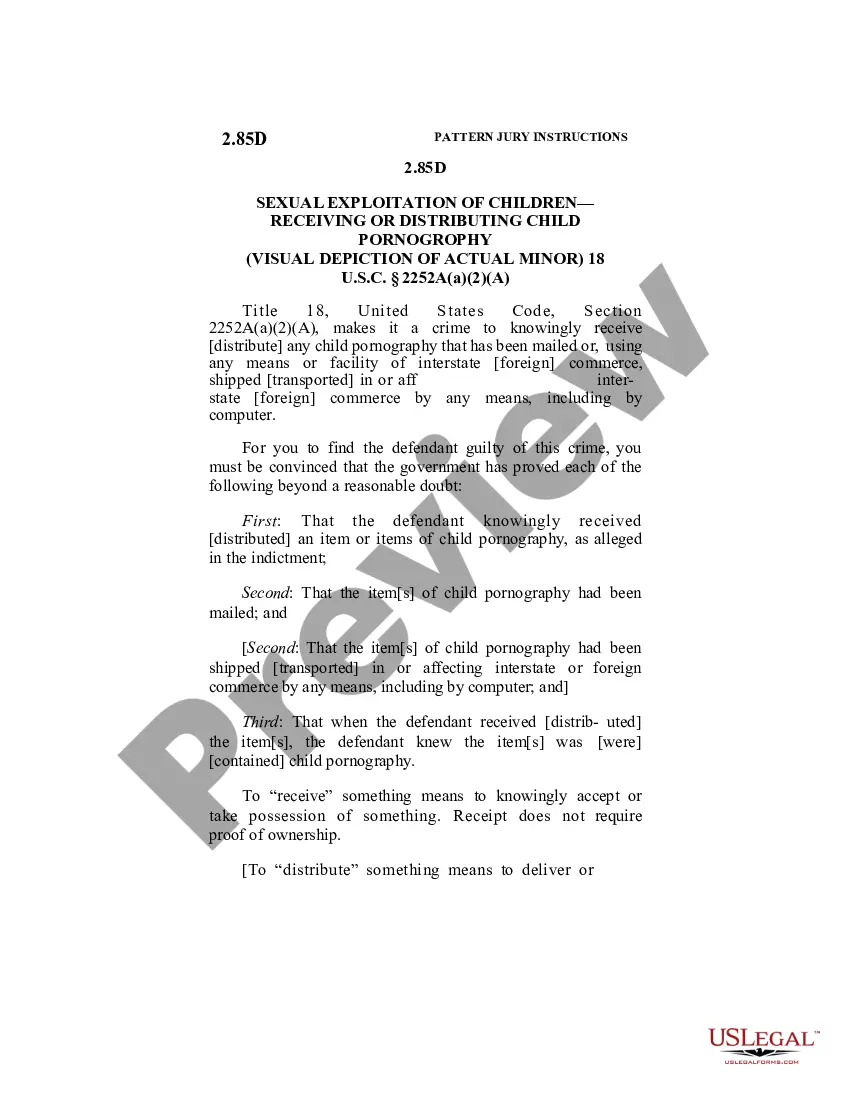
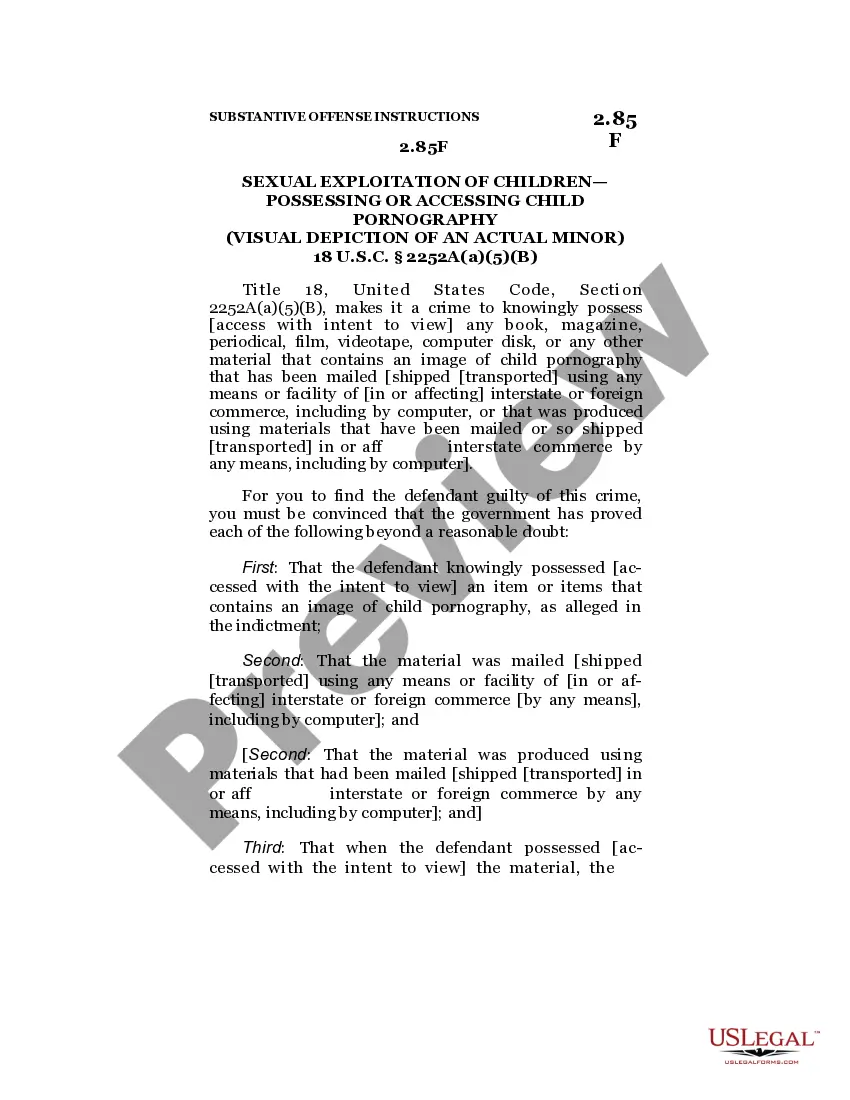
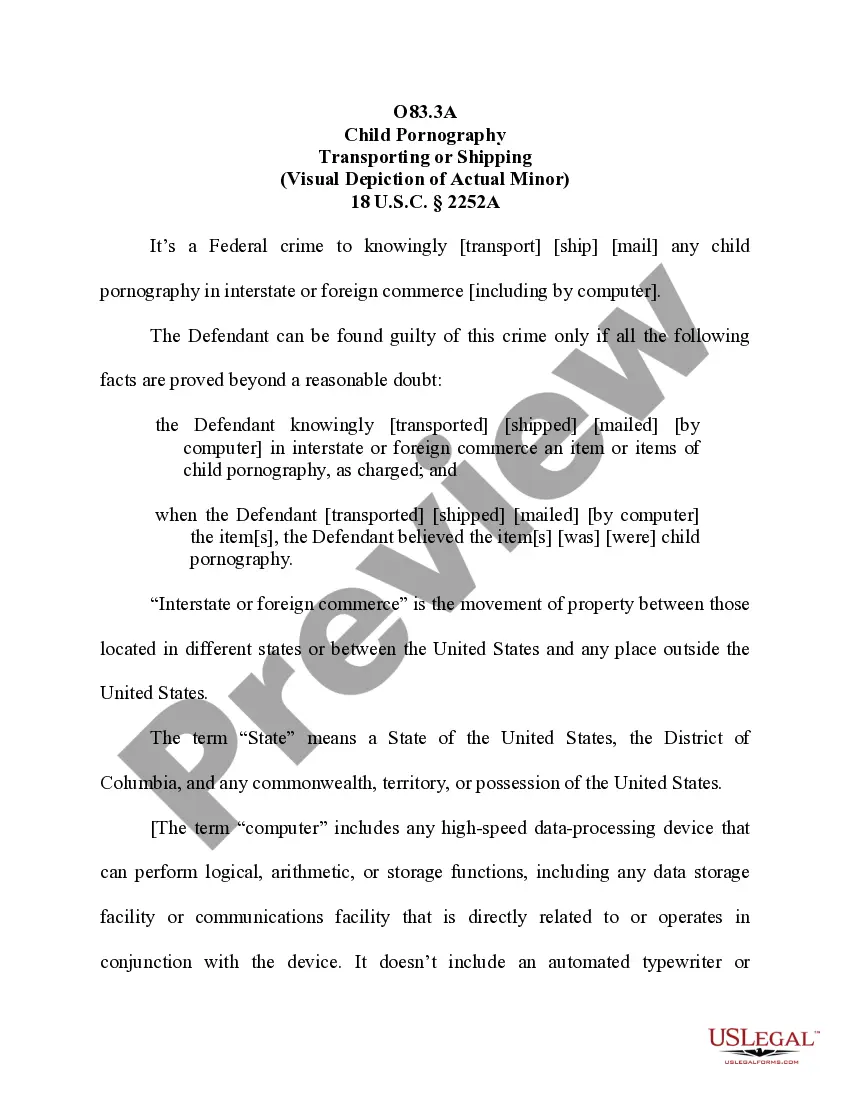
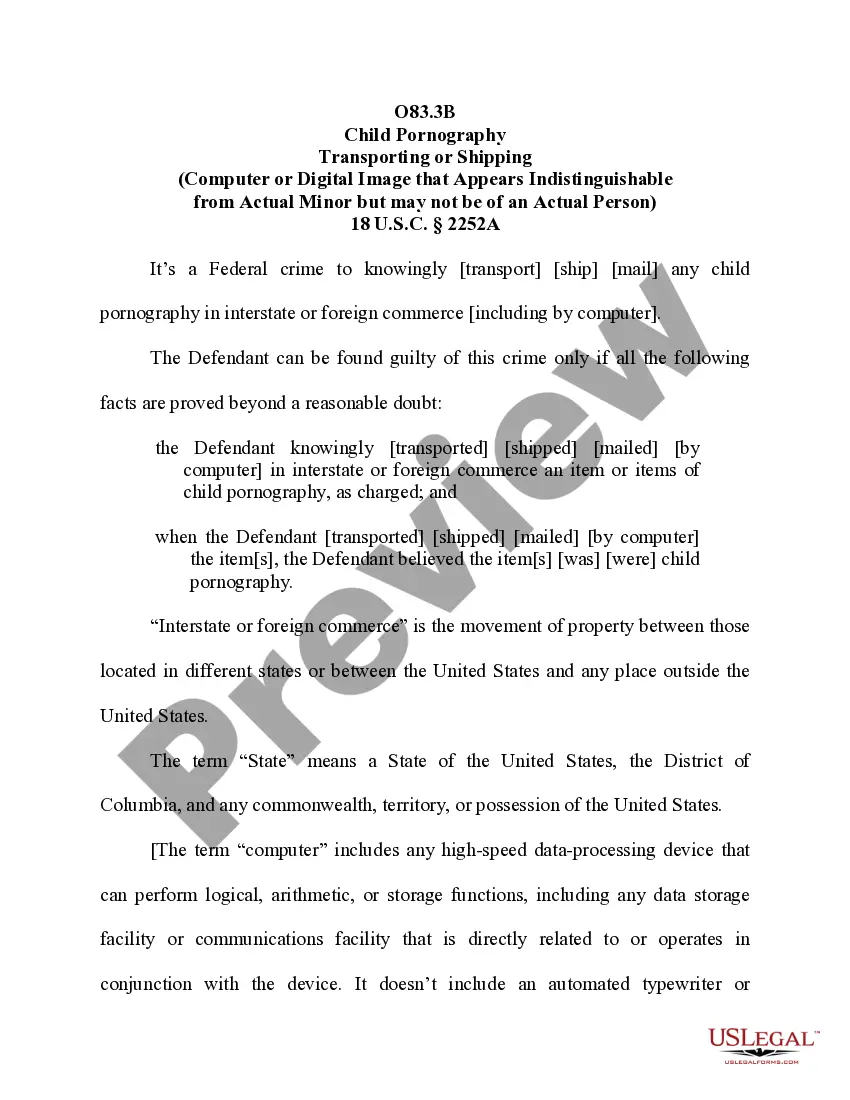
This form pertains to child pornography related offenses, specifically focusing on receiving, possessing, or distributing digital images that may resemble minors engaged in sexually explicit conduct. It distinguishes between actual minors and digital representations that are indistinguishable from those of actual minors. Understanding this legal framework is crucial for navigating charges related to these serious federal crimes.
What’s included in this form
- Definition of child pornography, including criteria for digital and computer-generated images.
- Explanation of what constitutes receiving, possessing, or distributing child pornography.
- Clarification of interstate or foreign commerce and how it applies to these offenses.
- Details regarding the legal definition of a minor and how identifiable minors are defined.
- Guidance on interpreting "indistinguishable" in the context of visual depictions.
When to use this document
This form is necessary if you are involved in a legal case regarding allegations of receiving, possessing, or distributing images of child pornography. It is used during federal trials to instruct a jury on the specific legal definitions and elements required to prove guilt beyond a reasonable doubt. Having this form can assist in understanding the legal context of the charges being faced.
Who should use this form
- Defendants accused of child pornography-related offenses.
- Legal representatives or attorneys handling such cases.
- Parties involved in federal criminal trials related to the possession or distribution of digital images that may involve minors.
Steps to complete this form
- Clearly identify the defendant involved in the case.
- Specify the exact charges pertaining to the receiving, possessing, or distributing of child pornography.
- Detail the circumstances under which the alleged illegal activity occurred.
- Gather necessary evidence or testimony to support the defense or prosecution based on the form's legal framework.
- Ensure all parts of the instruction align with the federal definitions provided in the form.
Notarization requirements for this form
This form does not typically require notarization to be legally valid. However, some jurisdictions or document types may still require it. US Legal Forms provides secure online notarization powered by Notarize, available 24/7 for added convenience.
Get your form ready online
Our built-in tools help you complete, sign, share, and store your documents in one place.
Make edits, fill in missing information, and update formatting in US Legal Forms—just like you would in MS Word.
Download a copy, print it, send it by email, or mail it via USPS—whatever works best for your next step.
Sign and collect signatures with our SignNow integration. Send to multiple recipients, set reminders, and more. Go Premium to unlock E-Sign.
If this form requires notarization, complete it online through a secure video call—no need to meet a notary in person or wait for an appointment.
We protect your documents and personal data by following strict security and privacy standards.
Make edits, fill in missing information, and update formatting in US Legal Forms—just like you would in MS Word.
Download a copy, print it, send it by email, or mail it via USPS—whatever works best for your next step.
Sign and collect signatures with our SignNow integration. Send to multiple recipients, set reminders, and more. Go Premium to unlock E-Sign.
If this form requires notarization, complete it online through a secure video call—no need to meet a notary in person or wait for an appointment.
We protect your documents and personal data by following strict security and privacy standards.
Mistakes to watch out for
- Failing to understand the distinction between actual minors and indistinguishable digital representations.
- Neglecting to provide sufficient evidence to support the legal definitions outlined in the form.
- Assuming state laws will supersede federal definitions without consulting legal counsel.
- Misinterpreting the requirements for proving possession or distribution in federal court.
Legal use & context
- This form is essential for outlining legal guidelines in federal trials concerning child pornography.
- It is used to ensure jurors understand the legal standards required to reach a verdict.
- Understanding this form is critical for effective defense planning and conviction prevention in relevant cases.
Main things to remember
- The form addresses serious federal crimes related to child pornography.
- It provides a legal framework necessary for jury instruction in criminal cases.
- Users must be clear on definitions and elements to effectively utilize this form.
- Consultation with legal professionals is recommended for specific guidance.
Looking for another form?




Form popularity
FAQ
§ 2252A is identical to 18 U.S.C § 2252, with two exceptions. First, section 2252A expands the definition of the prohibited material by using the more inclusive term "child ography" instead of the words "visual depiction of a minor engaging in sexually explicit conduct" that is utilized in § 2252.
Any violation of federal child ography law is a serious crime, and convicted offenders face severe statutory penalties. For example, a first time offender convicted of producing child ography under 18 U.S.C. § 2251, face fines and a statutory minimum of 15 years to 30 years maximum in prison.
A child can be charged if they ?knowingly distribute, offer, send or provide to a minor any visual depiction, including any photograph, film, video, picture or computer-generated image? showing ?a minor engaging in sexually explicit conduct.?
Did you know there is a difference between viewing and possessing child in Texas? Generally speaking, possessing child ography is always illegal, whereas simply viewing it is not necessarily illegal.
'Possession' is defined as the physical or digital possession of an indecent image which is prohibited by law. 'Making' or 'viewing' of indecent images refers to the viewing of an image which in turn results in the image being downloaded to the device.