Child Pornography Transporting or Shipping (Visual Depiction of Actual Minor)
Overview of this form
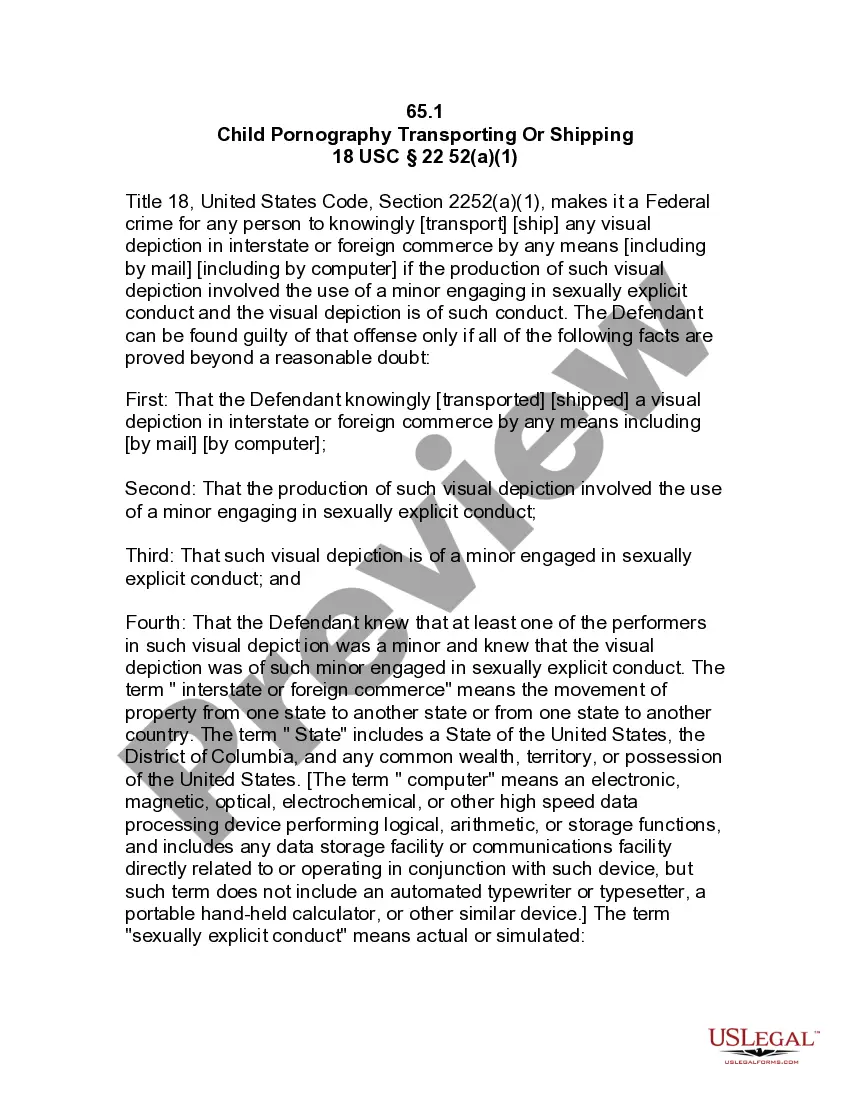
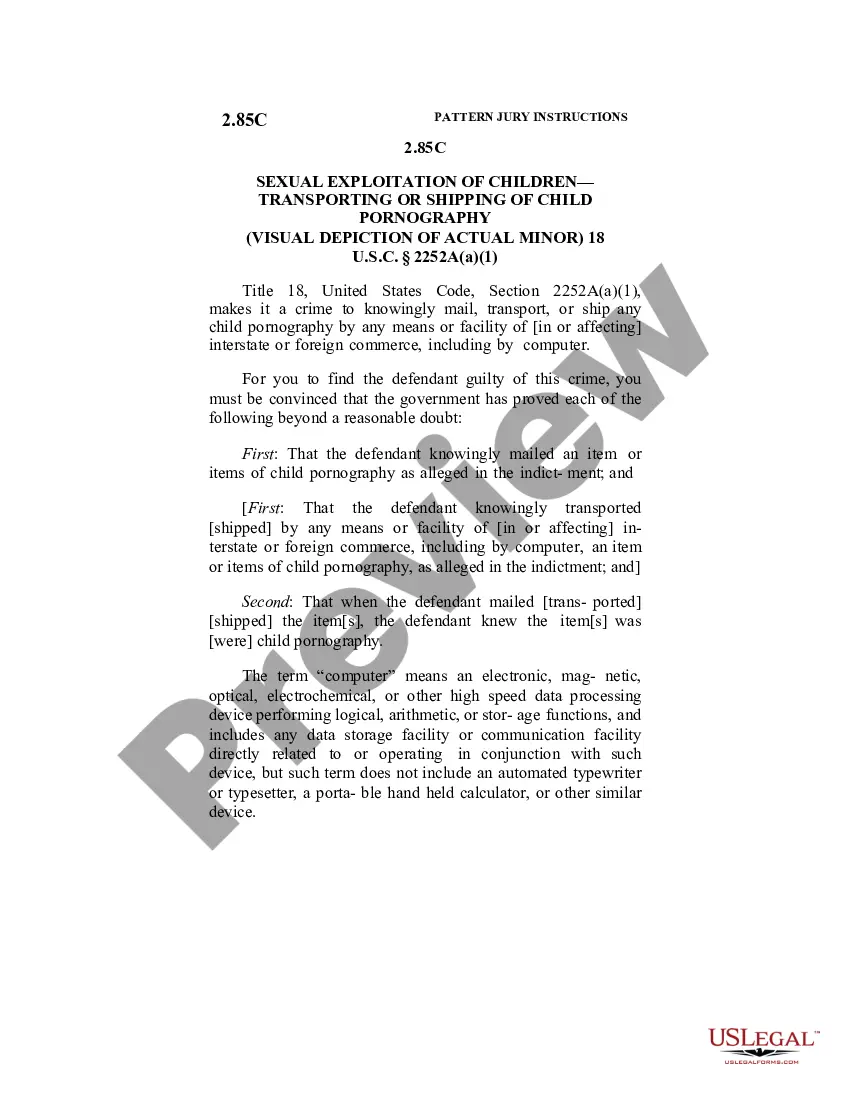
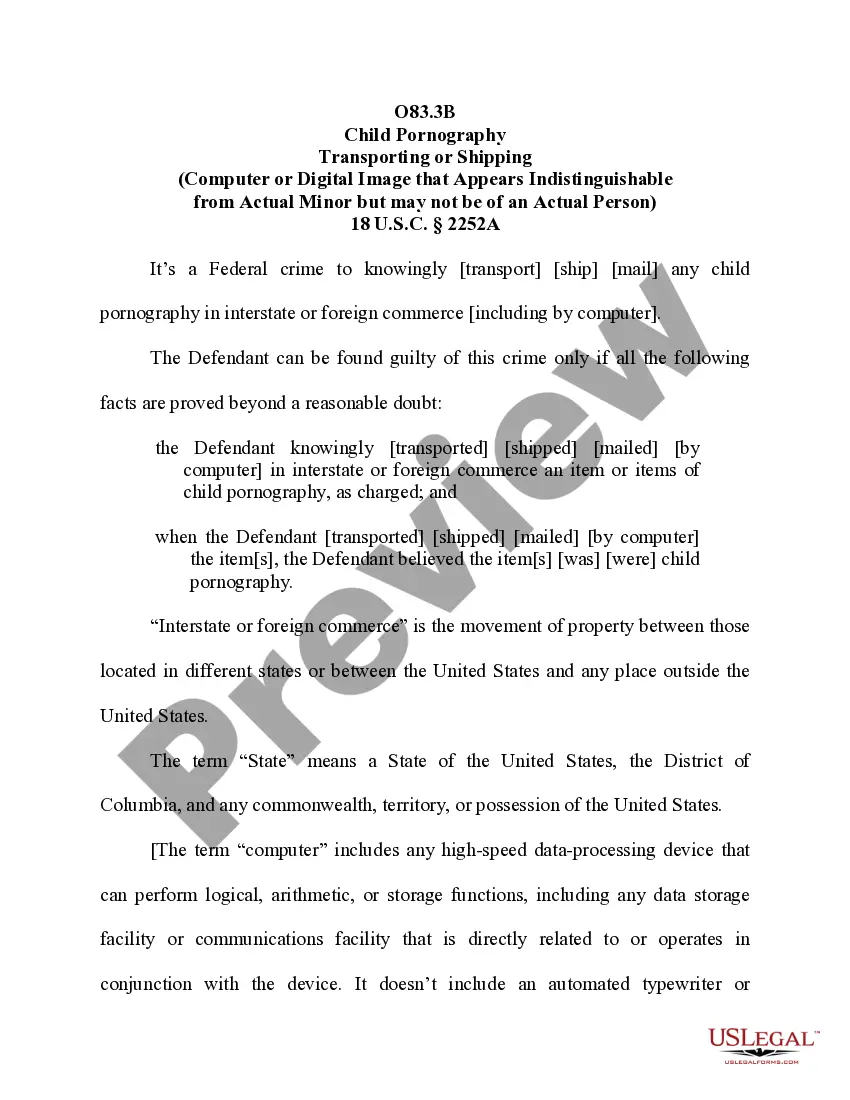
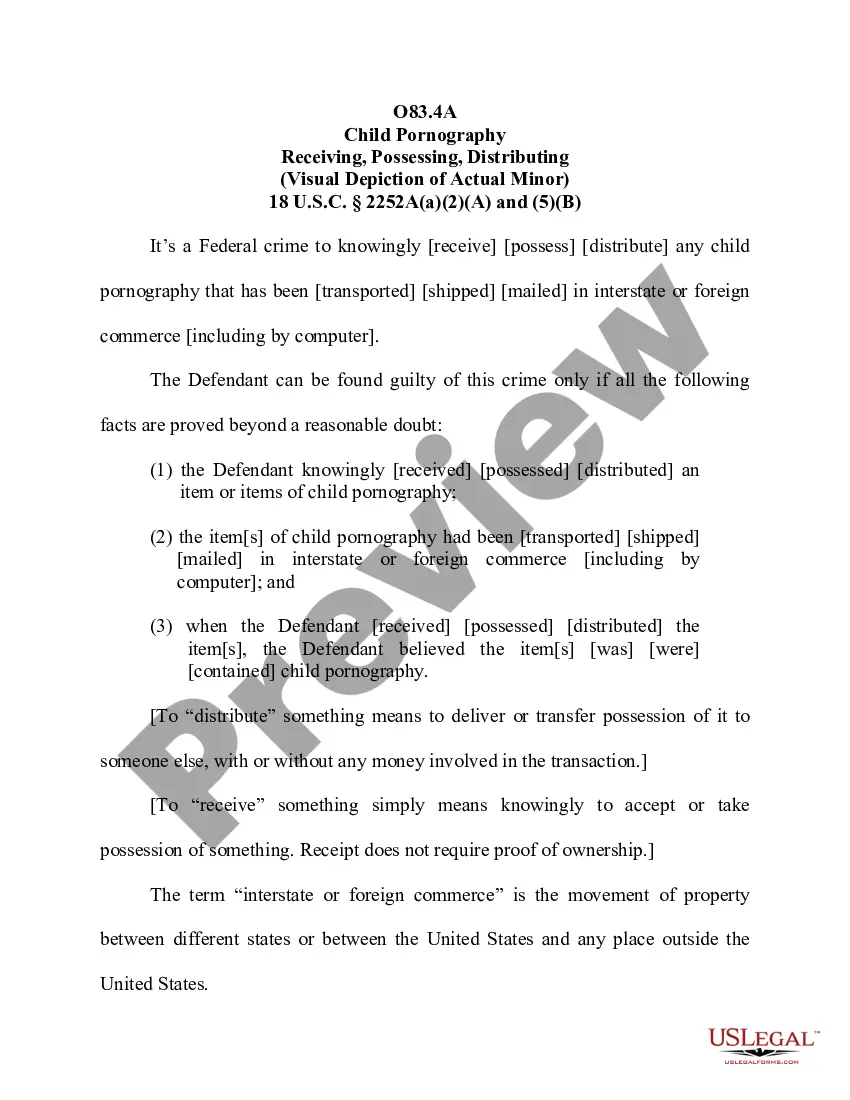
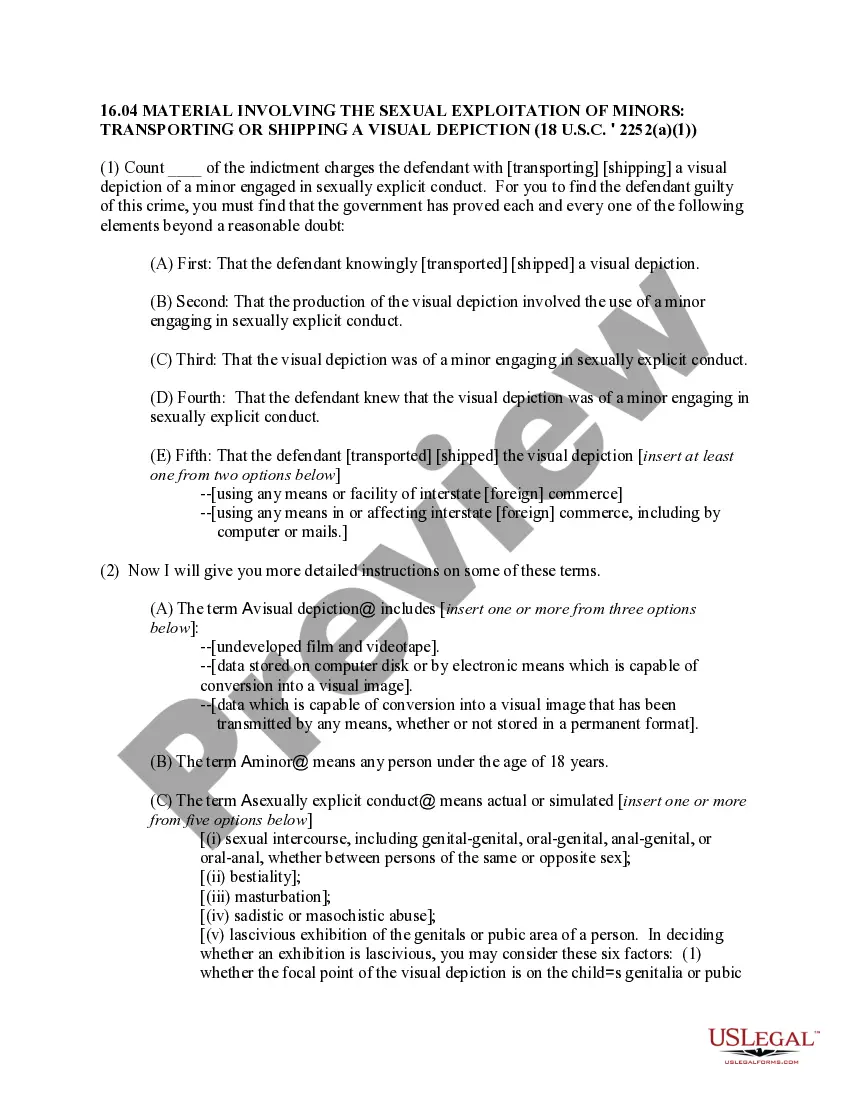
The Child Pornography Transporting or Shipping form is a legal document used in federal legal proceedings, specifically concerning the illegal transport or shipment of child pornography. This form outlines federal laws under 18 U.S.C. § 2252A related to the transport of visual depictions of actual minors engaging in sexually explicit conduct. Unlike state-specific forms, this federal document addresses serious crimes that carry severe penalties, emphasizing the federal government's commitment to combating child exploitation.
Form components explained
- Definition of child pornography, including various forms of visual depictions.
- Criteria for proving the guilt of the defendant, including knowledge and intent.
- Clarification of terms such as "interstate or foreign commerce" and "identifiable minor".
- Description of sexually explicit conduct and what constitutes a lascivious exhibition.
- Key legal instructions pertinent to jury deliberations in related cases.
Situations where this form applies
This form should be used in federal legal cases where an individual is accused of transporting or shipping child pornography. It is relevant in scenarios involving interstate or international transport of materials that feature minors in sexually explicit situations. Legal representatives may utilize this form when preparing for court, ensuring that jurors receive accurate and legally grounded instructions to guide their decisions.
Who this form is for
This form is intended for:
- Legal professionals involved in federal criminal defense cases.
- Prosecutors handling cases of child pornography transport.
- Judges presiding over related cases in federal court.
- Jurors who need clear legal parameters for understanding the charges.
Steps to complete this form
To use this form effectively:
- Understand the federal statutes outlined for convicting a defendant.
- Ensure clarity on what constitutes child pornography and legally relevant terms.
- Review the comprehensive instructions to guide the jury through the legal definitions.
- Prepare to address any questions that arise related to definitions and legal standards.
Is notarization required?
This form does not typically require notarization unless specified by local law. Ensure compliance with all legal formalities in your jurisdiction for validity.
Get your form ready online
Our built-in tools help you complete, sign, share, and store your documents in one place.
Make edits, fill in missing information, and update formatting in US Legal Forms—just like you would in MS Word.
Download a copy, print it, send it by email, or mail it via USPS—whatever works best for your next step.
Sign and collect signatures with our SignNow integration. Send to multiple recipients, set reminders, and more. Go Premium to unlock E-Sign.
If this form requires notarization, complete it online through a secure video call—no need to meet a notary in person or wait for an appointment.
We protect your documents and personal data by following strict security and privacy standards.

Make edits, fill in missing information, and update formatting in US Legal Forms—just like you would in MS Word.

Download a copy, print it, send it by email, or mail it via USPS—whatever works best for your next step.

Sign and collect signatures with our SignNow integration. Send to multiple recipients, set reminders, and more. Go Premium to unlock E-Sign.

If this form requires notarization, complete it online through a secure video call—no need to meet a notary in person or wait for an appointment.

We protect your documents and personal data by following strict security and privacy standards.
Mistakes to watch out for
- Failing to understand the distinction between state and federal laws regarding child pornography.
- Overlooking the specific requirements for proving intent and knowledge of the defendant.
- Improperly defining terms such as âchild pornographyâ and âidentifiable minorâ in jury instructions.
Benefits of using this form online
- Convenience of having a ready-to-use legal template drafted by licensed attorneys.
- Editability allows customization to suit specific case needs when necessary.
- Reliability ensured by using a form that reflects current legal standards and practices.
- The form is essential for creating legally sound jury instructions in federal cases involving serious criminal charges.
- It stresses the importance of accuracy in defining aspects surrounding child pornography laws.
- This document can help mitigate errors in jury understanding, leading to fairer trials.
Quick recap
- The Child Pornography Transporting or Shipping form is crucial for federal legal proceedings involving child exploitation.
- Understanding the legal definitions and components of child pornography is vital for proper case proceedings.
- This form aids legal professionals in ensuring accurate jury instructions, impacting the overall trial outcome.
Looking for another form?
Form popularity
FAQ
The requirements in section 2252(a)(1)(A), (2)(A), (3)(B)(i), and (4)(B)(i) that the production of a visual depiction involve the use of a minor engaging in 'sexually explicit conduct' of the kind described in section 2256(2)(E) are satisfied if a person photographs a minor in such a way as to exhibit the child in a
"(ii) Effect . -Nothing in subparagraph (A)(vi) authorizes a law enforcement agency to provide child ography images to an electronic communications service provider or a remote computing service."
Did you know there is a difference between viewing and possessing child in Texas? Generally speaking, possessing child ography is always illegal, whereas simply viewing it is not necessarily illegal.
§ 2252A is identical to 18 U.S.C § 2252, with two exceptions. First, section 2252A expands the definition of the prohibited material by using the more inclusive term "child ography" instead of the words "visual depiction of a minor engaging in sexually explicit conduct" that is utilized in § 2252.
Under section 2252A, it is also unlawful to knowingly distribute, offer, or send to a minor any visual depiction of a minor engaging in sexually explicit conduct, or to send a minor visual materials that appear to be a minor engaging in sexually explicit conduct, using mail or interstate commerce.
Section 2252 of Title 18, United States Code sets forth four offenses. Subsection (a)(1) prohibits anyone from knowingly transporting in interstate or foreign commerce or mailing any visual depiction involving the use of a minor engaging in sexually explicit conduct.
Whoever, in the course of an offense under this section, engages in conduct that results in the death of a person, shall be punished by death or imprisoned for not less than 30 years or for life.