New York Living Trust Property Record
Understanding this form
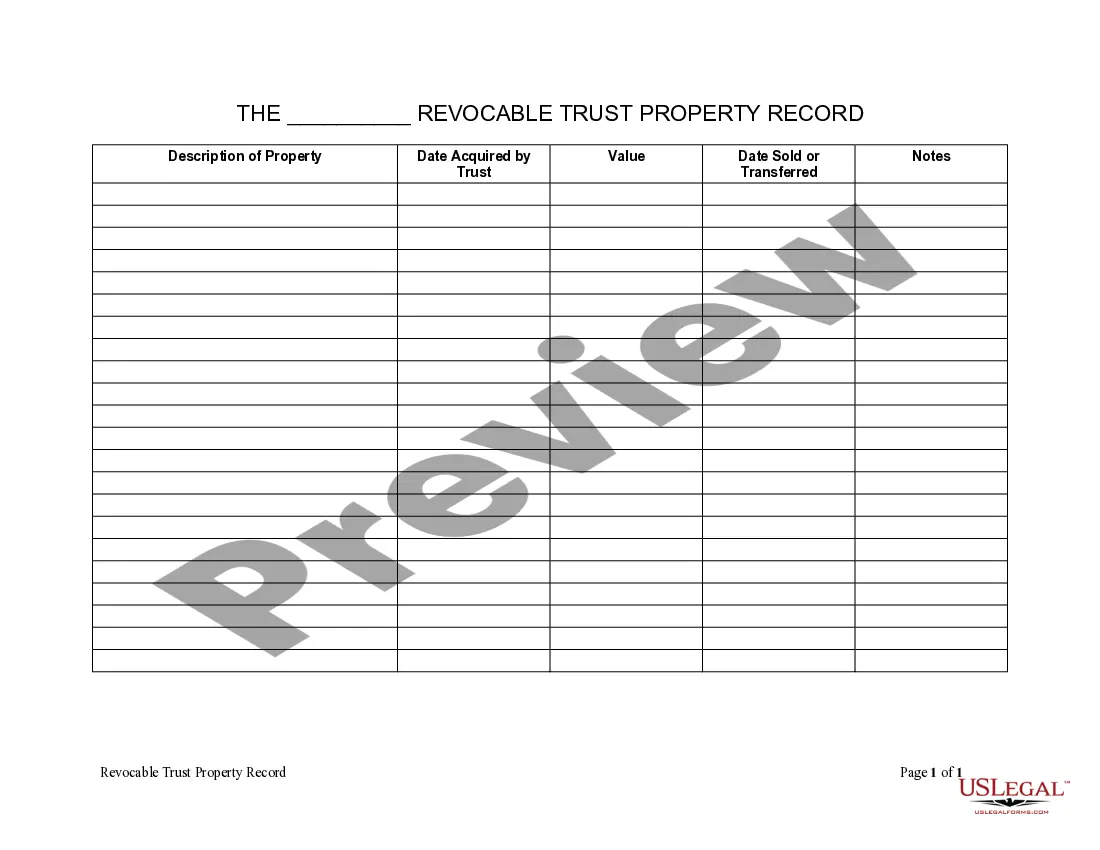
The Living Trust Property Record is a vital document used to maintain an inventory of all property held within a living trust. This form is essential for Trustees as it allows them to record details such as the description of property, date acquired by the trust, value, and date sold or transferred. This ensures that all assets, whether real, personal, or intellectual, are properly accounted for and managed during the grantor's lifetime and after their passing. Unlike other estate planning documents, this form focuses specifically on tracking property assets within the trust framework.
Key parts of this document
- Description of Property: A detailed account of each asset included in the trust.
- Date Acquired by Trust: When the asset was transferred into the trust.
- Value: The current worth of the asset at the time it is recorded.
- Date Sold or Transferred: Record of any sale or transfer involving the asset.
- Asset Type: Specifies whether the property is real, personal, or intellectual.

Situations where this form applies
This form is useful when setting up a living trust to ensure accurate tracking of all assets included. It is particularly beneficial when managing estates with multiple properties or valuable items, as well as for those who wish to maintain clear records for the benefit of beneficiaries. Use this form to update the property inventory whenever there are changes, such as new acquisitions or transfers of property out of the trust.
Who can use this document
- Trustees managing a living trust.
- Individuals who have established a living trust and need to organized their assets.
- Estate planners assisting their clients in documenting trust property.
- Beneficiaries involved in understanding the assets within a trust.
How to complete this form
- Identify the properties to be included in the trust inventory.
- Provide a detailed description of each property.
- Add the date when each asset was acquired by the trust.
- Document the current value of each asset.
- Include any dates pertaining to the sale or transfer of these assets.
Does this form need to be notarized?
Notarization is not commonly needed for this form. However, certain documents or local rules may make it necessary. Our notarization service, powered by Notarize, allows you to finalize it securely online anytime, day or night.
Get your form ready online
Our built-in tools help you complete, sign, share, and store your documents in one place.
Make edits, fill in missing information, and update formatting in US Legal Forms—just like you would in MS Word.
Download a copy, print it, send it by email, or mail it via USPS—whatever works best for your next step.
Sign and collect signatures with our SignNow integration. Send to multiple recipients, set reminders, and more. Go Premium to unlock E-Sign.
If this form requires notarization, complete it online through a secure video call—no need to meet a notary in person or wait for an appointment.
We protect your documents and personal data by following strict security and privacy standards.

Make edits, fill in missing information, and update formatting in US Legal Forms—just like you would in MS Word.

Download a copy, print it, send it by email, or mail it via USPS—whatever works best for your next step.

Sign and collect signatures with our SignNow integration. Send to multiple recipients, set reminders, and more. Go Premium to unlock E-Sign.

If this form requires notarization, complete it online through a secure video call—no need to meet a notary in person or wait for an appointment.

We protect your documents and personal data by following strict security and privacy standards.
Common mistakes
- Failing to update the inventory after property transactions.
- Not accurately documenting the value of assets, leading to discrepancies.
- Incomplete property descriptions, which may cause confusion later.
Why complete this form online
- Convenient access to the form anytime, from anywhere.
- Easily editable templates to meet your specific needs.
- Reliable resources prepared by licensed attorneys.
Legal use & context
- This form is important for the lawful management of trust assets.
- It helps prevent disputes by providing clear records of trust property.
- Using this form can enhance transparency with trust beneficiaries.
Quick recap
- The Living Trust Property Record is essential for managing estate assets.
- Proper documentation prevents future disputes and simplifies estate administration.
- This form is user-friendly and designed for non-professionals to use.
Looking for another form?
Form popularity
FAQ
What happens if you have lost your Trust?If a Trust is lost, and the decedent has assets titled in the name of the Trust, the court will require that the heirs/Successor Trustees spend a significant amount of time and money searching for the Trust and documenting the search process.
Legally your Trust now owns all of your assets, but you manage all of the assets as the Trustee. This is the essential step that allows you to avoid Probate Court because there is nothing for the courts to control when you die or become incapacitated.
Funding a Trust Is Expensive... This is the major drawback to using a revocable living trust for many people, but it's not worth the time, money, and effort to create one if the trust isn't fully funded.
Today clients who have living trusts normally keep the original copy. Having the attorney keep the original copy of the trust is not as important as keeping the original will used to be. At death, a copy of the trust generally suffices for all parties in place of the original.
If you can't find original living trust documents, you can contact the California Bar Association for assistance. Trusts aren't recorded anywhere, so you can't go to the County Recorder's office in the courthouse to ask to see a copy of the trust.
Paperwork. Setting up a living trust isn't difficult or expensive, but it requires some paperwork. Record Keeping. After a revocable living trust is created, little day-to-day record keeping is required. Transfer Taxes. Difficulty Refinancing Trust Property. No Cutoff of Creditors' Claims.
Trusts aren't public record, so they're not usually recorded anywhere. Instead, the trust attorney determines who is entitled to receive a copy of the document, even if state law doesn't require it.
Trusts created during your lifetime, known as living trusts, do not go into the public record after you die. With rare exceptions, trusts remain private regardless of whether you have an irrevocable or revocable trust at the time of your death.
If you can't find original living trust documents, you can contact the California Bar Association for assistance. Trusts aren't recorded anywhere, so you can't go to the County Recorder's office in the courthouse to ask to see a copy of the trust.