New York Warranty Deed from Individual to Husband and Wife
Understanding this form
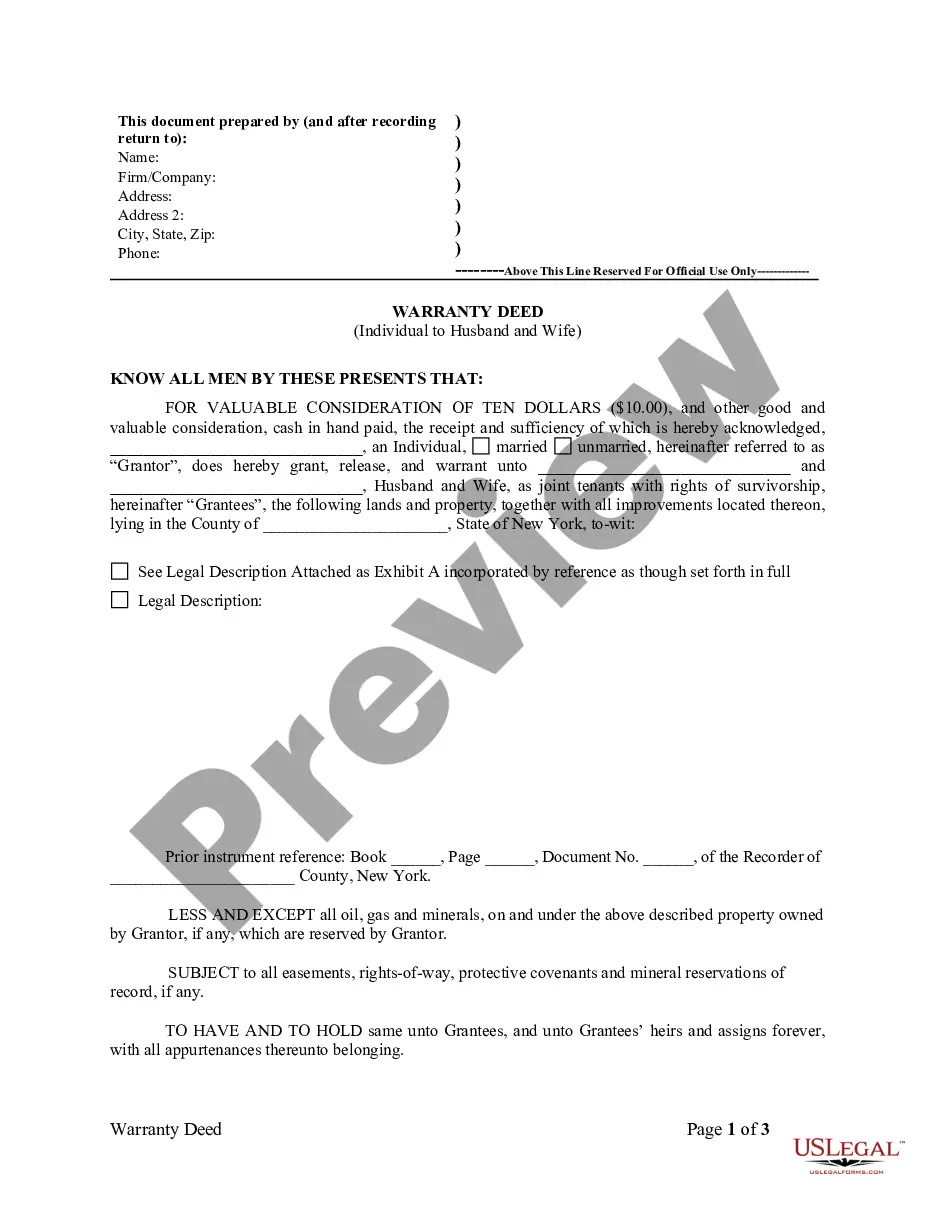
The Warranty Deed from Individual to Husband and Wife is a legal document used to transfer property ownership from an individual (the Grantor) to a couple (the Grantees). This deed ensures that the property is free from any legal encumbrances, unless noted otherwise, and establishes the Grantees' title as joint tenants with right of survivorship. This form is distinct from other deed types as it specifically addresses the transfer of property to a married couple and includes protections for both parties.
What’s included in this form
- Identification of the Grantor and Grantees, including their legal names.
- Description of the property being conveyed, along with any reservations.
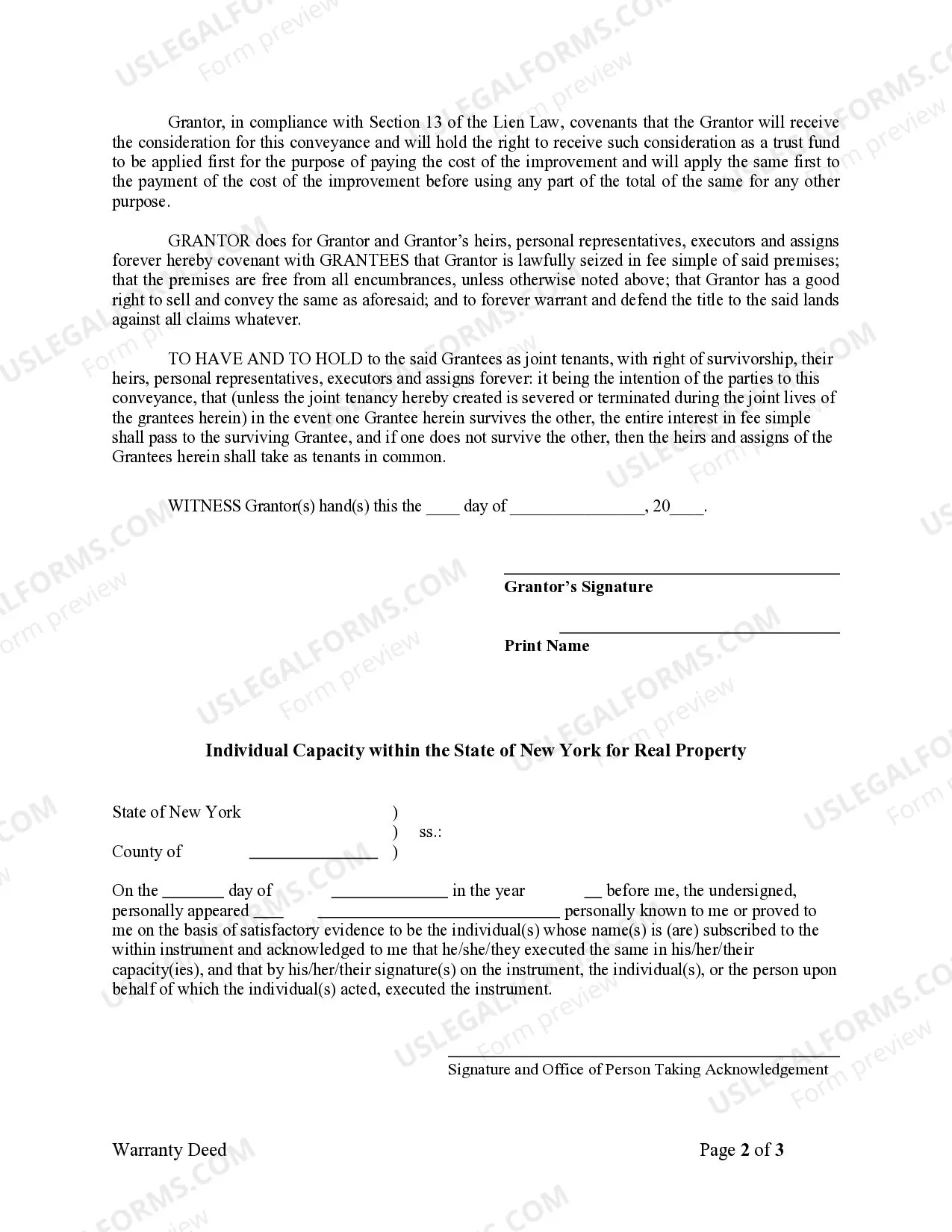
- Clauses detailing the Grantor's warranty of title and the lack of encumbrances.
- Joint tenancy provision, explaining survivorship rights between Grantees.
- Signatures of the Grantor and witnesses for verification of execution.






When to use this form
This form is typically used when an individual wishes to transfer property to a married couple, ensuring they hold the title jointly. It is suitable for situations such as gift transfers between family members, property additions to marital assets, or estate planning where property needs to be passed to a spouse. Utilizing this deed can help clarify ownership and rights, preventing future disputes.
Who should use this form
- Property owners looking to transfer ownership to their spouse and themselves.
- Individuals who are granting property to a married couple as a gift.
- Heirs or executors dealing with estate planning issues in relation to joint ownership.
- Individuals seeking to clarify ownership rights for joint property holdings.
Instructions for completing this form
- Identify the parties by entering the full legal names of the Grantor and Grantees.
- Specify the property's legal description, typically found in the property deed or title.
- Include any reservations or exceptions related to oil, gas, and minerals if applicable.
- Ensure all relevant signatures are collected, including those of witnesses if required by state law.
- Complete the date of execution to finalize the document.
Notarization requirements for this form
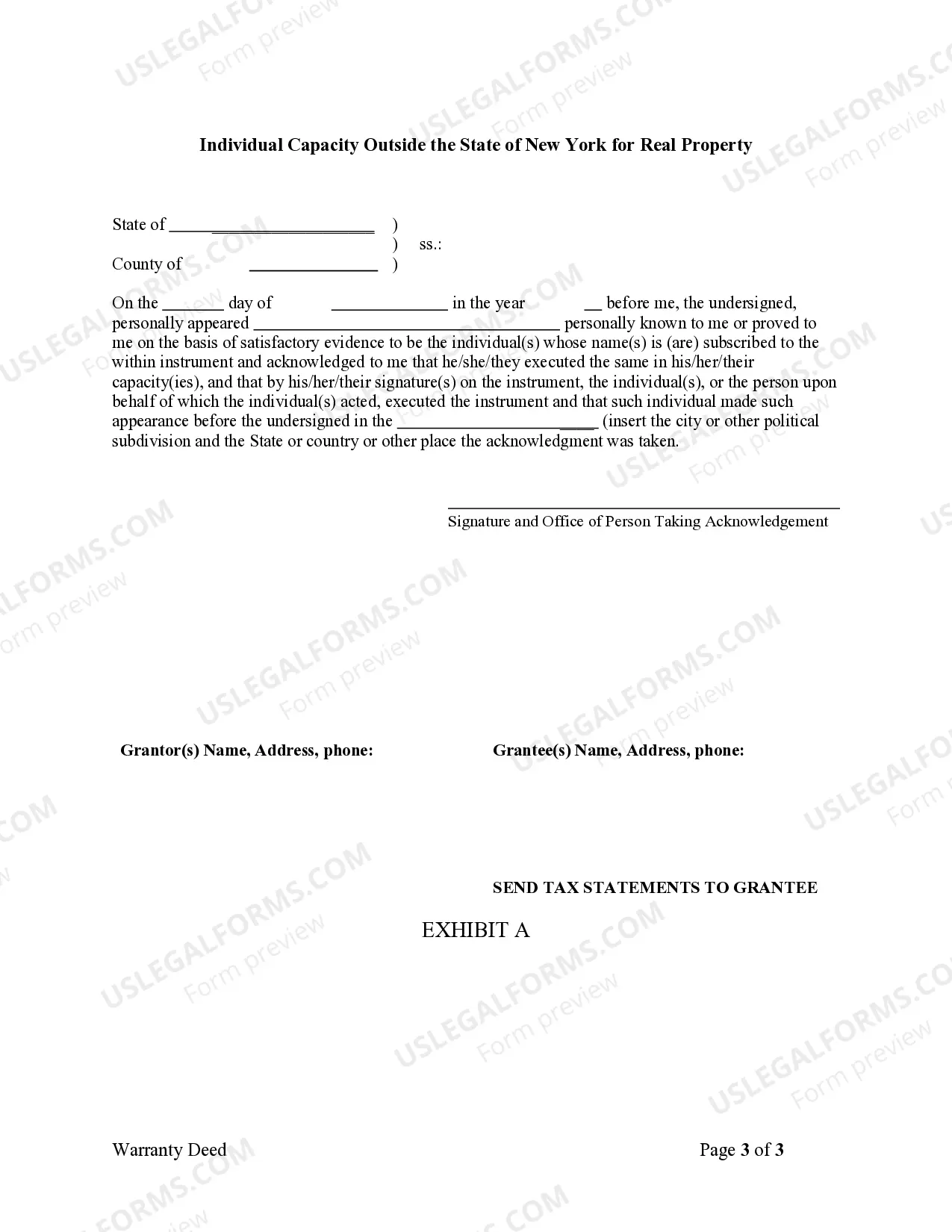
This form must be notarized to be legally valid. US Legal Forms provides secure online notarization powered by Notarize, allowing you to complete the process through a verified video call.
Get your form ready online
Our built-in tools help you complete, sign, share, and store your documents in one place.
Make edits, fill in missing information, and update formatting in US Legal Forms—just like you would in MS Word.
Download a copy, print it, send it by email, or mail it via USPS—whatever works best for your next step.
Sign and collect signatures with our SignNow integration. Send to multiple recipients, set reminders, and more. Go Premium to unlock E-Sign.
If this form requires notarization, complete it online through a secure video call—no need to meet a notary in person or wait for an appointment.
We protect your documents and personal data by following strict security and privacy standards.

Make edits, fill in missing information, and update formatting in US Legal Forms—just like you would in MS Word.

Download a copy, print it, send it by email, or mail it via USPS—whatever works best for your next step.

Sign and collect signatures with our SignNow integration. Send to multiple recipients, set reminders, and more. Go Premium to unlock E-Sign.

If this form requires notarization, complete it online through a secure video call—no need to meet a notary in person or wait for an appointment.

We protect your documents and personal data by following strict security and privacy standards.
Avoid these common issues
- Failing to provide a complete legal description of the property.
- Not naming the Grantees correctly, including spelling errors.
- Omitting signatures from all necessary parties.
- Not checking state-specific requirements for additional clauses or notarization.
Benefits of completing this form online
- Convenience of accessing and downloading forms from anywhere, anytime.
- Editability allows users to easily customize the form to their needs.
- Reliability in using attorney-drafted forms that comply with legal standards.
Quick recap
- The Warranty Deed from Individual to Husband and Wife is a specialized form for transferring property to a married couple.
- It ensures joint tenancy and sets out the rights of survivorship between the Grantees.
- Completing this form correctly helps prevent legal issues concerning property ownership in the future.
Looking for another form?
Form popularity
FAQ
You may be able to transfer your interest in the property through a quitclaim deed, where you relinquish all ownership of the property to someone else. Your lender may also agree to add another name to the mortgage. In this case, someone else would be able to legally make payments on the mortgage.
You would simply prepare a deed to you and your fiance. You would then have to prepare and execute the other necessary forms take them to the clerks office and file them. I suggest that you consult with a local attorney. They can do this at a modest cost.
Title the deed and list the amount given for the transfer. If it is a quitclaim deed, title the deed Quitclaim Deed; for warranty deeds, title the deed Warranty Deed. Write In consideration of dollar amount to list the amount given for the transfer. List the names of the parties involved.
Identify the donee or recipient. Discuss terms and conditions with that person. Complete a change of ownership form. Change the title on the deed. Hire a real estate attorney to prepare the deed. Notarize and file the deed.
Two of the most common ways to transfer property in a divorce are through an interspousal transfer deed or quitclaim deed. When spouses own property together, but then one spouse executes an interspousal transfer or a quitclaim deed, this is known as transmutation.
In states like California and Florida, the spouses may use a quitclaim deed to transfer the property without warranting title. Other stateslike Texasrecognize a similar type of deed called a deed without warranty.
You can gift property to spouse, child or any relative and register the same. Under section 122 of the Transfer of Property Act, 1882, you can transfer immovable property through a gift deed. The deed should contain your details as well as those of the recipient.
Fill in the deed form. Print it out. Have the grantor(s) sign and get the signature(s) notarized. Complete a transfer tax form, Form TP-584. Complete and print out Form RP-5217 (or, if you are in New York City, Form RP-5217NYC).
If you've recently married and already own a home or other real estate, you may want to add your new spouse to the deed for your property so the two of you own it jointly. To add a spouse to a deed, all you have to do is literally fill out, sign and record a new deed in your county recorder's office.