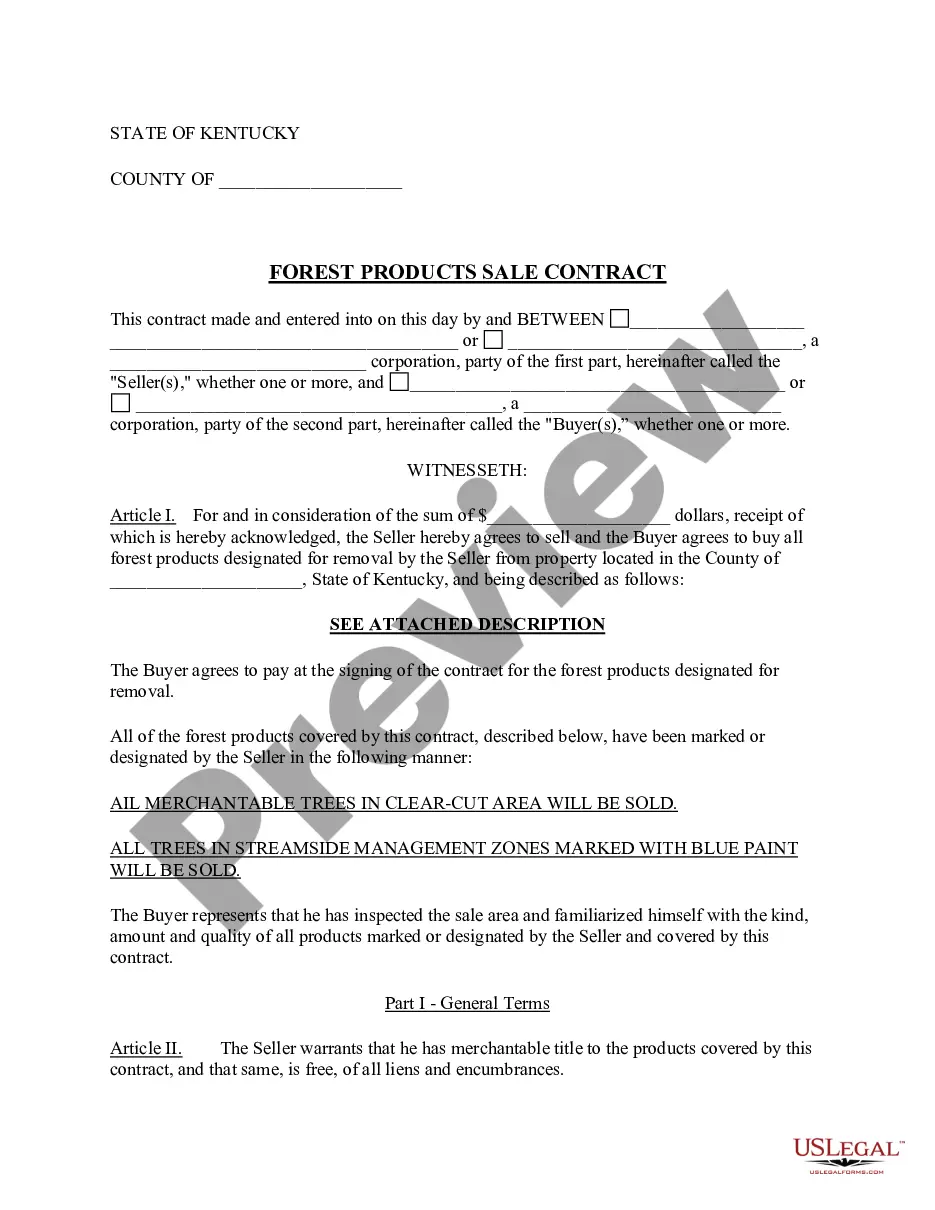
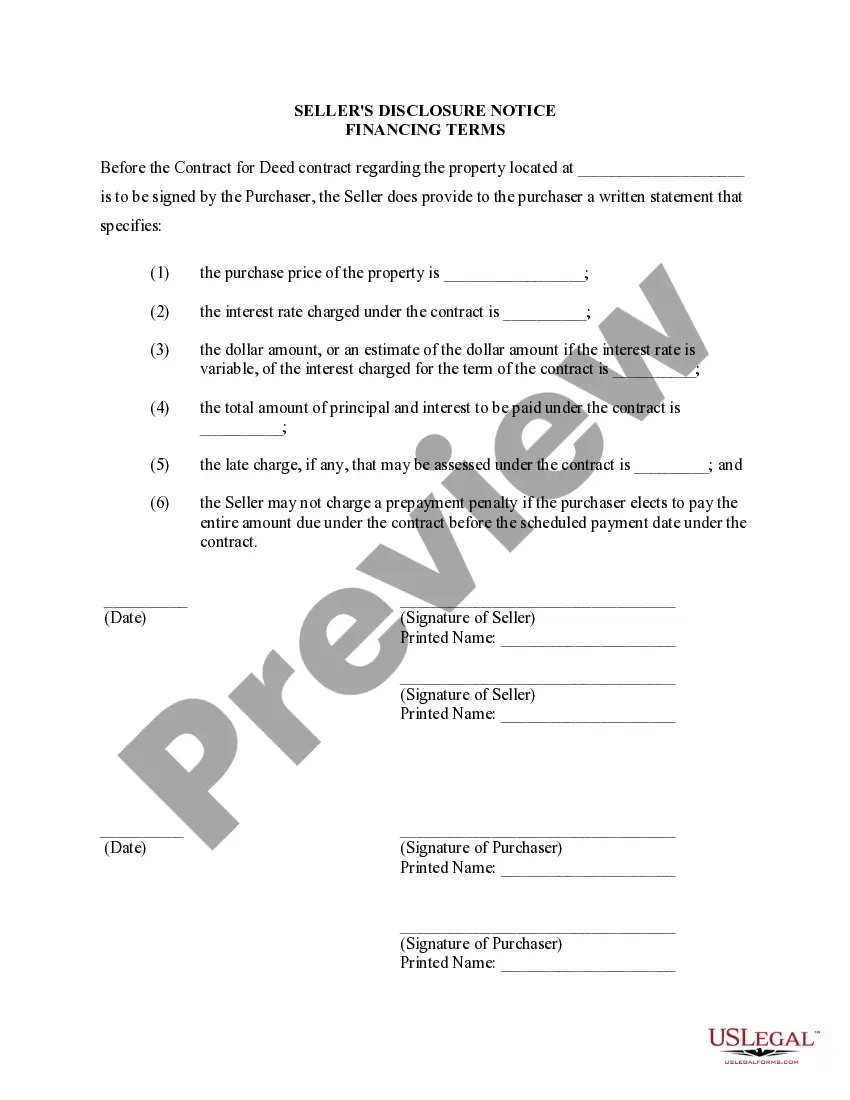
North Carolina Seller's Disclosure of Financing Terms for Residential Property in connection with Contract or Agreement for Deed a/k/a Land Contract
Overview of this form
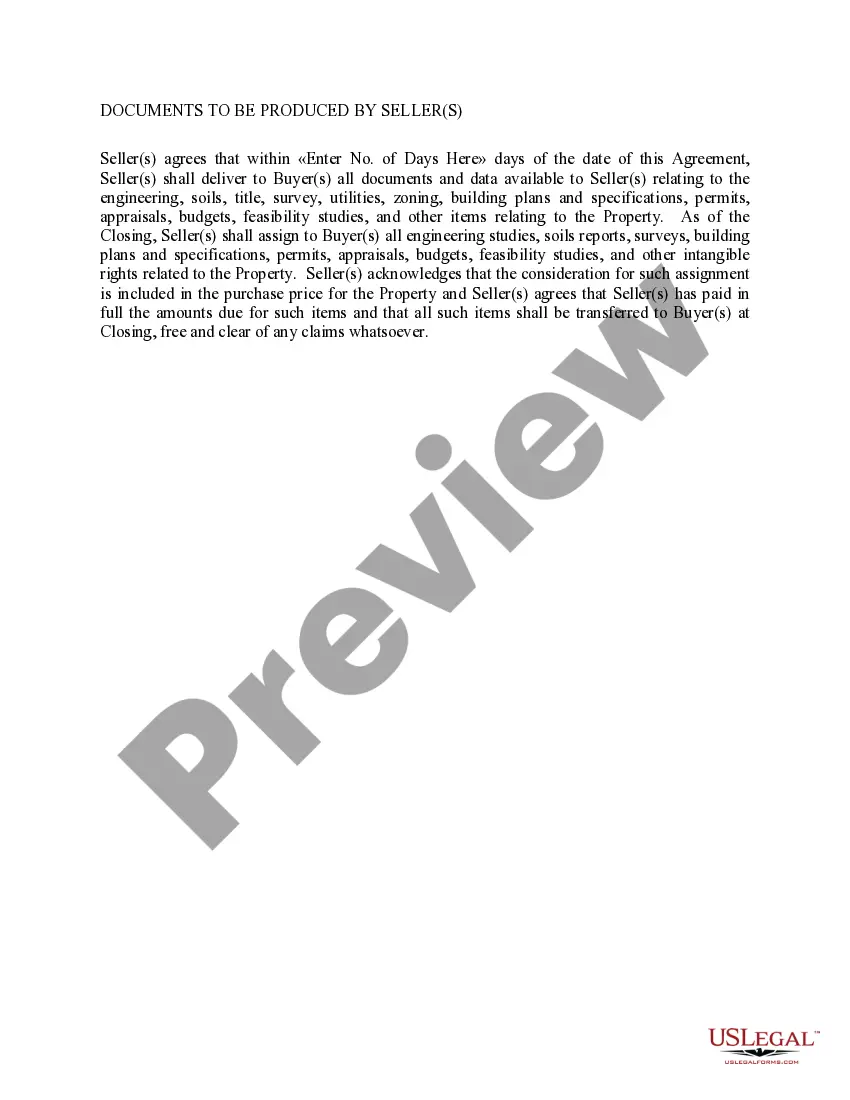
The Seller's Disclosure of Financing Terms for Residential Property in connection with Contract or Agreement for Deed serves as a formal notice to the purchaser regarding the specifics of the purchase price of the property. This form outlines how payments, interest, and late charges will be determined. It is essential for sellers to complete this document and provide it to the purchaser at or before the signing of the contract for deed. This disclosure is crucial for transparent communication and helps to prevent misunderstandings between the buyer and seller.
What’s included in this form
- Purchase price of the property
- Payment terms including amounts and frequencies
- Interest rates applicable to the financing terms
- Late charges provisions
- Signature fields for both seller and purchaser
Common use cases
This form should be used whenever a seller is offering residential property under a contract for deed arrangement. It is typically required when the seller and purchaser agree on financing that involves installment payments rather than a full upfront payment. This disclosure allows both parties to have a clear understanding of the financial terms involved prior to signing a legally binding contract.
Who needs this form
This form is intended for:
- Property sellers who are providing financing options to buyers
- Home buyers seeking clarity on loan terms included in a contract for deed
- Real estate agents facilitating residential property transactions
- Attorneys representing either party in the sale
Instructions for completing this form
Follow these steps to complete the Seller's Disclosure of Financing Terms:
- Identify the parties involved: the seller and the purchaser.
- Specify the property being sold, including its address and legal description.
- Detail the agreed purchase price of the property.
- Outline the payment terms, including frequency and amount of payments.
- Include the interest rate and any provisions for late fees.
- Ensure both parties sign and date the form to validate it.
Does this document require notarization?
This form must be notarized to be legally valid. US Legal Forms provides secure online notarization powered by Notarize, allowing you to complete the process through a verified video call.
Get your form ready online
Our built-in tools help you complete, sign, share, and store your documents in one place.
Make edits, fill in missing information, and update formatting in US Legal Forms—just like you would in MS Word.
Download a copy, print it, send it by email, or mail it via USPS—whatever works best for your next step.
Sign and collect signatures with our SignNow integration. Send to multiple recipients, set reminders, and more. Go Premium to unlock E-Sign.
If this form requires notarization, complete it online through a secure video call—no need to meet a notary in person or wait for an appointment.
We protect your documents and personal data by following strict security and privacy standards.

Make edits, fill in missing information, and update formatting in US Legal Forms—just like you would in MS Word.

Download a copy, print it, send it by email, or mail it via USPS—whatever works best for your next step.

Sign and collect signatures with our SignNow integration. Send to multiple recipients, set reminders, and more. Go Premium to unlock E-Sign.

If this form requires notarization, complete it online through a secure video call—no need to meet a notary in person or wait for an appointment.

We protect your documents and personal data by following strict security and privacy standards.
Avoid these common issues
- Not providing complete payment details, such as the payment schedule.
- Failing to specify late charges and interest rates clearly.
- Omitting signatures, which may render the form invalid.
- Using outdated or incorrect property descriptions.
Benefits of completing this form online
- Immediate accessibility: Download the form anytime from anywhere.
- Editable templates: Customize specific fields to fit your circumstances.
- Reliable and legally compliant forms drafted by licensed attorneys.
Looking for another form?

Form popularity
FAQ
If a seller fails to disclose, or actively conceals, problems that affect the value of the property; they are violating the law, and may be subject to a lawsuit for recovery of damages based on claims of fraud and deceit, misrepresentation and/or breach of contract.
As a last resort, a homeowner may file a lawsuit against the seller within a limited amount of time, known as a statute of limitations. Statutes of limitations are typically two to 10 years after closing. Lawsuits may be filed in small claims court relatively quickly and inexpensively, and without an attorney.
In general, a disclosure document is supposed to provide details about a property's condition that might negatively affect its value. Sellers who willfully conceal information can be sued and potentially convicted of a crime. Selling a property As Is will usually not exempt a seller from disclosures.
Under Ohio law, in fact, sellers must disclose any material defect about which they are aware before the sale is complete. If you discover a significant defect with your home following the closing, you might be able to seek recovery from the seller in court.
Sellers should disclose anything that required a permit in their home. These are usually significant items that should be disclosed. Examples include the heating system, air conditioning, the roof, or anything related to the plumbing or electrical systems.
If a seller fails to disclose, or actively conceals, problems that affect the value of the property; they are violating the law, and may be subject to a lawsuit for recovery of damages based on claims of fraud and deceit, misrepresentation and/or breach of contract.
In general, if the defect existed before you bought the home and the seller failed to disclose the defect, and you incurred monetary damages as a result, you can sue the seller or another party for breach of contract. A successful lawsuit could result in payment for the cost of repairs.
Sellers have to disclose any occupants (ie boyfriend, grandparent), who should also sign the contract. Sellers must disclose any official letters that have been received. And it is advisable to disclose any planning matters relating to the house or the neighbourhood.
If a seller fails to disclose, or actively conceals, problems that affect the value of the property; they are violating the law, and may be subject to a lawsuit for recovery of damages based on claims of fraud and deceit, misrepresentation and/or breach of contract.