Kentucky Notice of Assignment to Living Trust
Understanding this form
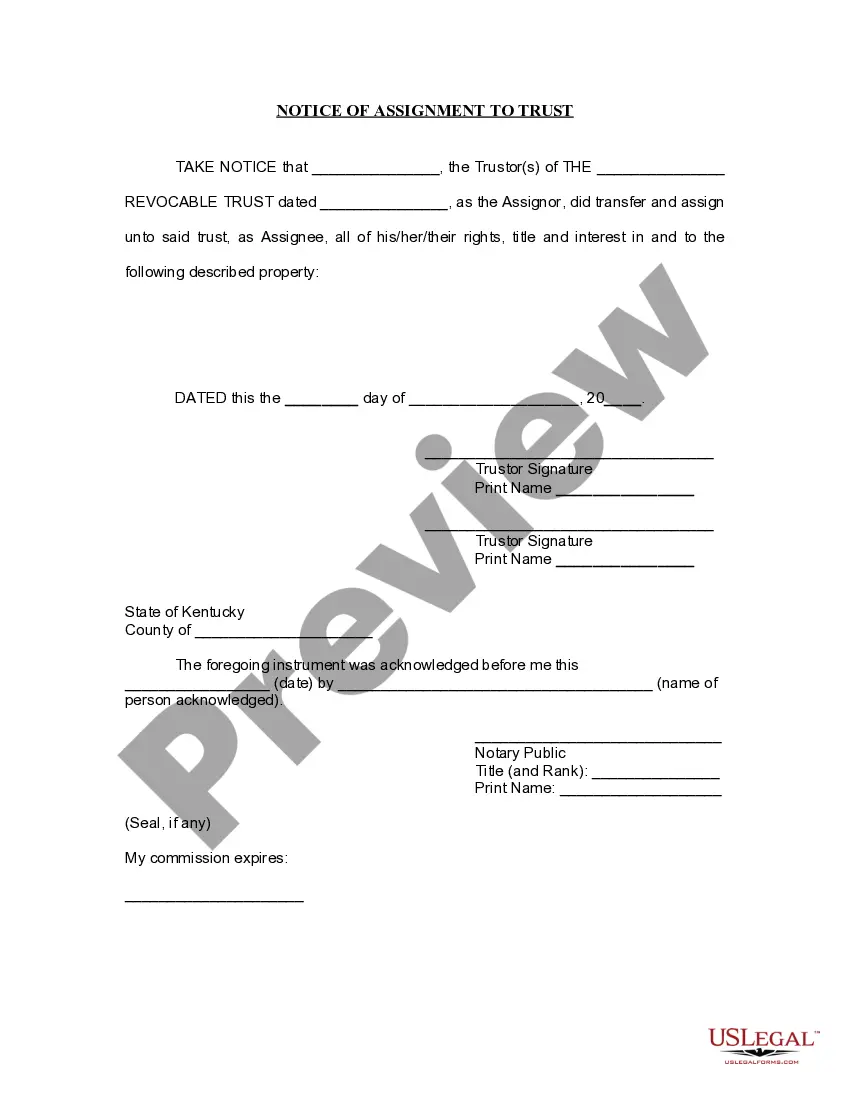
The Notice of Assignment to Living Trust is a legal document that informs interested parties that certain assets and properties have been transferred into a living trust. This form is essential for estate planning, as it clarifies that the trustor(s) have assigned their rights and interests in specific properties to a revocable trust. Unlike other forms related to trusts, this document specifically serves as a formal notice of assignment.
Key parts of this document
- Trustor's name: The individual(s) establishing the trust.
- Trust name: The title of the revocable trust being referenced.
- Date of the trust: The date when the trust was created.
- Property description: Detailed information about the assets being transferred.
- Signature fields: Areas for trustor(s) to sign and print their names.
- Notary section: Verification by a notary public to validate the document.
Common use cases
You should use the Notice of Assignment to Living Trust when you want to officially declare that specific assets have been transferred into your living trust. This form is commonly used during the estate planning process to ensure that all assets are correctly assigned to the trust, protecting them from probate and ensuring that they are managed according to the trustorâs wishes. It is particularly useful when changing the ownership of real estate, bank accounts, or other valuable property.
Intended users of this form
This form is intended for:
- Individuals establishing a living trust to manage their assets.
- Trustors who want to document the transfer of property into their trust.
- Estate planners and attorneys assisting clients with asset management.
Instructions for completing this form
- Identify the trustor(s) and provide their names.
- Specify the name of the living trust and its creation date.
- Describe the property being assigned to the trust clearly.
- Have the trustor(s) sign the form where indicated.
- Locate a notary public to acknowledge the signatures and complete the notarization process.
Is notarization required?
Yes, this form must be notarized to be legally valid. You will need to sign the document in front of a notary public, who will verify your identity and acknowledge your signature. US Legal Forms offers integrated online notarization, available twenty-four hours a day, ensuring a secure and convenient process without the need for travel.
Get your form ready online
Our built-in tools help you complete, sign, share, and store your documents in one place.
Make edits, fill in missing information, and update formatting in US Legal Forms—just like you would in MS Word.
Download a copy, print it, send it by email, or mail it via USPS—whatever works best for your next step.
Sign and collect signatures with our SignNow integration. Send to multiple recipients, set reminders, and more. Go Premium to unlock E-Sign.
If this form requires notarization, complete it online through a secure video call—no need to meet a notary in person or wait for an appointment.
We protect your documents and personal data by following strict security and privacy standards.

Make edits, fill in missing information, and update formatting in US Legal Forms—just like you would in MS Word.

Download a copy, print it, send it by email, or mail it via USPS—whatever works best for your next step.

Sign and collect signatures with our SignNow integration. Send to multiple recipients, set reminders, and more. Go Premium to unlock E-Sign.

If this form requires notarization, complete it online through a secure video call—no need to meet a notary in person or wait for an appointment.

We protect your documents and personal data by following strict security and privacy standards.
Common mistakes to avoid
- Failing to specify all assets being transferred into the trust.
- Not having the form notarized when required.
- Leaving out signatures or dates, which invalidates the document.
Advantages of online completion
- Immediate access to legally vetted templates drafted by licensed attorneys.
- Convenience of downloading and completing the form at your own pace.
- Ability to edit the form to fit specific needs without hassle.
Summary of main points
- The Notice of Assignment to Living Trust is essential for asset transfer into a trust.
- Complete the form accurately and ensure notarization for legality.
- Use this form to clarify property rights and enhance estate planning efforts.
Looking for another form?
Form popularity
FAQ
Sure you can write your own revocable living trust.The discussion of your need for a revocable living trust is in another of my articles, but it is safe to say that if you own real property and have a significant estate (over about $50,000), then you could use a trust and it would help your loved ones.
Locate your current deed. Use the proper deed. Check with your title insurance company and lender. Prepare a new deed. Sign in the presence of a notary. Record the deed in the county clerk's office. Locate the deed that's in trust. Use the proper deed.
List Your Assets and Decide Which You'll Include in the Trust. Gather the Paperwork. Decide Whether You Will Be the Sole Grantor. Choose Beneficiaries. Choose a Successor Trustee. Choose Someone to Manage Property for Minor Children. Prepare the Trust Document. Sign and Notarize.
Determine the Current Title and Vesting to Your Property. Prepare a Deed. Be Aware of Your Lender and Title Insurance. Prepare a Preliminary Change of Ownership Report. Execute Your Deed. Record Your Deed. Wait for the Deed to be Returned. Keep the Property in the Trust.
Make a List of All Your Assets. Be sure to include make a list of your assets that includes everything you own. Find the Paperwork for Your Assets. Choose Beneficiaries. Choose a Successor Trustee. Choose a Guardian for Your Minor Children.
Transferring Real Property to a Trust You can transfer your home (or any real property) to the trust with a deed, a document that transfers ownership to the trust. A quitclaim deed is the most common and simplest method (and one you can do yourself).
The process of funding your living trust by transferring your assets to the trustee is an important part of what helps your loved ones avoid probate court in the event of your death or incapacity. Qualified retirement accounts such as 401(k)s, 403(b)s, IRAs, and annuities, should not be put in a living trust.
Pick a type of living trust. If you're married, you'll first need to decide whether you want a single or joint trust. Take stock of your property. Choose a trustee. Draw up the trust document. Sign the trust. Transfer your property to the trust.