Mississippi Site Work Contractor Package
Understanding this form package
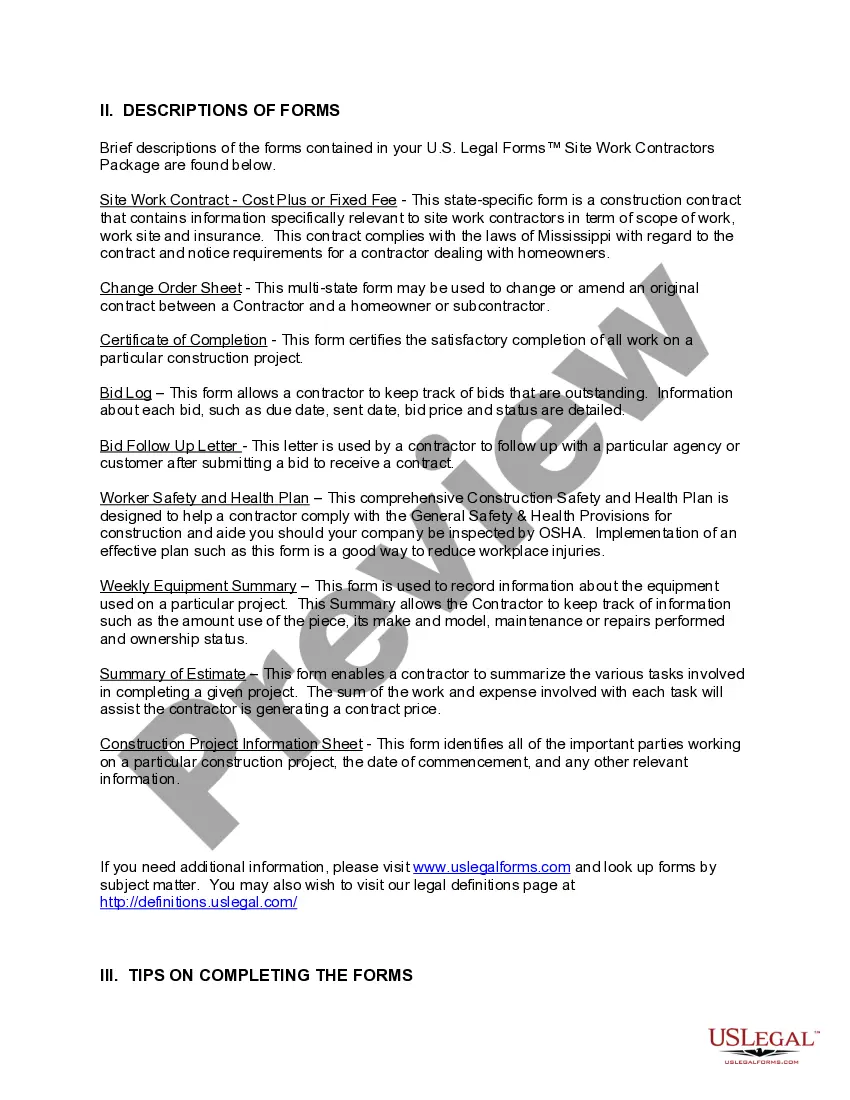
The Mississippi Site Work Contractor Package is a comprehensive set of legal documents designed specifically for site work contractors, homeowners, suppliers, and subcontractors. This package stands out by providing essential tools to assert legal rights and manage important issues that arise during construction projects involving site preparation for residential properties. At its core, this package includes a site work contract that complies with Mississippi state law, ensuring that all parties have their legal rights protected.
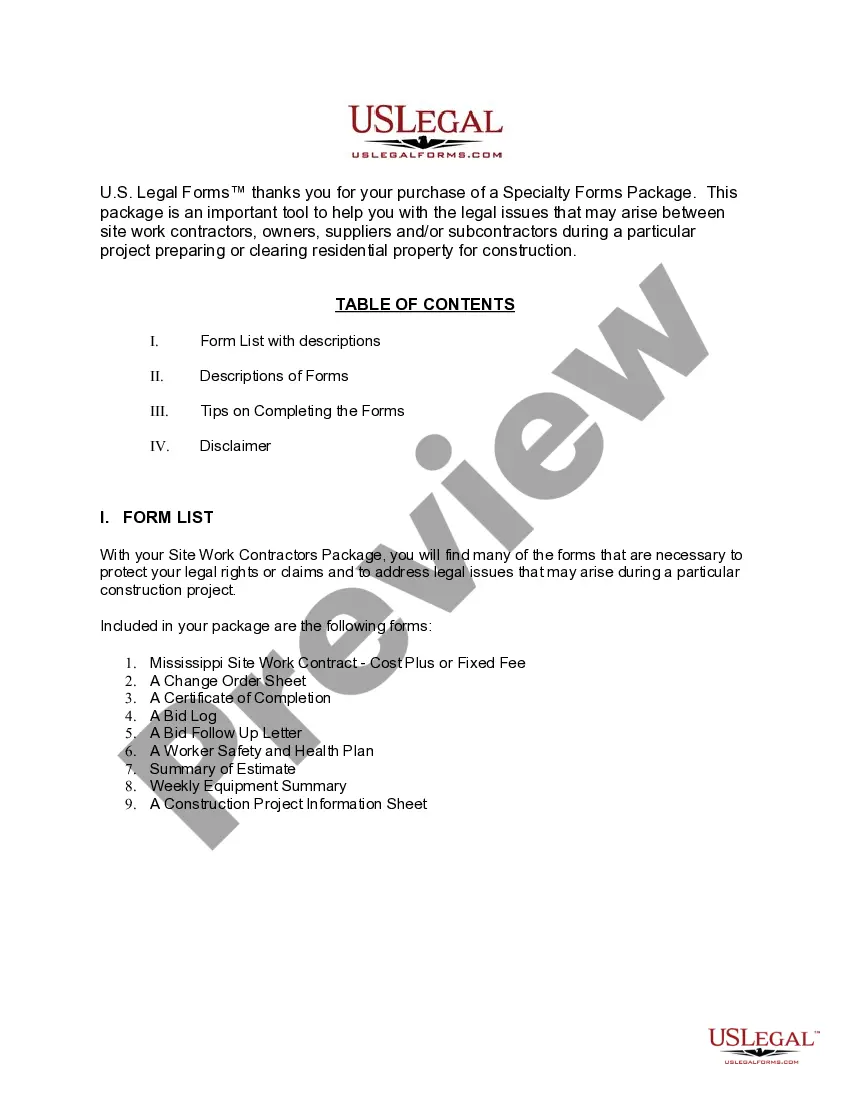
Forms provided in this package
- Site Work Contract for Contractor
- Contractor's Weekly Equipment Summary
- Contractor's Bid Log
- Contractor's Bid Follow Up Letter
- Contractor's Summary of an Estimate
- Construction Safety and Health Plan
- Change Order for Construction or Repairs by Contractor
- Certification of Completion by Contractor
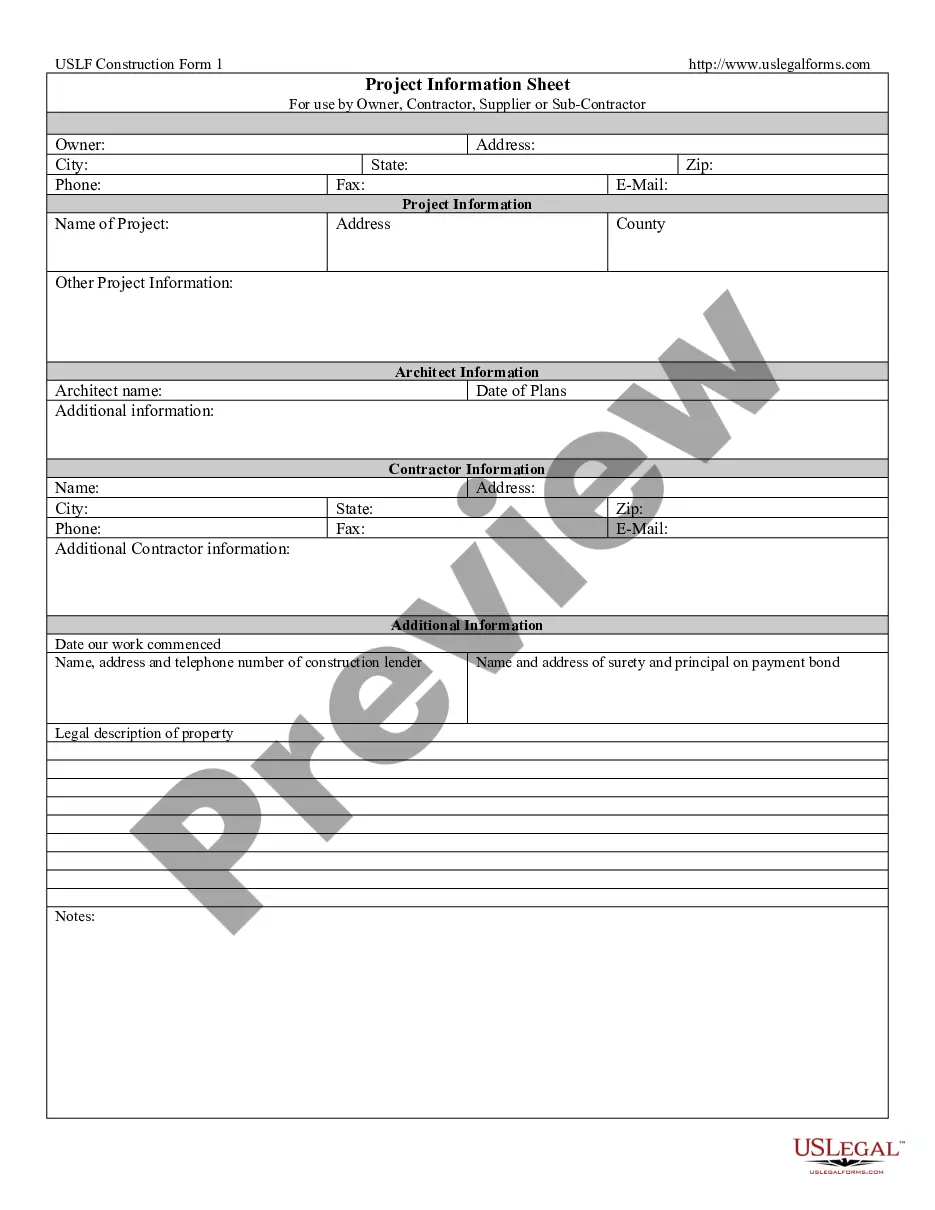
- Construction Project Information Sheet
When to use this form package
This form package is particularly useful in various scenarios, including:
- When entering into a contract for site work on a residential property.
- When modifications to the original contract are necessary.
- When documenting the completion of construction work.
- When managing bids and tracking project-related equipment and safety plans.
Who this form package is for
- Site work contractors operating in Mississippi.
- Homeowners planning construction projects.
- Suppliers providing materials for site preparation.
- Subcontractors working under a primary contractor.
How to prepare this document
- Review included forms and determine which are necessary for your project.
- Identify the parties involved and ensure all contact information is accurate.
- Enter relevant dates, locations, and project specifics into the forms.
- Obtain signatures from all required parties to execute the documents.
- Keep copies of completed forms for your records and future reference.
Notarization details for included forms
Notarization is generally not required for forms in this package. However, specific circumstances or local laws may require it. You can complete notarization remotely through US Legal Forms, powered by Notarize, with 24/7 availability.
Get your form ready online
Our built-in tools help you complete, sign, share, and store your documents in one place.
Make edits, fill in missing information, and update formatting in US Legal Forms—just like you would in MS Word.
Download a copy, print it, send it by email, or mail it via USPS—whatever works best for your next step.
Sign and collect signatures with our SignNow integration. Send to multiple recipients, set reminders, and more. Go Premium to unlock E-Sign.
If this form requires notarization, complete it online through a secure video call—no need to meet a notary in person or wait for an appointment.
We protect your documents and personal data by following strict security and privacy standards.

Make edits, fill in missing information, and update formatting in US Legal Forms—just like you would in MS Word.

Download a copy, print it, send it by email, or mail it via USPS—whatever works best for your next step.

Sign and collect signatures with our SignNow integration. Send to multiple recipients, set reminders, and more. Go Premium to unlock E-Sign.

If this form requires notarization, complete it online through a secure video call—no need to meet a notary in person or wait for an appointment.

We protect your documents and personal data by following strict security and privacy standards.
Common mistakes to avoid
- Failing to include all necessary parties' signatures on contracts.
- Not specifying all details in the site work contract that might lead to disputes.
- Neglecting to update the Change Order Sheet when changes occur.
- Overlooking the importance of a Worker Safety and Health Plan for compliance.
Why use this package online
- Convenience of accessing documents anytime from anywhere.
- Editable forms that allow customization to suit your specific needs.
- Reliability of having forms drafted by licensed attorneys within the state.
Looking for another form?
Form popularity
FAQ
Submit an application to the Mississippi State Board of Contractors. Pass the Law and Business Management exam. Pass a Technical (trade) exam specific to the type of work you perform.
Submit an application to the Mississippi State Board of Contractors. Pass the Law and Business Management exam. Pass a Technical (trade) exam specific to the type of work you perform.
General contractor decision comes down to licensing: general contractors need them, but a handyman does not. Furthermore, there's a difference in scope in terms of the work each does. A handyman usually tackles multiple small jobs in a visit while a general contractor focuses on one larger and more specialized job.
Mississippi. A handyman does not need a license in Mississippi unless the residential job costs more than $10,000. In this case, you'll need a Residential Remodeling license issued by the Mississippi Contractor Licensing Board.
To become a licensed contractor, candidates are required to pass two examinations: business and law and their trade. Applications can be obtained from the Mississippi State Board of Contractors by calling 1-800-880-6161. Examinations can be scheduled through PSI by calling 1-800-733-9267.
To become a general contractor, you need at least a high school diploma, but there is an increase in a need for a bachelor's degree or at least an associate degree, plus years of construction industry experience. Regardless of education though, experience in the industry is the most important requirement.
Submit a CPA statement showing a minimum net worth of $50,000. Successfully pass 2 examinations (trade; business and law) Obtain an application from the Board (call 1-800-880-6161) Pay a $200 application fee.
Commercial and residential contractors and roofers are required to be licensed by the Mississippi State Board of Contractors. For more information on how to obtain a license please refer to the FAQ's section of our website or contact us at (800) 880-6161.
A general contractor provides a strong background in framing and carpentry along with many other skills. Because remodeling jobs typically involve several specialty areas, the general contractor serves as a project manager who coordinates the entire job.