Michigan Uniform Anatomical Gift Act Donation
Overview of this form
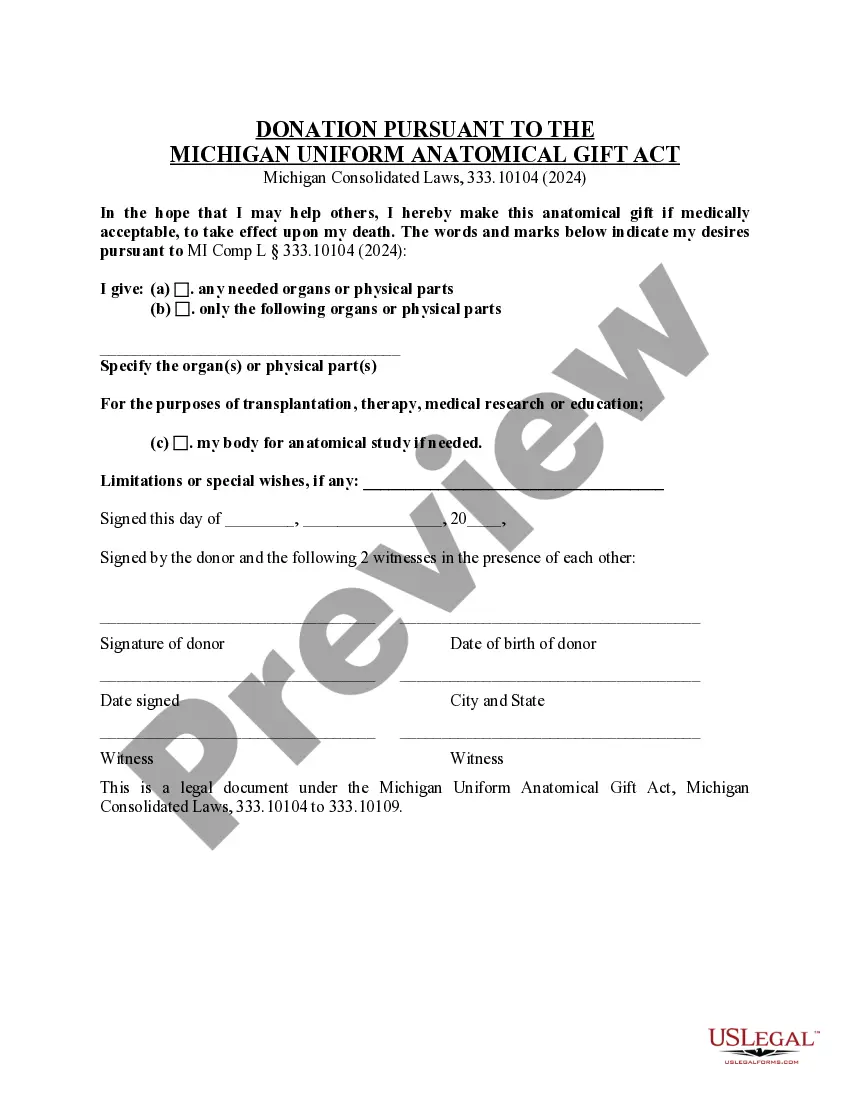
The Uniform Anatomical Gift Act Donation form enables individuals to specify their wishes regarding organ and tissue donation after death. This form is legally binding and allows an individual of sound mind, aged 18 or older, to donate all or specific parts of their body. It differs from similar documents in its formal recognition of both the intent to donate and the process required to ensure it is honored, making it an essential tool for those wishing to contribute to medical science or save lives through organ donation.
Main sections of this form
- Donor information: Includes signature, date of birth, and date signed.
- Gift specification: Allows donors to choose between donating any needed organs or specifying particular organs or parts.
- Witness signatures: Requires the signatures of two witnesses present during the signing of the form.
- Notarization: The form must be notarized to confirm its validity.
- Special wishes: Section to include any limitations or specific requests regarding the anatomical gift.

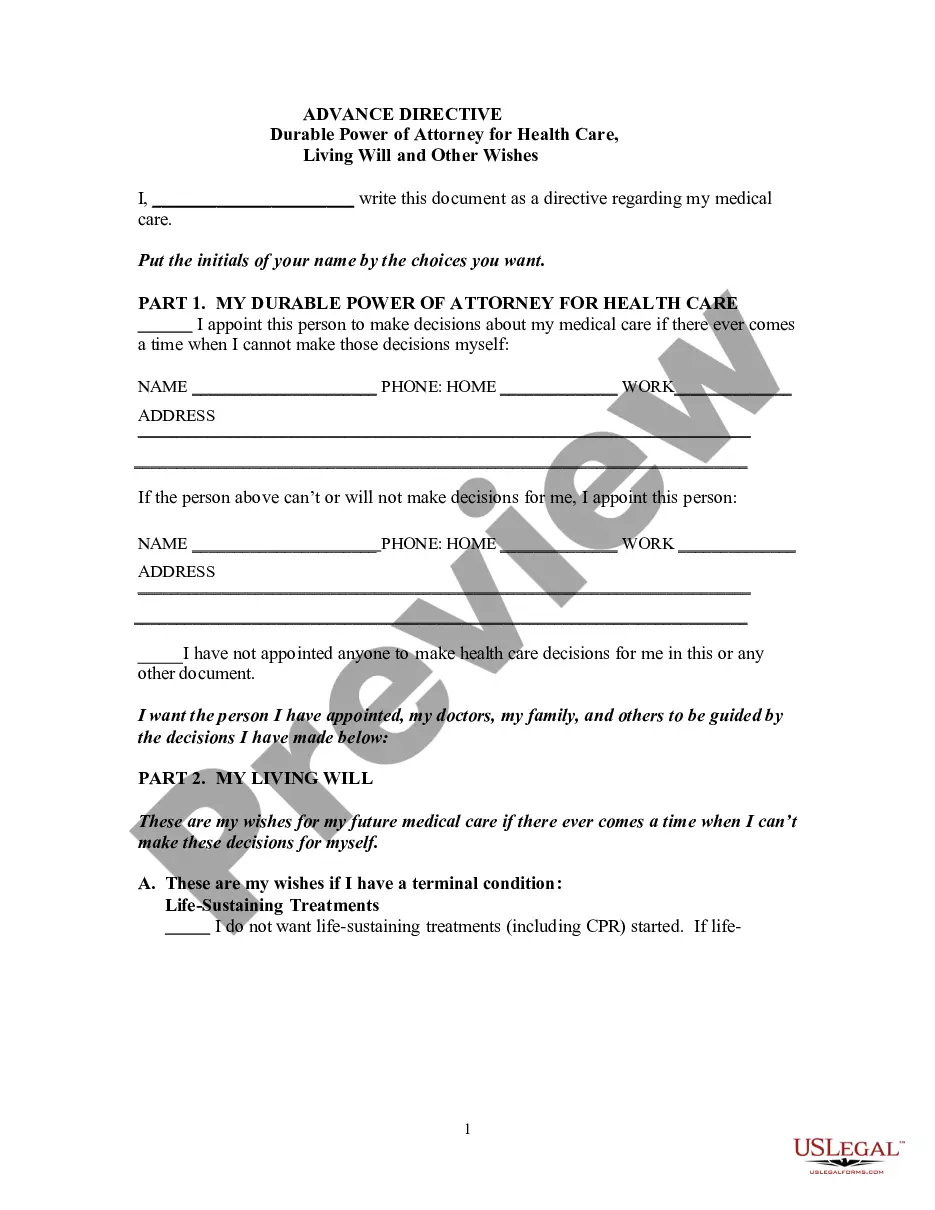
When this form is needed
This form is needed when an individual wishes to make a legally recognized donation of their body parts or organs after death. It should be completed in advance of any medical procedures and kept in a secure location where the donor's family and medical professionals can access it. Using this form ensures that one's wishes are clearly documented and respected, helping to alleviate any uncertainties or disputes during a difficult time.
Intended users of this form
- Adults aged 18 or older who are of sound mind and wish to contribute to organ and tissue donation.
- Individuals who wish to specify what parts of their bodies they are willing to donate.
- People looking to ensure their wishes about anatomical gifts are legally documented.
- Those considering becoming organ donors as part of their end-of-life planning.
How to prepare this document
- Identify yourself as the donor by providing your full name and date of birth.
- Specify your wishes regarding organ donation by selecting preferred options.
- Include any limitations or special instructions related to your donation.
- Sign the document in the presence of two witnesses.
- Have the form notarized to confirm its legal validity.
Does this form need to be notarized?
This form usually doesn’t need to be notarized. However, local laws or specific transactions may require it. Our online notarization service, powered by Notarize, lets you complete it remotely through a secure video session, available 24/7.
Get your form ready online
Our built-in tools help you complete, sign, share, and store your documents in one place.
Make edits, fill in missing information, and update formatting in US Legal Forms—just like you would in MS Word.
Download a copy, print it, send it by email, or mail it via USPS—whatever works best for your next step.
Sign and collect signatures with our SignNow integration. Send to multiple recipients, set reminders, and more. Go Premium to unlock E-Sign.
If this form requires notarization, complete it online through a secure video call—no need to meet a notary in person or wait for an appointment.
We protect your documents and personal data by following strict security and privacy standards.

Make edits, fill in missing information, and update formatting in US Legal Forms—just like you would in MS Word.

Download a copy, print it, send it by email, or mail it via USPS—whatever works best for your next step.

Sign and collect signatures with our SignNow integration. Send to multiple recipients, set reminders, and more. Go Premium to unlock E-Sign.

If this form requires notarization, complete it online through a secure video call—no need to meet a notary in person or wait for an appointment.

We protect your documents and personal data by following strict security and privacy standards.
Common mistakes to avoid
- Failing to have the form witnessed or notarized, which may invalidate the document.
- Not specifying which organs or body parts are to be donated, leading to potential confusion.
- Overlooking the importance of keeping the document accessible to family and medical personnel.
- Signing the form without ensuring the correct details are filled out, including personal information and specific wishes.
Advantages of online completion
- Convenience of accessing and completing the form from anywhere with an internet connection.
- Editability allows users to easily make adjustments or updates as needed.
- Reliable templates drafted by licensed attorneys ensure legal compliance and clarity.
- Ability to securely store and manage important legal documents electronically.
Looking for another form?


Form popularity
FAQ
While donating plasma can provide a source of income, making $1000 a month solely from plasma donations may be challenging. The compensation for plasma donation typically ranges from $20 to $50 per session, depending on various factors. To reach $1000, you would need to donate several times a week. Additionally, consider the ethical implications and legal aspects under the Michigan Uniform Anatomical Gift Act Donation when engaging in such activities.
To donate your body to science under the Michigan Uniform Anatomical Gift Act Donation, you typically need to be at least 18 years old and have a clear intention to donate. You must also provide consent, often through a signed document, which can be facilitated on platforms like uslegalforms. Each institution may have its own specific guidelines, so it is wise to check directly with the chosen medical school or research facility for their requirements.
Certain medical conditions can disqualify you from participating in the Michigan Uniform Anatomical Gift Act Donation. For instance, active infections, severe chronic diseases, or certain cancers may prevent donation. Additionally, if you have a history of certain lifestyle choices, such as drug abuse, this could also impact your eligibility. It's important to consult with a medical professional or a donation organization to determine your specific situation.
There are specific conditions under the Michigan Uniform Anatomical Gift Act Donation that may lead to a body being declined for donation. Bodies are typically not accepted if there are infectious diseases, extreme trauma, significant decomposition, or if the individual did not meet the age or health eligibility criteria. Understanding these conditions can help you make informed decisions regarding body donation. If you have further questions, the US Legal Forms platform can guide you through the necessary documentation for your wishes.
To donate your body to science in Michigan, you must first contact a participating medical school or research institution. They will provide you with the necessary information and forms to complete, often under the guidelines of the Michigan Uniform Anatomical Gift Act Donation. Once accepted, your donation will contribute to medical research and education, potentially helping future generations. Ensure you have your wishes documented clearly to support a seamless donation process.
Registering to donate your body under the Michigan Uniform Anatomical Gift Act Donation is a straightforward process. You can begin by contacting a medical school or research organization in Michigan that accepts body donations. They will provide you with specific instructions and forms to complete. Additionally, it is a good practice to discuss your decision with family members to ensure they are informed and supportive.
The potential donor has an infectious or contagious disease (such as HIV/AIDS, hepatitis B or hepatitis C, or prion diseases). The next of kin objects to the donation of the body. The body is not acceptable for anatomical study (extremely emaciated or extremely obese).
Any person wishing to donate their body can make prior arrangements with the local medical college, hospital, or an NGO, before death. Individuals may request a consent form from a medical institution or an NGO, who will then give information about policies and procedures followed after the potential donor is deceased.
One may consider donation to an alternate willed body program. Our website (medicine.umich.edu/ anatomical-donations) has links to other anatomical donations programs in the United States. A funeral director can assist family in making arrangements for delivery to an alternate recipient.
Science Care obtains any pending authorizations, death certificate information and medical social history needed to process the donation. Science Care files the death certificate in the county of passing. Your loved ones are responsible for purchasing certified copies of the death certificate directly from the county.