Michigan Name Affidavit of Buyer
About this form
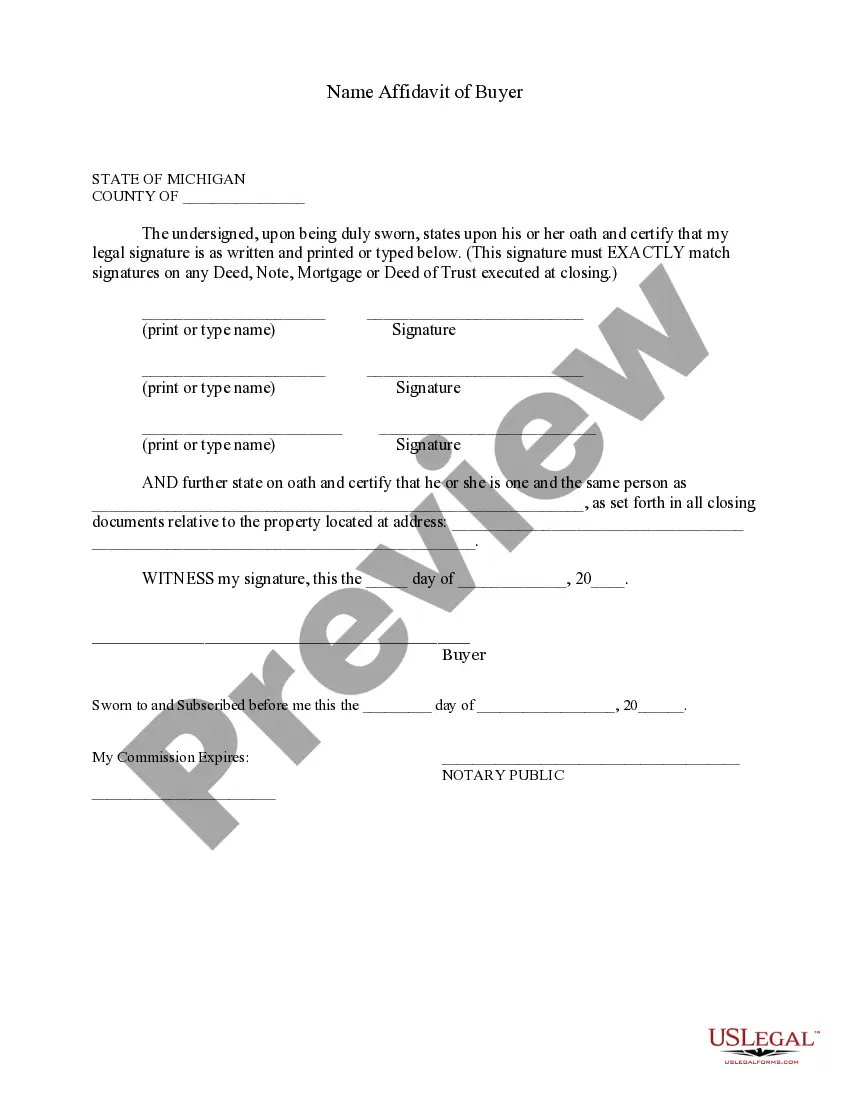
The Name Affidavit of Buyer is a legal document that allows the buyer to affirm their legal name and clarify any alternate names used. This affidavit serves to confirm that variations in the buyer's signature, such as John Jones, John T. Jones, and J.T. Jones, belong to the same individual. It differs from other forms by specifically addressing name discrepancies to ensure clarity in legal documentation.
Key parts of this document
- Legal name and signature of the buyer.
- A declaration that all variations of the name are for the same person.
- Signature lines for the buyer to confirm their identity.
- The property address related to the closing documents.
- Notary section for official validation of the affidavit.

When this form is needed
This form is essential when a buyer needs to validate their identity and signature for legal documents related to property transactions. It is particularly useful if the buyer has signed documents using different variations of their name, ensuring all documentation is consistent and accurately reflects the buyer's true identity.
Intended users of this form
This affidavit is intended for:
- Buyers involved in any property transactions.
- Individuals who have used multiple names in legal documentation.
- Anyone requiring clarification of identity for real estate closing purposes.
Completing this form step by step
- Enter the county and state at the top of the form.
- Provide your legal name exactly as it appears on identification documents.
- Specify any "known as" names you may have used.
- Sign and print your name in the designated spaces.
- Have the form notarized to ensure it is legally binding.
Is notarization required?
To make this form legally binding, it must be notarized. Our online notarization service, powered by Notarize, lets you verify and sign documents remotely through an encrypted video session.
Get your form ready online
Our built-in tools help you complete, sign, share, and store your documents in one place.
Make edits, fill in missing information, and update formatting in US Legal Forms—just like you would in MS Word.
Download a copy, print it, send it by email, or mail it via USPS—whatever works best for your next step.
Sign and collect signatures with our SignNow integration. Send to multiple recipients, set reminders, and more. Go Premium to unlock E-Sign.
If this form requires notarization, complete it online through a secure video call—no need to meet a notary in person or wait for an appointment.
We protect your documents and personal data by following strict security and privacy standards.

Make edits, fill in missing information, and update formatting in US Legal Forms—just like you would in MS Word.

Download a copy, print it, send it by email, or mail it via USPS—whatever works best for your next step.

Sign and collect signatures with our SignNow integration. Send to multiple recipients, set reminders, and more. Go Premium to unlock E-Sign.

If this form requires notarization, complete it online through a secure video call—no need to meet a notary in person or wait for an appointment.

We protect your documents and personal data by following strict security and privacy standards.
Mistakes to watch out for
- Failing to correctly match signatures across documents.
- Omitting alternate names that have been used in previous transactions.
- Not obtaining notarization, which is crucial for the affidavit's validity.
Why use this form online
- Convenient access to the form anytime, anywhere.
- Editable format allows for accurate personal information entry.
- Reliable templates drafted by licensed attorneys for legal compliance.
Looking for another form?
Form popularity
FAQ
The property transfer affidavit in Michigan is usually filled out by the seller or the buyer of the property. This document outlines the details of the transfer and ensures compliance with local regulations. If you are dealing with a Michigan Name Affidavit of Buyer, it is important to complete this affidavit accurately. Platforms like USLegalForms can assist you in understanding what information to include and provide the correct forms.
Obtaining an affidavit of affixture in Michigan typically takes a few days to a couple of weeks. This timeline can vary based on the specific circumstances surrounding the property and workload at the local assessor's office. Utilizing services like USLegalForms can expedite the process by providing the necessary templates and guidance for your Michigan Name Affidavit of Buyer. Be prepared with all relevant documents to streamline the procedure.
In Michigan, affidavits must be notarized to be considered valid. This means a certified notary public must witness the signing of the document. Notarization adds an extra layer of authenticity and helps ensure that the Michigan Name Affidavit of Buyer is credible and legally sound. You can easily find notary services at local banks, libraries, or legal offices.
No, you do not need a lawyer to transfer a deed in Michigan, although having legal assistance can be beneficial. Individuals can complete the process by themselves, as long as they follow state guidelines. However, a Michigan Name Affidavit of Buyer can help ensure that all necessary documentation is in place, streamlining the transfer process. For detailed instructions and templates, consider using US Legal Forms, which simplifies this task.
In Michigan, failing to file a property transfer affidavit can result in penalties, including late fees and possible fines. The state requires timely submission to ensure accurate property records. If you neglect this requirement, it may affect your property taxes or create complications during future transactions. US Legal Forms provides guidance on how to properly complete and submit a Michigan Name Affidavit of Buyer, helping you avoid such issues.
A property transfer affidavit is not the same as a deed. While a deed officially transfers ownership of property, a Michigan Name Affidavit of Buyer typically provides information about the parties involved in the transaction and may affirm the buyer's identity. Understanding the distinction helps ensure proper documentation and compliance with state laws. If you need assistance with property transfers, US Legal Forms offers resources tailored to your needs.
Filling out a Michigan quit claim deed requires specific sections to be completed accurately. Start by entering the names of the grantor and grantee, ensuring that all details match official identification. Next, provide a description of the property being transferred, including its address and legal description. To finalize the process, both parties must sign the document in front of a notary. For more precise assistance, consider using the Michigan Name Affidavit of Buyer through US Legal Forms, which simplifies the process and ensures you meet all legal requirements.