Louisiana Financial Account Transfer to Living Trust
What this document covers
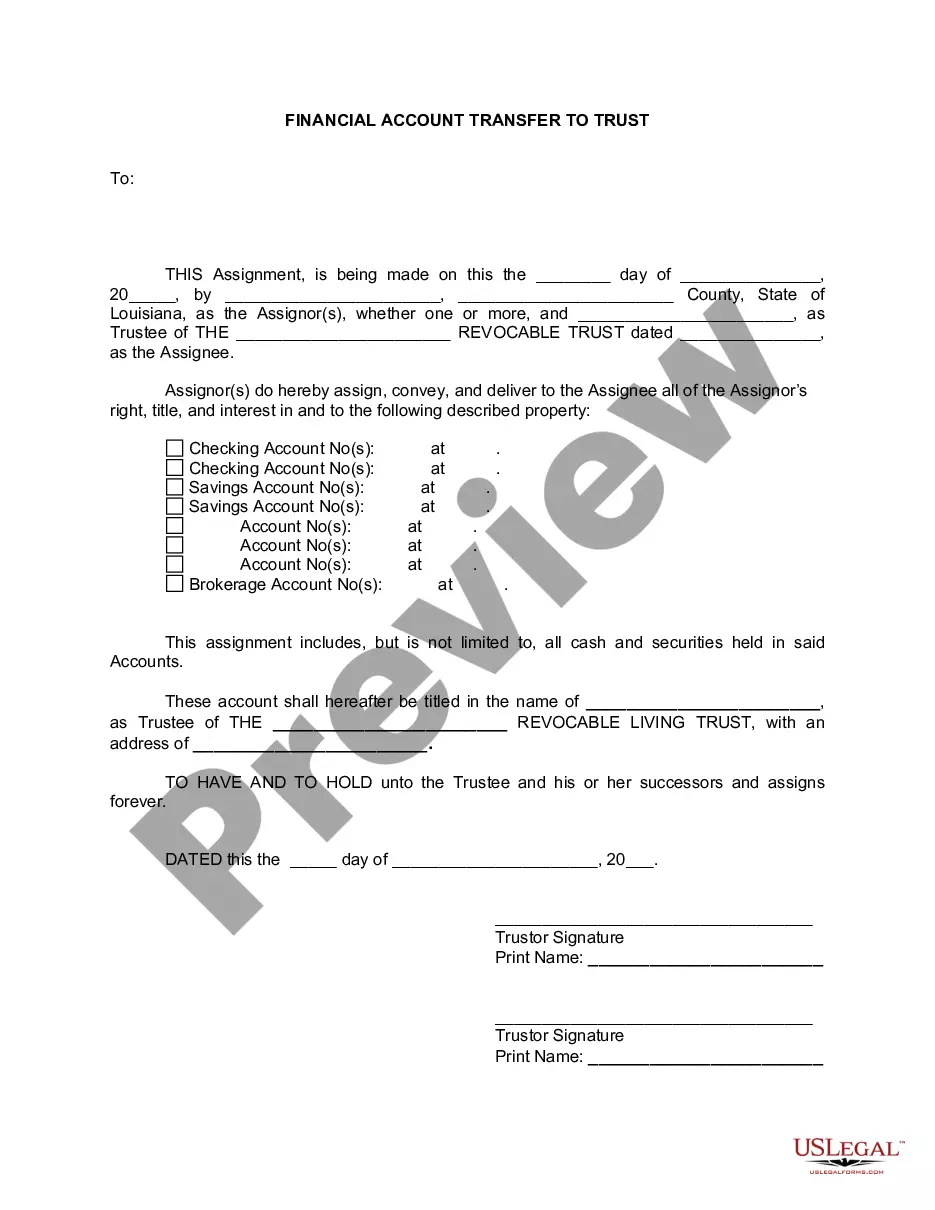
The Financial Account Transfer to Living Trust form is a legal document used to transfer ownership of bank and other financial accounts into a living trust. Unlike other transfer methods, this form ensures that the accounts are managed according to the terms of the trust, aiding in estate planning and asset management while you are still alive. This process can help avoid probate upon death and maintain privacy regarding financial assets.
Form components explained
- Assignor's information: Details of the individual(s) transferring the account.
- Assignee's details: Name and address of the trustee for the living trust.
- Description of property: Specifications of the accounts being transferred.
- Date and signatures: Confirmation from the assignor(s) and notarization details.
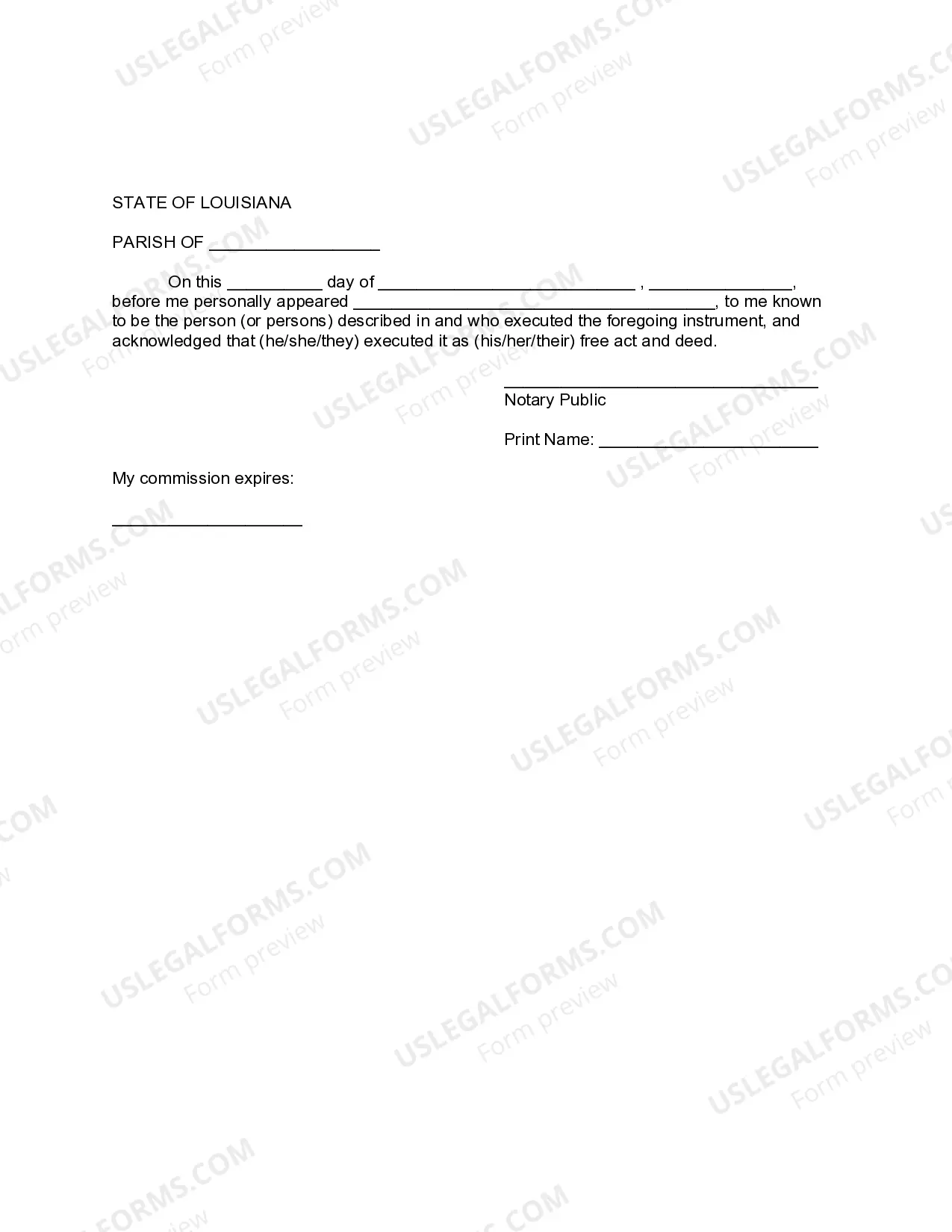
- Notary acknowledgment: Verification of signatures by a notary public.


Common use cases
This form should be utilized when you want to officially transfer your bank accounts or other financial assets into a living trust. Common scenarios include creating a trust to manage inheritance for beneficiaries, ensuring that assets are accessible only under the terms of the trust, or simplifying the distribution of your estate upon death. Using this form can facilitate smoother asset management during your lifetime and provide clarity for your heirs.
Who can use this document
This form is intended for:
- Individuals establishing a living trust.
- Trustors who wish to transfer financial accounts into their revocable trust.
- Anyone involved in estate planning seeking to ensure that assets are effectively managed and distributed.
Instructions for completing this form
- Identify the parties involved: Clearly list the Assignor(s) and Assignee with their legal names.
- Specify the financial accounts: Provide detailed descriptions of the accounts being transferred.
- Fill in the trustee's name: Include the name of the living trust and the appointed trustee.
- Enter the date and signatures: Ensure the Assignor(s) date and sign the document in the presence of a notary public.
- Obtain notary acknowledgment: Have the document notarized to validate the transfer legally.
Notarization requirements for this form
This form must be notarized to be legally valid. US Legal Forms provides secure online notarization powered by Notarize, allowing you to complete the process through a verified video call.
Get your form ready online
Our built-in tools help you complete, sign, share, and store your documents in one place.
Make edits, fill in missing information, and update formatting in US Legal Forms—just like you would in MS Word.
Download a copy, print it, send it by email, or mail it via USPS—whatever works best for your next step.
Sign and collect signatures with our SignNow integration. Send to multiple recipients, set reminders, and more. Go Premium to unlock E-Sign.
If this form requires notarization, complete it online through a secure video call—no need to meet a notary in person or wait for an appointment.
We protect your documents and personal data by following strict security and privacy standards.

Make edits, fill in missing information, and update formatting in US Legal Forms—just like you would in MS Word.

Download a copy, print it, send it by email, or mail it via USPS—whatever works best for your next step.

Sign and collect signatures with our SignNow integration. Send to multiple recipients, set reminders, and more. Go Premium to unlock E-Sign.

If this form requires notarization, complete it online through a secure video call—no need to meet a notary in person or wait for an appointment.

We protect your documents and personal data by following strict security and privacy standards.
Avoid these common issues
- Failing to fully describe the accounts being transferred.
- Not having the form notarized, which is necessary for legal validity.
- Omitting the trustee's details or making errors in their name.
- Not specifying the effective date of the transfer properly.
Why complete this form online
- Convenient access: Download and complete the form at your convenience.
- Editability: Easily modify the form as needed to fit your specific situation.
- Reliability: Templates are drafted and reviewed by licensed attorneys to ensure compliance with legal standards.
Looking for another form?
Form popularity
FAQ
This form is a Louisiana-specific legal document used to transfer ownership of bank and other financial accounts into a living trust. It ensures accounts are managed under the trust terms, supports estate planning, and can help avoid probate and preserve privacy. The form includes sections for the assignor, assignee, property description, date and signatures, and a notary acknowledgment.
To complete this form, fill out the assignor's information (the person transferring the account) and the assignee's details (the trustee of the living trust), describe the accounts being transferred, include the date and signatures, and obtain a notary acknowledgment. This documents the transfer of bank and other financial accounts into the trust.
This form is designed to document the transfer of bank and other financial accounts into the living trust. It includes the assignor's information, the assignee (trustee) details, a description of property (accounts), and requires dates, signatures, and a notary acknowledgment to formally complete the transfer.
Common mistakes when using this form include incomplete or inaccurate descriptions of the accounts, missing or incorrect assignor and assignee details, forgetting the date and signatures, and failing to obtain the notary acknowledgment. Correcting these ensures the transfer is clearly documented and enforceable under the trust terms.
Whether you need a living trust in Louisiana depends on your estate planning goals. This form helps transfer bank and other financial accounts into a living trust to manage assets under the trust terms and can aid in probate avoidance; consult an attorney for guidance specific to your situation.
This form is the Louisiana-specific version of a financial account transfer to a living trust. It targets Louisiana residents and uses the same core components—assignor and assignee information, description of property (accounts), date and signatures, and a notary acknowledgment—designed to fit Louisiana’s practice and documentation expectations.