District of Columbia Warranty Deed for Separate or Joint Property to Joint Tenancy
What is this form?
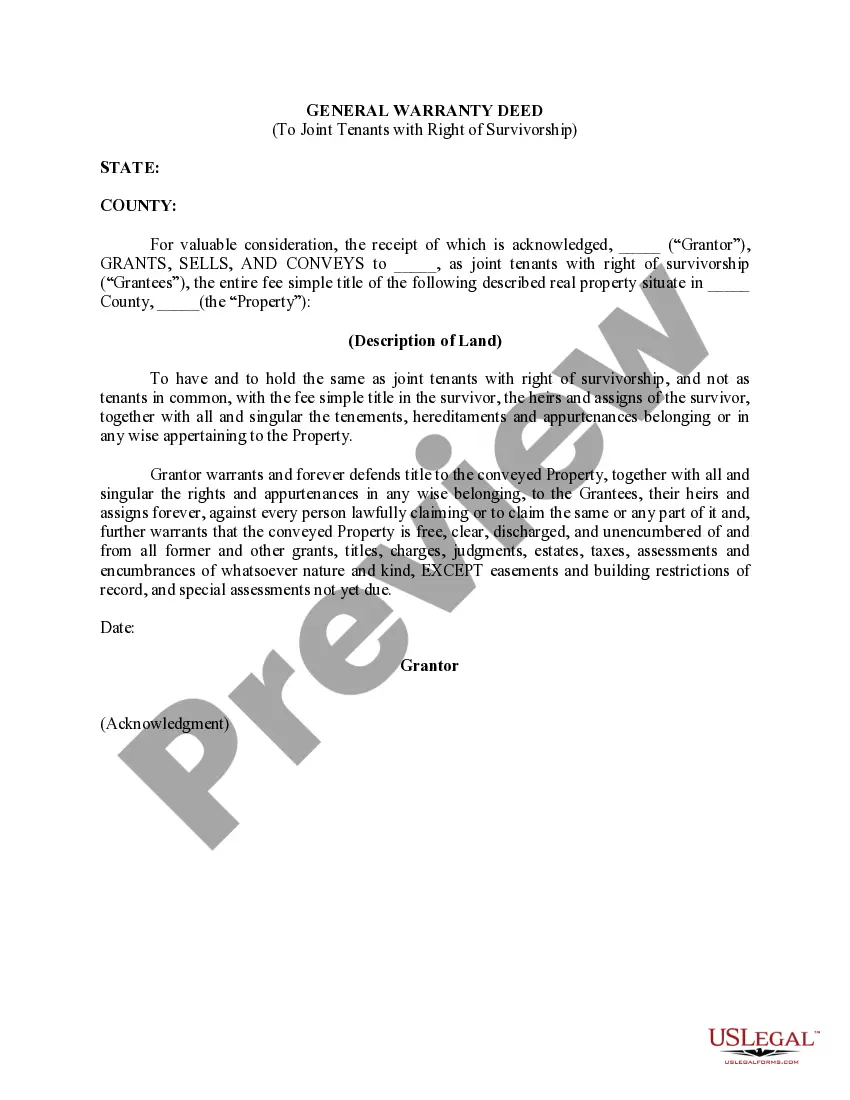
The Warranty Deed for Separate or Joint Property to Joint Tenancy is a legal document that transfers ownership of property from one individual (the grantor) to joint tenants. This type of deed ensures that the co-owners hold equal shares in the property and have the right of survivorship. This means that if one of the joint tenants passes away, the surviving tenant automatically inherits the deceased's share, unlike tenants in common, who may leave their share to others through a will.
Key components of this form
- The name of the grantor transferring the property.
- The names of the grantees who are receiving the title as joint tenants.
- A legal description of the property being transferred.
- Signature lines for witnesses and the grantor.
- A section for notarization to validate the transfer.




When to use this form
This form is used when an individual wishes to transfer property to one or more persons with the intention that they hold it jointly. It is particularly beneficial in situations where the property is intended to be passed on directly to the co-owners without going through probate upon the death of one owner. Common scenarios include family properties or when couples purchase real estate together.
Intended users of this form
- Individuals transferring property to joint tenants.
- Couples looking to purchase property together to ensure rights of survivorship.
- Families wanting to keep property in joint ownership.
- Anyone familiar with legal documents wishing to simplify property transfer processes.
How to prepare this document
- Identify the parties involved by entering the names of the grantor and grantees.
- Specify the property by providing an accurate legal description.
- Fill in the purchase price in the designated space.
- Ensure all witnesses sign the document as required.
- Notarize the document to validate the transfer of ownership.
Notarization requirements for this form
This form must be notarized to be legally valid. US Legal Forms provides secure online notarization powered by Notarize, allowing you to complete the process through a verified video call.
Get your form ready online
Our built-in tools help you complete, sign, share, and store your documents in one place.
Make edits, fill in missing information, and update formatting in US Legal Forms—just like you would in MS Word.
Download a copy, print it, send it by email, or mail it via USPS—whatever works best for your next step.
Sign and collect signatures with our SignNow integration. Send to multiple recipients, set reminders, and more. Go Premium to unlock E-Sign.
If this form requires notarization, complete it online through a secure video call—no need to meet a notary in person or wait for an appointment.
We protect your documents and personal data by following strict security and privacy standards.

Make edits, fill in missing information, and update formatting in US Legal Forms—just like you would in MS Word.

Download a copy, print it, send it by email, or mail it via USPS—whatever works best for your next step.

Sign and collect signatures with our SignNow integration. Send to multiple recipients, set reminders, and more. Go Premium to unlock E-Sign.

If this form requires notarization, complete it online through a secure video call—no need to meet a notary in person or wait for an appointment.

We protect your documents and personal data by following strict security and privacy standards.
Mistakes to watch out for
- Failing to have the deed notarized, which can nullify its legal standing.
- Missing signatures from witnesses or the grantor.
- Not including a complete legal description of the property.
- Using incorrect or ambiguous terms that may confuse ownership rights.
Advantages of online completion
- Convenience of filling out the form at your own pace from any device.
- Ability to easily edit and correct entries before finalizing the deed.
- Access to resources and customer support for assistance during the completion process.
- Peace of mind with downloadable and printable copies for your records.
What to keep in mind
- The Warranty Deed for Separate or Joint Property to Joint Tenancy is essential for joint ownership with survivorship rights.
- Accurate completion and notarization are crucial for the validity of the deed.
- This form serves individuals and families wishing to ensure property is smoothly transferred and retained within a defined group.
Looking for another form?
Form popularity
FAQ
A warranty deed for joint tenants is a legal document that conveys property ownership to two or more people, featuring specific provisions for joint tenancy. This District of Columbia Warranty Deed for Separate or Joint Property to Joint Tenancy establishes equal ownership rights and includes rights of survivorship. When one owner dies, their share automatically passes to the surviving joint tenants without going through probate, ensuring a smooth transition of ownership.
The most important clause in a District of Columbia Warranty Deed for Separate or Joint Property to Joint Tenancy is the granting clause. This clause clearly states the intent of the grantor to transfer ownership. It lays out vital information about the property, ensuring the transfer is legally effective. A clear granting clause can prevent disputes in the future, so it's critical to get it right.
Yes, two people can be on a District of Columbia Warranty Deed for Separate or Joint Property to Joint Tenancy. This arrangement allows them to share ownership rights equally. Both parties must sign the deed, and it is important to understand how it affects ownership, especially in the event of a death or sale. Consider using resources from USLegalForms to ensure compliance with local laws.
'Joint tenants' on a warranty deed refers to a type of ownership where two or more people share equal rights to a property. In the context of a District of Columbia Warranty Deed for Separate or Joint Property to Joint Tenancy, this means that if one owner passes away, their interest automatically transfers to the surviving owner or owners. This arrangement simplifies estate management while ensuring that the property remains within the group of owners.
One disadvantage of a District of Columbia Warranty Deed for Separate or Joint Property to Joint Tenancy is the level of liability it imposes on the grantor. By using this type of deed, the grantor guarantees clear ownership, which means they can be held responsible for any undisclosed issues. Additionally, this deed may not always protect against claims from previous owners. Consider discussing your concerns with a legal expert to understand your options.
To fill out a District of Columbia Warranty Deed for Separate or Joint Property to Joint Tenancy, begin by downloading a template from a trusted source, such as USLegalForms. Make sure to provide details about the property, including the legal description and the current owner's information. After filling in the necessary information, both parties must sign the deed in the presence of a notary to make it legally binding.
A quitclaim deed may be voided if it fails to meet legal requirements or if it contains any fraudulent information. Additionally, if the grantor lacks the legal capacity to transfer property, the deed can be invalidated. To protect your interests, consider using a District of Columbia Warranty Deed for Separate or Joint Property to Joint Tenancy which provides more extensive protections and assurances.
Yes, it is possible to execute a quitclaim deed by yourself, but take extra care to follow local regulations accurately. Using a reliable platform like uslegalforms can simplify this process by offering templates and resources specifically for the District of Columbia Warranty Deed for Separate or Joint Property to Joint Tenancy. With the right tools, you can ensure your deed is properly drafted and recorded.
Yes, you can prepare a quitclaim deed on your own; however, it is often wise to consult a legal professional. An attorney can help you navigate the specifics of a District of Columbia Warranty Deed for Separate or Joint Property to Joint Tenancy. This way, you can ensure that all legal requirements are met and avoid potential pitfalls.
One major disadvantage of a quitclaim deed is that it does not guarantee the title's quality. Unlike other deeds, a District of Columbia Warranty Deed for Separate or Joint Property to Joint Tenancy provides assurances about ownership. Additionally, if there are any existing liens or claims against the property, a quitclaim deed does not shield you from these issues.