Mississippi Temporary Order
What this document covers
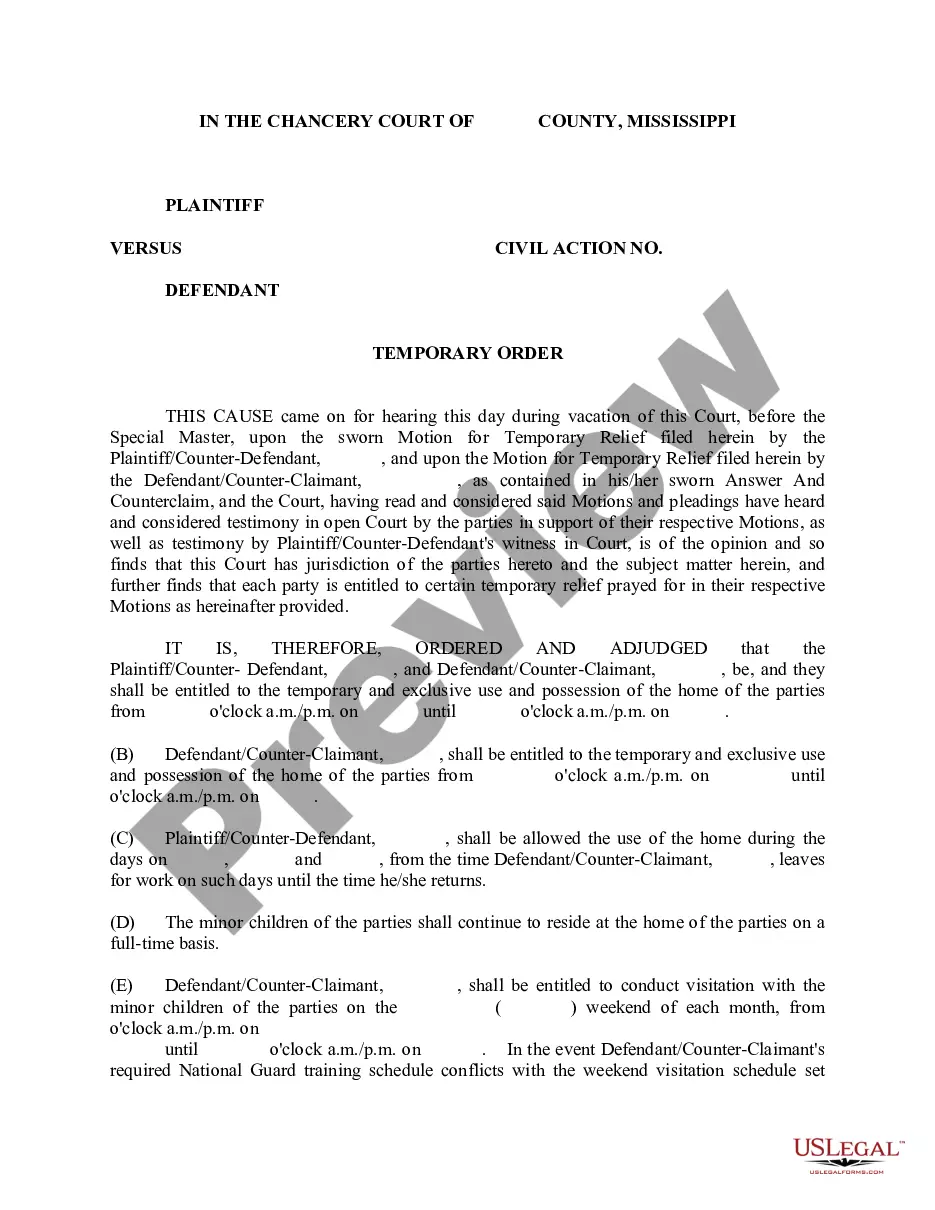
The Temporary Order is a legal document used in divorce proceedings. This form establishes immediate arrangements regarding the use of the family residence, custody of minor children, and financial support. Unlike final custody orders or long-term agreements, a Temporary Order provides short-term relief to both parties while the divorce case is ongoing. It is essential for ensuring that both spouses and children have the necessary arrangements in place during a potentially tumultuous period.
Main sections of this form
- Identification of the parties involved, including Plaintiff and Defendant.
- Details on the temporary use and possession of the marital home.
- Custody arrangements for minor children, specifying residency and visitation schedules.
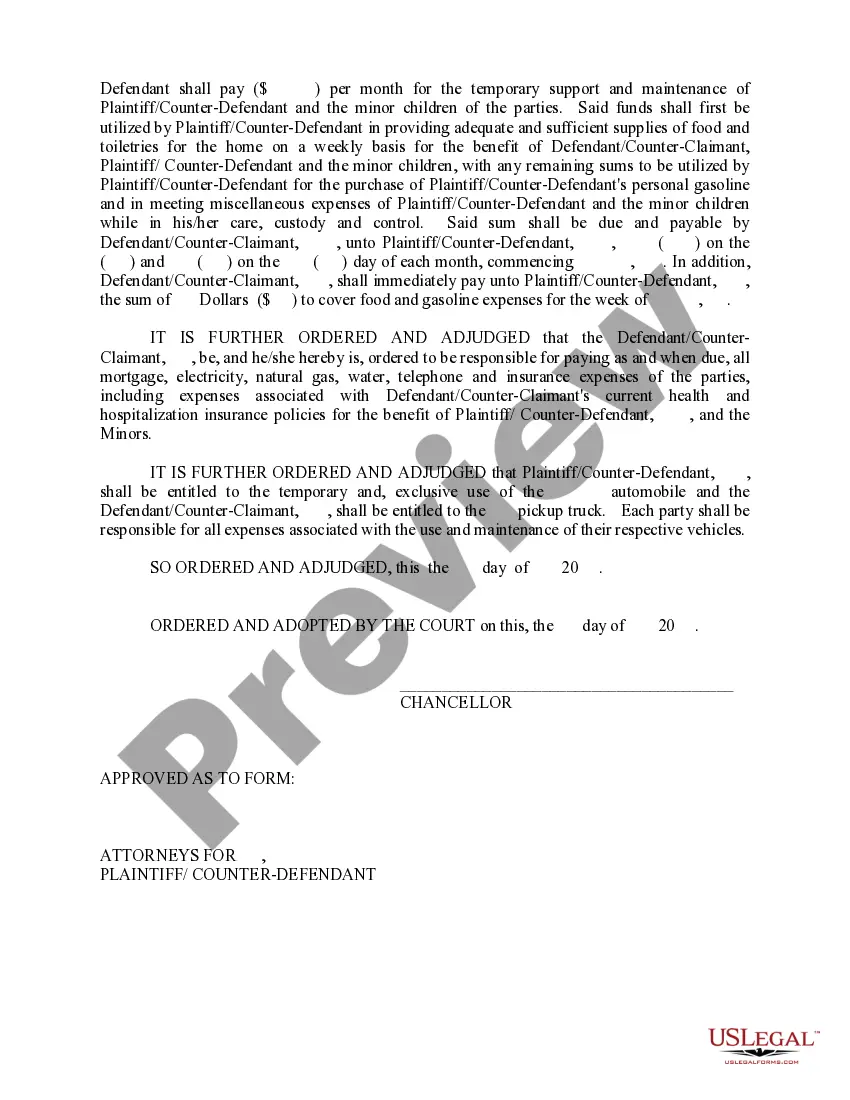
- Temporary financial support obligations, including amounts and payment schedules.
- Responsibilities for household expenses and vehicle usage during the temporary period.
When this form is needed
This form is typically used during divorce proceedings when immediate decisions are needed about living arrangements, child custody, and financial support. For example, if one spouse needs to stay in the marital home, or if arrangements for children's visitation need to be established before a final custody determination can be made, this form provides the necessary legal framework to address these urgent issues.
Intended users of this form
- Individuals currently undergoing a divorce who need immediate legal arrangements.
- Parents seeking temporary custody and visitation rights for their children.
- Spouses requiring temporary financial support during divorce proceedings.
- Anyone involved in a divorce where immediate decisions about living arrangements are necessary.
How to prepare this document
- Identify and enter the names of the Plaintiff and Defendant at the top of the document.
- Specify the dates for the temporary use of the marital home, detailing the scheduling for both parties.
- Outline custody arrangements, including the primary residence of the children and visitation times.
- Detail financial support amounts, payment intervals, and how funds should be used for household necessities.
- Conclude with signatures and date of the order by both parties and the court to finalize the Temporary Order.
Notarization requirements for this form
This form does not typically require notarization unless specified by local law. Make sure to check your jurisdiction's requirements to confirm whether notarization is necessary for the document to be legally binding.
Get your form ready online
Our built-in tools help you complete, sign, share, and store your documents in one place.
Make edits, fill in missing information, and update formatting in US Legal Forms—just like you would in MS Word.
Download a copy, print it, send it by email, or mail it via USPS—whatever works best for your next step.
Sign and collect signatures with our SignNow integration. Send to multiple recipients, set reminders, and more. Go Premium to unlock E-Sign.
If this form requires notarization, complete it online through a secure video call—no need to meet a notary in person or wait for an appointment.
We protect your documents and personal data by following strict security and privacy standards.

Make edits, fill in missing information, and update formatting in US Legal Forms—just like you would in MS Word.

Download a copy, print it, send it by email, or mail it via USPS—whatever works best for your next step.

Sign and collect signatures with our SignNow integration. Send to multiple recipients, set reminders, and more. Go Premium to unlock E-Sign.

If this form requires notarization, complete it online through a secure video call—no need to meet a notary in person or wait for an appointment.

We protect your documents and personal data by following strict security and privacy standards.
Typical mistakes to avoid
- Failing to include specific dates for possession and use of the marital home.
- Not clearly defining visitation schedules, leading to confusion and potential disputes.
- Omitting financial obligations, which may leave one party unprotected.
- Not updating or reviewing the order with regard to changing circumstances.
Benefits of completing this form online
- Convenience of downloading and completing the form from home, saving time and effort.
- Editability allows users to customize the document to fit their specific circumstances.
- Access to templates drafted by licensed attorneys ensures legal accuracy and reliability.
- Immediate availability for urgent situations that require prompt legal attention.
Legal use & context
- The Temporary Order is legally binding until a final order is issued in the divorce.
- Failure to comply with the terms laid out in this order may lead to legal consequences.
- The form helps prevent disputes by clarifying temporary arrangements during a divorce.
What to keep in mind
- A Temporary Order is essential for immediate arrangements in a divorce.
- This form addresses critical issues such as custody, support, and property use.
- It is adaptable to specific state laws, so verify local requirements.
Looking for another form?
Form popularity
FAQ
Typically, a temporary orders hearing will be handled in one of two ways, either by calling witnesses (including the parties) to the stand and asking them questions aimed at eliciting direct testimony from them (referred to as an evidentiary hearing) or by your attorney offering summaries of what witnesses would say,
What Is Temporary Relief? After a case is filed, but before it is resolved, sometimes it is necessary to ask the court for an award of temporary relief. This usually happens when the parties have a dispute about payment of ongoing bills, support, or issues involving children.
If the judge is satisfied, he or she will issue a temporary protective order that will last ten days, but which can be extended upon request, up to the maximum length of one year, but can only last 30 days where the victim has minor children with the abuser.
Temporary orders Normally, a temporary order remains in effect until a judge ends it, modifies it or issues a final order replacing it. Occasionally, a temporary order has an expiration date. If parents can agree how to co-parent for the duration of their case, they may not need a temporary order.
If a family court lawsuit is administratively dismissed, all temporary orders become void and any outstanding obligations under the temporary order also become void. If there is a prior final order between the parties, that final order regains its effect (to the extent a temporary order in the new action modified it).
As their name says, temporary orders are not permanent. They're not intended to have a long-term, binding effect on a divorce settlement (though temporary orders can influence2026
Temporary orders are made by family courts at a hearing when couples separate.Decisions on issues that must be resolved quickly are made, and given temporary effect, until family court decisions can be made in a formal divorce hearing or until the parties agree through mediation or negotiation.
Typically, a temporary orders hearing will be handled in one of two ways, either by calling witnesses (including the parties) to the stand and asking them questions aimed at eliciting direct testimony from them (referred to as an evidentiary hearing) or by your attorney offering summaries of what witnesses would say,
At a temporary hearing, for example, a Family Court Judge receives temporary hearing packets from both parties, reviews those packets, hears from each party's attorney regarding her/his client's position on the matter, and then makes a ruling, on a temporary basis, as to what terms the parties will abide by until the