Arkansas Warranty Deed to Separate Property of one Spouse to both as Joint Tenants or as Community Property with Right of Survivorship
What is this form?
This Warranty Deed allows one spouse to transfer ownership of separate property to both spouses as joint tenants or as community property with the right of survivorship. This legal document differs from other deeds by specifically addressing the rights of both spouses in the property and ensuring that, upon the death of one spouse, the surviving spouse automatically inherits the property without going through probate.
Key parts of this document
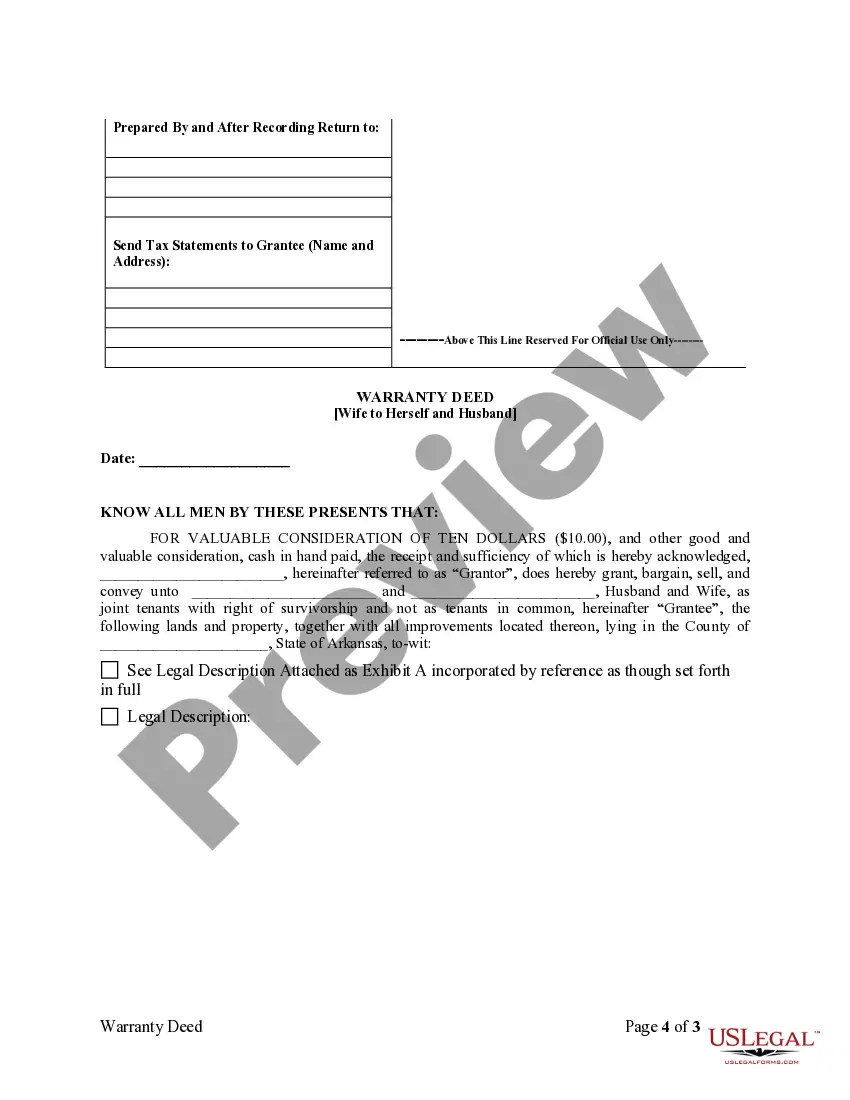
- Grantor and Grantee Information: Details about the spouse transferring the property (grantor) and the receiving spouse (grantee).
- Property Description: A clear description of the property being transferred, including legal description.
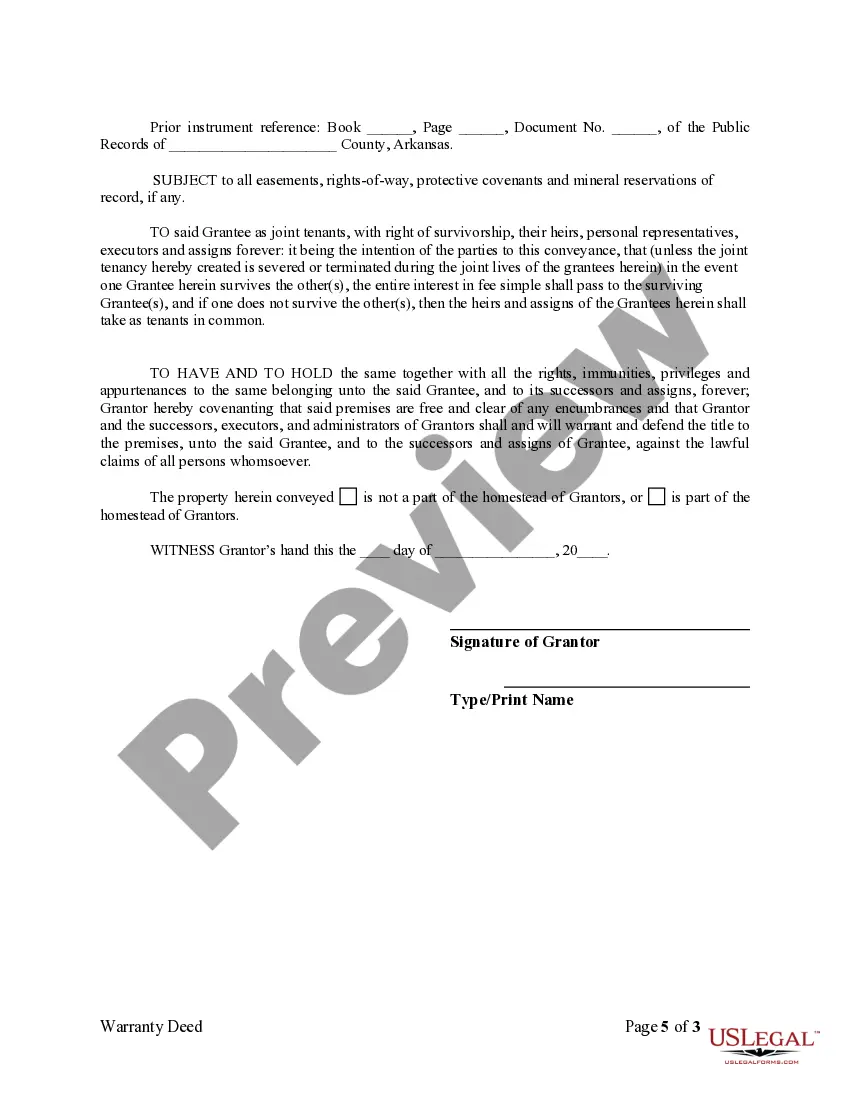
- Joint Tenancy Clause: Specifies the intent to hold the property as joint tenants with rights of survivorship.
- Warrant of Title: The grantor confirms that the property is free from encumbrances and warrants the title to the grantee.
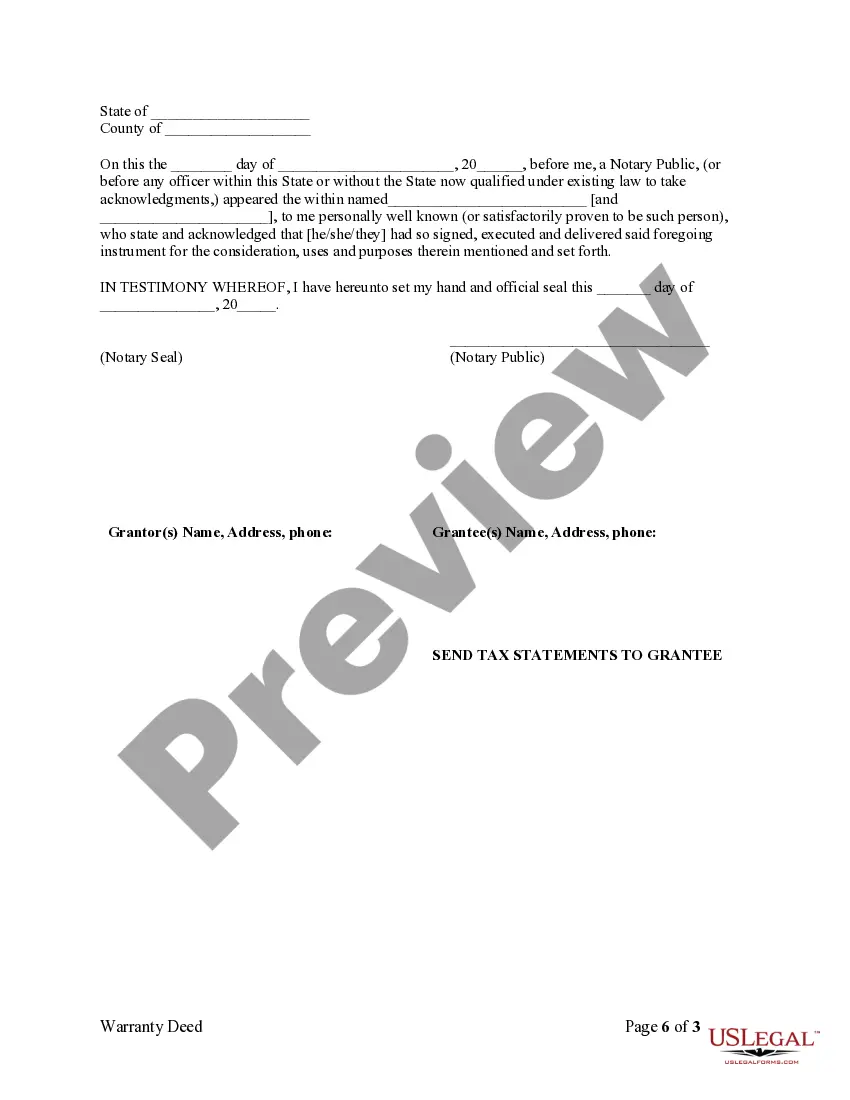
- Signatures and Dates: Required signatures of the grantor and witnesses, along with the date of execution.




Situations where this form applies
This form is useful when one spouse wishes to legally transfer their individual property into joint ownership with their spouse. It can be used in situations such as marriage, estate planning, or when one spouse wants to ensure that the other has full rights to the property upon their death.
Who can use this document
This Warranty Deed is suitable for:
- Married couples looking to consolidate ownership of property.
- Individuals who own separate property and wish to transfer it to their spouse.
- Spouses wanting to establish joint ownership with survival rights.
How to prepare this document
- Identify the parties involved by entering the names of the grantor (spouse transferring the property) and grantee (spouse receiving the property).
- Clearly specify the property being transferred, including legal descriptions and physical addresses.
- Complete the joint tenancy clause, indicating the intention for rights of survivorship.
- Sign and date the document as the grantor, ensuring all required witness signatures are included.
- Review the entire document for accuracy before finalizing it.
Does this document require notarization?
This form does not typically require notarization unless specified by local law. However, it's advisable to check with a local legal professional to confirm any requirements specific to your jurisdiction.
Get your form ready online
Our built-in tools help you complete, sign, share, and store your documents in one place.
Make edits, fill in missing information, and update formatting in US Legal Forms—just like you would in MS Word.
Download a copy, print it, send it by email, or mail it via USPS—whatever works best for your next step.
Sign and collect signatures with our SignNow integration. Send to multiple recipients, set reminders, and more. Go Premium to unlock E-Sign.
If this form requires notarization, complete it online through a secure video call—no need to meet a notary in person or wait for an appointment.
We protect your documents and personal data by following strict security and privacy standards.

Make edits, fill in missing information, and update formatting in US Legal Forms—just like you would in MS Word.

Download a copy, print it, send it by email, or mail it via USPS—whatever works best for your next step.

Sign and collect signatures with our SignNow integration. Send to multiple recipients, set reminders, and more. Go Premium to unlock E-Sign.

If this form requires notarization, complete it online through a secure video call—no need to meet a notary in person or wait for an appointment.

We protect your documents and personal data by following strict security and privacy standards.
Common mistakes
- Failing to provide a complete property description.
- Not having the document properly signed or witnessed.
- Neglecting to check state-specific requirements.
Why use this form online
- Convenient access: Download the form from the comfort of your home.
- Editability: Make changes easily using your computer before filling it out.
- Reliability: Forms are drafted by licensed attorneys and adhere to state laws.
Looking for another form?

Form popularity
FAQ
The weakest form of deed is the quitclaim deed. It offers no guarantees or warranties, merely transferring whatever interest the grantor holds without liability. This means that if there are any claims or encumbrances on the property, the grantee assumes that risk. If you are considering using an Arkansas Warranty Deed to Separate Property of one Spouse to both as Joint Tenants or as Community Property with Right of Survivorship, be cautious of potentially opting for a quitclaim deed unless you are fully aware of the implications.
The strongest form of deed is a warranty deed. A warranty deed provides the grantee with full assurances of clear title and protections against any future claims on the property. This type of deed is ideal for buyers who wish to ensure their investment is secure. If you are transferring an Arkansas Warranty Deed to Separate Property of one Spouse to both as Joint Tenants or as Community Property with Right of Survivorship, choosing a warranty deed can help safeguard your property rights.
Yes, Arkansas recognizes joint property but operates under a unique system that combines joint tenancy and community property principles. In this state, couples can hold property either as joint tenants with rights of survivorship or as community property. Choosing the right form of ownership can significantly impact your estate planning, and knowing the implications of an Arkansas Warranty Deed to Separate Property of one Spouse to both as Joint Tenants or as Community Property with Right of Survivorship is essential for making informed decisions.
The primary difference lies in the guarantees offered by each type of deed. A warranty deed guarantees that the grantor holds clear title to the property and has the right to sell it. In contrast, a quitclaim deed makes no promises regarding the status of the title. If you are considering transferring property using an Arkansas Warranty Deed to Separate Property of one Spouse to both as Joint Tenants or as Community Property with Right of Survivorship, understanding these differences will ensure you select the right option for your needs.
A quitclaim deed in Arkansas transfers whatever interest the grantor has in a property to the grantee without any warranties. This means that if issues arise regarding the title, the grantee cannot hold the grantor liable. This type of deed is often used among family members or in divorces, as it is a quick and simple way to change property ownership. Understanding how a quitclaim deed relates to an Arkansas Warranty Deed to Separate Property of one Spouse to both as Joint Tenants or as Community Property with Right of Survivorship can help clarify your ownership intentions.
Yes, joint tenancy with right of survivorship can override a will, as the property transfers automatically to the surviving owner. This can contradict the intentions laid out in a will, making planning essential. When considering the Arkansas Warranty Deed to Separate Property of one Spouse to both as Joint Tenants or as Community Property with Right of Survivorship, it's important to clearly establish your estate planning objectives to avoid unintended consequences.
A quitclaim deed transfers whatever interest the grantor has without guaranteeing its validity, whereas a warranty deed guarantees clear ownership and the right to transfer it. The Arkansas Warranty Deed to Separate Property of one Spouse to both as Joint Tenants or as Community Property with Right of Survivorship provides an assurance of title, making it a more secure option for protecting property rights. Understanding these differences is essential when deciding on property transfers.
The right of survivorship provision in a warranty deed allows surviving owners to gain full ownership of the property automatically, avoiding probate. This can be a compelling reason to use an Arkansas Warranty Deed to Separate Property of one Spouse to both as Joint Tenants or as Community Property with Right of Survivorship. It ensures a clear, direct transfer of ownership, providing convenience and security.
One notable disadvantage of the right of survivorship is that it can disregard individual estate plans. For example, if you intend to leave your property to certain heirs, joint ownership could override your will. When dealing with the Arkansas Warranty Deed to Separate Property of one Spouse to both as Joint Tenants or as Community Property with Right of Survivorship, it’s crucial to evaluate how these designations align with your long-term goals.
While the right of survivorship is a standard feature in joint tenancies, challenging this right in the UK can lead to legal disputes and may involve examining ownership documentation. Differences in property law between jurisdictions mean that what applies in Arkansas may not transfer directly to the UK. If you’re considering these arrangements, consulting with a legal expert can clarify your specific rights and options.