Quitclaim Deed Illinois With Covenant
Description
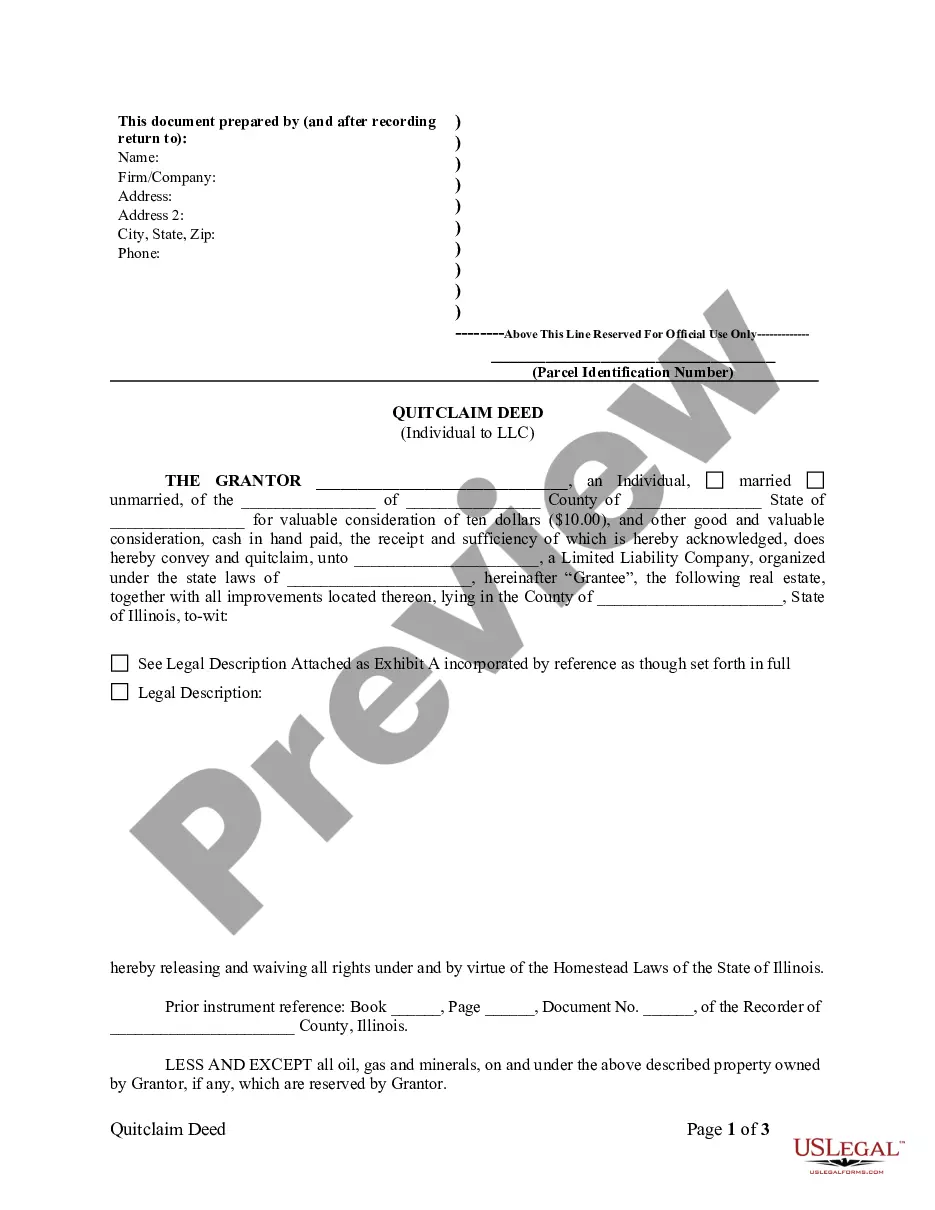
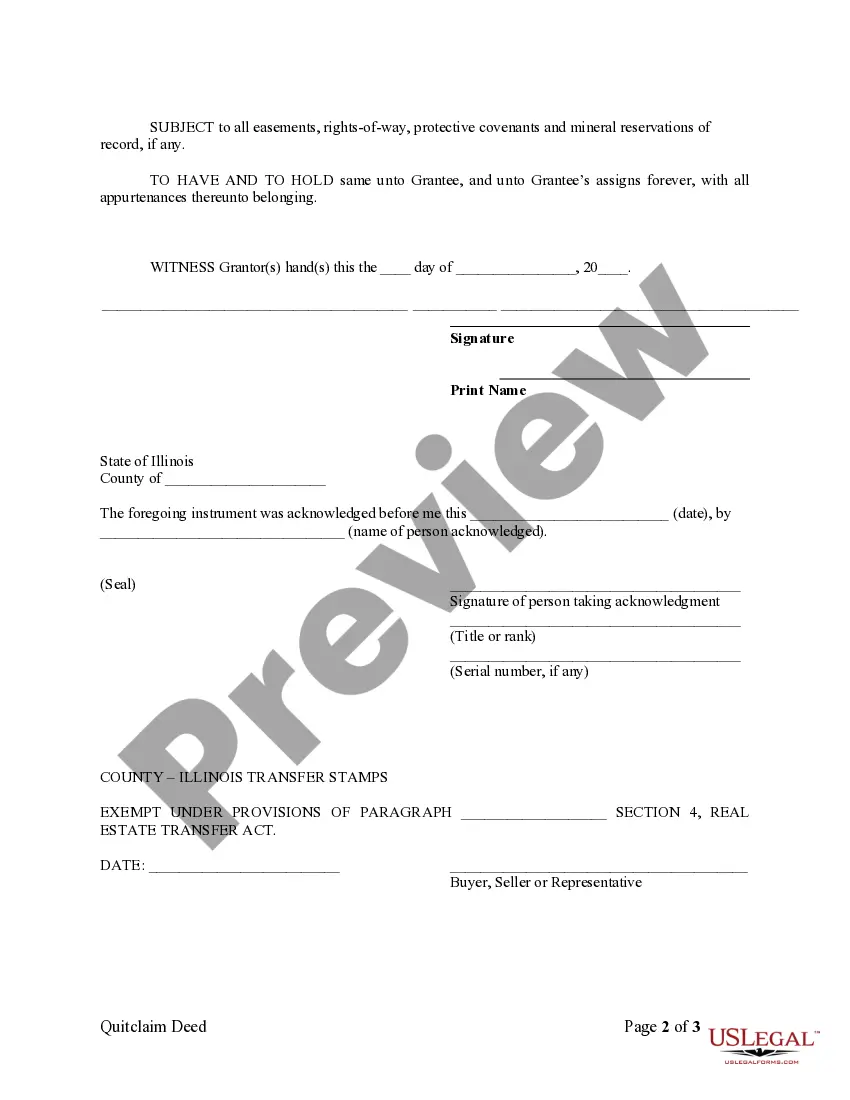

Get your form ready online
Our built-in tools help you complete, sign, share, and store your documents in one place.
Make edits, fill in missing information, and update formatting in US Legal Forms—just like you would in MS Word.
Download a copy, print it, send it by email, or mail it via USPS—whatever works best for your next step.
Sign and collect signatures with our SignNow integration. Send to multiple recipients, set reminders, and more. Go Premium to unlock E-Sign.
If this form requires notarization, complete it online through a secure video call—no need to meet a notary in person or wait for an appointment.
We protect your documents and personal data by following strict security and privacy standards.

Make edits, fill in missing information, and update formatting in US Legal Forms—just like you would in MS Word.

Download a copy, print it, send it by email, or mail it via USPS—whatever works best for your next step.

Sign and collect signatures with our SignNow integration. Send to multiple recipients, set reminders, and more. Go Premium to unlock E-Sign.

If this form requires notarization, complete it online through a secure video call—no need to meet a notary in person or wait for an appointment.

We protect your documents and personal data by following strict security and privacy standards.
Looking for another form?










How to fill out Illinois Quitclaim Deed From Individual To LLC?
Managing legal documents can be daunting, even for experienced individuals.
If you are seeking a Quitclaim Deed Illinois With Covenant and cannot find the time to search for the correct and updated version, the process can be stressful.
US Legal Forms caters to all your needs, from personal to business documentation, all in one place.
Utilize sophisticated tools to complete and manage your Quitclaim Deed Illinois With Covenant.
Here are the steps to follow after downloading the form you need: Check that it is the correct form by previewing it and reviewing its description, confirm that the template is accepted in your state or county, click Buy Now when you are ready, select a monthly subscription plan, choose the format you need, and Download, complete, sign, print, and submit your document. Take advantage of the US Legal Forms online library, supported by 25 years of expertise and trustworthiness. Transform your daily document management into a seamless and user-friendly experience today.
- Access a repository of articles, guidelines, manuals, and resources pertinent to your situation and needs.
- Save time and effort in finding the documents you require, using US Legal Forms’ advanced search and Preview tool to find and download Quitclaim Deed Illinois With Covenant.
- If you have a subscription, Log Into your US Legal Forms account, search for the form, and download it.
- Check the My documents tab to view the documents you have previously downloaded and organize your folders as desired.
- If this is your first experience with US Legal Forms, create an account and gain unlimited access to all the benefits of the library.
- A comprehensive online form library could be a transformative solution for those looking to navigate these issues efficiently.
- US Legal Forms is a leading provider of online legal documents, offering over 85,000 state-specific legal forms accessible at any time.
- With US Legal Forms, you can access state or county-specific legal and business documents.
Form popularity
FAQ
Due to this, quitclaim deeds typically are not used in situations where the property involved has an outstanding mortgage. After all, it would be difficult for many grantors to pay off a mortgage without proceeds from the sale of the property.
Quitclaim deeds include no title of covenant and are therefore less comprehensive, providing the least amount of protection of all deed transfers. For this reason, quitclaim deeds are rarely used to transfer title between a buyer and seller of real property.
A quitclaim deed contains no covenants or warranties of title. An interested witness, such as the grantee of a deed, cannot witness the grantor's signature.
LEGAL FEES - ILLINOIS QUIT CLAIM DEEDS The fee is $150 (or $160 if paid by credit card). It will be your responsibility to get the transfer stamps (if necessary) and get the deed recorded with the County Recorder. There is nothing legal about obtaining the municipal stamp and recording the deed.
A covenant of seisin is an agreement entered into by a grantor, or owner of a property, and a grantee, or buyer. The covenant states that the grantor solely owns the land or property being purchased, and no other parties have a property interest or claim to ownership of the land.