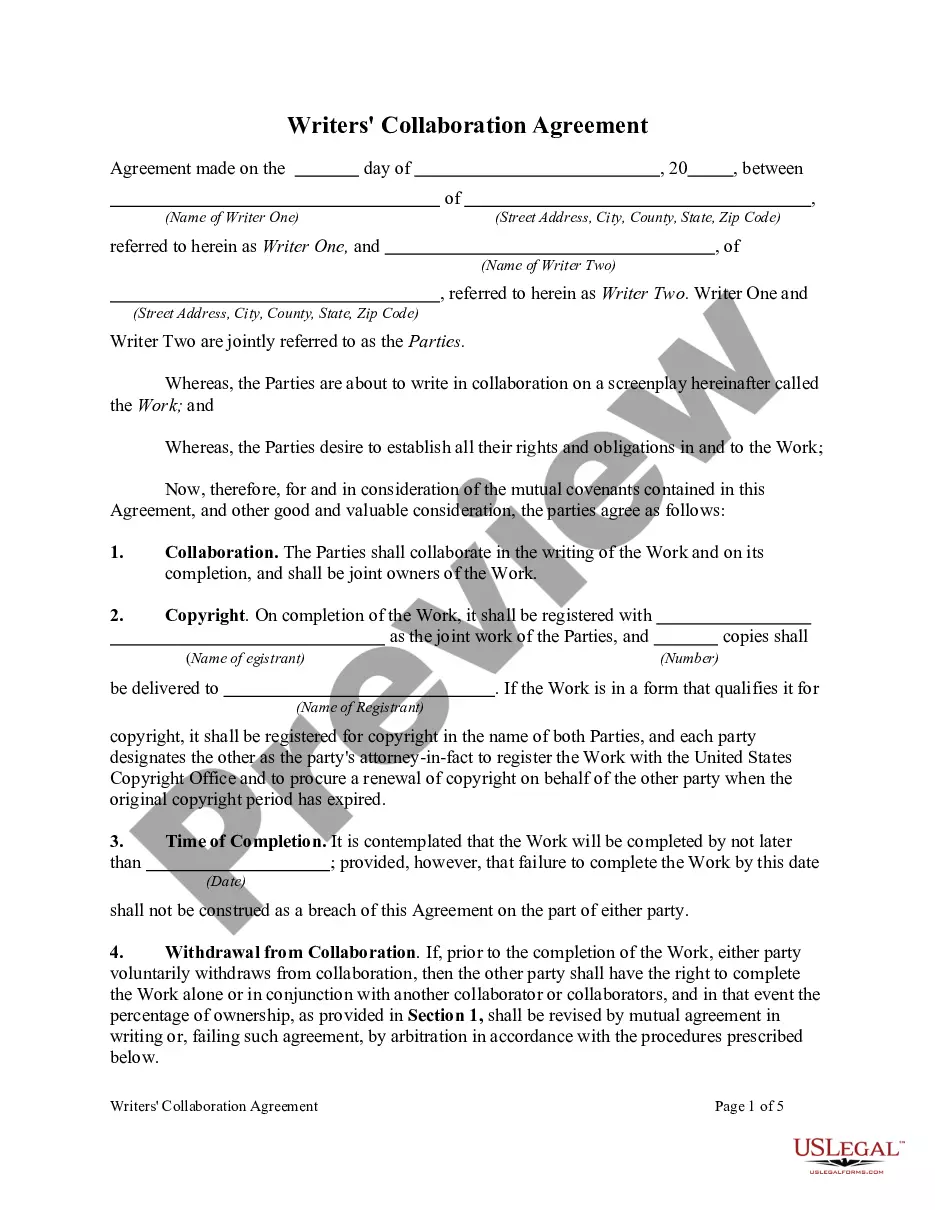
Writers' Collaboration Agreement
What this document covers
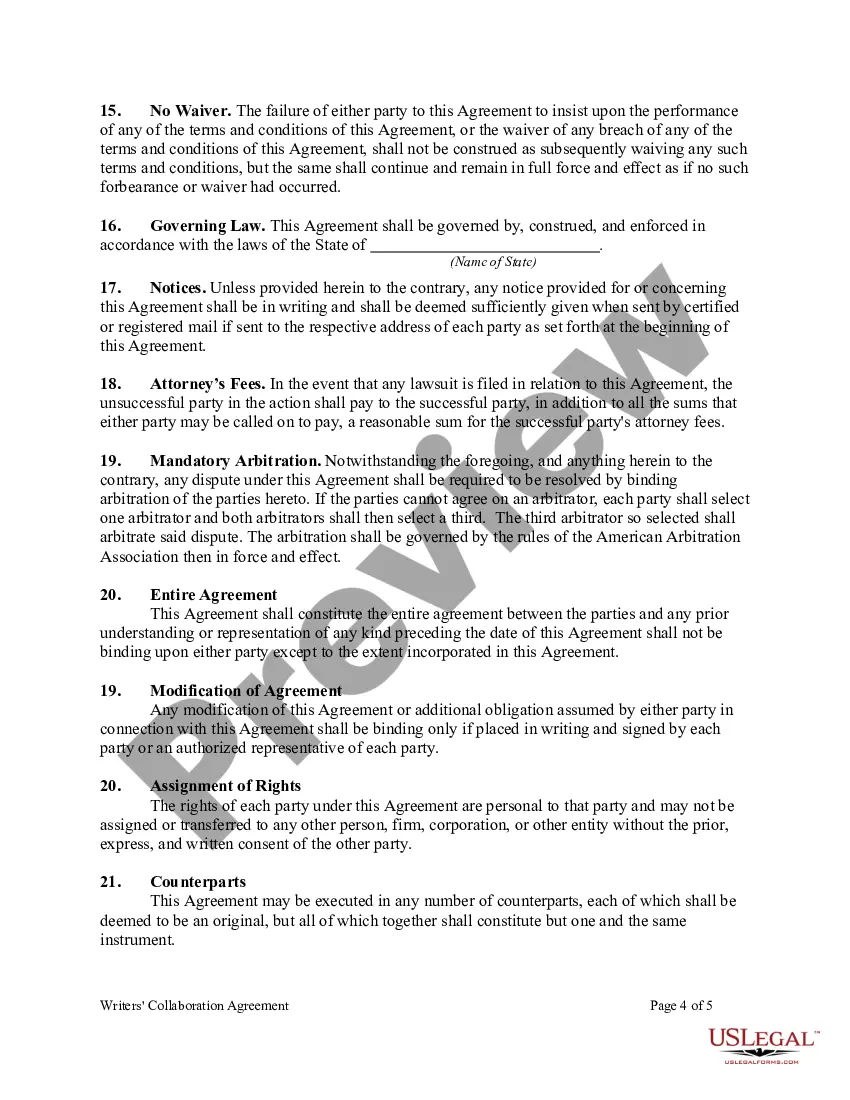
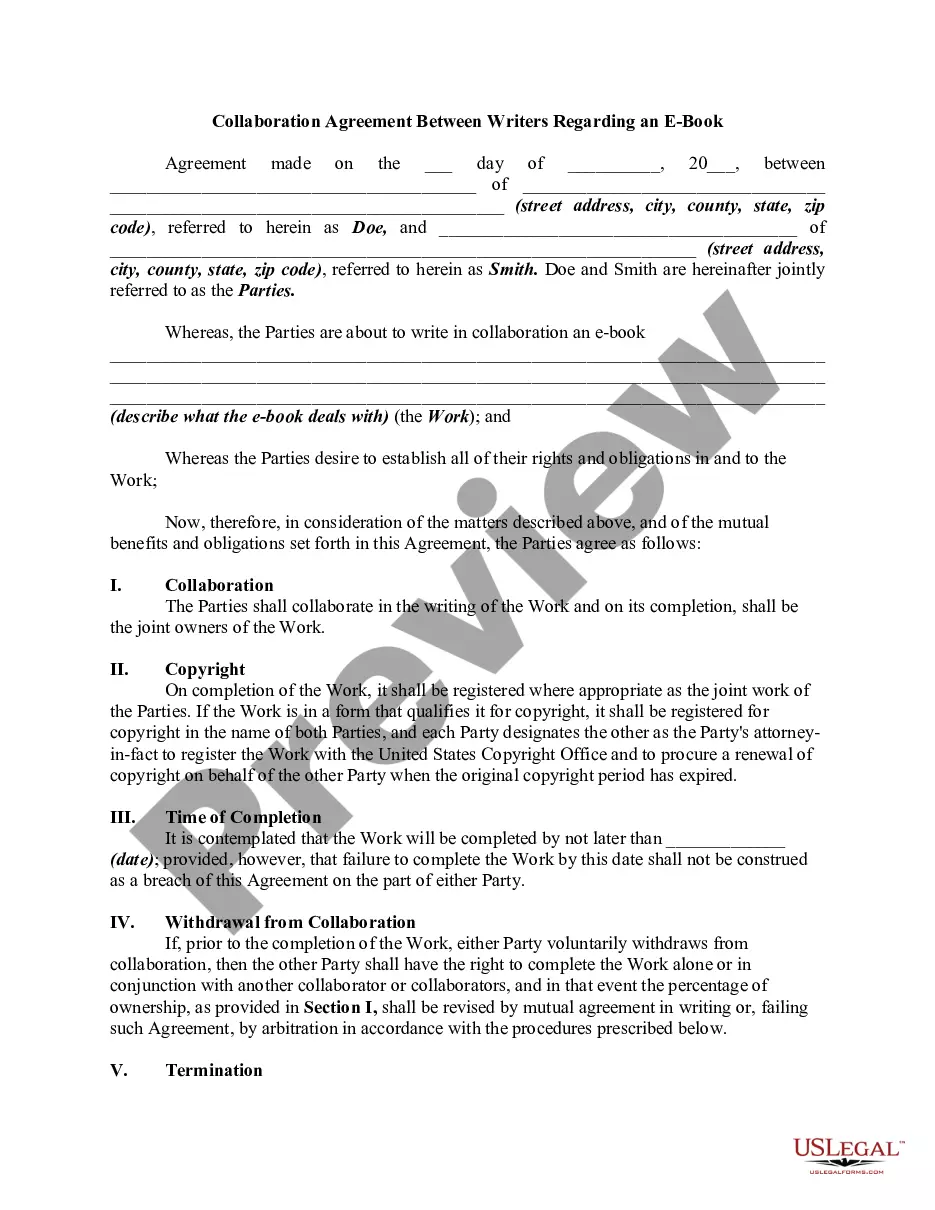
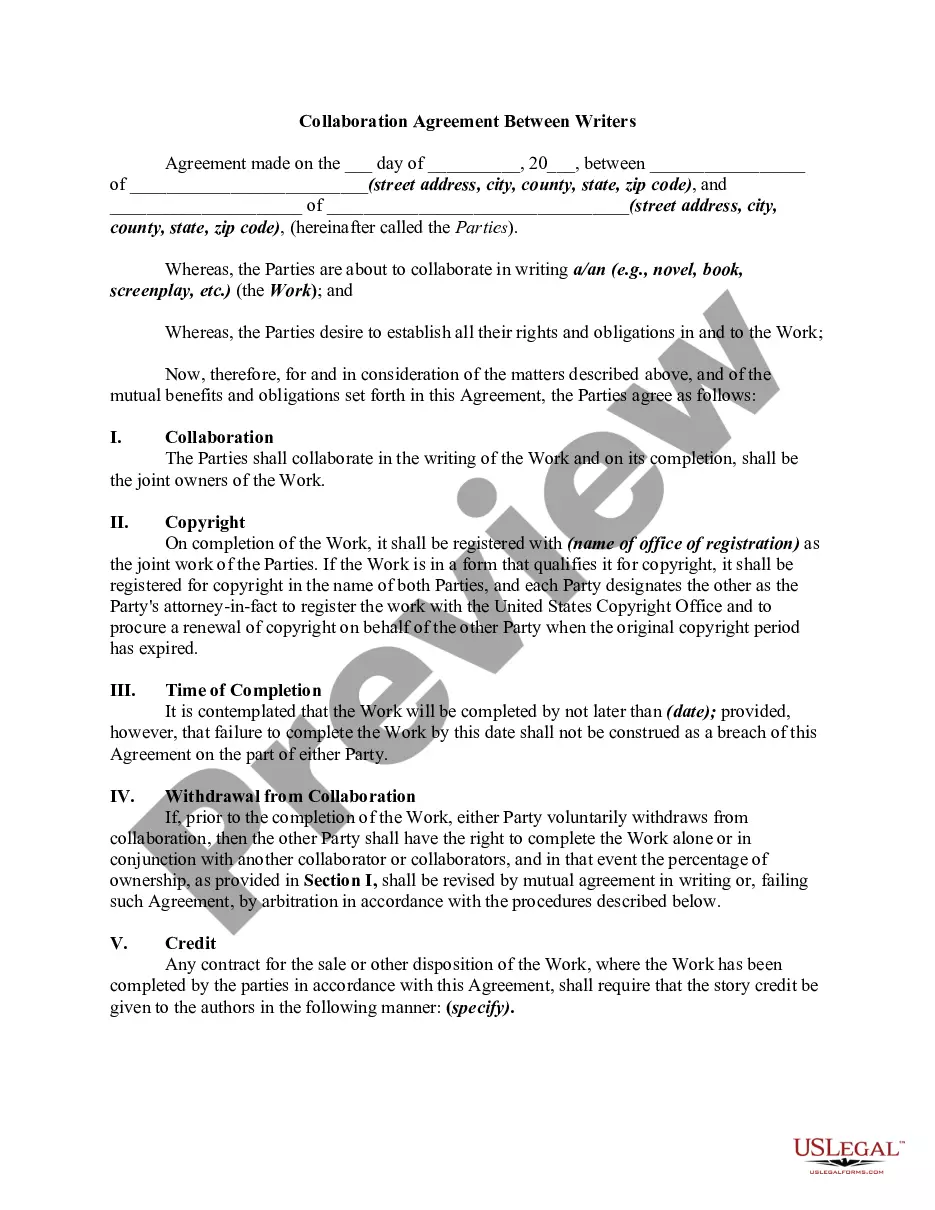
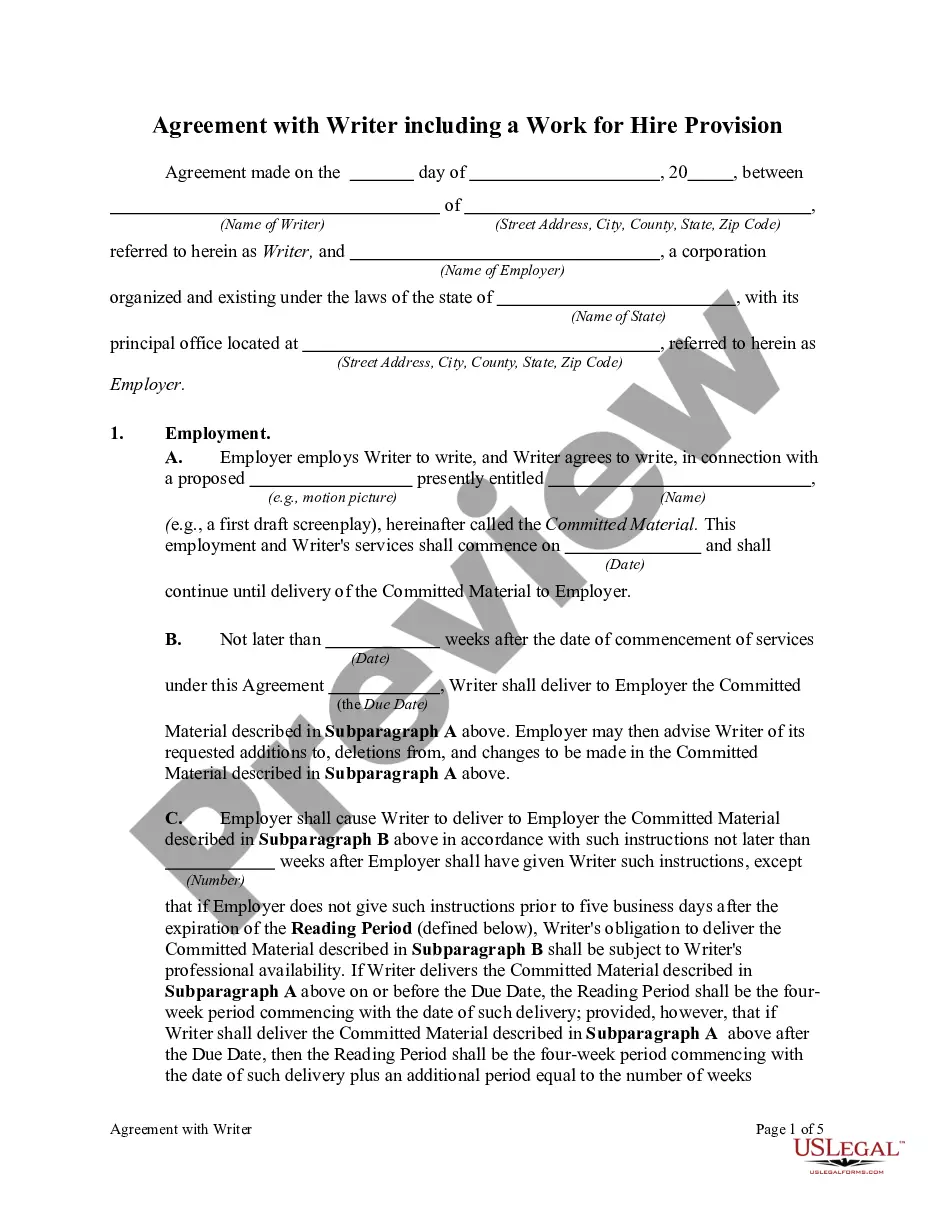
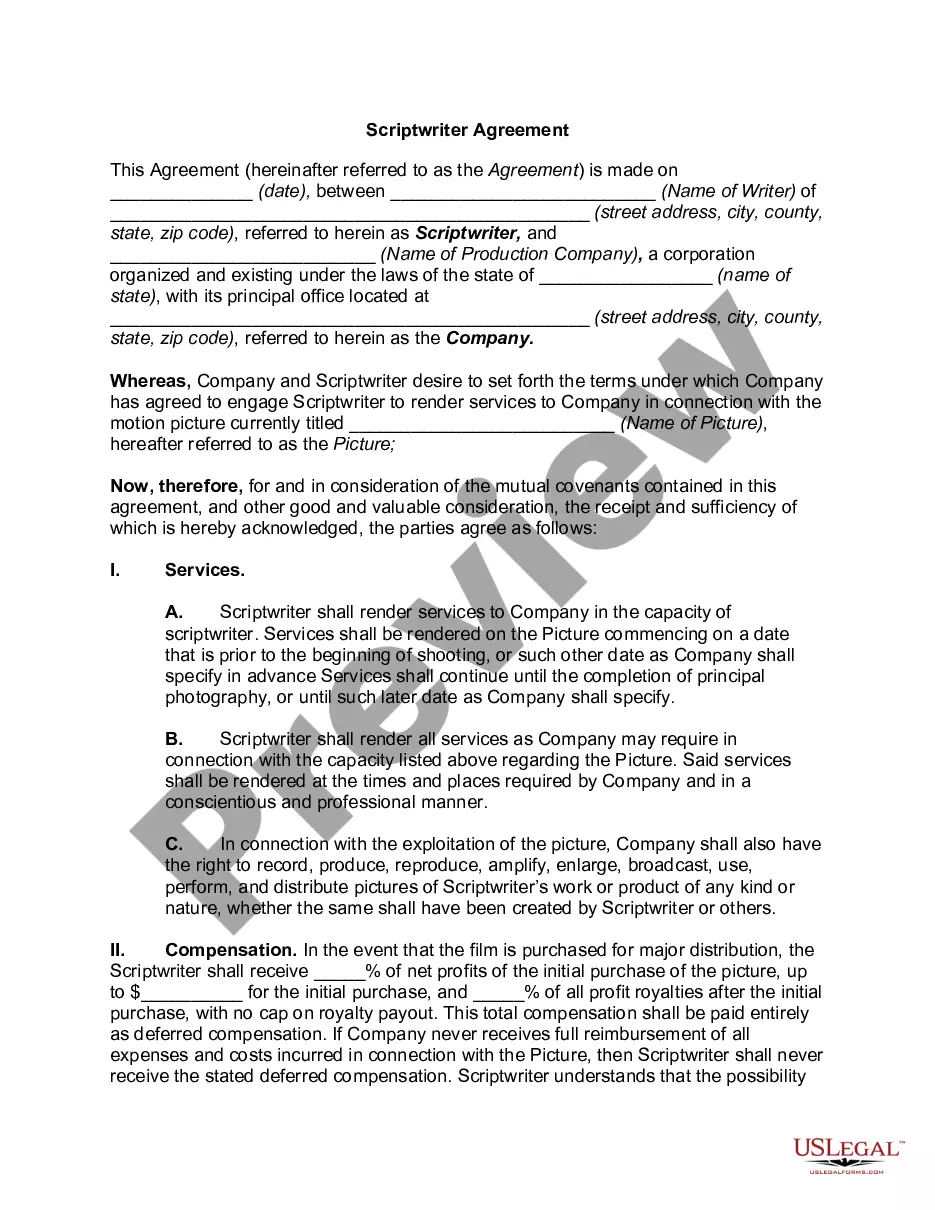
The Writers' Collaboration Agreement is a legal document designed for writers who are co-authoring a significant work, such as a book or screenplay. This agreement outlines the rights and obligations of each party involved in the collaboration, ensuring clarity and protecting the interests of both writers. By establishing terms regarding ownership and profit-sharing, a collaboration agreement helps prevent disputes and lays a foundation for a successful partnership.
Key components of this form
- Definitions of the parties involved in the collaboration.
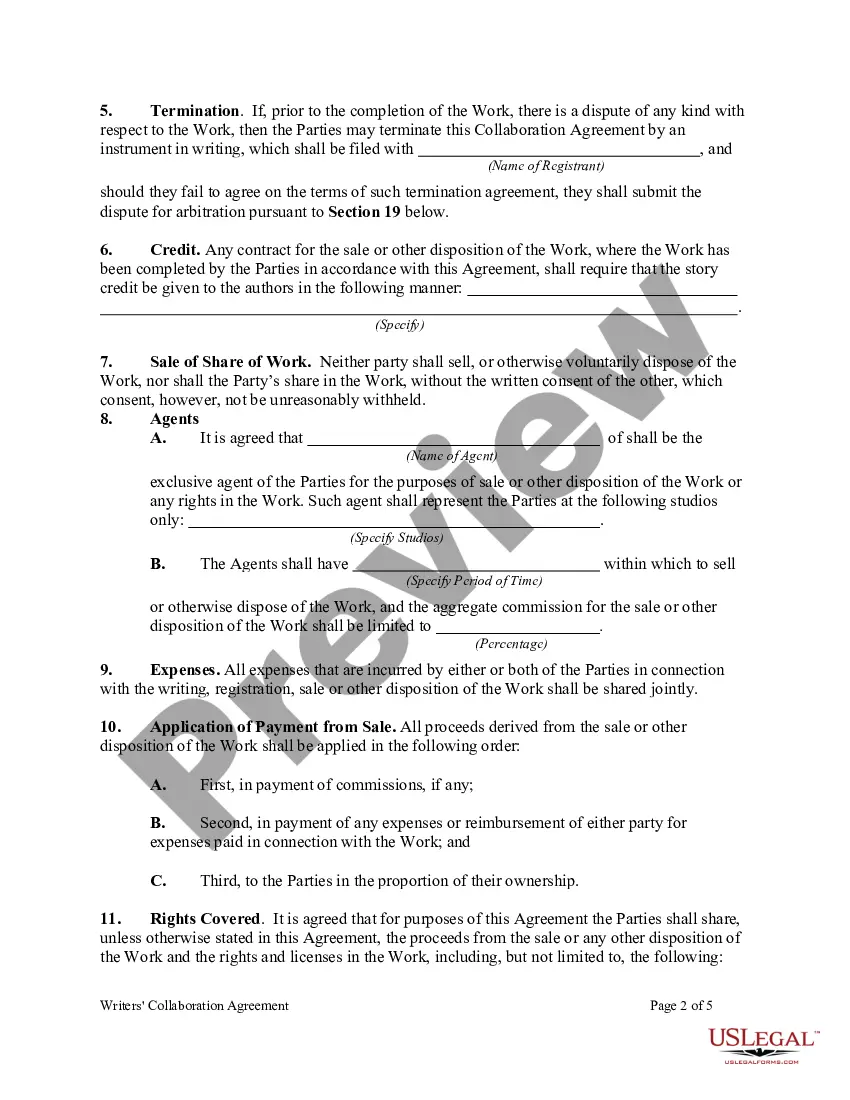
- Payment application from the sale of the work, including commission and expense reimbursement.
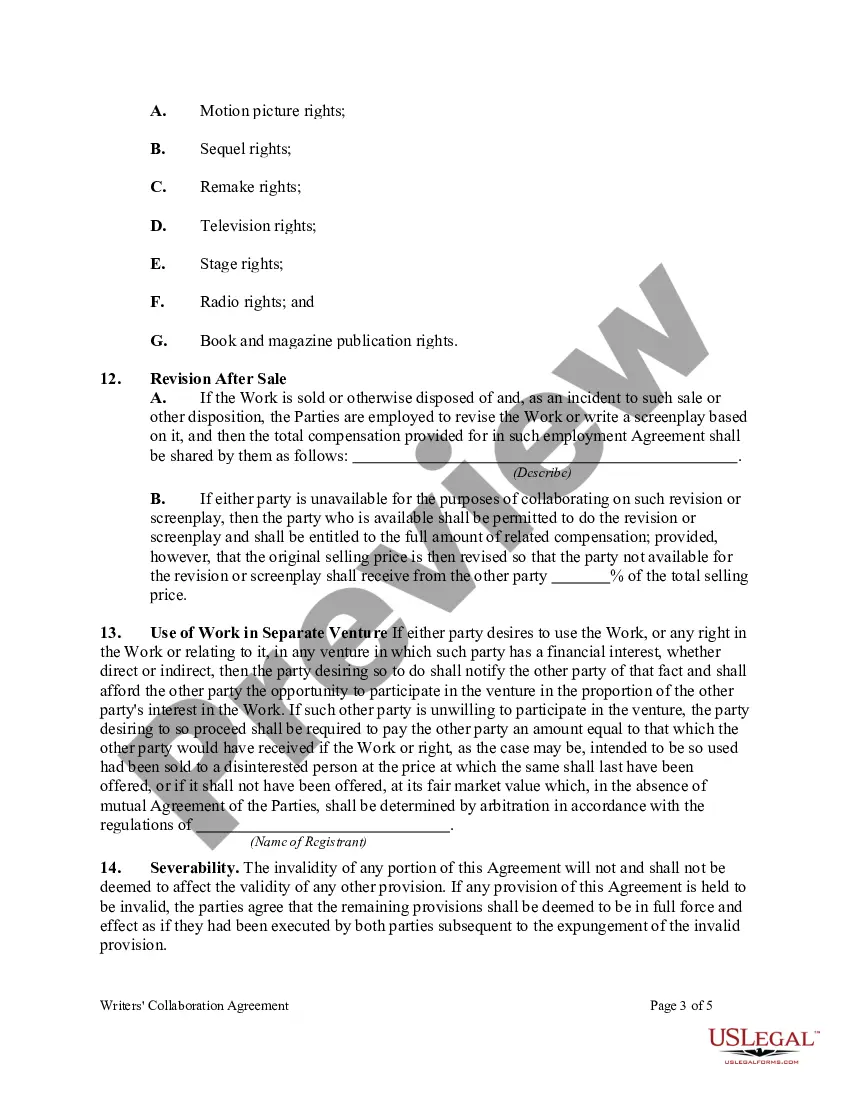
- Details on shared rights and licenses related to the work, such as motion picture and television rights.
- Terms regarding any revisions after the sale of the work.
Situations where this form applies
This form should be used when two or more writers decide to collaborate on a substantial project. If you are working together on a book, screenplay, or other creative work that involves a significant investment of time and resources, creating a Writers' Collaboration Agreement is essential. This will help you manage expectations and clarify financial arrangements, especially if you anticipate selling the work or seek compensation for your efforts.
Who this form is for
- Co-authors of books or screenplays who intend to share ownership and royalties.
- Creative professionals collaborating on a substantial project.
- Writers who want to clearly define their rights and responsibilities in a joint work.
How to prepare this document
- Identify the parties involved by providing their legal names and contact information.
- Clearly define the work being produced, including the title and type of creative project.
- Specify the payment structure and how proceeds from the work will be distributed.
- Outline the rights associated with the work, detailing how these will be shared.
- Include any additional clauses that address revisions or future agreements.
Does this form need to be notarized?
In most cases, this form does not require notarization. However, some jurisdictions or signing circumstances might. US Legal Forms offers online notarization powered by Notarize, accessible 24/7 for a quick, remote process.
Get your form ready online
Our built-in tools help you complete, sign, share, and store your documents in one place.
Make edits, fill in missing information, and update formatting in US Legal Forms—just like you would in MS Word.
Download a copy, print it, send it by email, or mail it via USPS—whatever works best for your next step.
Sign and collect signatures with our SignNow integration. Send to multiple recipients, set reminders, and more. Go Premium to unlock E-Sign.
If this form requires notarization, complete it online through a secure video call—no need to meet a notary in person or wait for an appointment.
We protect your documents and personal data by following strict security and privacy standards.

Make edits, fill in missing information, and update formatting in US Legal Forms—just like you would in MS Word.

Download a copy, print it, send it by email, or mail it via USPS—whatever works best for your next step.

Sign and collect signatures with our SignNow integration. Send to multiple recipients, set reminders, and more. Go Premium to unlock E-Sign.

If this form requires notarization, complete it online through a secure video call—no need to meet a notary in person or wait for an appointment.

We protect your documents and personal data by following strict security and privacy standards.
Common mistakes to avoid
- Not specifying the ownership percentage of each writer.
- Failing to clarify the payment structure and how expenses are handled.
- Neglecting to sign the agreement, making it unenforceable.
Why use this form online
- Convenience of downloading and editing the form at your own pace.
- Availability of templates created by licensed attorneys, ensuring legal reliability.
- Easy access to updates or revisions, allowing for quick adjustments as needed.
Legal use & context
- A Writers' Collaboration Agreement is legally binding once all parties have signed it.
- It protects the interests of both writers by outlining rights, responsibilities, and compensation terms.
- Consulting a legal professional can help ensure the agreement meets all necessary requirements.
Main things to remember
- The agreement is vital for defining the terms of collaboration between writers.
- Clearly outlining rights and payment structures can prevent future disputes.
- Using a professionally drafted template adds legal confidence to your collaboration.
Looking for another form?

Form popularity
FAQ
Have clearly defined roles. Will you split responsibilities down the middle? Know your strengths and weaknesses. Be able to take critiques from your partner/s. Be flexible. Smooth out stylistic differences. Agree on a referee. Put it in writing. Define how the process of collaborative writing will work.
Collaboration agreements document the terms and conditions of a project between two or more companies. Each company may be contributing intellectual property, resources, or research, product development or marketing expertise to the project.
Get it in writing. Keep it simple. Deal with the right person. Identify each party correctly. Spell out all of the details. Specify payment obligations. Agree on circumstances that terminate the contract. Agree on a way to resolve disputes.
A Collaboration agreement is an agreement between at least two parties looking to work together on a commercial project on a collaborative or cooperative basis.
A memorandum of agreement (MOA) or cooperative agreement is a document written between parties to cooperatively work together on an agreed upon project or meet an agreed upon objective. The purpose of an MOA is to have a written understanding of the agreement between parties.
Some of the most common types of collaboration include networks, coalitions, movements, strategic alliances, strategic co-funding, public private partnerships and collective impact initiatives. It can sometimes be difficult to differentiate among them and know which might be the best fit for certain situations.
A collaboration agreement is a legally binding agreement between different parties that want to co-operate together or work collaboratively on a commercial project that sets out how the parties will work together, divides the benefits, responsibilities and obligations created by or for the project between the parties