Wisconsin Plumbing Contractor Package
What is this form package?
The Wisconsin Plumbing Contractor Package is designed to address the legal aspects that may arise during plumbing projects, including new construction, remodeling, and repairs. This package is crucial for plumbing contractors, property owners, and subcontractors, featuring essential documents that ensure compliance with Wisconsin state law. Unlike other generic forms, this package contains specific forms tailored to meet legal requirements in Wisconsin, emphasizing the plumbing contract, which serves as the cornerstone of the collection.
Documents contained in this package
- Plumbing Contract for Contractor
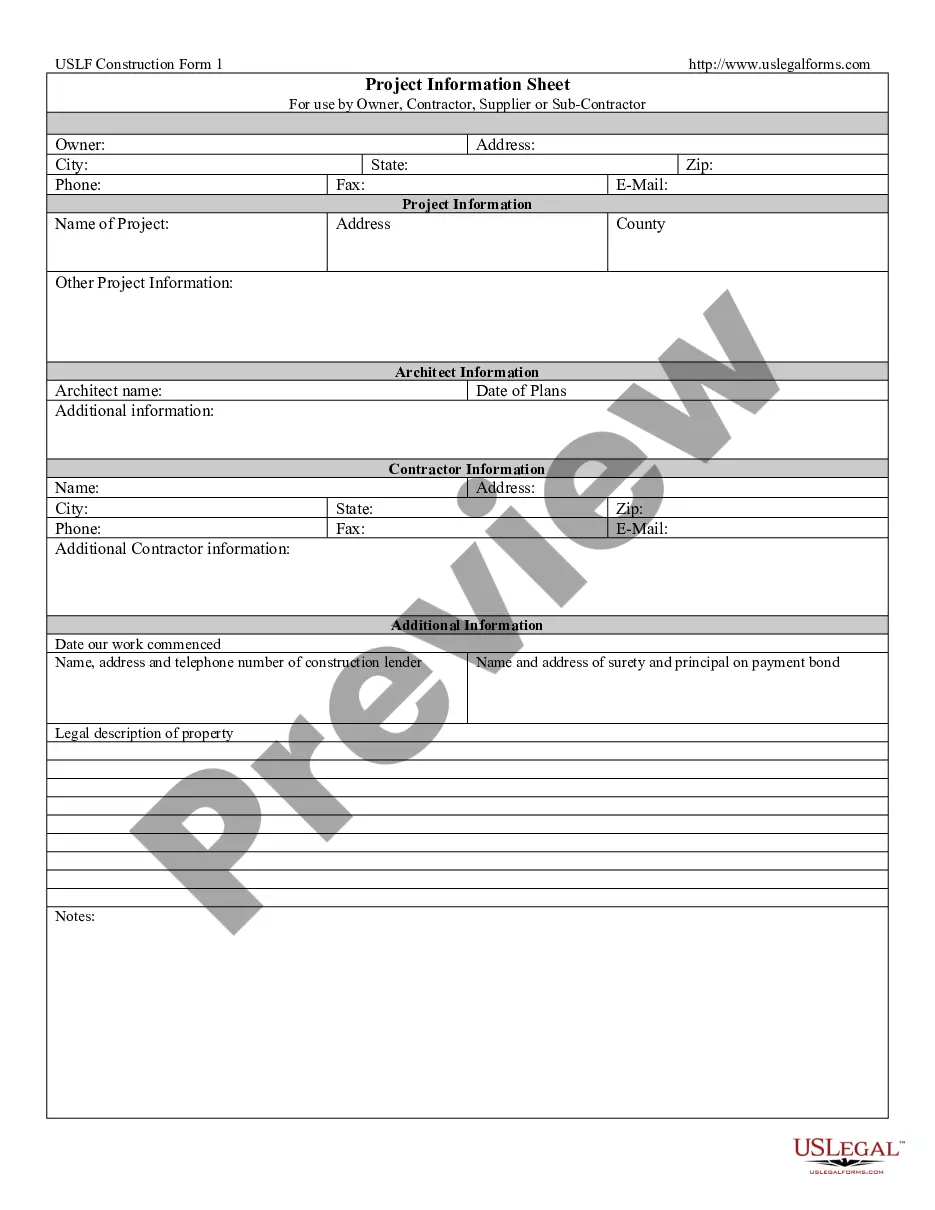
- Contractor's Bid Log
- Contractor's Bid Follow Up Letter
- Contractor's Summary of an Estimate
- Contractor's Job Progress Sheet
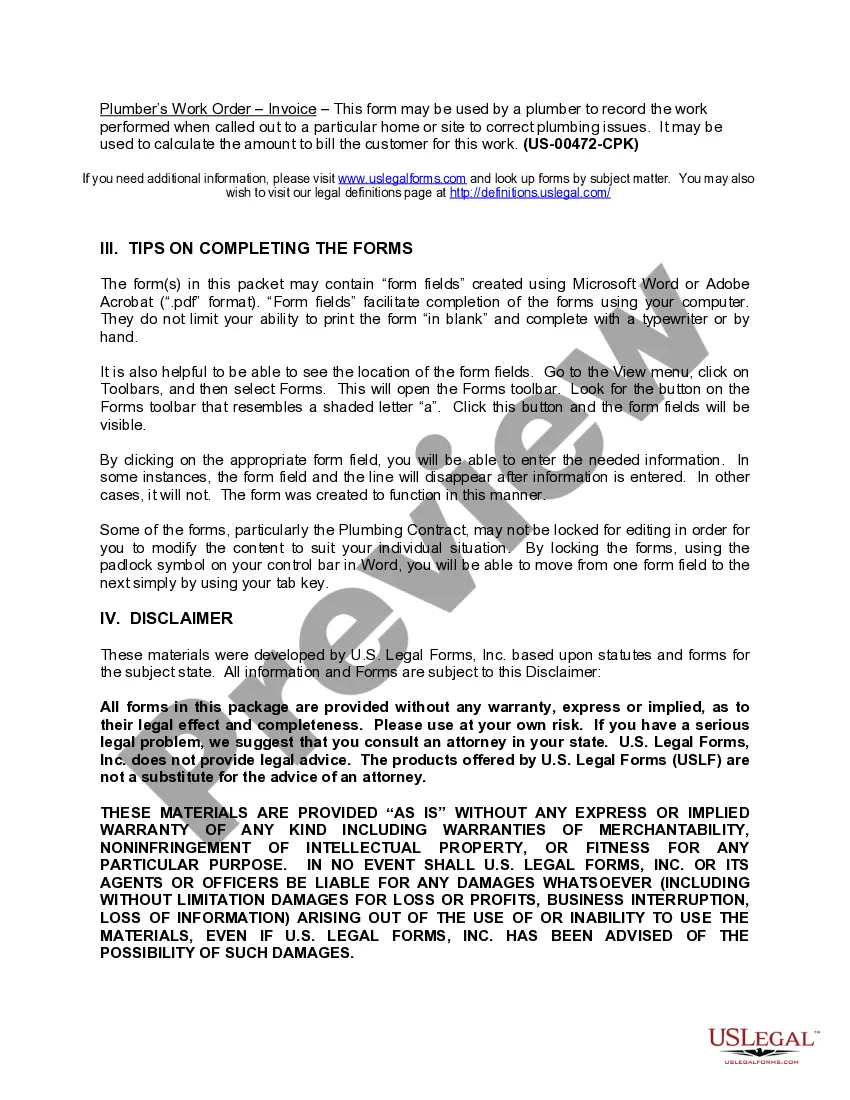
- Plumber's Work Order - Invoice
- Customer Satisfaction Survey
- Construction Company Evaluation by a Customer
- Construction Safety and Health Plan
- Change Order for Construction or Repairs by Contractor
- Certification of Completion by Contractor



When to use this form package
This form package is useful in a variety of situations, including:
- Entering into a contract for plumbing services, whether for new construction or renovations.
- Tracking project bids and proposals throughout the planning stages.
- Documenting changes in project scope through change orders.
- Ensuring compliance with safety regulations using the worker safety and health plan.
- Gathering customer feedback upon project completion.
Who needs this form package
- Plumbing contractors looking to formalize agreements and protect their legal interests.
- Property owners engaging plumbing services and seeking clear contract terms.
- Subcontractors collaborating with primary contractors on plumbing projects.
- Suppliers providing materials or services within plumbing contracts.
How to prepare this document
- Review all forms included in the Wisconsin Plumbing Contractor Package.
- Identify the parties involved in the contract: contractors, subcontractors, and property owners.
- Enter necessary details such as project scope, timelines, and pricing into the plumbing contract.
- Complete the bid log and follow-up letters to manage proposals effectively.
- Utilize the change order sheet for any modifications during the project lifecycle.
- Ensure all parties sign the necessary forms, and retain copies for your records.
Do forms in this package need to be notarized?
Forms in this package typically do not require notarization unless required by local law. It is advisable to check the specifications for any particular document you are filling out to ensure compliance with regulations.
Get your form ready online
Our built-in tools help you complete, sign, share, and store your documents in one place.
Make edits, fill in missing information, and update formatting in US Legal Forms—just like you would in MS Word.
Download a copy, print it, send it by email, or mail it via USPS—whatever works best for your next step.
Sign and collect signatures with our SignNow integration. Send to multiple recipients, set reminders, and more. Go Premium to unlock E-Sign.
If this form requires notarization, complete it online through a secure video call—no need to meet a notary in person or wait for an appointment.
We protect your documents and personal data by following strict security and privacy standards.

Make edits, fill in missing information, and update formatting in US Legal Forms—just like you would in MS Word.

Download a copy, print it, send it by email, or mail it via USPS—whatever works best for your next step.

Sign and collect signatures with our SignNow integration. Send to multiple recipients, set reminders, and more. Go Premium to unlock E-Sign.

If this form requires notarization, complete it online through a secure video call—no need to meet a notary in person or wait for an appointment.

We protect your documents and personal data by following strict security and privacy standards.
Common mistakes
- Failing to fill out forms completely or accurately, leading to disputes.
- Not reviewing the specific legal requirements for Wisconsin plumbing contracts.
- Neglecting to obtain necessary signatures on contracts and completion certificates.
- Ignoring safety regulations outlined in the worker safety and health plan.
Why use this package online
- The convenience of downloading forms instantly saves time.
- Editable forms allow customization to fit specific project needs.
- Access to forms drafted by licensed attorneys ensures legal reliability.
- Compliance with state laws provides additional protection for all parties involved.
Main things to remember
Key points to remember about the Wisconsin Plumbing Contractor Package include:
- This package includes essential forms for managing plumbing contracts in Wisconsin.
- It is beneficial for contractors, property owners, and subcontractors.
- Each form is designed to protect legal rights and ensure compliance with state laws.
Looking for another form?


Form popularity
FAQ
State AdoptionsWisconsin does use their own hybrid residential code (UDC) and plumbing code. They will remain on '09 IECC, however for residential and the '15 IECC for commercial.
The Dwelling Contractor Qualifier license is your personal license, held under your name, and requires 12 hours of continuing education every 2 years. This license renews every other year. The Dwelling Contractor license is for your business, held under the business name, and does NOT require continuing education.
As of Apr 12, 2021, the average annual pay for a Journeyman Plumber in Wisconsin is $48,140 an year. Just in case you need a simple salary calculator, that works out to be approximately $23.14 an hour.
To work as a handyman in Wisconsin you'll need to hold a Wisconsin Dwelling Contractor Qualifier license, which is the contractor license that is issued to individuals. You'll need to complete and pass a 12-hour course to be eligible for a license from the Department of Safety and Professional Services.
Best-Paying States for Plumbers The states and districts that pay Plumbers the highest mean salary are Illinois ($86,120), Alaska ($79,610), Minnesota ($74,700), New Jersey ($74,360), and Massachusetts ($73,970).
The average salary for a plumber in Wisconsin is around $67,830 per year.
To become a general contractor, you need at least a high school diploma, but there is an increase in a need for a bachelor's degree or at least an associate degree, plus years of construction industry experience. Regardless of education though, experience in the industry is the most important requirement.
Contractor licenses are issued through the Wisconsin Department of Safety and Professional Services. In order to pull permits to do work on one- or two- family homes, you need both the dwelling contractor certification for the business, and at least one person from the company needs a dwelling contractor certification.
A plumbing license is required to install plumbing in Wisconsin, except when the plumbing work is performed by a property owner in a one-family dwelling he or she occupies. Farmers may install plumbing in their own buildings. Before you install plumbing in your home, you must live there.