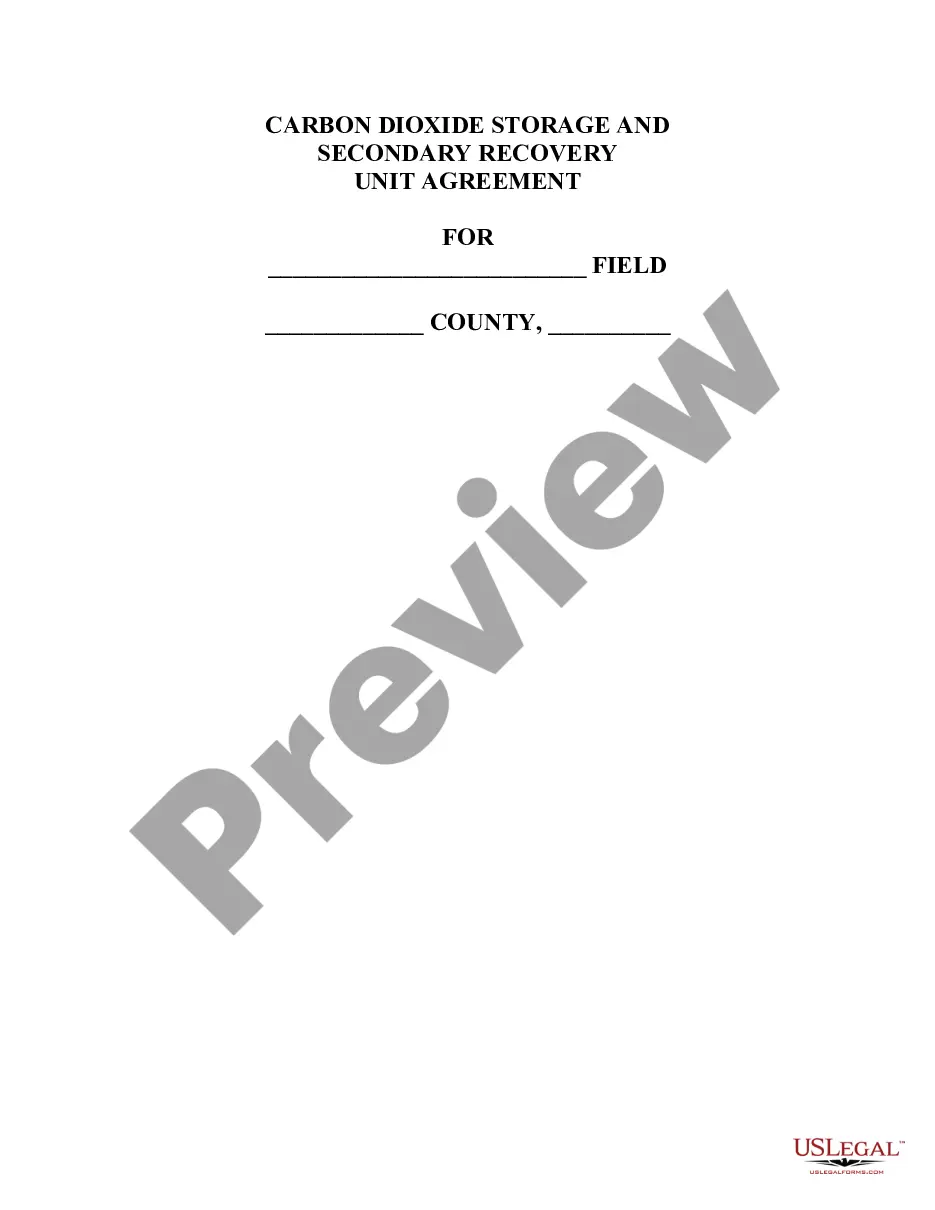
Carbon Dioxide Storage Unit Agreement
Understanding this form
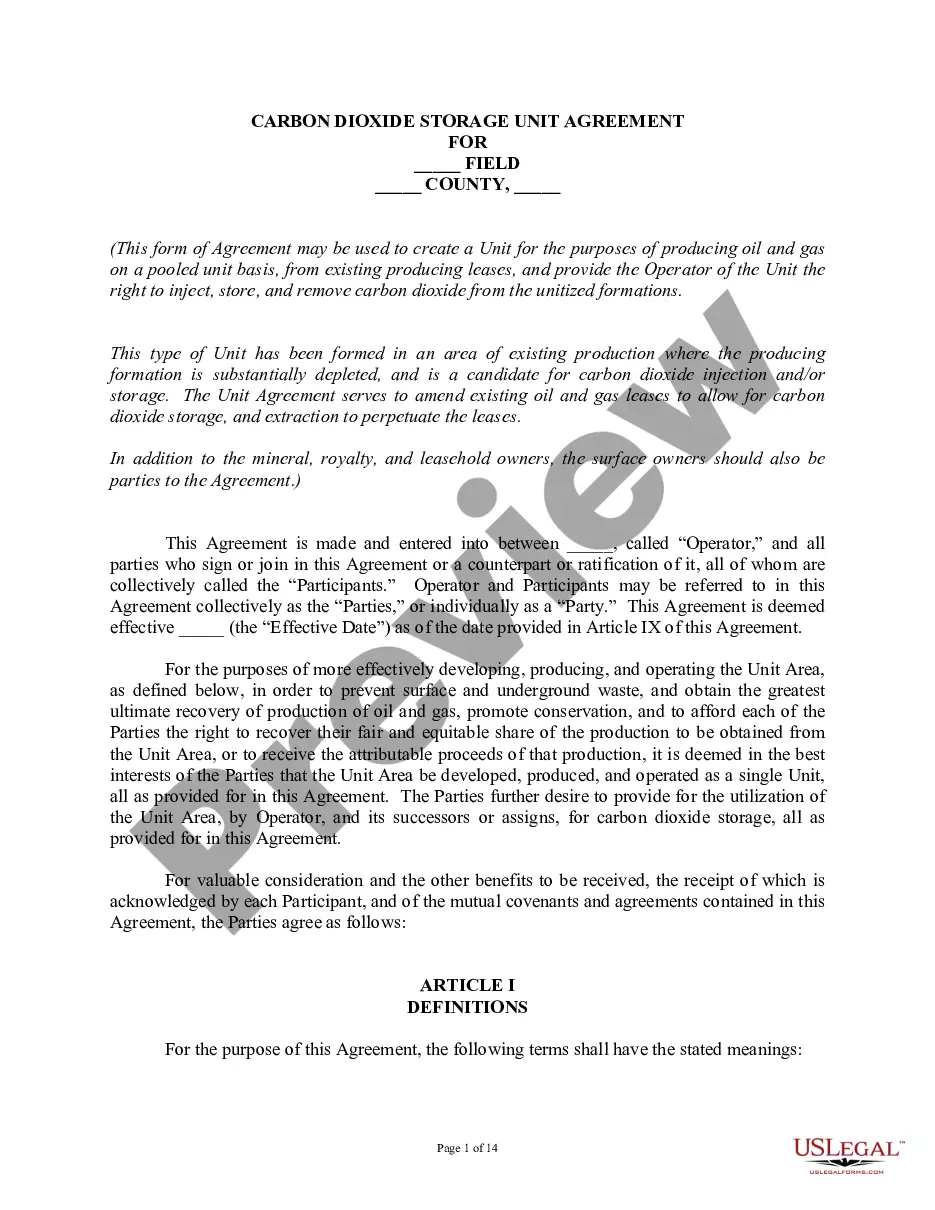
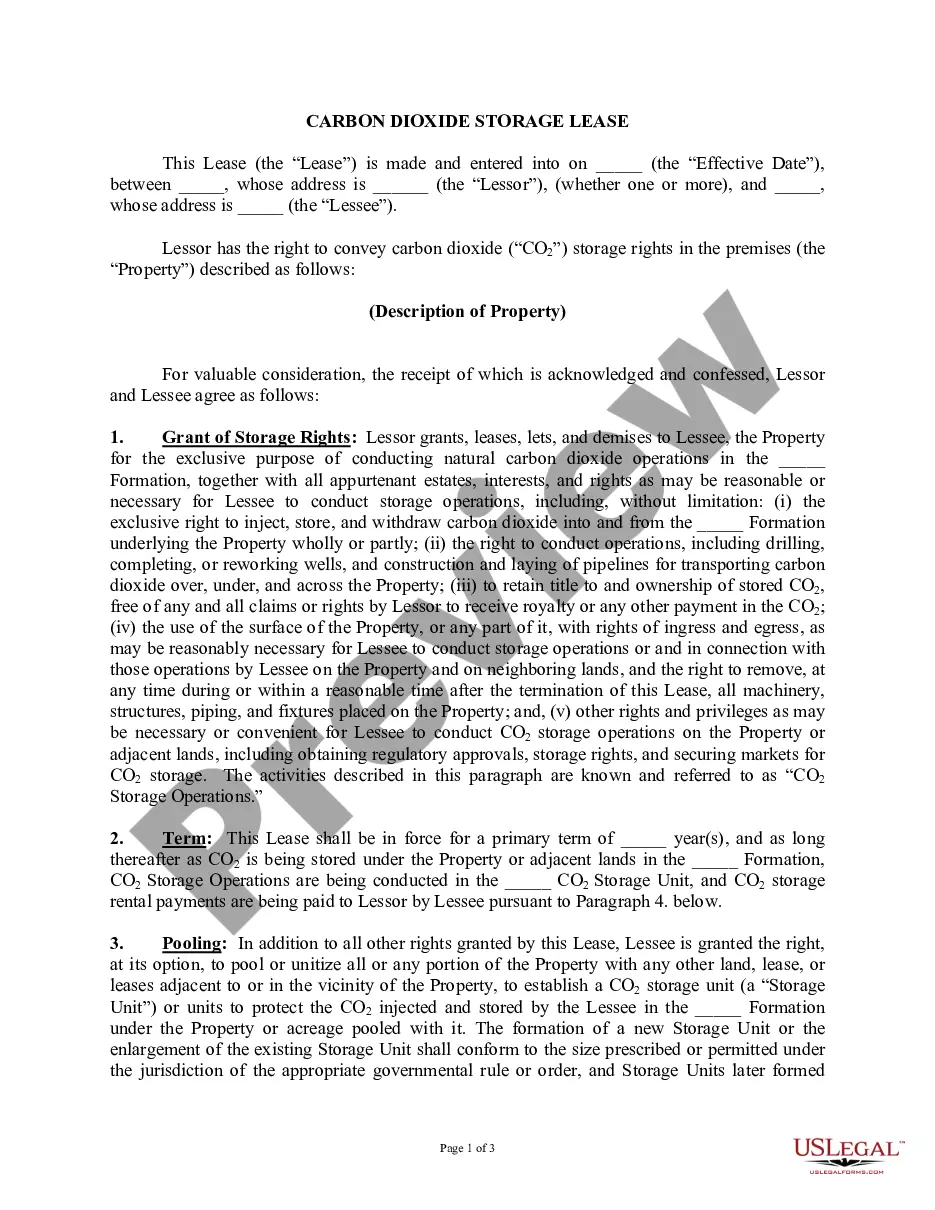
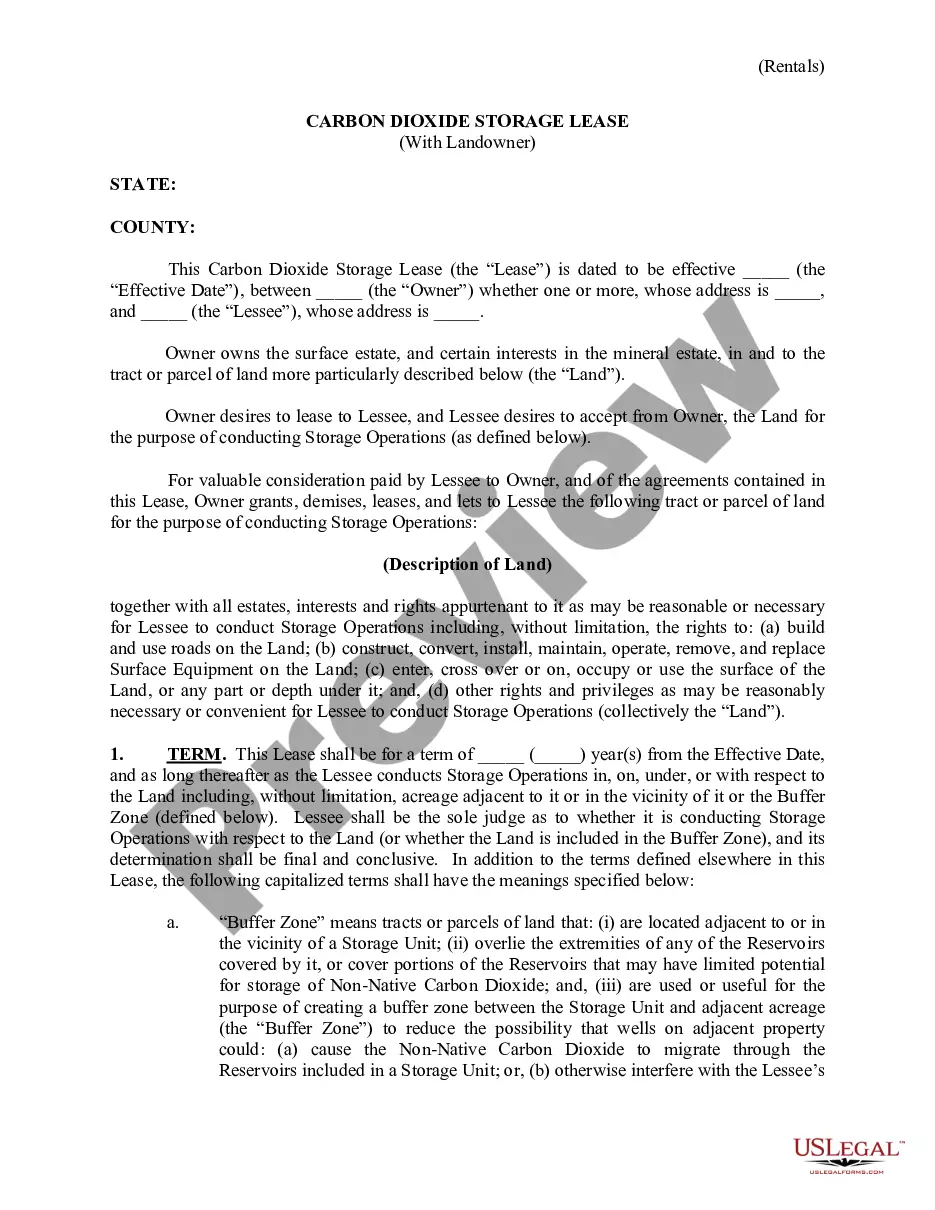
The Carbon Dioxide Storage Unit Agreement is a legal document that establishes an agreement for the injection, storage, and extraction of carbon dioxide in a specified unitized area for oil and gas production. This agreement allows participants, including mineral and royalty owners, to collectively manage the unit area, ensuring carbon dioxide can be utilized efficiently. The key distinction of this form lies in its specific focus on carbon dioxide storage within the context of existing oil and gas production, making it essential for those involved in such operations.
Main sections of this form
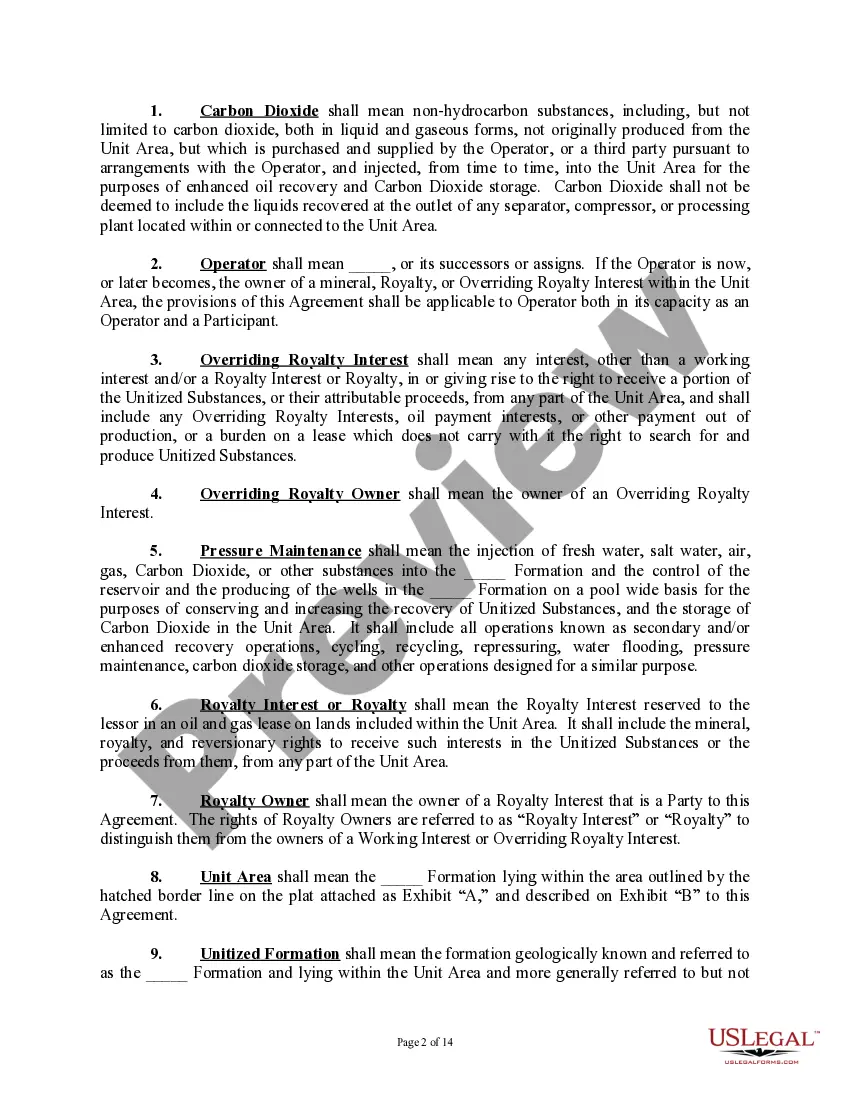
- Definitions: Key terms such as Operator, Carbon Dioxide, and Unit Area are defined for clarity.
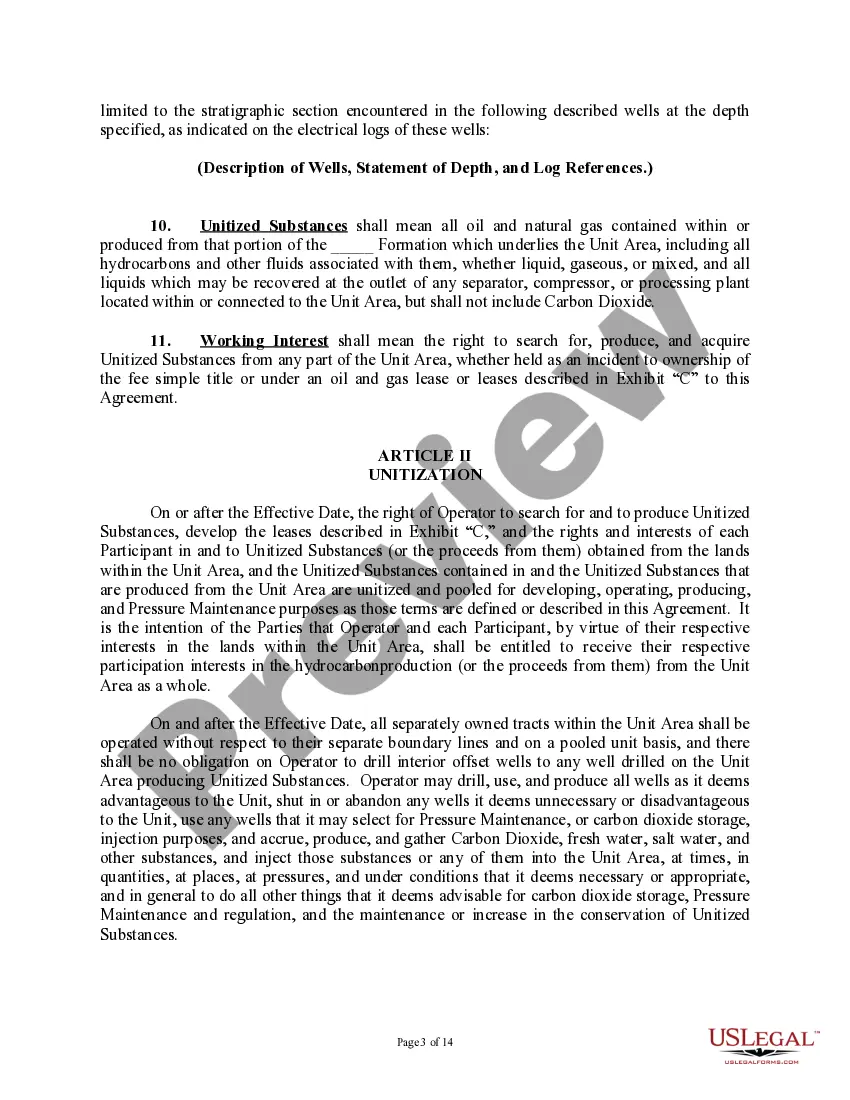
- Unitization Clause: Details how the unit area will be developed and operated collectively by all participants.
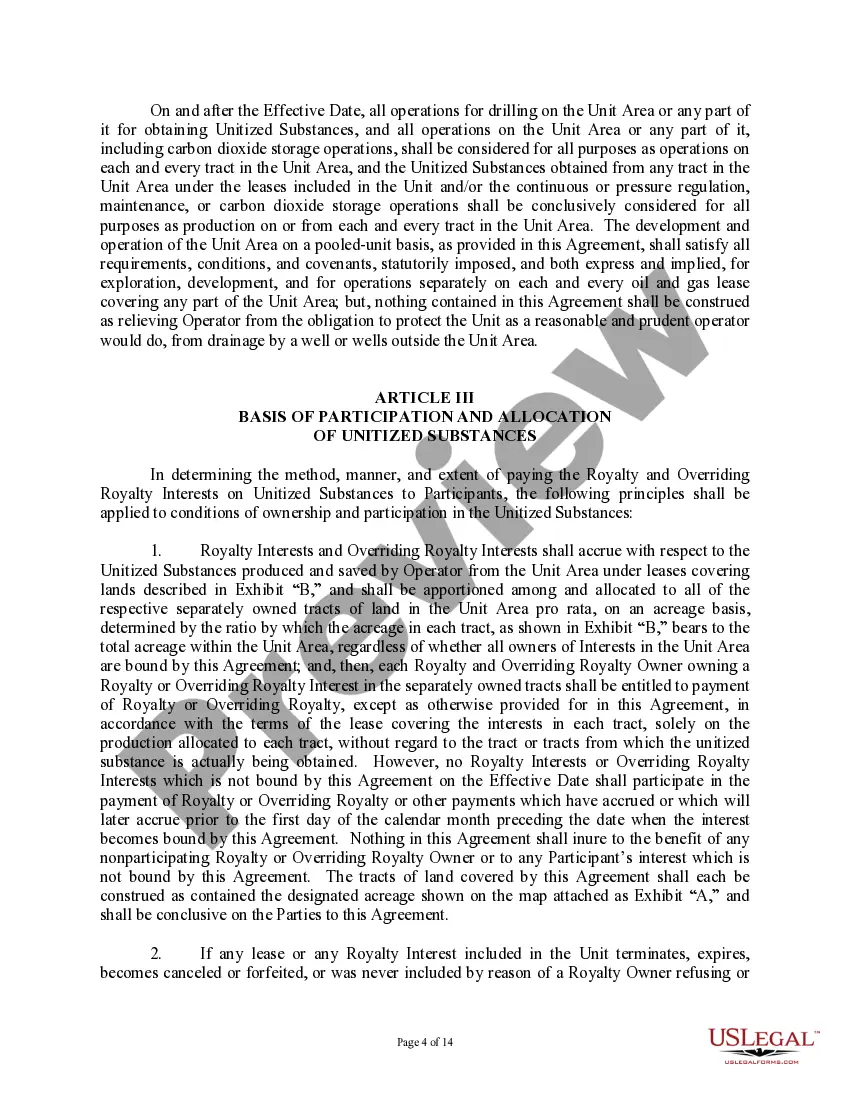
- Rights and Responsibilities: Outlines the rights of participants regarding their interests and obligations concerning carbon dioxide storage.
- Pressure Maintenance System: Provides guidelines on how pressure maintenance will be conducted within the unit area.
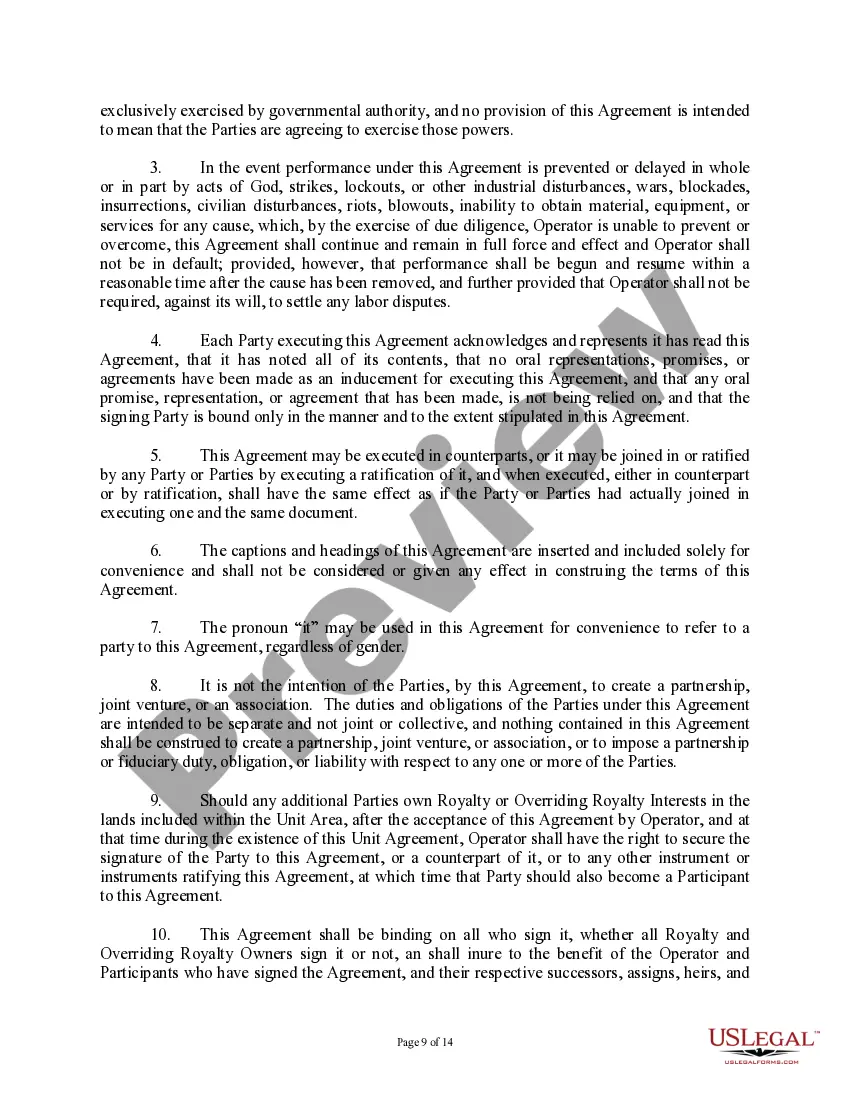
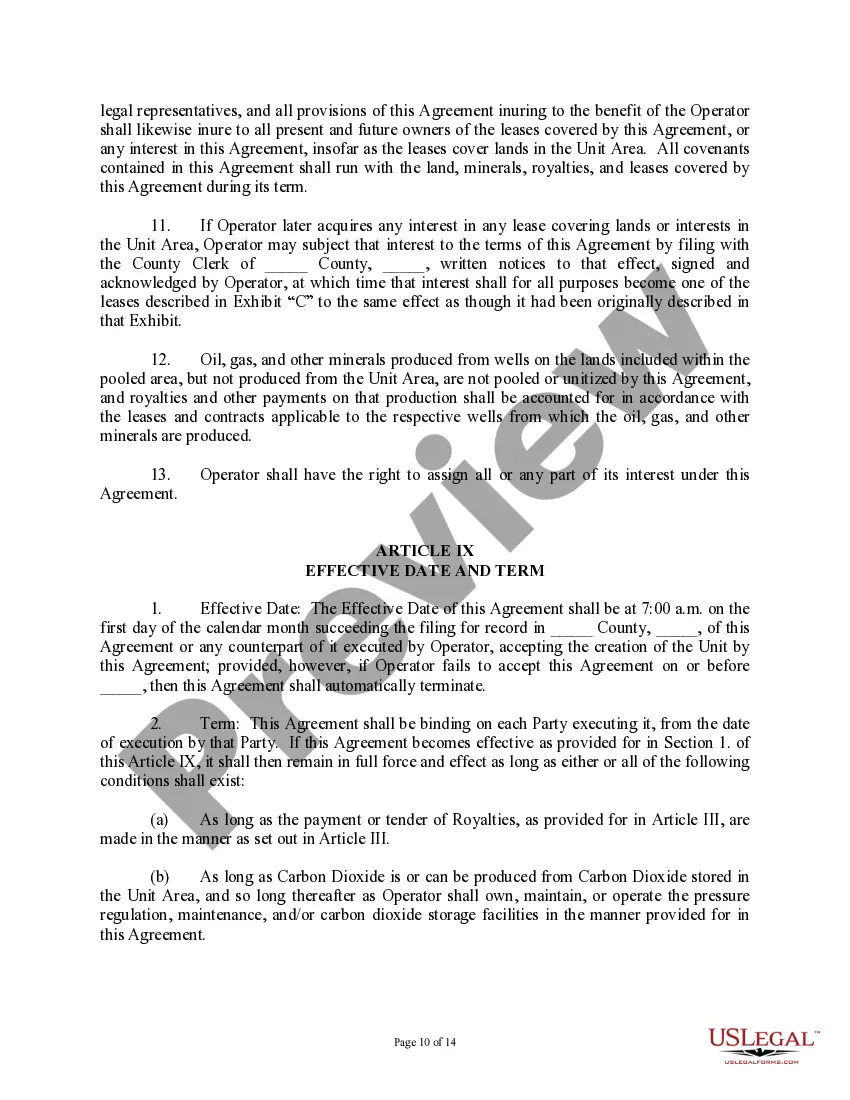
- Effective Date and Term: Specifies when the agreement takes effect and its duration.

Common use cases
This form should be used when multiple parties involved in oil and gas production wish to jointly agree to initiate carbon dioxide storage in depleted reservoirs. It is particularly relevant in areas where conventional oil and gas production has ceased, and carbon dioxide can be injected for enhanced recovery or storage purposes. The agreement helps ensure compliance with legal and operational standards while protecting the interests of all parties involved.
Who needs this form
- Mineral owners seeking to allow carbon dioxide storage on their land.
- Royalty owners wishing to participate in carbon dioxide management in a pooled unit.
- Operators involved in managing oil and gas extraction and carbon dioxide storage operations.
- Surface owners who want to ensure their rights are considered in the unitization process.
How to complete this form
- Identify the parties involved: Clearly list the Operator and all Participants who will sign the agreement.
- Specify the unit area: Define the geographical boundaries of the area where carbon dioxide will be stored.
- Enter the effective date: Specify the date when the agreement becomes effective for all parties.
- Provide relevant lease information: Include details of the existing oil and gas leases that are part of this agreement.
- Obtain signatures: Each participant must sign and date the agreement to validate their participation.
Notarization guidance
In most cases, this form does not require notarization. However, some jurisdictions or signing circumstances might. US Legal Forms offers online notarization powered by Notarize, accessible 24/7 for a quick, remote process.
Get your form ready online
Our built-in tools help you complete, sign, share, and store your documents in one place.
Make edits, fill in missing information, and update formatting in US Legal Forms—just like you would in MS Word.
Download a copy, print it, send it by email, or mail it via USPS—whatever works best for your next step.
Sign and collect signatures with our SignNow integration. Send to multiple recipients, set reminders, and more. Go Premium to unlock E-Sign.
If this form requires notarization, complete it online through a secure video call—no need to meet a notary in person or wait for an appointment.
We protect your documents and personal data by following strict security and privacy standards.
Make edits, fill in missing information, and update formatting in US Legal Forms—just like you would in MS Word.

Download a copy, print it, send it by email, or mail it via USPS—whatever works best for your next step.

Sign and collect signatures with our SignNow integration. Send to multiple recipients, set reminders, and more. Go Premium to unlock E-Sign.

If this form requires notarization, complete it online through a secure video call—no need to meet a notary in person or wait for an appointment.
We protect your documents and personal data by following strict security and privacy standards.
Common mistakes
- Failing to clearly define the unit area, which may lead to disputes later.
- Not obtaining all necessary signatures from participants required for the agreement to be binding.
- Oversight in specifying the effective date or terms, causing confusion about agreement validity.
Benefits of completing this form online
- Convenience of downloading and customizing the agreement according to specific needs.
- Editability allows for quick adjustments and updates as needed.
- Access to templates drafted by licensed attorneys, ensuring legal reliability and comprehensiveness.
Legal use & context
- The agreement legally binds all parties to the terms outlined for carbon dioxide storage and management.
- It helps establish rights and responsibilities, reducing the potential for disputes over resource use.
- Enforceability may depend on local laws governing carbon dioxide storage and oil and gas operations.
Quick recap
- The Carbon Dioxide Storage Unit Agreement facilitates collaborative management of resources in oil and gas contexts.
- It is essential for ensuring legal compliance and protecting interests in carbon dioxide storage initiatives.
- All relevant parties should thoroughly understand their rights and responsibilities as outlined in the agreement.
Glossary of terms used in this form
- Operator: The entity responsible for managing the unit area and operations.
- Unit Area: The defined geographical area where carbon dioxide will be stored.
- Participants: All parties who sign the agreement and have interests in the unit area.
- Royalty Interest: The right to receive a portion of the proceeds from production in the unit area.
Looking for another form?
Form popularity
FAQ
One major concern with CCS is that CO2 could leak out of these underground reservoirs into the surrounding air and contribute to climate change, or taint nearby water supplies. Another is the risk of human-made tremors caused by the build-up of pressure underground, known as induced seismicity.
The most well-developed approach to storing CO2 is injecting it underground into naturally occurring, porous rock formations such as former natural gas or oil reservoirs, coal beds that can't be mined, or saline aquifers.
Where can captured carbon dioxide be stored? After capture, carbon dioxide (CO2) is compressed and then transported to a site where it is injected underground for permanent storage (also known as "sequestration"). CO2 is commonly transported by pipeline, but it can also be transported by train, truck, or ship.
By studying a natural reservoir in Utah, USA, where CO2 released from deeper formations has been trapped for around 100,000 years, a Cambridge-led research team has now shown that CO2 can be securely stored underground for far longer than the 10,000 years needed to avoid climatic impacts.
In the case of saline aquifers, as well as structural and mineral storage, the CO2 can dissolve into the salty water in a process called 'dissolution storage'. Here, the dissolved CO2 slowly descends to the bottom of the aquifer. In any given reservoir, each (or all) of these processes work to store CO2 indefinitely.
Studies have shown that CO2 can be safely stored underground, such as in deep, porous rock formations, for thousands of years, and we've even found natural pockets of CO2 that have existed for millions.
CCS involves the capture of carbon dioxide (CO2) emissions from industrial processes, such as steel and cement production, or from the burning of fossil fuels in power generation. This carbon is then transported from where it was produced, via ship or in a pipeline, and stored deep underground in geological formations.
Once the carbon dioxide has been transported, it is stored in porous geological formations that are typically located several kilometers under the earth's surface, with pressure and temperatures such that carbon dioxide will be in the liquid or supercritical phase. Suitable storage sites include former gas and oil
Carbon dioxide is first dissolved into a beaker containing an electrolyte liquid, then a small amount of the liquid metal catalyst is added. When an electrical current is applied, the catalyst chemically activates the surface of the mixture, which slowly converts the CO2 into solid flakes of carbon.